
Houseplant
Weeping fig
Ficus benjamina
Also known as Benjamin fig, Ficus tree
How to care for Ficus benjamina. Why it drops every leaf when you move it, settling a new plant, treating scale, and handling the irritant sap when you prune.
At a glance
- Difficulty
- Moderate
- Water
- When the top 3 cm of compost has dried
- Light
- Bright indirect light, and it dislikes being moved
- Temperature
- 18-24 deg C. Never below 15 deg C
- Humidity
- Moderate to high, and dry air worsens the leaf drop
- Hardiness
- USDA 10-12, RHS H1b, hardy to 13 C
- Type
- Evergreen tree, very long-lived indoors
- Height
- 1.5-3 m indoors
- Native to
- South and south-east Asia, and northern Australia
- Best month
- December in the Northern Hemisphere, June in the Southern Hemisphere
Leaf drop after a move is the defining complaint and is a response to changed light rather than to water. Outdoors year round in USDA 10 and warmer, where it is a large street tree whose roots lift pavements.
Hardiness zones describe winter cold alone. Summer heat, humidity, rainfall and the length of the growing season decide as much, so treat the range as the outer limit rather than as a recommendation.
Every month named in this guide is for the temperate Northern Hemisphere. If you garden in the Southern Hemisphere, shift each one by six months, so December becomes June. Closer to the equator the wet and dry seasons matter more than the calendar, and the shift stops being a useful guide.
Harmful if eaten
- Do not eat
- The milky sap in leaves and stems
- Harm from
- Eating it and handling it
- Affects
- People, cats and dogs
The white latex is the issue and it is a moderate irritant rather than a poison. Ficus benjamina bleeds a milky sap when a leaf or stem is broken, containing proteolytic enzymes and furanocoumarins. On skin it causes redness and itching, and in sunlight it can produce a mild phytophotodermatitis in the way fig sap does, though far less severely than the edible fig. Wear gloves when pruning and wash any sap off promptly. The ASPCA lists Ficus benjamina as toxic to cats and dogs, causing mouth irritation, drooling, vomiting and skin inflammation on contact. Effects are unpleasant rather than dangerous and serious cases are rare. One point is important for anyone with allergies. Ficus benjamina is a recognised cause of respiratory allergy, particularly among people who work with the plants, and there is well-documented cross-reactivity between weeping fig latex and natural rubber latex, and separately with fig, kiwi, banana and papaya. Anyone with a latex allergy should think twice about a large specimen in a small room. For most households the plant is unremarkable and the only precaution needed is gloves at pruning time.
Sources: ASPCA (Weeping Fig, Ficus benjamina), RHS potentially harmful garden plants
About
No houseplant has a stronger reputation for sulking. A weeping fig moved from one side of a room to the other will drop half its leaves, and one carried home from a shop in December can be a bare skeleton within a fortnight.
That is not a plant dying. It is a plant that grows in a stable tropical climate responding to a sudden change in light, temperature and humidity by shedding the leaves it can no longer support, and then growing new ones adapted to the conditions it has landed in. Given warmth and light and left alone, it re-leafs.
Understanding that turns the weeping fig from a frustrating plant into a very long-lived one. Choose the position first, put it there, and stop moving it.
Appearance and character
An evergreen tree with a woody trunk and arching, drooping branches, reaching 1.5 to 3 m indoors and 30 m in the wild.
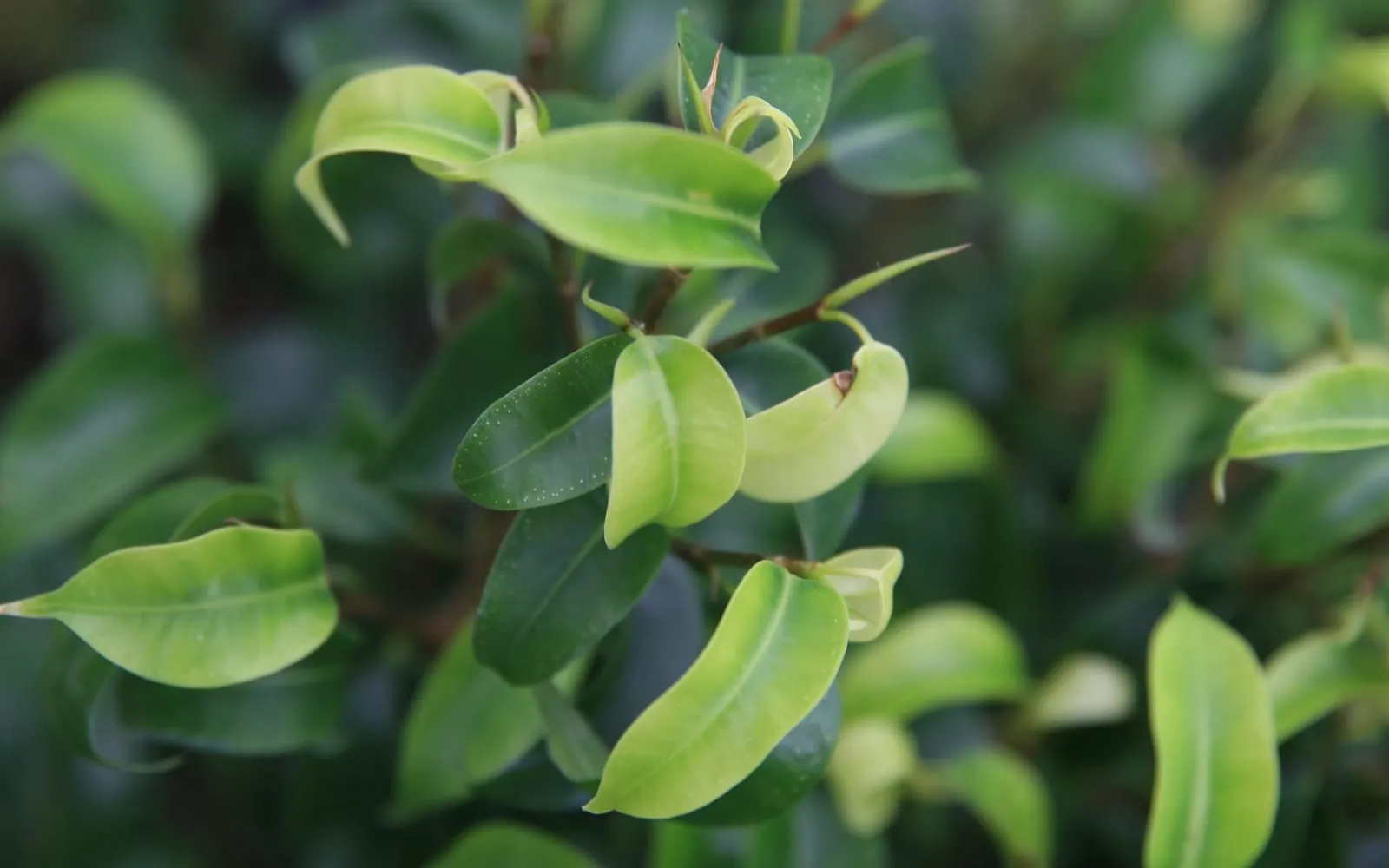
Leaves are the identifier. Oval, 6 to 13 cm long, glossy, thin and slightly wavy, tapering to a long pointed drip tip. New leaves emerge pale green and darken with age.
Branches are slender and pendulous, which is where the weeping comes from.
Trunks are often sold plaited or braided, made by training three or four young stems together while flexible. Those eventually fuse.
The plant bleeds white latex from any cut or broken leaf.
Small fig fruit appear on mature plants in the right conditions, ripening from green to orange-red, and are rarely seen indoors.
Variegated forms are widely grown. ‘Starlight’ is heavily white-margined, ‘Golden King’ is edged in cream, and both need brighter light than the plain green form.
Related plants in the same genus include the rubber plant, the fiddle-leaf fig and the edible fig, all of which share the milky sap.
Where it is from
South and south-east Asia and northern Australia, from India through Malaysia to Queensland, where it grows as a large forest tree.
It often begins life as an epiphyte. A seed germinates in the fork of another tree, sends roots down to the ground, and the fig eventually envelops and replaces its host, which is the strangler fig habit.
Its natural climate is warm, humid and stable, with no cold season and little variation. That stability is the key to the plant’s indoor behaviour, since it has no evolutionary experience of sudden change.
Wild figs are pollinated by species-specific fig wasps, which is why an indoor plant produces no viable fruit.
It is the official tree of Bangkok, and mature specimens across south-east Asia are enormous.
The species became a mainstream houseplant in the 1970s and 1980s, and its reputation for leaf drop dates from the same period.
How it grows
Choose the final position before you unwrap it, and leave it there. Bright indirect light, away from draughts, radiators, external doors and cold glass.
Keep it warm and steady, 18 to 24 deg C, and never below 15 deg C.
Expect leaf drop for two to four weeks after buying or moving it. Do not respond by watering more, which is the instinct and which rots the roots.
Water when the top 3 cm of compost has dried, using tepid water, and drain completely.
Raise the humidity moderately with a pebble tray or by grouping plants.
Feed monthly from April to September.
Rotate the pot a quarter turn every few weeks so growth stays even. This is a small enough change not to trigger leaf drop.
Prune in spring to shape it or keep it in bounds, cutting back to just above a leaf node. Wear gloves, since the cut stems bleed freely.
Repot every two or three years in spring, into a pot only slightly larger. Weeping figs are content slightly pot-bound.
Wipe the leaves with a damp cloth regularly. It keeps them glossy and is the best early warning for scale.
Propagate from tip cuttings in spring, dipping the cut end in water to stop the latex flowing before potting them up in a warm humid propagator.
Through the seasons
Winter is when leaf drop peaks. Light is scarce, heating dries the air and cold draughts come through doors. Move it to the brightest available spot before winter rather than during it, keep the humidity up, water sparingly, and stop feeding.
Spring is recovery and pruning. New leaves come through from March. Prune, repot, take cuttings, and resume feeding.
Summer is the growing season. Water when the surface dries, feed monthly, and watch for scale and spider mite.
Autumn is the wind-down. Reduce watering and feeding from October and check that the plant is not near a door that will be opened all winter.
Care difficulty
Moderate, and the difficulty is psychological as much as horticultural.
Leaf drop looks like failure and is usually adjustment. The plant that has lost half its leaves in the fortnight after coming home is behaving normally.
Overwatering in response to leaf drop is what turns a temporary problem into a fatal one. A leafless plant needs less water, not more.
Scale insects are the persistent pest and they hide along the leaf undersides and in the branch joints.
The plant is long-lived once settled, and specimens of twenty and thirty years are common.
Watering
Water when the top 3 cm of compost has dried, which in summer usually means weekly.
Use tepid water. Cold water triggers leaf drop.
Water thoroughly and drain completely, and never leave the pot standing in water.
Reduce watering in winter, and reduce it further if the plant has dropped a lot of leaves, since a plant with less foliage uses less water.
Yellowing leaves that drop are more often overwatering than thirst. Check the compost before reaching for the can.
Rainwater or filtered water suits it better than hard tap water.
Warning signs, diseases and pests
Leaf drop is the complaint that defines this plant. After a move, a delivery or a change of room it is normal and temporary, and the plant re-leafs over several weeks. Ongoing leaf drop in a settled plant means one of the conditions is wrong, and the usual suspects are a cold draught, a position near a door, insufficient light, cold water, dry air or overwatering. Work through those rather than moving the plant again.
Scale insects are the main pest, appearing as small flat brown discs along the midribs and leaf undersides and in the branch joints. They produce sticky honeydew that drips onto the floor and grows black sooty mould. Wipe them off with a damp cloth or a cotton bud dipped in alcohol, and check regularly, since they are easy to miss until the stickiness appears.
Red spider mite produces fine pale stippling and webbing in hot dry rooms.
Sticky floor beneath the plant means scale or mealybug above, and it is often the first thing an owner notices.
Yellowing leaves throughout usually mean overwatering, particularly in winter.
Bare inner branches with leaves only at the tips mean insufficient light.
Variegated forms reverting to plain green also means too little light.
Growing environment
Bright indirect light. An east or west-facing window, or well back from a south-facing one. Variegated forms need more light than plain green ones.
Never harsh direct summer sun, which scorches the thin leaves.
Steady warmth of 18 to 24 deg C, and never below 15 deg C.
Moderate to high humidity, helped by a pebble tray or grouping plants.
Away from draughts above all. A weeping fig beside a front door that opens all winter will never look well.
Free-draining peat-free compost with added perlite, in a pot with drainage holes.
Choose the position once and commit to it. This plant repays being left alone more than almost any other.
Out of reach of a pet inclined to chew, since the sap irritates.
Feeding
Feed monthly from April to September with a balanced liquid houseplant fertiliser.
Stop feeding from October to March.
Do not feed a plant that has just dropped its leaves after a move. Let it settle and re-leaf first.
Repot every two or three years in spring, or top-dress a large specimen.
Flush the compost with plain water occasionally to clear accumulated salts.
Troubleshooting
It dropped all its leaves after I brought it home. Normal. Weeping figs shed leaves in response to any change in light, temperature or humidity, then grow new ones suited to the new position. Keep it warm and bright, water less rather than more, and wait several weeks.
It keeps dropping leaves even though I have not moved it. Look for a cold draught, a door that opens onto the street, a radiator, cold water, dry air or overwatering.
Should I water it more when the leaves fall? No, and this is the mistake that kills them. A plant with fewer leaves needs less water. Overwatering a leafless weeping fig rots the roots.
The floor beneath it is sticky. Scale insects producing honeydew. Check the leaf undersides and branch joints, and wipe them off.
The inner branches have gone bare. Not enough light. Move it somewhere brighter without putting it in direct sun.
Can I prune it? Yes, in spring, cutting back to just above a leaf node. Wear gloves, since the cut stems bleed irritant latex freely.
Why is the trunk plaited? Several young stems were braided together while flexible and have fused as they thickened. It is cosmetic and does the plant no harm.
Is it safe with a cat? The sap irritates the mouth and skin and causes vomiting if eaten. It is unpleasant rather than dangerous. Keep it out of reach of a determined chewer.
Weeping fig problem guides
Not sure what is wrong? See the common houseplant pests guide.