
Houseplant
Hoya
Hoya carnosa
Also known as Wax plant, Porcelain flower, Honey plant
How to care for Hoya carnosa, the wax plant. Never cutting off the flower spur, keeping it pot-bound so it blooms, and the winter rest that sets the buds.
At a glance
- Difficulty
- Easy
- Water
- When the compost has dried out almost completely
- Light
- Bright indirect light, with some direct morning sun
- Temperature
- 18-24 deg C in summer, and 13-16 deg C in winter
- Humidity
- Moderate. It tolerates ordinary room air better than most
- Hardiness
- USDA 10-12, RHS H1b, hardy to 10 C
- Type
- Evergreen climbing perennial, very long-lived
- Height
- 2-4 m of trailing growth over many years
- Native to
- Eastern Asia and eastern Australia
- Best month
- November in the Northern Hemisphere, May in the Southern Hemisphere
Forests of east Asia and Australia, growing as an epiphytic climber. It flowers from short spurs that must never be removed, since the same spur flowers year after year, and deadheading them is why many plants never bloom twice. Outdoors year round in USDA 10 and warmer.
Hardiness zones describe winter cold alone. Summer heat, humidity, rainfall and the length of the growing season decide as much, so treat the range as the outer limit rather than as a recommendation.
Every month named in this guide is for the temperate Northern Hemisphere. If you garden in the Southern Hemisphere, shift each one by six months, so November becomes May. Closer to the equator the wet and dry seasons matter more than the calendar, and the shift stops being a useful guide.
Not known to be toxic
Non-toxic. The ASPCA lists Hoya carnosa among plants that are not harmful to cats, dogs or horses, and the RHS does not include it in its list of potentially harmful garden plants. This makes hoya one of the few genuinely pet-safe flowering houseplants, and a reasonable choice for a household where a cat chews foliage. Two minor points need context rather than worry about. The stems exude a milky latex when cut, as many members of the milkweed family do, and it can irritate sensitive skin, so wash your hands after taking cuttings. The flowers also produce nectar in quantity, enough to form visible droplets that fall from the flower head, and that nectar is sticky and sugary rather than harmful. Hang the plant somewhere the drips will not mark a polished surface or a carpet, since the sugar dries hard and attracts ants in summer. Neither point affects the plant's safety around animals or children.
Sources: ASPCA (Wax Plant, Hoya carnosa), RHS potentially harmful garden plants
About
Do not cut off old flower spurs. After the flowers fade, the short woody stalk they were carried on stays behind, looking like a dead twig. Cut it off and you have removed the structure that would have produced flowers on that spot every year for the rest of the plant’s life.
That stalk is called a spur or a peduncle, and a mature hoya flowers from the same ones repeatedly, adding new ones slowly. A plant that has been tidied up each autumn by a well-meaning owner will never flower well.
Everything else about hoyas is forgiving. They are semi-succulent, they tolerate neglect better than attention, they live for decades, and they were a fixture of Victorian parlours for good reason.
Appearance and character
An evergreen twining climber with woody stems, capable of 2 to 4 m of growth over many years, usually grown trailing from a hanging pot or trained around a hoop.
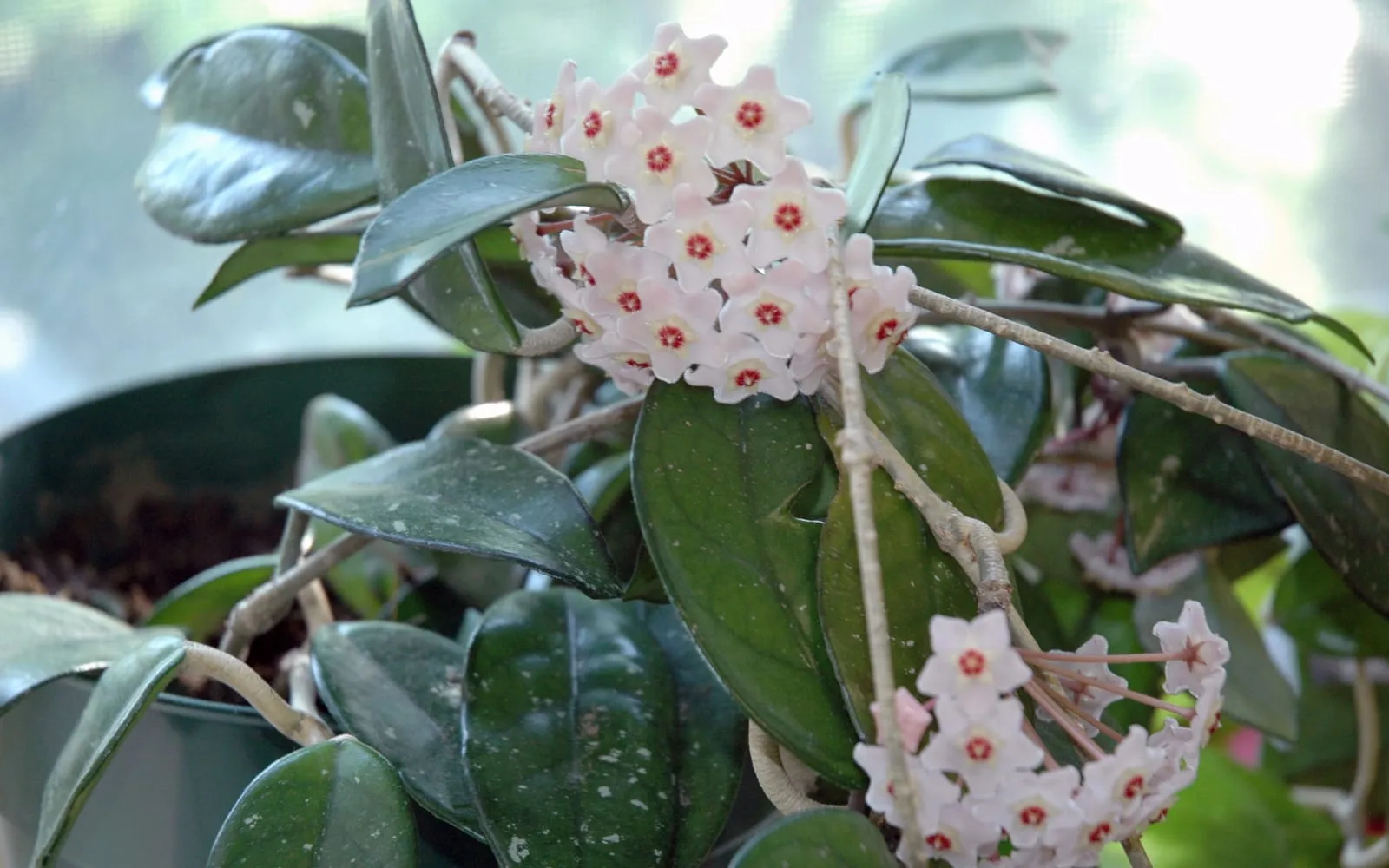
Leaves are thick, fleshy and semi-succulent, oval, 5 to 8 cm long, deep glossy green, and often flecked with small silvery spots.
Flowers are the reason to grow it. They open in tight rounded umbels of fifteen to thirty small star-shaped blooms, each about 1.5 cm across, pale pink to white with a deeper red or pink centre.
The texture is what gives the plant both its common names. Each flower looks moulded from wax or glazed porcelain, and the surface is finely furred.
The scent arrives in the evening, sweet and heavy with a note of chocolate or vanilla, and it is much stronger after dark.
Nectar collects in the flowers and drips as clear sticky droplets, which is where the name honey plant comes from.
Flower spurs are short leafless woody stalks that persist after the blooms fall, and the same spur produces flowers year after year.
Long bare shoots with no leaves appear from time to time. These are searching for something to climb and will leaf up once they find support.
Where it is from
Eastern Asia and eastern Australia, from southern China and Japan through to Queensland and New South Wales, where it grows as an epiphyte on trees and rocks in humid forest.
Growing on a tree rather than in soil explains the two most important requirements. The roots need air and sharp drainage, since an epiphyte sits in leaf litter and moss rather than in earth, and the plant tolerates drought because it is often exposed.
Its semi-succulent leaves store water for the same reason.
The genus honours Thomas Hoy, head gardener to the Duke of Northumberland at Syon House in the late eighteenth and early nineteenth centuries.
Hoya carnosa was among the first to reach Britain and became a standard Victorian houseplant. Many surviving specimens in old greenhouses are over a century old.
There are several hundred species, and the trade in unusual hoyas has grown considerably. Hoya kerrii has heart-shaped leaves, Hoya linearis trails in fine green threads, and Hoya bella is smaller and flowers more freely on a young plant.
How it grows
Position it in bright indirect light with an hour or two of direct morning sun. A hoya in shade grows and does not flower.
Use a very free-draining mix. Ordinary houseplant compost with a third added orchid bark and perlite is about right, and a straight peat-free compost holds too much water.
Keep it pot-bound. Hoyas flower best when the roots are crowded, and repotting a plant that was about to bloom is a common way to lose the flowers. Repot only every three or four years.
Water when the compost has dried out almost completely. This is a plant that tolerates being forgotten and dies from attention.
Give it a cooler drier winter. Around 13 to 16 deg C with much less water from November to February is what initiates the flower buds, and a plant kept warm and watered all year often never blooms.
Never cut off the flower spurs. They flower again from the same point every year.
Provide something to climb. A hoop, a small trellis or a moss pole all suit it, and it will also trail from a hanging pot.
Feed monthly through the growing season, switching to a high-potassium feed as buds form.
Propagate from stem cuttings with two or three pairs of leaves, taken in spring or summer, which root readily in water or in a gritty mix.
Expect to wait. A young plant usually takes two to three years to flower, and patience is most of the technique.
Through the seasons
Winter is the rest that produces the flowers. Move it somewhere cooler, around 13 to 16 deg C, water sparingly, and stop feeding.
Spring is when growth restarts. Resume watering and feeding, take cuttings, and repot only if the roots are bursting from the pot.
Summer is growth and flowering, usually from June onward. Water when the compost dries, feed monthly, and switch to a high-potassium feed as buds appear.
Autumn often brings a second flush of flowers. Reduce watering and feeding from October and move the plant to its cooler winter position.
Care difficulty
Easy to keep alive and moderately difficult to bring into flower, which is a distinction worth making before buying one.
Overwatering is the main way people kill hoyas. The semi-succulent leaves and epiphytic roots want to dry out between waterings.
Flowering depends on three things that run against ordinary houseplant instincts. Keep it pot-bound, give it a cool dry winter, and leave the spent flower spurs alone.
Bright light is needed for buds. A hoya in a dim corner grows perfectly well and never blooms.
Once settled, it needs almost nothing and lives for decades.
Watering
Water only when the compost has dried out almost completely, which in summer usually means every ten to fourteen days.
Water thoroughly, let it drain fully, and never leave the pot standing in water.
Reduce watering sharply from November to February, giving just enough to stop the leaves shrivelling.
Wrinkled, softening leaves usually mean thirst. Yellowing leaves that drop off and a soft stem base mean overwatering.
Use tepid water, and rainwater where the tap water is very hard.
The thick leaves buy a good deal of tolerance, and a hoya will forgive being forgotten for a fortnight far more readily than being watered twice a week.
Warning signs, diseases and pests
Cutting off the flower spurs is the mistake that costs the most and it does not look like a mistake at the time. After the flowers fall, a short bare woody stalk remains and looks dead. Leave it. The same spur flowers again next year and for many years after, and removing it means waiting for the plant to grow a new one.
Refusing to flower is the commonest complaint. Work through the causes in order. Too little light comes first, then a plant that is too young, then a pot that is too large, then a winter that was too warm and too wet, then spurs that have been cut off.
Root rot from overwatering shows as yellowing leaves, a soft blackened stem base and a plant that collapses. Let the compost dry between waterings and use a grittier mix.
Mealybug is the main pest, gathering in the leaf axils and among the developing flower buds, where it is difficult to reach. Check new buds closely and dab the insects with a cotton bud dipped in alcohol.
Buds forming and then dropping before opening usually means the plant was moved, or the watering changed sharply, while the buds were developing. Leave a budding hoya alone.
Long bare shoots with no leaves are normal. They are searching for support and will leaf up once they find it, so give them something to twine around rather than cutting them off.
Sticky droplets on the leaves and the floor beneath are nectar from the flowers rather than a pest, though check for scale if there are no flowers.
Growing environment
Bright indirect light with an hour or two of direct morning sun. An east-facing window is close to ideal.
Warmth of 18 to 24 deg C through the growing season, and a cooler winter at 13 to 16 deg C to set the buds.
Ordinary room humidity is acceptable, which is unusual among tropical houseplants and makes hoya easy to place.
A very free-draining mix with orchid bark and perlite, in a pot only slightly larger than the rootball.
A hanging pot, a high shelf or a hoop and trellis, since the plant needs somewhere to trail or climb.
Site it where the nectar drips will not matter, and where the evening scent will be noticed.
Avoid moving it once buds have formed.
Feeding
Feed monthly from April to September with a balanced liquid houseplant fertiliser at half strength.
Switch to a high-potassium feed, such as a tomato fertiliser, as flower buds appear.
Stop feeding entirely from October to March during the cool rest.
Repot only every three or four years. A hoya flowers better when pot-bound, and frequent repotting is a common reason for a leafy plant that never blooms.
Top-dress with fresh compost each spring instead of repotting.
Troubleshooting
Should I cut off the dead flower stalk? No. That short woody spur produces flowers again from the same point every year. Cutting it off is the commonest reason a hoya stops flowering.
It has never flowered. Check the light first, since it needs bright indirect light with some direct morning sun. Then check that it is pot-bound, that it had a cool dry winter, and that the spurs have not been removed. Young plants often need two to three years.
The leaves have gone yellow and it is collapsing. Overwatering. Let the compost dry out almost completely between waterings and use a grittier mix with added bark and perlite.
The leaves are wrinkled. Thirst. Water thoroughly and it will plump up within a day or two.
The buds fell off before opening. Usually the plant was moved or the watering changed while the buds were developing. Leave a budding hoya where it is.
There are long bare stems with no leaves. Normal. They are searching for something to climb. Give them a hoop or a pole and they will leaf up.
Something sticky is dripping onto the floor. Nectar from the flowers, which is where the name honey plant comes from. Move the pot off anything that will mark.
Is it safe for cats? Yes. Hoya carnosa is listed by the ASPCA as non-toxic to cats and dogs, which makes it one of the few pet-safe flowering houseplants.
Hoya problem guides
Not sure what is wrong? See the common houseplant pests guide.