
Edible
Plum
Prunus domestica
Also known as European plum, Gage, Damson
How to grow plums, Prunus domestica. Why you must never prune in winter, thinning to stop branches snapping, silver leaf and bacterial canker, and the cyanide in the stones.
At a glance
- Difficulty
- Moderate
- Water
- Weekly for the first three years, then in droughts
- Light
- Full sun, with shelter for the very early blossom
- Temperature
- Hardy in wood. The blossom is the vulnerable part
- Hardiness
- USDA 4-9, RHS H6, hardy to -30 C
- Type
- Deciduous tree, shorter-lived than apple or pear
- Height
- 2.5 m on Pixy rootstock to 6 m on St Julien A
- Native to
- The Caucasus, from a natural cross between sloe and cherry plum
- Best month
- August in the Northern Hemisphere, February in the Southern Hemisphere
European plums need 700 to 1000 chill hours and flower late enough to miss most frosts, which makes them the most dependable stone fruit in a cool climate. Mild-winter regions get poor flowering instead. Some cultivars fruit alone and many need a partner, so buy by name.
Hardiness zones describe winter cold alone. Summer heat, humidity, rainfall and the length of the growing season decide as much, so treat the range as the outer limit rather than as a recommendation.
Every month named in this guide is for the temperate Northern Hemisphere. If you garden in the Southern Hemisphere, shift each one by six months, so August becomes February. Closer to the equator the wet and dry seasons matter more than the calendar, and the shift stops being a useful guide.
Toxic if eaten
- Safe to eat
- The flesh and skin of the fruit
- Do not eat
- The stone kernel, the leaves, the bark and the wilted prunings
- Harm from
- Eating it
- Affects
- People, cats, dogs and horses
The fruit is food and the rest of the tree is not. The ASPCA lists plum as toxic to cats, dogs and horses, naming the stems, leaves and seeds and identifying cyanogenic glycosides as the mechanism. Plum stones contain amygdalin, which releases hydrogen cyanide when the kernel is crushed, and the kernel inside the woody stone holds far more than an apple pip does. A swallowed stone passes through, and a chewed kernel is a different matter, so teach children to spit the stones out. The larger risk is to grazing animals. Wilting Prunus leaves, whether frosted, cut or blown down, release cyanide far more readily than fresh ones, and prunings thrown over a fence into a paddock have killed horses and cattle. Never dispose of plum, cherry or laurel prunings where livestock can reach them. Dogs that swallow whole stones risk intestinal blockage, which in practice is the more common veterinary problem.
Sources: ASPCA (Plum, Prunus domestica), RHS potentially harmful garden plants
About
Plums have one rule that overrides everything else. Never prune them between autumn and early spring. Silver leaf spores are airborne through the winter and enter through fresh cuts, and the disease kills branches and eventually the tree.
Prune in June or July instead, when the wound seals fast and the spores are scarce. That single habit prevents most plum tree deaths in temperate gardens.
The other thing to expect is generosity. A good year on an unthinned plum tree produces so much fruit that the branches break under it, so thinning in June is work that protects the tree as much as it improves the crop.
Appearance and character
A round-headed deciduous tree with dark grey bark, generally smaller and shorter-lived than an apple, and inclined to throw suckers from the base.
Leaves are oval, toothed and slightly downy beneath, dull mid-green.
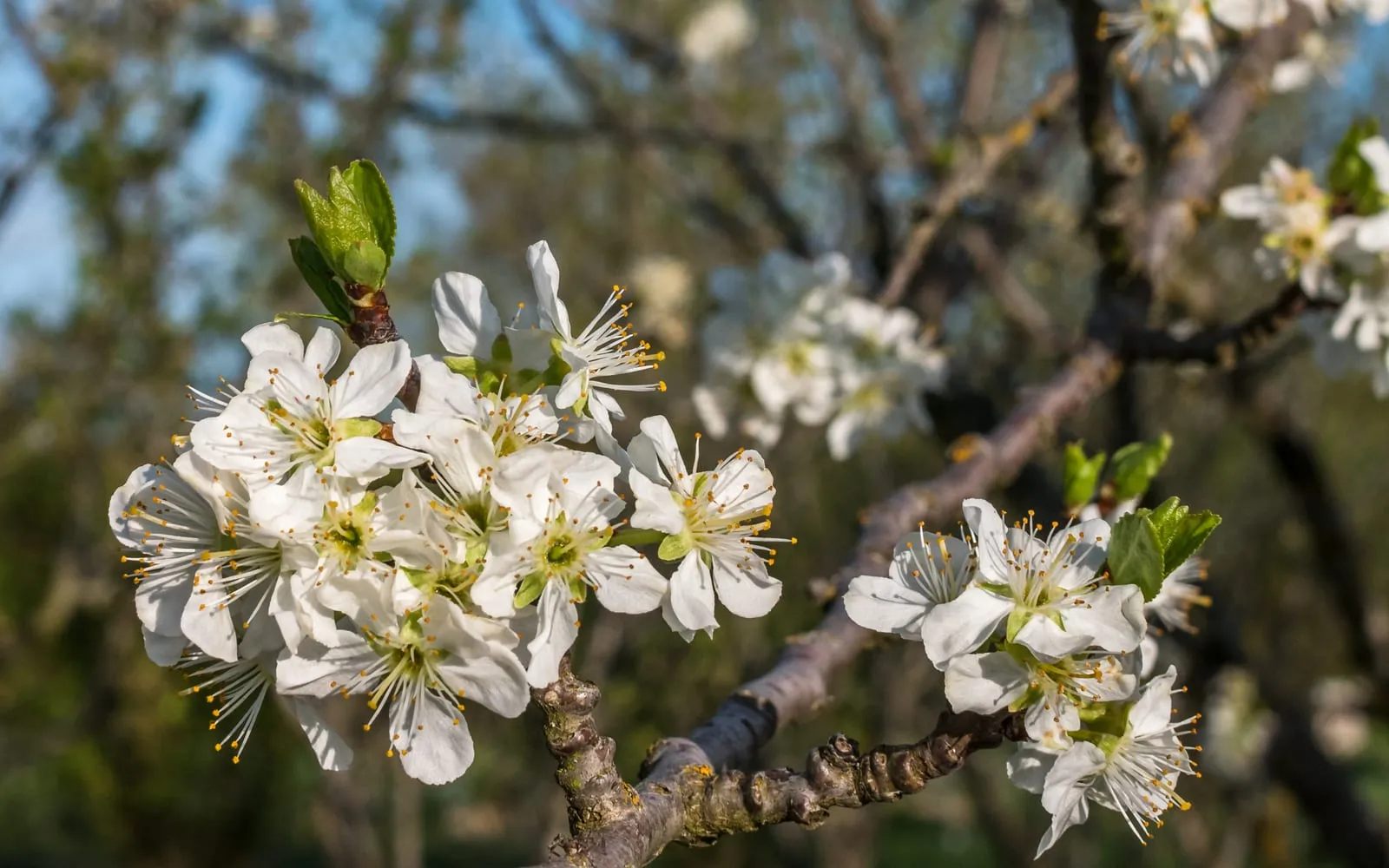
Blossom is white and opens in late March and April, usually before the leaves, covering the bare branches. It is among the earliest fruit blossom and therefore the most frost-vulnerable.
Fruit ripens from late July to September, oval or round, in purple, blue-black, red, yellow or green, usually with a waxy bloom on the skin.
Three groups matter in the kitchen. Dessert plums such as ‘Victoria’ are eaten fresh, gages such as ‘Cambridge Gage’ are smaller, greener and far sweeter, and damsons are small, tart, and made for cooking and gin.
Where it is from
The Caucasus and eastern Europe, where Prunus domestica arose as a natural hybrid between the sloe, Prunus spinosa, and the cherry plum, Prunus cerasifera.
That hybrid origin left it hexaploid, carrying six sets of chromosomes, which is part of why it is so variable and why so many local landrace varieties exist across Europe.
The Romans grew and spread plums, and by the Middle Ages Britain had damsons, bullaces and gages established.
‘Victoria’, the most widely grown plum in Britain, was found as a chance seedling in a Sussex garden around 1840. It is self-fertile, heavy cropping and generous, and it is also the variety most prone to breaking under its own weight and to silver leaf.
The natural habitat is woodland edge and scrub in a continental climate, which is why the trees are hardy in wood while their early blossom struggles in a maritime spring.
How it grows
Buy a grafted tree. Pixy rootstock gives a small tree of 2.5 to 3 m suitable for a small garden, St Julien A gives 4 to 5 m and is the standard choice, and Brompton gives a full-sized tree.
Pollination is simpler than for apples. Many plums, including ‘Victoria’, ‘Czar’ and most damsons, are self-fertile and crop alone. Gages generally are not and need a partner.
Plant bare-root from November to March, keeping the graft union clear of the soil, and stake for the first few years.
Fruit forms on both one-year shoots and older spurs, which is why plums need less formative pruning than apples once a framework is established.
Thin the fruitlets in June, after the natural drop, to about 5 to 8 cm apart. This prevents branch breakage, improves size, reduces brown rot and prevents biennial cropping.
Support heavily laden branches with props if thinning has been insufficient.
Suckers arise from the rootstock and should be pulled off at the point of origin rather than cut, since cutting encourages more.
Through the seasons
Winter is for planting only. Plant bare-root trees, and do not prune anything.
Spring brings very early blossom. Protect small trees against frost where possible, and feed and mulch in February.
Summer is pruning and thinning. Prune in June or July, thin the fruitlets, and prop any branch carrying too much.
Late summer and autumn is the harvest, from late July to September. Pick when the fruit parts easily and yields slightly. Remove any mummified fruit before winter.
Care difficulty
Moderate, and the difficulty is disease management rather than horticulture.
Silver leaf is the defining risk and it is largely preventable by pruning only in summer.
Bacterial canker is the other serious disease and it is worse on wet heavy ground and in exposed sites.
Frost at blossom time removes the crop in some years and cannot be prevented on a large tree.
Cropping is famously irregular. Plums swing between gluts and nothing, and thinning hard in a heavy year is the best correction available.
Wasps and birds take a share of ripe fruit and there is little to be done about it.
Watering
Water newly planted trees weekly through their first three summers.
Established trees need watering during prolonged drought, particularly while the fruit is swelling in July. Dry roots at that point cause heavy fruit drop.
Plums are less drought-tolerant than apples and prefer moisture-retentive soil.
Mulch each spring with well-rotted manure or compost, kept clear of the trunk.
Avoid waterlogged ground, which encourages bacterial canker.
Warning signs, diseases and pests
Silver leaf gives the leaves a distinct silvery sheen, usually on one branch first, and the wood shows a dark stain when cut across. The fungus enters through wounds in autumn and winter. Cut affected branches back to 15 cm beyond the stain and burn them. Prevention is the only reliable approach, and it means pruning only between June and August.
Bacterial canker causes sunken patches on the bark that ooze amber gum, along with small round holes in the leaves as infected tissue drops out. Cut out affected wood in summer, and avoid wet exposed sites.
Brown rot turns fruit brown with concentric rings of buff pustules, spreading rapidly through touching fruit. Remove and destroy every affected and mummified fruit, since they carry it into the next year.
Plum moth larvae tunnel into the fruit around the stone. Pheromone traps hung in May reduce the numbers. It has never established in North America, where a different insect, plum curculio, cuts a crescent-shaped scar into young green fruit weeks earlier in the season and does the equivalent job instead.
Gum oozing from the trunk without canker symptoms is often a stress response to drought or damage rather than disease.
Branches snapping in August mean the crop was not thinned.
Suckers from the base are rootstock growth. Pull rather than cut them.
Japanese beetle skeletonises the leaves in visible feeding groups and is well established across most of the United States. It reached northern Italy in 2014 and has since spread into southern Switzerland, and the rest of Europe treats a sighting as notifiable. Shake beetles into soapy water in the cool of the morning where it occurs.
Brown marmorated stink bug leaves dimpled, corky patches on the fruit and is already established across North America and a growing list of European countries. It does not occur in Australia or New Zealand, where a find is reportable.
Spotted lanternfly, spreading across the eastern and midwestern US since 2014, mobs the trunk and weeps sap where it feeds, and has not established outside North America and its native Asia.
Spotted wing drosophila lays eggs in fruit while it is still ripening on the tree, and plums that looked sound can collapse into a soft, maggot-filled mess within a day. It has been established across North America and Europe since 2008 and remains a quarantine priority in Australia and New Zealand.
Apple maggot fly also attacks plum in North America, tunnelling through the flesh from a faint surface dimple rather than boring to the core. Hang sticky red sphere traps from mid-June.
Growing environment
Full sun, with as much shelter as possible for the early blossom.
Deep, fertile, moisture-retentive soil. Plums tolerate heavier ground than apples and want good drainage nonetheless.
Avoid frost pockets, since blossom in late March is exposed.
Choose Pixy rootstock for a small garden and St Julien A for a standard tree.
A fan against a warm wall suits gages, which need more heat to ripen properly.
Allow room. Even on Pixy the tree spreads, and the branches will be heavy.
Feeding
Apply a nitrogen-rich fertiliser in late winter. Plums are hungrier for nitrogen than apples and pears.
Add sulphate of potash in early spring to support fruiting.
Mulch generously with well-rotted manure in spring.
Do not overfeed a young tree, since soft sappy growth is more vulnerable to bacterial canker.
Container-grown trees on Pixy need regular liquid feeding and annual top-dressing.
Troubleshooting
Silvery sheen on the leaves of one branch. Silver leaf. Cut back to 15 cm beyond any dark staining in the wood and burn the prunings. Never prune plums in winter.
When can I prune? June to August only. Winter and autumn cuts invite silver leaf.
A branch snapped off under the fruit. The crop was not thinned. Thin the fruitlets to 5 to 8 cm apart in June, and prop heavy branches.
Amber gum oozing from the bark with small holes in the leaves. Bacterial canker. Cut out affected wood in summer and improve drainage.
Fruit going brown with rings of pale spots. Brown rot. Remove every affected fruit, including mummified ones still hanging in winter.
Masses of fruit one year and none the next. Typical plum behaviour. Thin hard in the heavy year to even it out.
Shoots coming up from the ground around the trunk. Rootstock suckers. Pull them off where they emerge rather than cutting them.
Blossom killed by frost. Plums flower in late March and are exposed. Fleece a small tree overnight, and avoid planting in a hollow.
Plum problem guides
Not sure what is wrong? See the common vegetable pests guide.
- Silver leaf, which enters through winter pruning cuts
- Bacterial canker
- Brown rot
- Plum moth
- Japanese beetle across the US, newly arrived in northern Italy and Switzerland
- Brown marmorated stink bug, established across North America and Europe
- Spotted lanternfly, spreading across the eastern and midwestern US
- Spotted wing drosophila, established across North America and Europe since 2008
- Plum curculio, a North America-only weevil and the transatlantic counterpart to plum moth
- Apple maggot fly, a North America-only fly that also attacks plum
- Plum pox, which rings the fruit and the leaves and has no cure