
Pest
Vine weevil
Otiorhynchus sulcatus
Also called Black vine weevil, Vine weevil grubs
Adult vine weevils cut neat semicircles from leaf edges, while the grubs eat roots from container plants over winter. Use nematodes while the compost is warm enough and larvae are active.
At a glance
- Type
- Pest
- Cause
- Insect
- Severity
- Can kill the plant
- Affects
- Garden plants, Houseplants, Herbs and edibles
- Active
- All year
- Established in
- Europe, North America, Asia, Australia and New Zealand
What you are seeing
- Neat semicircular notches cut in from the edge of a leaf, never a hole in the middle
- Notching on rhododendron, camellia, euonymus, bergenia and primula from late spring onwards
- A container plant wilting and collapsing over a few days in autumn or spring with no other cause
- The plant lifting out of the pot with almost no roots attached
- Plump, creamy white, legless C-shaped grubs with an orange-brown head in the compost
- Dull black beetles about nine millimetres long walking up stems and pot sides after dark
Before you treat anything
Nothing recommended here is harmful to a child, a pet or a pond. Nematodes are living organisms with a short shelf life, so buy from a supplier who ships them cold, check the date, and use the whole pack at once rather than storing an opened one.
Two problems wearing one name
The adult and the grub do such different things that most people never connect them, and they search for them separately.
Above ground, something is cutting neat semicircular notches out of the edges of rhododendron, camellia, euonymus, bergenia and primula leaves from late spring onwards. It looks deliberate, almost stamped, and it is disfiguring rather than harmful. The plant carries on.
Below ground, a container plant that was fine in October is dead in March. It lifts out of the pot with no resistance because it has no roots left. Heuchera, primula, cyclamen, begonia, fuchsia and strawberry are the usual casualties.
Same insect. The notches are the adult feeding, and they are the warning that eggs are going into the compost.
What to look for
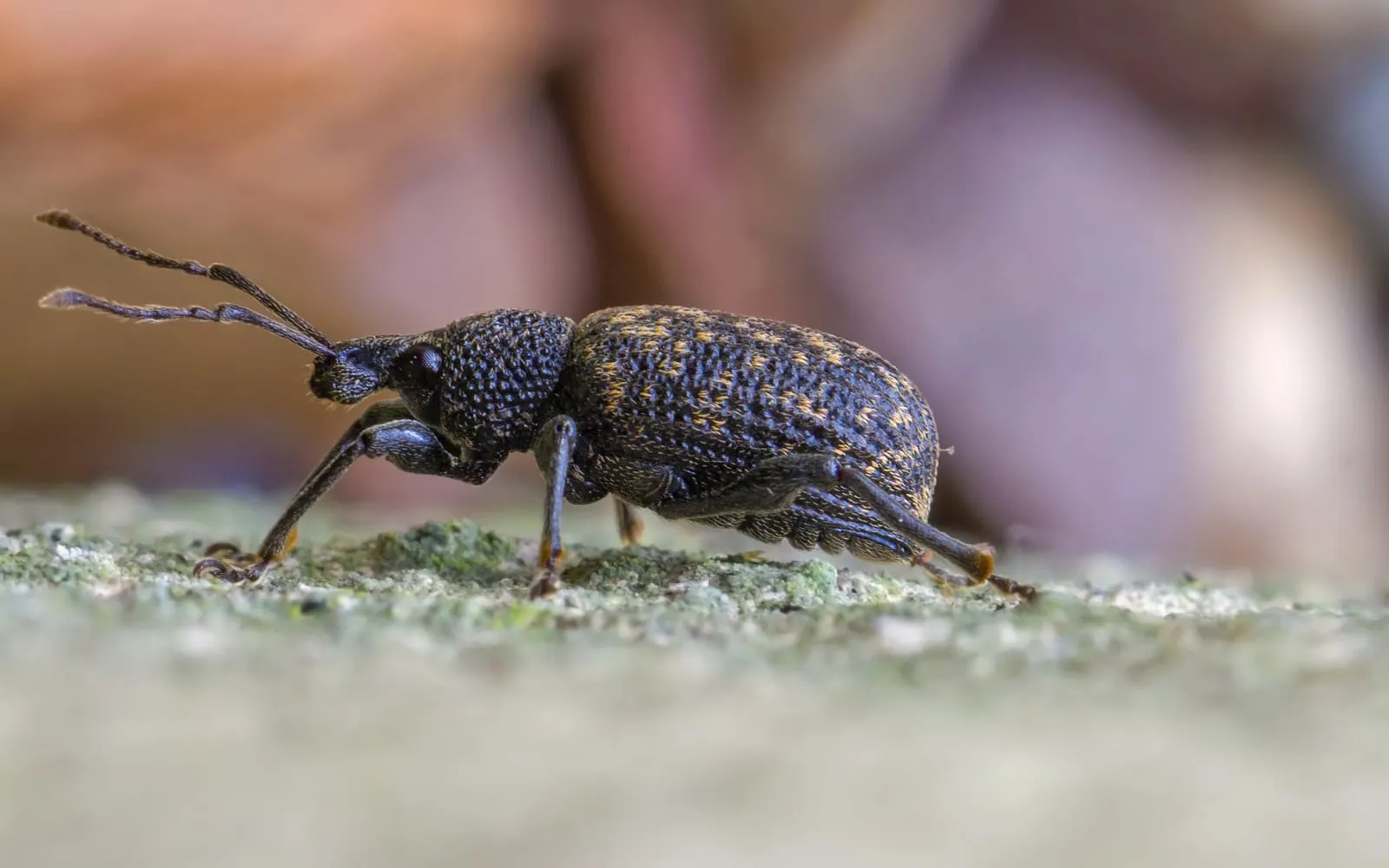
The adult is about nine millimetres long, dull black with a scatter of dull gold flecks, pear-shaped, with a short broad snout and antennae elbowed halfway along. Its wing cases are fused, so it cannot fly. Everywhere it goes, it walks.
It feeds at night and hides by day under pot rims, in leaf litter, behind labels and in the crown of a plant. Almost nobody sees one until they go out with a torch, at which point a garden that appeared to have none turns out to have plenty.
The grub is plump, creamy white, legless and curled into a C, up to about ten millimetres, with a hard orange-brown head. It is unmistakable. Tip out a pot of a plant that has collapsed and they are against the inside of the pot and around the root ball.
Almost every vine weevil in Britain is female and lays without mating, which means one insect arriving in a pot of compost is enough to start a population. Each lays several hundred eggs across a summer.
The calendar that decides what you do
Adults emerge from around May and feed for two or three weeks before they start laying. Egg-laying then runs through summer into early autumn.
Eggs hatch within a few weeks, and the young grubs eat fine roots. Through autumn they grow, and by winter they are large enough to strip the bark off the stem base as well, which is the point at which the plant is finished. They pupate in spring and emerge as the next generation of adults.
Two windows matter. Torchlight collecting between May and August removes females before they lay. Nematodes in late August and September kill the grubs while they are small and the compost is still warm enough for the treatment to work. A nematode drench applied in January to cold compost, when the grubs are large and the damage is done, is the commonest way this control gets a poor reputation.
What to do about them
Buy carefully. Slide the root ball out of any container plant before it comes home and look at the compost. That single habit keeps this out of a garden better than anything you can do once it is in.
Grow the vulnerable plants in the ground where you can. The same heuchera that dies in a pot survives in a border, because the root system is bigger than the grubs can get through and there are predators in the soil.
Between May and August, take a torch out after dark. They climb pot sides and stems to feed and they drop and play dead when you touch them, so hold a sheet of paper underneath and knock the plant. Every female you collect is several hundred eggs that will not be laid.
In late August or September, water nematodes into every susceptible container. Use Heterorhabditis while the compost is still above 12 degrees C, and switch to Steinernema kraussei once it cools, since that one works down to about 5 degrees. Keep the compost moist for a fortnight afterwards so they can move through it, and treat again in spring.
When a plant does collapse, tip it out, pick out every grub, wash the roots, and repot into fresh compost. The plant will often recover if any root remains, and the old compost should go in the bin rather than onto a border.
What it gets mistaken for
Caterpillars and slugs both make holes in the middle of a leaf. Vine weevil only ever works in from the margin, taking neat scallops out of the edge, and it never leaves a slime trail or a pellet of frass.
Root rot produces the same sudden collapse of a container plant. Tip the pot out and the difference settles it. Rot leaves black, soft, foul-smelling roots and no animals. Vine weevil leaves clean compost, chewed-off roots and grubs.
Chafer grubs and leatherjackets in a lawn get called vine weevil regularly. A chafer grub is much larger, has three pairs of obvious legs and a fat grey rear end. A vine weevil grub has no legs at all, which settles it in a second.
Leaf-cutter bees take smooth semicircles out of rose and lilac leaves, and the edges are cut cleanly as though with scissors rather than chewed. They are harmless, they are pollinators, and they should be left entirely alone.
What to do, in order
Start here
Prevention, and the changes that stop the problem returning. Most of these pages should end at this tier.
- Knock every new container plant out of its pot before you buy it
- Vine weevil travels in compost, and a nursery pot is how it reaches a garden that has never had it. Slide the root ball out in the car park. Grubs are unmistakable and there is no argument with a plant you have not paid for yet.
- Grow the most vulnerable plants in the ground
- Heuchera, primula, cyclamen, begonia, fuchsia and strawberry in containers are what this insect ruins. The same plants in open ground usually survive, because the root system is larger than the grubs can get through and predators reach them.
- Take away the daytime shelter
- Adults hide by day under pot rims, in leaf litter, behind labels and in the folds of a plant. Standing pots on feet, keeping the area around them swept and lifting old debris removes the places they spend fifteen hours of every day.
- Change the compost on long-term pots
- A container left undisturbed for three years accumulates generations. Repotting every second year, washing the roots and inspecting them as you go, resets a population before it is large enough to kill the plant.
Then reach for a barrier
Netting, hand removal and water. Nothing here harms anything except the target.
- Go out with a torch from May to August
- Adults feed at night and climb stems and pot sides to do it, and they are slow, flightless and easy to pick off. An hour after dark, two or three nights a week during egg-laying, removes females before each of them lays several hundred eggs.
- Shake the plant over a sheet of paper
- They drop and play dead when disturbed rather than running. Holding a sheet of white paper under a rhododendron and giving it a sharp knock collects in seconds what searching by eye would not find at all.
- Check the compost whenever you repot
- The grubs are near the root ball surface and against the inside of the pot. Pick every one out, wash the roots, and repot into fresh compost rather than tipping the old mix onto a border.
- Ring the pot with a sticky barrier
- The adults cannot fly, so they must walk up. A band of horticultural glue or an adhesive barrier around the rim of a pot standing clear of surrounding foliage stops them reaching the compost to lay.
Then bring in the predators
Encourage what already lives in the garden, and buy predators in where the problem is under glass and nothing will arrive on its own.
- Water on Steinernema kraussei in autumn
- This nematode works down to about 5 degrees C, which makes it the one for September and October and again in spring. Apply to moist compost and keep it moist for a fortnight, and target the young grubs before they are big enough to ring a stem.Widely sold across Europe and North America. Australia and New Zealand permit far fewer species, because releasing an entomopathogenic nematode that is not already approved is prohibited there. Check what is registered locally rather than ordering from overseas.
- Use Heterorhabditis in late summer while it is warm
- Heterorhabditis bacteriophora needs soil at 12 degrees C or above, so it suits late August into early September. Timing is most of the result with either species. A treatment in midwinter on cold compost achieves very little.
- Leave the ground beetles and the birds to the adults
- Ground beetles, shrews, frogs, toads and thrushes all take adult weevils, which is a large part of why the insect is so much worse in containers than in a border. A garden with rough corners and no broad-spectrum spraying keeps a working predator population.
Biological controls are live organisms and their sale and release are regulated country by country. An agent sold freely in one place may be unapproved in another, so buy from a licensed supplier where you live and never import or move one yourself.
Plants affected
Guides that name it among the problems to watch for. The list is the plants it is characteristic of rather than everything it will feed on.
Common on UK allotments
This is one of the pests and diseases allotment growers meet most often. See it alongside the other common problems on the allotment guide.
Common allotment pests and diseasesA common houseplant pest
This is one of the pests and problems that houseplant owners meet most often. See it alongside the others, with a quick table for telling them apart, on the houseplant pests guide.
Common houseplant pestsA common rose problem
This is one of the pests, diseases and disorders that rose growers meet most often. See it alongside the others on the common rose problems guide.
Common rose problems