
Outdoor plant
Laurustinus
Viburnum tinus
Also known as Viburnum tinus, Winter viburnum
How to grow laurustinus, Viburnum tinus. Winter flowering, clipping it as a hedge, dealing with viburnum beetle, and the blue-black berries that follow.
At a glance
- Difficulty
- Easy
- Water
- Rarely once established
- Light
- Full sun to quite deep shade
- Temperature
- Hardy to about -10 deg C, and happiest in mild gardens
- Hardiness
- USDA 8-10, RHS H4, hardy to -10 C
- Type
- Evergreen shrub, long-lived and dense
- Height
- 2-3 m, and up to 4 m unpruned
- Native to
- The Mediterranean basin and south-eastern Europe
- Best month
- December in the Northern Hemisphere, June in the Southern Hemisphere
It flowers through winter, which is the point of it, and that only works where winter is mild enough for buds to open. Below about -10 C the flowers are lost and the leaves brown, and a cold drying wind does more damage than still cold. It takes coastal salt and chalk. Viburnum beetle chews the leaves to lace across Europe and North America.
Hardiness zones describe winter cold alone. Summer heat, humidity, rainfall and the length of the growing season decide as much, so treat the range as the outer limit rather than as a recommendation.
Every month named in this guide is for the temperate Northern Hemisphere. If you garden in the Southern Hemisphere, shift each one by six months, so December becomes June. Closer to the equator the wet and dry seasons matter more than the calendar, and the shift stops being a useful guide.
Harmful if eaten
- Do not eat
- The berries, and the leaves in quantity
- Harm from
- Eating it
- Affects
- People, cats and dogs
The metallic blue-black berries are mildly poisonous and the plant is otherwise harmless to have in a garden. The RHS lists Viburnum among plants that are harmful if eaten. Eating a quantity of the fruit causes nausea, vomiting and diarrhoea, and the effect is uncomfortable rather than dangerous. Reported cases involve children attracted by the colour, and a berry or two swallowed by accident is not a cause for alarm, although a handful is worth a call to a doctor or to the vet. Birds eat the fruit readily through winter without harm, which is what the plant produces it for, so a berry-covered shrub in a garden with a bird table is doing useful work. The leaves are not a realistic hazard, being tough and bitter, and no poisoning from foliage is on record. Site a plant away from where very small children play if the berries concern you, and note that a clipped hedge trimmed each spring produces far less fruit than a shrub left to grow naturally.
Sources: RHS potentially harmful garden plants, ASPCA toxic and non-toxic plants
About
Laurustinus does the job nobody else wants. It grows in dry shade under trees, in a north-facing corner, in a windy coastal garden, in heavy clay, and it flowers through the winter while doing it.
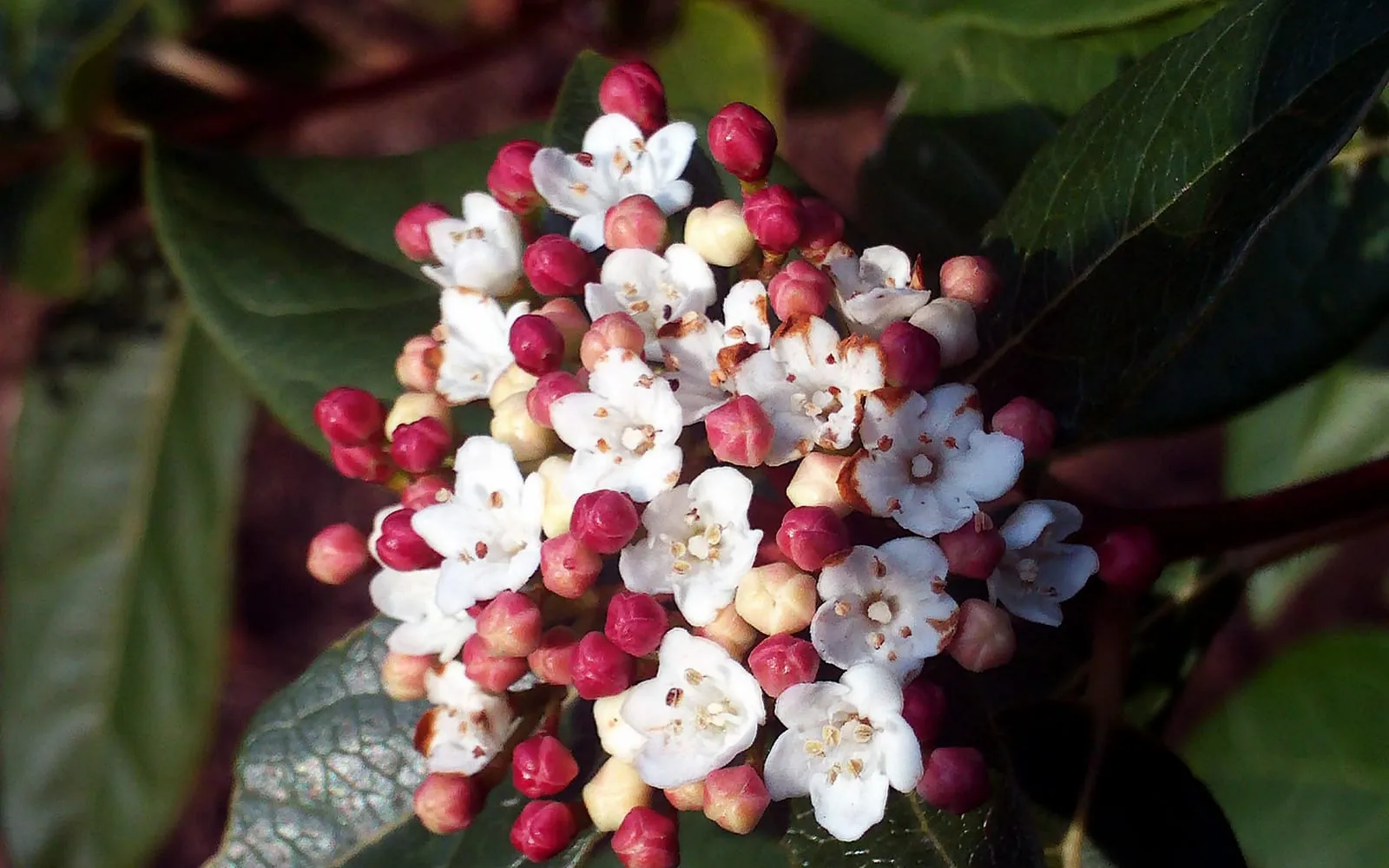
The flowers open from November to April, a long slow succession of flat heads where deep pink buds sit beside small white blooms, so the shrub carries two colours at once for months.
Its one real enemy is a beetle. Viburnum beetle larvae reduce the leaves to lace every spring and the shrub grows through it, but a badly attacked plant looks poor from May until the new growth covers the damage.
Appearance and character
A dense rounded evergreen shrub, 2 to 3 m each way in a garden and reaching 4 m if left alone for long enough.
Leaves are oval, 4 to 10 cm long, dark glossy green above, paler and slightly downy beneath, carried in opposite pairs on reddish stems. They have a faintly unpleasant smell when crushed.
Flowers open in flat heads 5 to 10 cm across from late autumn through to spring. The unopened buds are a strong pink and the open flowers are white with five lobes, and the contrast between them is what makes the plant worth looking at.
Berries follow in late summer and autumn, small and oval, ripening through pink to a metallic blue-black that has an odd oily sheen. Birds strip them by midwinter.
Growth is dense from the base, which is why it clips into such a good hedge and why it screens so effectively.
Named forms differ mostly in flower colour and vigour. ‘Eve Price’ is more compact with deeper carmine buds, ‘Gwenllian’ is very free with berries, and ‘French White’ is larger and paler.
Where it is from
The Mediterranean basin, from Portugal and Spain through southern France and Italy to Greece and North Africa, where it grows in evergreen scrub and open woodland on dry rocky ground.
Winter flowering follows directly from that climate. In a Mediterranean summer the dry season is the hard one, and the mild wet winter is when the plant can afford to bloom.
It has been grown in Britain since the sixteenth century and is thoroughly naturalised in mild parts of the south and west, where birds have spread it into hedgerows and woodland.
The name laurustinus combines the laurel it vaguely resembles with the old Latin name tinus for the plant itself.
Its origin also sets the limit on hardiness. Laurustinus is reliable to about -10 deg C and can be cut back in a hard continental winter in an exposed inland garden, recovering from the base afterwards.
How it grows
Plant in autumn or spring into any reasonable soil that drains. It accepts clay, chalk and sandy ground equally.
Space plants 60 to 90 cm apart for a hedge, and give a specimen shrub 2 m each way.
Prune after flowering finishes in late spring, which is usually May. Trim a hedge then, and shape a specimen by shortening long shoots to a leaf pair.
Clipping in late spring costs the berries, since fruit follows the flowers you have just removed. Choose which display you want, or clip only part of the plant.
Renovate an overgrown shrub by cutting it back hard into old wood in spring. It reshoots readily from the base, unlike many evergreens.
Take semi-ripe cuttings in late summer, which root easily.
Mulch in spring with compost, especially on dry soil under trees.
Water new plants through their first two summers, particularly in dry shade, which is a tougher position than it looks.
Through the seasons
Winter is the main flowering season. The shrub carries pink buds and white flowers together from November onward and needs nothing at all.
Spring finishes the flowering and starts the pruning. Trim after the last flowers in May, and watch for viburnum beetle larvae from April.
Summer is growth and the second beetle generation. Water young plants, and check the leaf undersides in August.
Autumn ripens the berries to metallic blue-black. Plant new shrubs, and leave the fruit for the birds.
Care difficulty
Easy. Laurustinus tolerates shade, wind, salt, pollution, clay, chalk and drought once established, which is a shorter list of complaints than most shrubs manage.
Viburnum beetle is the one persistent nuisance and it disfigures rather than kills.
Hard winters damage the foliage in cold inland gardens, and the plant regrows.
Pruning is optional and forgiving. It takes hard renovation better than almost any other evergreen.
Nothing about it requires feeding, staking or winter protection above about -10 deg C.
Watering
Established plants need no watering except in a long drought.
Water new plants through their first two summers, and be more generous where they are in dry shade beneath trees, which is the hardest position to establish in.
Mulch in spring to hold moisture on dry soil.
Container plants need regular summer watering and a pot of at least 45 cm, and laurustinus grows well as a clipped standard in a tub.
Avoid waterlogging, which is the only soil condition it dislikes.
Warning signs, diseases and pests
Viburnum beetle is the pest that defines this plant. Creamy yellow larvae with black markings hatch in April and eat the leaves from beneath, leaving them skeletonised and lace-like by May. A second generation of adult beetles feeds in August, producing rounded holes. Check the underside of the leaves from mid-April and pick the larvae off by hand on a small plant. Encouraging birds helps, and the shrub grows through the damage each year without lasting harm.
Viburnum whitefly gathers under the leaves, producing sticky honeydew and then sooty mould. It is more disfiguring than damaging.
Powdery mildew coats the foliage in white in a dry summer, particularly on a plant in dry shade against a wall.
Leaf spot produces brown or purple blotches in wet weather and needs no treatment beyond clearing fallen leaves.
Brown scorched foliage after a hard winter is cold damage. Cut back to live wood in spring and the plant reshoots.
A shrub that has stopped flowering has usually been clipped at the wrong time of year, since pruning in summer or autumn removes the winter buds.
Honey fungus kills viburnums, showing as sudden collapse with white fungal sheets under the bark.
Growing environment
Full sun through to fairly deep shade. Flowering is heaviest in sun and the plant survives shade better than almost any other winter-flowering shrub.
Any soil that drains, including clay and chalk. It has no pH preference.
Shelter improves it in cold inland gardens, and it is exceptionally good in coastal ones, standing salt wind without damage.
It makes an excellent evergreen hedge or screen at 1.5 to 2.5 m, dense to the ground and clipping neatly.
A large container suits it, especially clipped as a lollipop standard by a door, where the winter flowers get noticed.
Dry shade under mature trees is where it earns its reputation, and the only extra help it needs there is watering for the first two summers.
Avoid a frost pocket in a cold inland garden, where hard winters will keep cutting it back.
Feeding
Laurustinus needs very little feeding on reasonable soil.
Apply a general-purpose fertiliser in spring where growth is weak or the plant is in poor dry ground.
Mulch with garden compost each spring, which matters more than fertiliser on dry soil under trees.
Feed container plants with a slow-release fertiliser in spring.
A renovated shrub cut hard back benefits from a feed and a mulch as it regrows.
Troubleshooting
The leaves are skeletonised and full of holes. Viburnum beetle. The larvae feed from beneath in April and May. Check the leaf undersides and pick them off, and the plant will grow through it.
It flowers less since I started clipping it. Trim only after the flowers finish in May. Cutting in summer or autumn removes the winter buds.
Where have the berries gone? Clipping in late spring removes the flowers that would have set fruit. Leave part of the shrub untrimmed if you want berries.
Are the berries poisonous? Mildly. A quantity causes vomiting and diarrhoea in people, cats and dogs. Birds eat them safely and strip them by midwinter.
White powder over the leaves in summer. Powdery mildew, usually on a plant in dry shade. Mulch, water in drought, and improve airflow.
It went brown all over in the cold. Winter damage in an exposed inland garden. Cut back to live wood in spring and it will reshoot from the base.
Can I cut an overgrown one right back? Yes. Laurustinus takes hard renovation into old wood in spring better than most evergreens and reshoots freely.
Will it grow in dry shade under a tree? Yes, which is one of its main uses. Water it through the first two summers to get it established.