
Outdoor plant
Primrose
Primula vulgaris
Also known as Common primrose, English primrose, Primula
How to grow the native primrose, Primula vulgaris. Planting, dividing, pin and thrum flowers, and which primulas cause a rash.
At a glance
- Difficulty
- Moderate
- Water
- Rain is usually enough. Water through dry spells
- Light
- Partial shade, ideally dappled light under deciduous trees
- Temperature
- Fully hardy. Dislikes hot dry summers
- Hardiness
- USDA 4-8, RHS H6, hardy to -25 C
- Type
- Evergreen perennial
- Height
- 5-15 cm
- Native to
- Western and southern Europe, Western Asia
- Best month
- February in the Northern Hemisphere, August in the Southern Hemisphere
Cold is never the difficulty and heat is. Primroses want cool moist summers and shade, and they die out through hot summers, which is why they are treated as winter bedding and discarded in warm climates. Note that primrose means Primula vulgaris in Britain and evening primrose, an unrelated Oenothera, in much of North America.
Hardiness zones describe winter cold alone. Summer heat, humidity, rainfall and the length of the growing season decide as much, so treat the range as the outer limit rather than as a recommendation.
Every month named in this guide is for the temperate Northern Hemisphere. If you garden in the Southern Hemisphere, shift each one by six months, so February becomes August. Closer to the equator the wet and dry seasons matter more than the calendar, and the shift stops being a useful guide.
Harmful if eaten
- Do not eat
- Leaves and stems
- Harm from
- Eating it
- Affects
- People, cats, dogs and horses
The ASPCA lists Primula vulgaris as toxic to cats, dogs and horses, gives the toxic principle as unknown, and reports mild vomiting as the sign. That is the whole of it for pets, and it is a low-grade problem rather than an emergency. The reputation primulas have for causing dermatitis belongs to a different plant: the RHS puts Primula obconica, the German primrose sold as a winter houseplant, in category B as a skin irritant, and P. auricula in category C as a skin allergen, whilst this species appears on neither list. If handling primulas has given you a rash before, the culprit was almost certainly obconica on a windowsill rather than primroses in a border. Wear gloves if you are sensitive.
Sources: ASPCA, RHS potentially harmful garden plants
About
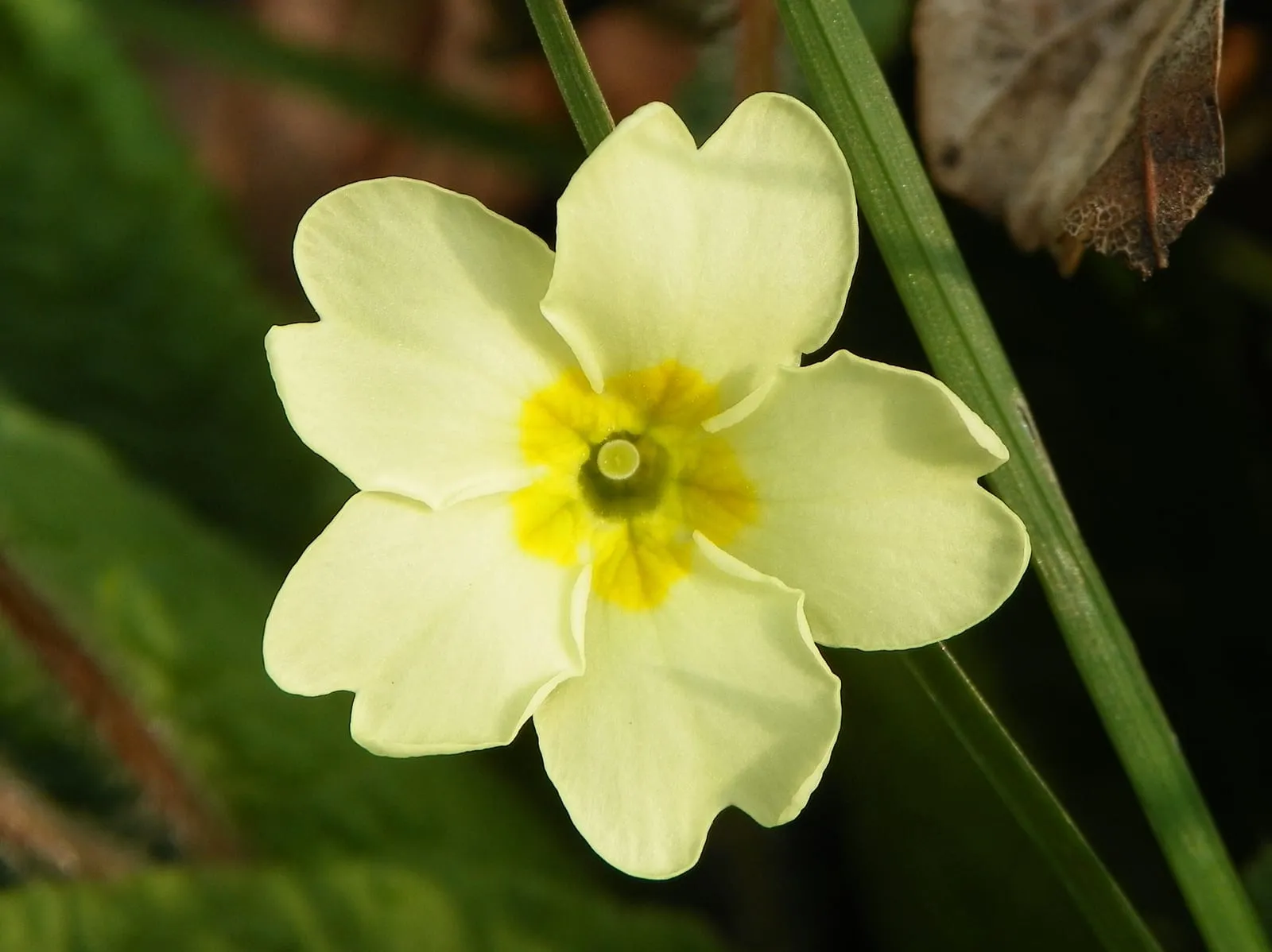
The primrose is a native European wildflower and one of the first things to flower in a cold February. Pale yellow flowers, each on its own slender stalk, sit just above a rosette of crinkled leaves on a hedge bank or a woodland floor.
The name is worth a moment. It comes from prima rosa, first rose, and it refers to the timing rather than to any relationship with roses. Primroses are in the Primulaceae, along with cowslips and oxlips, and they hybridise with both where they grow together.
The plant sold in trays outside supermarkets from January is usually not this species. Those are bedding primulas, mostly hybrids in strong reds, purples and oranges, bred for a single season of colour. The wild primrose is a long-lived perennial in a much softer yellow, and it is the better garden plant.
Appearance and character
A flat rosette of oval, crinkled, slightly toothed leaves, evergreen through mild winters and tattered by spring. Flowers are pale sulphur-yellow with a deeper yellow eye, about 3 cm across, each carried singly on a hairy stalk straight from the crown. There is a light, sweet scent, best on a warm afternoon.
Look down the throat of a few flowers and you will find two different arrangements, which is the most interesting thing about the plant. Some show a round green knob in the centre, like the head of a pin. Others show a ring of five stamens instead, with the knob hidden below. A knob at the mouth makes a flower pin-eyed, a ring of stamens thrum-eyed, and any individual plant carries one or the other, never both.
Darwin worked this out in the 1860s. The arrangement puts pollen and stigma at different heights in the two forms, so a visiting bee picks up pollen at the level that matches the other form, so a pin is pollinated by a thrum and a thrum by a pin. It is a mechanism to prevent self-pollination, and you can see it with your eyes on a February afternoon.
Where it is from
Western and southern Europe and into western Asia, and native across Britain and Ireland. It grows in deciduous woodland, on shaded hedge banks, in old meadows and on damp coastal cliffs in the west.
The habitat gives you the growing conditions directly. It expects light in early spring before the canopy closes, shade and moisture through summer, and a soil topped up annually by falling leaves. Primroses do not want to bake.
One legal point, since it comes up. Digging up wild primroses is an offence under the Wildlife and Countryside Act 1981 without the landowner’s permission, as it is for any wild plant. Buy nursery-raised stock or grow from seed.
How it grows
An evergreen perennial forming a slowly expanding clump from a short woody rootstock, which can be divided. It also seeds itself freely where it is happy, and seedlings flower in their second or third year.
The seeds carry a fleshy attachment that ants collect, so a colony creeps outward and turns up in places you did not plant it.
Growth is concentrated in late winter and spring. It flowers from February to May, sets seed, and then goes quiet through summer, with the foliage often looking rough by August before fresh leaves come through in autumn.
Through the seasons
Winter brings the first flowers, from February in a mild year and often earlier in the south-west.
Spring is peak flowering. Deadhead if you want tidiness, or leave the seed to fall if you want more plants.
Summer is the season primroses are lost in. The clumps look tired, get forgotten, and dry out. Mulch and water them through a hot spell, particularly anything planted in sun.
Autumn is for dividing and mulching. Lift congested clumps, pull them apart into pieces with roots and a growing point each, and replant straight away. Then spread leaf mould over the whole area.
Care difficulty
Moderate. A primrose in the right place looks after itself for years, and a primrose in the wrong place quietly fails.
The wrong place is hot, sunny and dry. Gardeners who lose them usually planted them in an open border in full sun, where they scorch in July and never recover. Put them where you would put a fern, and they are easy.
The second issue is vine weevil, which is a serious problem for anything grown in containers.
Watering
Rain does most of it in an ordinary year, in open ground with soil that holds moisture.
Water through dry spells, especially in the first year after planting, and especially for anything in sun. Extended drought makes the leaves wither at the edges and dramatically reduces flowering the following spring, so a dry August costs you the display in February.
Mulch is more useful than watering. A layer of leaf mould or garden compost around the plants holds moisture where the roots are and saves you the job.
Winter waterlogging rots the crown, so heavy clay needs organic matter and grit working in before planting.
Warning signs, diseases and pests
Vine weevil is the main pest, and containers are where it does real damage. Adults cut neat semicircular notches out of the leaf edges at night, which is unsightly but survivable. The grubs, fat white legless things with brown heads, eat the roots through autumn and winter, and the first you know is a plant that wilts and lifts out of the soil with nothing underneath. Water on a nematode biological control in late summer and again in spring.
Slugs and snails go for young growth and flower buds in damp weather. Evening patrols work better than anything else.
Primula leaf spot shows as red-brown blotches spreading across the foliage. Pick off affected leaves, improve air movement around congested clumps, and water at the base rather than over the top.
Grey mould can take hold in a wet winter on plants in heavy soil that never dries.
Growing environment
Partial shade is what it wants, and dappled light under deciduous trees or shrubs is ideal. The north side of a wall, a hedge bottom, the front of a shady border, all work well. Full sun is tolerated only where the soil stays reliably moist.
Fully hardy to about -25 deg C, and untroubled by frost. Its difficulty is heat, not cold, and hot dry summers are what shorten its life in a garden.
Soil should be humus-rich and moisture-retentive, ideally neutral to slightly acidic, with enough drainage that it does not sit wet all winter. Adding leaf mould or garden compost at planting is worth more than any fertiliser.
Feeding
Primroses are not hungry. A dressing of leaf mould or well-rotted garden compost each autumn is the main thing, and it does the job of feeding, mulching and moisture retention at once.
On poor soil, a balanced granular fertiliser scattered around the clumps in early spring as growth starts is enough. Avoid high-nitrogen feeds, which push soft leafy growth that slugs find first.
Troubleshooting
Leaves scorched and brown at the edges by midsummer. Too much sun, too little moisture, or both. Mulch heavily now and move the plant in autumn.
Wilting suddenly, and the plant lifts out with no roots. Vine weevil grubs, almost certainly in a container. Apply nematodes and repot into fresh compost.
Neat notches cut from the leaf margins. Adult vine weevil. Cosmetic in itself, but it tells you grubs are coming.
Fewer flowers each year. The clump is congested. Divide it in autumn, or straight after flowering, into pieces with roots and a growing point each.
Red-brown spots spreading on the leaves. Primula leaf spot. Remove affected foliage and stop watering overhead.
Are these the ones that give you a rash? Almost certainly not. That is Primula obconica, the winter houseplant, which the RHS lists as a skin irritant. The garden primrose is not on that list.