
Outdoor plant
Florist's Cyclamen
Cyclamen persicum
Also known as Persian cyclamen, Florists cyclamen
How to grow florist's cyclamen, Cyclamen persicum. Why central heating kills it, watering from below, summer dormancy, and the danger in the tuber.
At a glance
- Difficulty
- Moderate
- Water
- Keep just moist while in leaf. Nothing at all in summer
- Light
- Bright indirect light. A cool windowsill out of direct sun
- Temperature
- 10-15 deg C. Warmth is what kills it. Not frost hardy
- Humidity
- Cool moist air. Central heating is the enemy
- Hardiness
- USDA 9-11, RHS H2, hardy to 5 C
- Type
- Tuberous perennial, dormant in summer
- Height
- 15-30 cm
- Native to
- The eastern Mediterranean
- Best month
- September in the Northern Hemisphere, March in the Southern Hemisphere
The florist cyclamen is the tender one. It grows through the cool months and rests through summer, so it wants 10 to 15 C and sulks in a warm room, which is why a plant on a mantelpiece over a radiator collapses within weeks. It is not the hardy species. For a border, buy Cyclamen hederifolium or Cyclamen coum, which take -15 C and naturalise.
Hardiness zones describe winter cold alone. Summer heat, humidity, rainfall and the length of the growing season decide as much, so treat the range as the outer limit rather than as a recommendation.
Every month named in this guide is for the temperate Northern Hemisphere. If you garden in the Southern Hemisphere, shift each one by six months, so September becomes March. Closer to the equator the wet and dry seasons matter more than the calendar, and the shift stops being a useful guide.
Poisonous if eaten
- Do not eat
- Every part, and the tuber most of all
- Harm from
- Eating it and handling it
- Affects
- People, cats, dogs and horses
The ASPCA lists Cyclamen as toxic to dogs, cats and horses through terpenoid saponins, with salivation, vomiting and diarrhoea from the leaves and flowers, and warns that substantial consumption of the tuber can cause heart rhythm abnormalities, seizures and death. The tuber holds by far the highest concentration and is the reason this entry is rated severe rather than mild. A pot of cyclamen sitting at floor level with a fat tuber half exposed at the compost surface is a genuine hazard to a dog that digs. The plant is a popular winter gift and often arrives in a house with no warning attached. Saponins also irritate skin, so wash your hands after repotting. Cyclamen does not appear on the RHS list of potentially harmful garden plants, which is a gap in that list rather than a clean bill of health, and the ASPCA entry should be treated as the authority here.
Sources: ASPCA (Cyclamen species), RHS potentially harmful garden plants
About
Most florist’s cyclamen are killed by kindness within a month. They arrive as a Christmas gift, go onto a warm windowsill above a radiator in a heated living room, and collapse.
The plant wants 10 to 15 deg C. That is a cold porch, an unheated bedroom, a conservatory in winter or a north-facing hallway. In a room at 21 deg C it yellows, the flower stems flop, and it is finished within weeks.
Get the temperature right and the same plant flowers from October to April, then rests through summer and does it all again. Cyclamen tubers can live for decades.
Appearance and character
A neat mound of heart-shaped leaves, dark green and beautifully marbled with silver in patterns that vary from plant to plant, held on fleshy stalks from a flattened tuber.
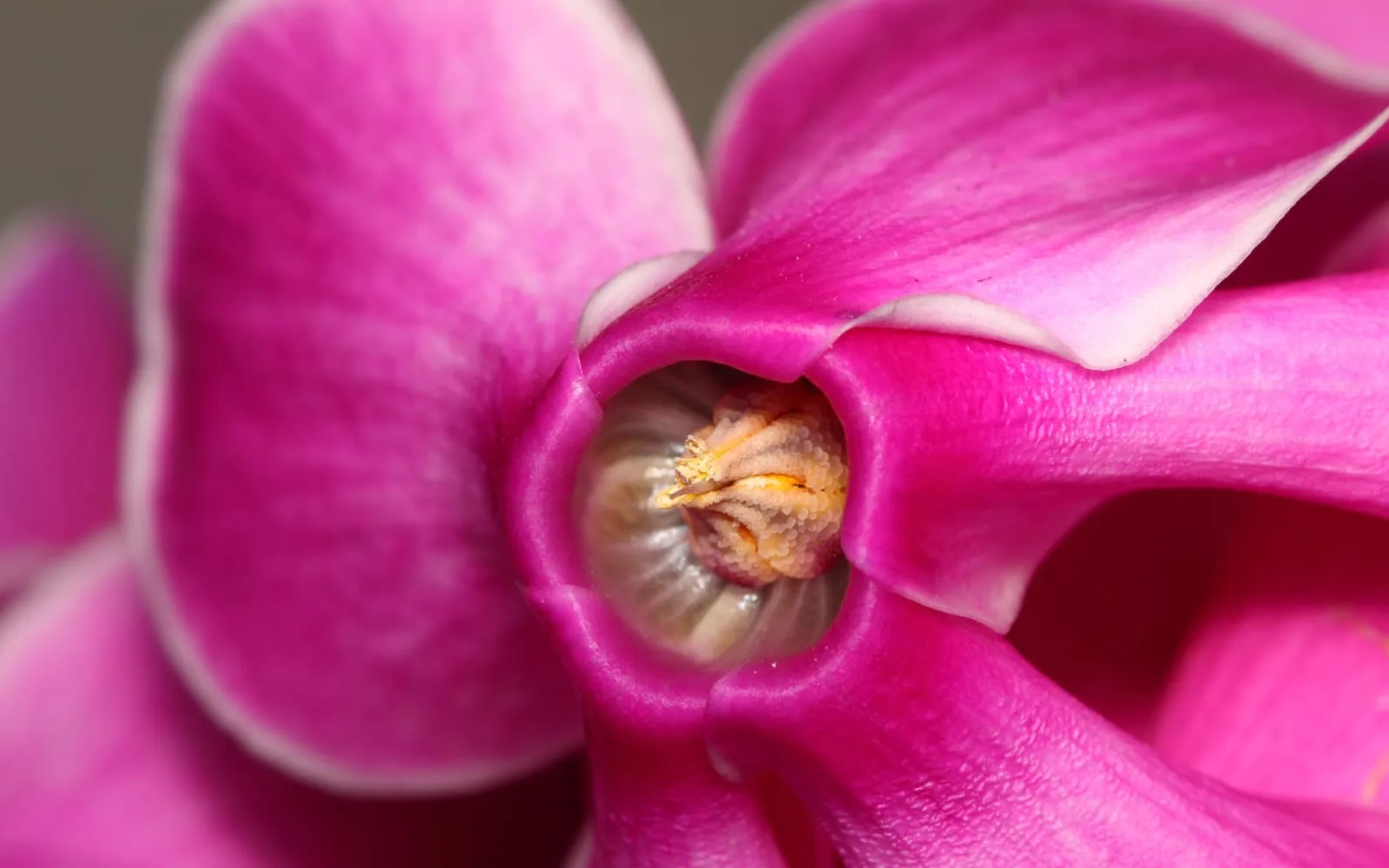
Flowers are unmistakable. Five petals sweep sharply backwards and upwards from a downward-facing mouth, so the bloom looks like something caught in a strong wind. Colours run from white through every shade of pink to deep magenta and scarlet, and some varieties are scented.
Flowers and leaves both come directly from the tuber rather than from stems, so the plant has no branching structure at all.
After flowering, the flower stalk coils into a tight spring and pulls the seed capsule down to the soil. Ants then carry the seeds away, drawn by an oily appendage on each one, which is how cyclamen spread themselves.
Where it is from
The eastern Mediterranean, from Turkey and Syria south through Lebanon and Israel, growing on rocky hillsides, in scrub and among limestone outcrops, often in the shade of rocks.
The climate there is the key to the whole care routine. Winters are cool, damp and bright. Summers are hot and completely dry, and the plant avoids them by going dormant underground.
A cyclamen in growth is therefore a winter plant expecting cool moist conditions, and a cyclamen in summer is a dormant tuber expecting to be baked dry. Treating it as an evergreen houseplant that wants steady warmth and water all year is wrong in both seasons at once.
Hardy species exist and are different plants. Cyclamen hederifolium and Cyclamen coum survive temperate winters outdoors and naturalise happily under trees. Cyclamen persicum does not.
How it grows
A tuberous perennial with a reversed growing season. Growth starts in autumn as temperatures fall, flowering runs through the winter, and the plant dies back in late spring for a summer dormancy.
The tuber is a flattened disc that sits at or just above the compost surface and enlarges each year. Roots emerge from the underside, and buds for leaves and flowers form on the top.
Burying the tuber is a common and fatal mistake. Water collects on the crown and rots it, so the top third should always be visible above the compost.
Deadheading matters more here than with most plants. Remove a spent flower by grasping the stalk near the base and twisting sharply while pulling, so the whole stalk comes away from the tuber. A cut stalk leaves a stub that rots and takes the tuber with it.
Cyclamen can be raised from seed, which takes about eighteen months to flowering, and this is the only propagation method since the tuber does not divide.
Through the seasons
Autumn is the start of the year. Bring the dormant tuber back into growth in September by watering lightly, repot into fresh gritty compost if needed, and move it somewhere cool and bright.
Winter is flowering, from October through to March or April. Keep it cool, water from below, deadhead by twisting off whole stalks, and feed fortnightly.
Spring is the wind-down. As the leaves yellow in April or May, reduce watering gradually and stop feeding. Let the leaves die back on their own rather than cutting them off.
Summer is dormancy. Stop watering completely. Lay the pot on its side somewhere cool, dry and shaded, and leave it entirely alone until September.
Care difficulty
Moderate, and every difficulty comes from treating it like an ordinary houseplant.
Temperature is the first and biggest. Central heating kills cyclamen, and no amount of correct watering compensates. If you have nowhere below about 16 deg C, this plant will be a short-lived cut-flower substitute rather than a perennial.
Watering technique is the second. Water on the crown rots the tuber, so water from below by standing the pot in a saucer for fifteen minutes and then draining it.
Summer dormancy is the third, and it defeats people because a dormant cyclamen looks dead. Keeping it dry through summer is what brings it back.
Watering
Water from below throughout. Stand the pot in a few centimetres of water for about fifteen minutes, then lift it out and let it drain completely.
Keep the compost just moist while the plant is in leaf and flower. Never saturated.
Water on the tuber crown is the single most common killer, so watering from above is worth avoiding even carefully.
From April, reduce watering gradually as the leaves yellow, and stop entirely once they have died back.
Give nothing at all through summer dormancy. The tuber needs to rest completely dry, and summer watering rots it.
Resume in early September with light watering to break dormancy.
Warning signs, diseases and pests
Crown rot is the main disease and it follows water sitting on the tuber, or a tuber buried too deep. The tuber goes soft and brown and the plant collapses. There is no cure. Water from below and keep the top of the tuber proud of the compost.
Grey mould rots flowers and leaf stalks in still damp air, and it feeds on dead flower stalks left on the plant. Remove spent flowers and yellowing leaves promptly by twisting them out whole, and give the plant air movement.
Cyclamen mite is microscopic and causes distorted, curled, thickened young leaves and deformed flowers. It is very difficult to control at home, and discarding a badly affected plant is the practical answer. Do not compost it.
Vine weevil grubs eat the tuber from below and cause sudden collapse. Nematodes in autumn and spring control them.
Yellowing leaves with drooping stems almost always means the plant is too warm. This is the commonest complaint and moving it to a cooler spot is the fix.
Leaves yellowing in April is normal dormancy rather than a problem.
Growing environment
Bright indirect light. An east or north-facing windowsill suits it. Direct sun fades the flowers quickly and overheats the plant.
Cool conditions of 10 to 15 deg C are the requirement that matters most. An unheated porch, a cool bedroom, a conservatory or a sheltered spot outdoors in autumn all work. Not frost hardy, so protect it below about 5 deg C.
Cool moist air suits it, which is another reason a centrally heated room fails.
Compost should be free-draining and gritty, and the tuber must sit with its top third above the surface.
Choose a snug pot. Cyclamen flower better slightly crowded, and a large pot holds water the roots cannot use.
Outdoors, it works well in a sheltered container by a door from September to November, where cool air and shelter from rain both suit it.
Feeding
A balanced liquid feed at half strength, fortnightly while the plant is in active growth and flower, from autumn through to spring.
Stop feeding as the leaves start to yellow in spring, and give nothing at all through summer dormancy.
Over-feeding produces lush leaves at the expense of flowers, which is a common outcome when a general houseplant fertiliser is used at full strength.
A high-potassium feed supports flowering better than a nitrogen-heavy one.
Troubleshooting
Yellow leaves and collapsing flower stems. Almost always too warm. Move it somewhere between 10 and 15 deg C. Central heating is the usual culprit.
Tuber gone soft and brown. Crown rot from water on the tuber, or from planting it too deep. Water from below and keep the top of the tuber exposed.
Grey fuzzy mould on flowers and stalks. Botrytis. Twist out every spent flower and yellowing leaf at the base, and improve air circulation.
Leaves yellowing in April. Normal. The plant is entering summer dormancy. Reduce watering and let it die back.
It looked dead all summer and never came back. Either it was watered during dormancy and rotted, or it was kept too warm. Store the pot dry and cool.
Distorted curled young leaves. Cyclamen mite. Very hard to treat. Bin the plant rather than composting it.
Flowers small and few, leaves lush. Over-fed with nitrogen. Switch to a half-strength high-potassium feed.
Can I plant it in the garden? Not this species. Use Cyclamen hederifolium or Cyclamen coum, which are hardy in a temperate climate.