
Houseplant
Polka dot begonia
Begonia maculata
Also known as Spotted begonia, Trout begonia, Angel wing begonia
How to care for Begonia maculata. Pruning to stop it going leggy, watering a cane begonia without rotting it, keeping the spots bold, and rooting cuttings.
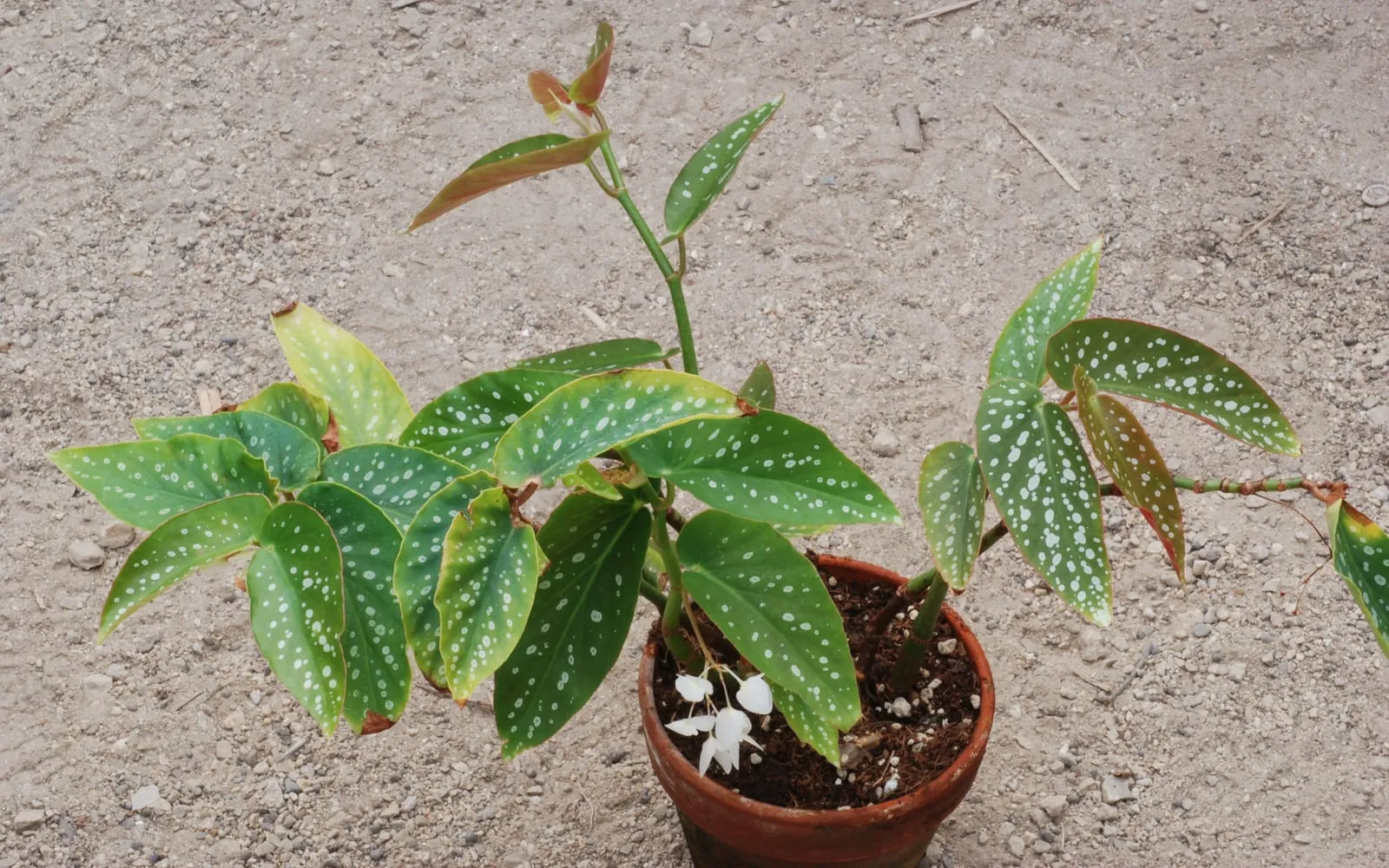
At a glance
- Difficulty
- Moderate
- Water
- When the top 3 cm of compost has dried
- Light
- Bright indirect light, and never direct midday sun
- Temperature
- 18-24 deg C. Never below 15 deg C
- Humidity
- Moderate to high, and dry air browns the leaf edges
- Hardiness
- USDA 10-12, RHS H1b, hardy to 13 C
- Type
- Evergreen cane-forming perennial, moderately long-lived
- Height
- 60-120 cm indoors
- Native to
- The Atlantic forest of south-eastern Brazil
- Best month
- November in the Northern Hemisphere, May in the Southern Hemisphere
A small stretch of Atlantic forest in south-east Brazil. It wants humidity and bright indirect light, and the silver spots fade in shade. Outdoors year round only in USDA 10 and warmer.
Hardiness zones describe winter cold alone. Summer heat, humidity, rainfall and the length of the growing season decide as much, so treat the range as the outer limit rather than as a recommendation.
Every month named in this guide is for the temperate Northern Hemisphere. If you garden in the Southern Hemisphere, shift each one by six months, so November becomes May. Closer to the equator the wet and dry seasons matter more than the calendar, and the shift stops being a useful guide.
Toxic to pets if eaten
- Do not eat
- Every part, and the underground tubers and roots most of all
- Harm from
- Eating it
- Affects
- Cats, dogs and horses
Begonias are toxic to pets and only mildly so to people. The ASPCA lists Begonia as toxic to cats, dogs and horses, and it is one of the more commonly reported houseplants to animal poison lines simply because it is so widely owned. The active compounds are soluble calcium oxalates, which cause immediate burning of the mouth, drooling, vomiting and difficulty swallowing. The concentration is highest in the roots and tubers rather than in the leaves, so a dog that digs into the pot is at more risk than a cat that chews a leaf. Effects are usually limited to a very unpleasant hour or two and serious cases are uncommon. For people the risk is lower still. Some begonia species are eaten as a sour vegetable in parts of south-east Asia and Brazil, and Begonia maculata is not among them, so there is no reason to try. The sap causes mild skin irritation in sensitive people, so wash your hands after taking cuttings. Keep the plant out of reach of a cat that chews, and stand it where a dog cannot dig in the compost.
Sources: ASPCA (Begonia), RHS potentially harmful garden plants
About
The spots are real, they are not variegation, and they have a job. Each silver dot sits over a pocket of air beneath the leaf surface that scatters light back into the photosynthetic tissue, which is a useful adaptation on a forest floor where very little light gets through.
The plant they belong to is a cane begonia, meaning it grows upward on jointed bamboo-like stems rather than as a rosette. That habit is what makes it dramatic and what makes it go leggy, since a cane keeps extending from the tip and drops its lower leaves as it goes.
Pruning is therefore not optional maintenance but the thing that keeps the plant looking like the photograph that made you buy it. Cut it back in spring, root the pieces, and put them in the same pot.
Appearance and character
An evergreen perennial forming upright jointed canes, 60 cm to 1.2 m indoors.
Canes are green to reddish, smooth and swollen at the nodes, resembling bamboo.
Leaves are the plant’s signature. Asymmetric and wing-shaped, 10 to 20 cm long, with one side of the leaf much larger than the other, so the pair look like a bird’s wings.
The upper surface is olive to deep green, scattered with rounded silver-white spots. The underside is a deep oxblood red, which is as good as the top.
Flowers appear in clusters on arching stems, small, waxy and white to pale pink with a yellow centre. A well-grown plant flowers freely from spring into autumn.
Begonias are monoecious, so male and female flowers appear in the same cluster. The female ones carry a small winged ovary behind the petals.
Growth is fast in summer and stops entirely in winter.
‘Wightii’ is the widely sold form with the boldest spots and it is what most plants labelled Begonia maculata turn out to be.
Where it is from
The Atlantic forest of south-eastern Brazil, where it grows on the shaded forest floor and on rocky slopes in warm, humid, frost-free conditions.
The Atlantic forest is one of the most threatened habitats on earth, reduced to a small fraction of its original extent, and the species has a restricted natural range while being propagated in enormous numbers in cultivation.
Its forest floor origin explains the light requirement. Bright indirect light reproduces the dappled shade under a canopy, and direct sun scorches leaves adapted to catch scattered light.
The spots are an adaptation to that low light rather than a decorative accident, and they fade in a plant grown too dark, which is the opposite of what people expect.
Constant warmth and humidity explain the intolerance of cold draughts and dry centrally heated air.
The plant reached wide popularity through social media in the late 2010s, having been an obscure specialist’s plant for decades.
How it grows
Position it in bright indirect light. An east or north-facing window is ideal. Direct midday sun scorches the leaves and too little light fades the spots.
Keep it warm, 18 to 24 deg C, and never below 15 deg C.
Water when the top 3 cm of compost has dried, watering at the base rather than over the plant. Water sitting on the crown or in the leaf joints rots the canes.
Use free-draining peat-free compost with a third added perlite. Begonias have fine roots and rot in dense wet compost.
Raise the humidity moderately with a pebble tray or by grouping plants, and keep the air moving. Begonias want humidity and hate still stagnant air, which is an awkward combination and the reason mildew is such a common problem.
Feed fortnightly from April to September at half strength.
Prune in spring. Cut each cane back to just above a node, taking off a third to a half of the plant. It looks drastic and it forces branching from the nodes below, which is the only way to keep the plant bushy.
Pinch the growing tips through the summer to encourage further branching.
Root the prunings. Cane cuttings with two or three nodes root readily in water or in damp compost, and pushing several back into the parent pot fills it out.
Repot every year or two in spring, into a pot only slightly larger. Begonias flower better slightly pot-bound.
Stake tall canes, which become top-heavy and snap at a node.
Through the seasons
Winter is rest. Growth stops, the plant may drop some leaves, and the risk of rot is highest. Water sparingly, stop feeding, and keep it away from cold glass.
Spring is the pruning and the restart. Cut the canes back hard, repot, take cuttings, and resume feeding as growth begins.
Summer is fast growth and flowering. Water when the surface dries, feed fortnightly, pinch the tips, and watch for mildew in humid spells.
Autumn is the wind-down. Reduce watering and feeding from October, and move it away from windows that get cold at night.
Care difficulty
Moderate. The plant grows quickly and forgives a good deal, and it has two persistent problems.
Legginess is inevitable without pruning. A cane begonia extends from the tip and sheds its lower leaves, so an unpruned plant becomes bare stems with a tuft on top within two years.
Powdery mildew affects begonias more than most houseplants, and the humidity they want is exactly what encourages it. Airflow is the resolution.
Rot from water on the crown is the third, and watering at the base prevents it.
Once those three habits are established the plant is straightforward and rewarding.
Watering
Water when the top 3 cm of compost has dried, which in summer usually means every five to seven days.
Water at the base of the plant, never over the leaves or into the crown. Standing water in the leaf joints rots the canes.
Water thoroughly and drain completely, and never leave the pot in a saucer.
Reduce watering considerably from November, perhaps to every two or three weeks.
Use tepid water, and filtered water or rainwater where the tap water is very hard.
Wilting with dry compost means thirst. Wilting with wet compost means rot and is far more serious.
Warning signs, diseases and pests
Bare leggy canes with leaves only at the top is the normal habit of the plant rather than a fault, and pruning is the answer. Cut the canes back by a third to a half in spring, just above a node, and root the pieces.
Powdery mildew appears as a white dusting on the leaves and spreads quickly. Begonias are notably susceptible. Improve air movement, avoid wetting the foliage, space plants apart, remove affected leaves, and reduce the humidity a little if it recurs.
Brown crispy leaf edges mean the air is too dry or the compost has dried out.
Yellowing lower leaves in quantity mean overwatering. Yellowing of the oldest leaf occasionally is normal.
Leaf drop after moving the plant, or after a cold draught, is a stress response. Settle it in one position and keep it away from doors and cold glass.
Faded or absent spots mean too little light. Move it somewhere brighter without putting it in direct sun.
Soft blackened canes at the base are stem rot, usually from water sitting on the crown. Take healthy cuttings from the top and start again.
Botrytis produces grey fuzzy patches on leaves and flowers in cool damp conditions.
Growing environment
Bright indirect light. An east-facing window suits it, and a north-facing one works with slightly less vigour.
Never direct midday sun, which scorches and bleaches the leaves.
Warmth of 18 to 24 deg C, and never below 15 deg C.
Moderate to high humidity combined with good air movement, which is the awkward part. A pebble tray plus a room that is not stuffy is about right.
Free-draining peat-free compost with added perlite, in a pot with drainage holes only slightly larger than the rootball.
Away from radiators, draughts, external doors and cold glass.
Give it room to be seen from the side, since the red leaf undersides are half the plant’s appeal and are lost when it stands against a wall.
Out of reach of a cat that chews foliage.
Feeding
Feed fortnightly from April to September with a balanced liquid houseplant fertiliser at half strength.
Stop feeding from October to March.
Switch to a slightly higher potassium feed while the plant is flowering if you want more blooms.
Repot annually or every second year in spring, which matters more than feeding for a fast-growing plant.
Flush the compost occasionally with plain water to clear accumulated salts.
Troubleshooting
It has gone leggy with bare stems. Normal for a cane begonia. Cut the canes back by a third to a half in spring, just above a node, and root the cuttings back into the same pot.
White dusty coating on the leaves. Powdery mildew, to which begonias are very prone. Improve air movement, keep water off the foliage, and remove affected leaves.
The spots have faded. Too little light. The silver spots are a low-light adaptation and they develop best in bright indirect light. Move it brighter, avoiding direct sun.
The canes went soft and black at the base. Stem rot from water sitting on the crown. Water at the base only. Take cuttings from healthy top growth and start again.
Why are the leaves lopsided? All begonias have asymmetric leaves, with one half larger than the other. It is a family characteristic, not a defect.
It dropped its leaves after I moved it. Begonias react to changes in position and temperature. Settle it somewhere warm and draught-free and leave it there.
How do I take cuttings? Cut a cane section with two or three nodes and root it in water or damp compost. They root readily, and pushing several back into the parent pot makes a fuller plant.
Is it safe with pets? No. Begonias are toxic to cats, dogs and horses, particularly the roots and tubers. Keep it out of reach and stop a dog digging in the pot.
Polka dot begonia problem guides
Not sure what is wrong? See the common houseplant pests guide.