
Outdoor plant
Ivy-leaved cyclamen
Cyclamen hederifolium
Also known as Hardy cyclamen, Sowbread, Autumn cyclamen
How to grow hardy cyclamen, Cyclamen hederifolium. Flowers before the leaves in September, the dry shade it thrives in, and buying tubers the right way up.
At a glance
- Difficulty
- Easy
- Water
- Rarely, and never during summer dormancy
- Light
- Partial to full shade, and it takes dry shade under trees
- Temperature
- Fully hardy, to about -15 deg C
- Hardiness
- USDA 5-9, RHS H5, hardy to -15 C
- Type
- Tuberous perennial, extremely long lived and dormant in summer
- Height
- 10-15 cm
- Native to
- Southern Europe and Turkey, from southern France to the Aegean
- Best month
- September in the Northern Hemisphere, March in the Southern Hemisphere
A dry summer rest is what it wants, which is why it thrives in the dust at the foot of a hedge or under a tree where nothing else will grow. Cyclamen hederifolium flowers in autumn before the leaves and Cyclamen coum flowers in late winter with them, so between them they cover both ends of the year. Both are far hardier than the florist cyclamen sold as a houseplant.
Hardiness zones describe winter cold alone. Summer heat, humidity, rainfall and the length of the growing season decide as much, so treat the range as the outer limit rather than as a recommendation.
Every month named in this guide is for the temperate Northern Hemisphere. If you garden in the Southern Hemisphere, shift each one by six months, so September becomes March. Closer to the equator the wet and dry seasons matter more than the calendar, and the shift stops being a useful guide.
Toxic if eaten
- Do not eat
- The tuber above all, and the whole plant to a lesser degree
- Harm from
- Eating it and handling it
- Affects
- People, cats and dogs
Cyclamen contains triterpenoid saponins, principally cyclamin, concentrated in the tuber. Eating it causes salivation, vomiting, abdominal pain and diarrhoea, and in larger quantities heart rhythm disturbance and seizures. The ASPCA lists Cyclamen as toxic to cats and dogs, and the risk is a dog digging up and chewing a tuber, which is where the dose is. The RHS lists it as harmful if eaten and as a skin irritant. Handling the tubers causes contact dermatitis in some people, so wear gloves when planting them. The old name sowbread records a belief that pigs ate the tubers without harm, which is a poor guide for other animals. Saponins from cyclamen tubers have historically been used to stupefy fish for catching, which is a fair indication of their strength. For a person, eating a piece of tuber causes an unpleasant stomach upset rather than anything worse, and a child who has eaten one is worth a call to a doctor. The leaves and flowers are far less concentrated than the tuber.
Sources: RHS potentially harmful garden plants, ASPCA toxic and non-toxic plants
About
Cyclamen hederifolium is the best plant available for dry shade under a tree, which is the position most gardeners have and nothing wants.
It flowers in September and October, before the leaves appear, in small pink or white shuttlecocks held just above bare ground. The leaves follow in October and stay all winter, marbled silver and green in patterns that vary from plant to plant, and they cover the ground until they die back in May.
Then it disappears entirely for the summer, which is the point. A cyclamen colony occupies ground from September to May, exactly when nothing else is growing under a deciduous tree, and it is dormant when the tree is taking all the water.
The tubers get bigger every year rather than dividing, reaching the size of a dinner plate on a plant of fifty years, and a colony seeds itself and spreads until it covers whatever ground it is given.
It is the hardiest and easiest of the genus. The florist’s cyclamen sold as a Christmas houseplant is Cyclamen persicum, a tender species from the eastern Mediterranean, and the two are not interchangeable.
Buying dry tubers is a gamble in the same way as winter aconite, and pot-grown plants in leaf establish far more reliably.
Appearance and character
A tuberous perennial reaching 10 to 15 cm, in leaf from October to May and fully dormant through the summer.
The tuber is a flattened disc, growing wider every year, reaching 20 cm or more on an old plant. Roots and shoots emerge from the upper surface and the shoulders rather than from the base, which matters when planting.
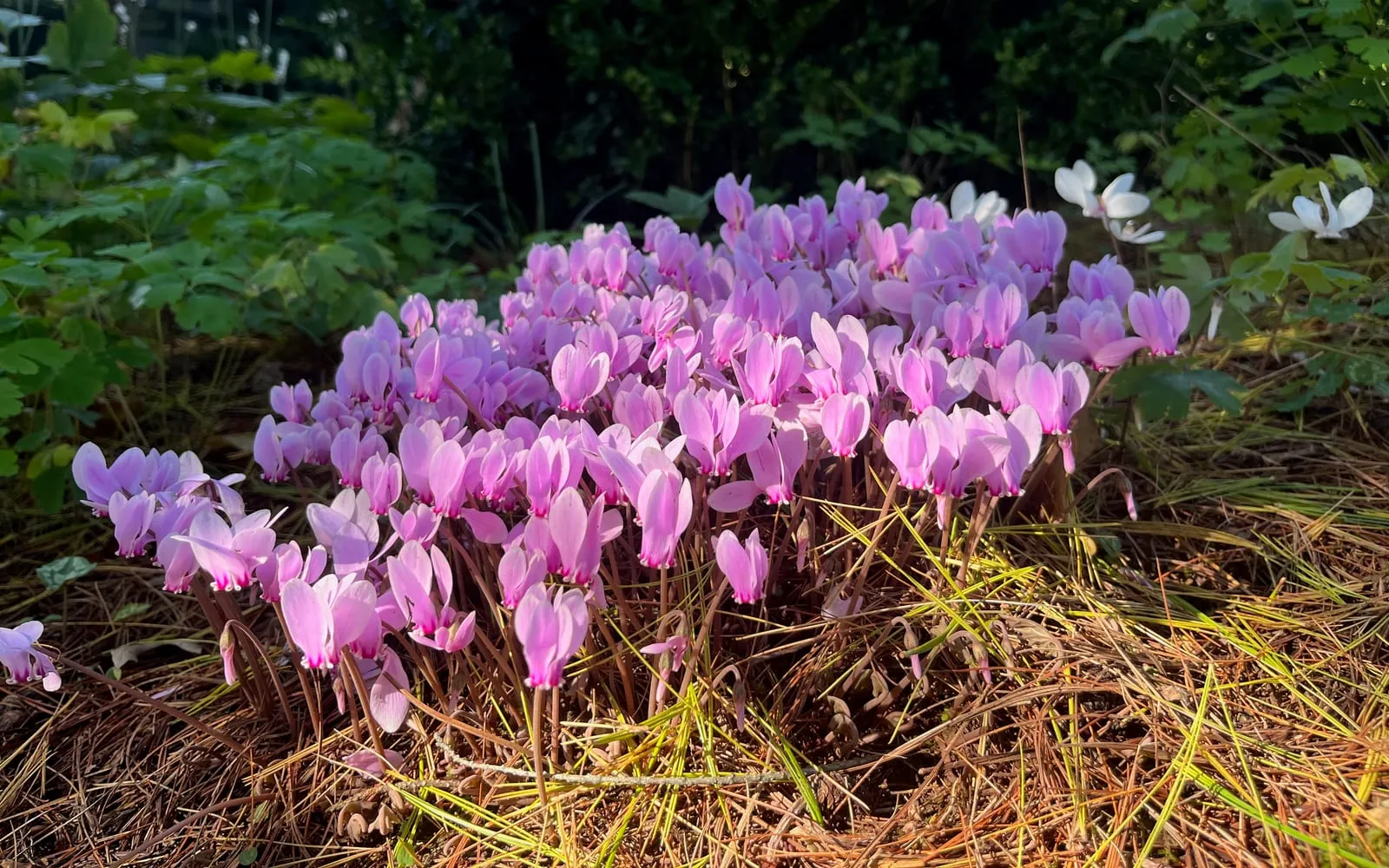
Flowers open from late August through October, before the leaves, on short stems 10 to 15 cm tall. Each is 2 cm across with five swept-back petals, in pale to deep pink or white, with a darker magenta blotch at the mouth.
The petals are reflexed straight back, which gives the shuttlecock shape, and many are lightly scented.
After flowering the stem coils into a tight spiral, drawing the seed capsule down to ground level, which is one of the more elegant seed dispersal arrangements in cultivation.
Leaves follow the flowers in October, heart-shaped to ivy-shaped, 5 to 12 cm across, dark green marbled and patterned with silver and grey in patterns that differ on every plant.
Some selections are almost entirely silver, and leaf form is as much a reason to grow it as the flowers.
Foliage dies back in May and the plant vanishes completely for the summer.
Where it is from
Southern Europe and Turkey, from southern France and Italy through the Balkans and Greece to the Aegean islands and western Turkey.
It grows in woodland, on shaded rocky slopes, among tree roots and on limestone, in a climate with hot dry summers and mild wet winters.
That cycle explains everything about it. The plant grows through the wet winter, flowers at the start of it, and rests through the summer drought, which is why it thrives in dry shade and why it must not be watered when dormant.
It reached Britain by the sixteenth century and has naturalised in a number of places, particularly in woodland around old gardens.
Ants disperse the seed. Each seed carries a sticky sugary coating that ants collect and carry back to the nest, eating the coating and discarding the seed, which is how a colony spreads outwards.
Sowbread is the old English name and records a belief that pigs rooted for and ate the tubers.
Cyclamen coum is the winter-flowering species, with rounded leaves and flowers in January and February, and growing both gives cyclamen in the garden from September to March.
How it grows
Buy pot-grown plants in leaf in autumn if you can, which establish far more reliably than dry tubers.
Plant dry tubers in late summer, and make sure you plant them the right way up. The upper surface is the one with the growing points and the remains of old flower stems, and it is usually the more knobbly and dished side. The lower surface is smoother and rounded. Planting one upside down is easy and it rarely recovers.
Set the tuber with the top just below the soil surface, about 3 to 5 cm deep, which is shallower than most tubers.
Choose partial or full shade, and dry shade suits it. Under a deciduous tree, at the base of a hedge, beneath shrubs and in a shady bank all work.
Free-draining humus-rich soil is what it wants, and it tolerates chalk readily.
Avoid heavy wet ground and anywhere that stays waterlogged in winter.
Mulch with leaf mould in late summer, before the flowers appear, keeping it thin over the tubers.
Do not water it in summer. The tuber is dormant and wet soil rots it.
Leave the seed heads. The coiled stems deposit the capsules at ground level, ants carry the seed away, and a colony spreads on its own over five or six years.
Leave the foliage to die back naturally in May.
Do not dig or fork the ground around a colony, since the tubers sit shallow.
Divide nothing. Cyclamen tubers do not divide and grow larger each year instead. Propagate from seed sown fresh in late summer.
Grow it in a container or a trough in a shady spot if you have no suitable ground, using a gritty loam-based compost.
Wear gloves when handling the tubers.
Through the seasons
Winter shows the marbled foliage covering the ground, at its best from December to March.
Spring carries the leaves on until they yellow and die back in May.
Summer is fully dormant, and the ground is bare. This is when not to water it and when to plant new tubers in late summer.
Autumn is the flowering season, from late August through October, with the leaves following on.
Care difficulty
Easy once it is in, and the two ways to get it wrong are both at planting.
Planting the tuber upside down is a common and unrecoverable error, and buying pot-grown plants in leaf avoids it entirely.
Watering it through the summer dormancy is the other, and it rots the tuber.
Beyond that it is close to permanent. It needs no feeding, no watering, no division and no attention, it tolerates dry shade and chalk, and a colony lasts for decades and spreads on its own.
Watering
Water a newly planted tuber lightly in autumn to settle it, and after that leave it alone.
Established cyclamen needs no watering in a temperate climate.
Never water it during the summer dormancy. The tuber is resting in soil that should be dry, and watering rots it.
Water a container-grown plant sparingly in autumn and winter and keep it dry through the summer.
Mulch with leaf mould in late summer, which is all the moisture management it needs.
Warning signs, diseases and pests
A tuber planted in autumn that never appears is usually planted upside down, or it was dried out before sale. Buy pot-grown plants in leaf instead.
A tuber going soft and rotting is almost always summer watering or waterlogged ground.
Notched leaf edges with plants that come away easily is vine weevil, whose larvae eat the tubers. It is a particular problem in containers. Use a biological nematode drench in late summer.
Tubers dug up and gnawed is mice, voles or squirrels. Lay wire netting over a new planting until it establishes.
Grey mould on the leaves in a wet winter is botrytis. Remove affected foliage and improve air movement.
Leaves yellowing in May is normal die-back rather than a problem.
No spread after several years usually means the seed heads are being tidied away. Leave them and let the ants do the work.
Flowers but very few leaves suggests a tuber planted too deep.
Growing environment
Partial to full shade, including dry shade under deciduous trees, which is the position it is best in and where little else will grow.
Free-draining, humus-rich soil. It grows well on chalk and dislikes heavy wet ground.
Fully hardy to about -15 deg C.
Allow 15 to 20 cm between tubers and plant in drifts, since a colony is the point.
It suits the base of a deciduous tree, a shady bank, a hedge bottom, a woodland garden, under shrubs, a north-facing bed or a shady trough.
Grow it with the plants that share the conditions. Snowdrops, winter aconite, hellebore, epimedium, hardy fern and Euphorbia amygdaloides var. robbiae all work in dry shade, and cyclamen provides the ground cover between them.
Grow Cyclamen coum alongside it, which flowers in January and February, so the two between them cover September to March.
Keep it out of reach where a dog digs, since the tuber is the toxic part.
Its wildlife value is real if modest. Late bees work the autumn flowers, and ants disperse the seed.
Feeding
None needed.
Mulch with leaf mould in late summer, kept thin over the tubers, which is all it wants.
Avoid fertiliser and avoid rich manure, neither of which suits a dry-shade woodland tuber.
Avoid a heavy mulch that buries the tubers, since they sit shallow and the growing points are on the upper surface.
A colony that fails to thrive has a drainage or a planting-depth problem rather than a nutrient one.
Troubleshooting
Which way up does the tuber go? Growing points up. The upper surface is the more knobbly and dished side, often with the remains of old flower stems on it, and the lower surface is smoother and rounded. Planting it upside down rarely recovers, so buy pot-grown plants in leaf if you are unsure.
How deep do I plant it? Shallow, with the top of the tuber just below the surface, about 3 to 5 cm down.
Should I water it in summer? No. The tuber is dormant and summer watering rots it. This is the commonest way a healthy plant is killed.
Will it grow in dry shade under a tree? Yes, and that is where it is best. It grows through the winter when the tree is bare and rests in summer when the tree takes the water.
Will it grow on chalk? Yes, readily. It grows on limestone in the wild.
It has not spread. The seed heads are probably being tidied away. Leave the coiled stems and their capsules, and ants carry the seed away and start new plants. A colony takes five or six years to build.
Is this the same as the cyclamen sold at Christmas? No. That is Cyclamen persicum, a tender species grown as a houseplant. Cyclamen hederifolium is fully hardy and belongs outdoors.
When do I divide it? Never. Cyclamen tubers do not divide and get larger every year. Grow more from fresh seed sown in late summer.
Is it poisonous to dogs? The ASPCA lists Cyclamen as toxic to cats and dogs, and the tuber carries the most saponin. A dog that digs one up and chews it needs a vet.