
Outdoor plant
Japanese box
Buxus microphylla
Also known as Littleleaf box, Small-leaved boxwood
How to grow Buxus microphylla. The blight-resistant box, clipping without spreading disease, spotting box tree caterpillar, and the alternatives worth considering.
At a glance
- Difficulty
- Easy
- Water
- Rarely once established
- Light
- Full sun to partial shade
- Temperature
- Very hardy, to -20 deg C
- Hardiness
- USDA 5-9, RHS H6, hardy to -20 C
- Type
- Evergreen shrub, slow-growing and very long-lived
- Height
- 60-100 cm, and kept at 20-40 cm as edging
- Native to
- Japan and Taiwan, in cultivation for centuries
- Best month
- March in the Northern Hemisphere, September in the Southern Hemisphere
Cold is not the problem and two organisms are. Box blight, which strips the leaves and blackens the stems, spreads in warm wet weather and in overhead watering. Box tree moth, a caterpillar from east Asia, reached Europe in 2007 and North America by way of Ontario in 2018, and it is now found across the American midwest and north-east. Both are worse where summers are humid, and together they are the reason many gardeners have replaced box altogether.
Hardiness zones describe winter cold alone. Summer heat, humidity, rainfall and the length of the growing season decide as much, so treat the range as the outer limit rather than as a recommendation.
Every month named in this guide is for the temperate Northern Hemisphere. If you garden in the Southern Hemisphere, shift each one by six months, so March becomes September. Closer to the equator the wet and dry seasons matter more than the calendar, and the shift stops being a useful guide.
Toxic if eaten
- Do not eat
- Every part, and the leaves and bark most of all
- Harm from
- Eating it and handling it
- Affects
- People, cats, dogs and horses
Box is poisonous in every part. It contains a group of steroidal alkaloids, chiefly buxine, concentrated in the leaves and bark. Eating a quantity causes vomiting, severe abdominal pain, diarrhoea, dizziness and, with a large dose, convulsions and respiratory failure. The RHS lists Buxus among plants that are harmful if eaten and that may irritate the skin. Human poisonings are rare because the leaves are intensely bitter and nobody eats them twice. Livestock are the real concern. Horses, cattle and sheep have been killed by eating box hedge clippings thrown into a field or by browsing a hedge when other grazing is short, and the lethal dose for a horse is around 750 g of leaves. Never dispose of box prunings anywhere an animal can reach them. Dogs and cats are unlikely to eat enough to be seriously harmed and will vomit if they try. The sap causes contact dermatitis in some people, so gloves are sensible when clipping a large amount, particularly since the dust from clipping also irritates the airways.
Sources: RHS potentially harmful garden plants, ASPCA toxic and non-toxic plants
About
Box has had a difficult twenty years. Box blight was identified in Britain in the 1990s and box tree caterpillar reached Europe in 2007, and between them they have destroyed parterres, knot gardens and thousands of metres of edging. The moth turned up in Ontario in 2018 and is now across the American midwest and north-east.
Japanese box is the reason the plant is still worth considering. Buxus microphylla is markedly more resistant to blight than the common box, Buxus sempervirens, that most old plantings used, and varieties such as ‘Faulkner’ and ‘Rococo’ hold up where common box fails.
It is not immune, and no box is immune to the caterpillar, which will eat any Buxus it finds. What Japanese box offers is a better chance, on a plant that clips as crisply and grows as slowly as the box everyone wants.
Appearance and character
A dense evergreen shrub, slow-growing, reaching 60 cm to 1 m over many years and usually clipped far lower.
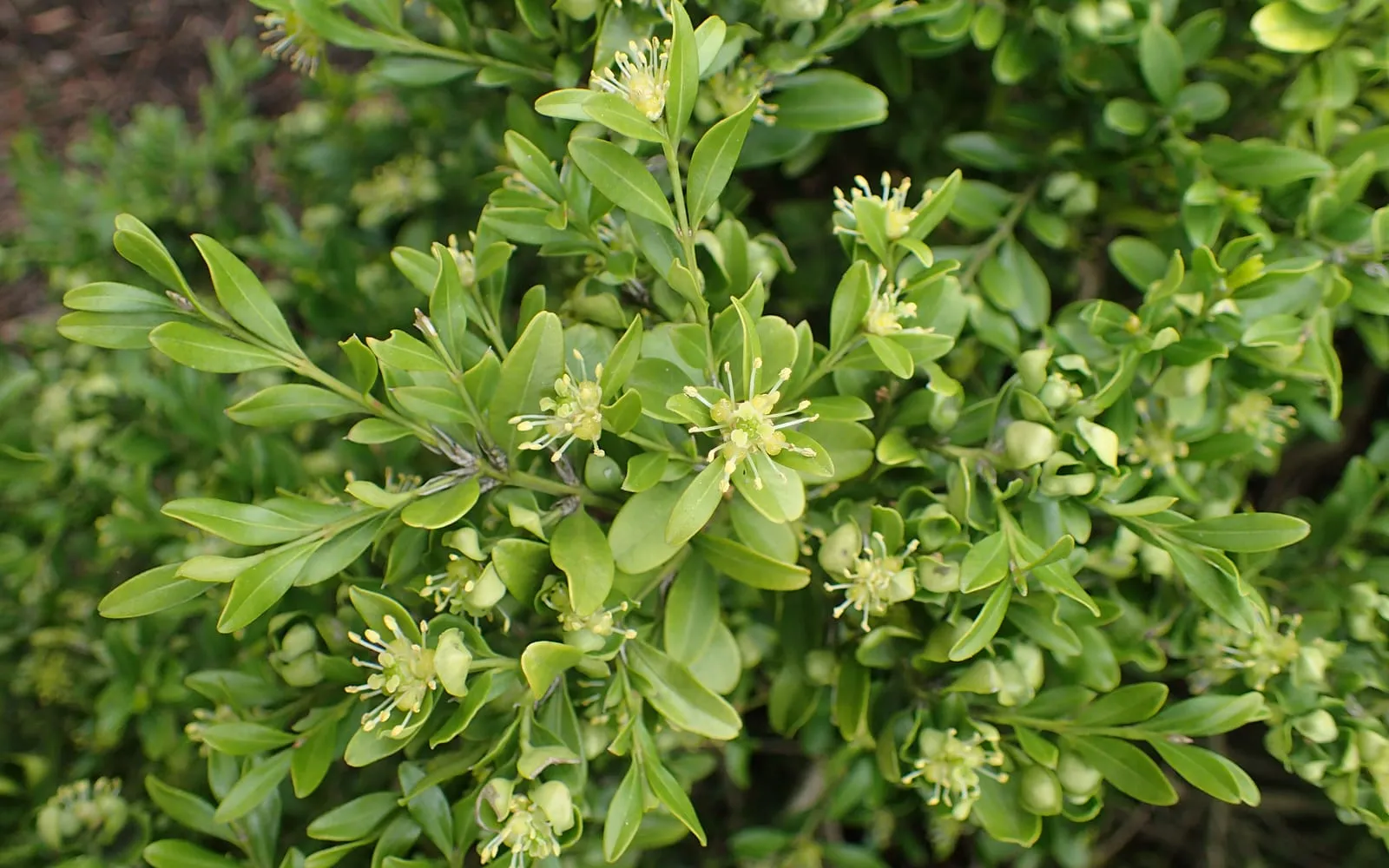
Leaves are small, 1 to 2.5 cm long, oval to oblong with a notched or rounded tip, glossy mid to dark green above and paler beneath, carried in opposite pairs.
The leaves of Japanese box are typically slightly broader, blunter and a brighter green than those of common box, which are narrower and darker.
Growth is very slow, perhaps 5 to 10 cm a year, which is what makes box hold a clipped shape so precisely and why mature topiary costs what it does.
Flowers open in March and April in small clusters in the leaf axils, pale yellow-green, without petals and easy to miss. They are honey-scented and bees work them hard.
Stems are square-ish in section on young growth and the wood is famously dense and fine-grained, historically used for rulers, chess pieces and engraving blocks.
Varieties matter here. ‘Faulkner’ is the standard blight-resistant choice with glossy rounded leaves, ‘Rococo’ is compact and upright, and var. japonica is bright green and vigorous.
Where it is from
Japan and Taiwan, where it grows on rocky slopes and in scrub, and where it has been cultivated and clipped for centuries.
The species has been used for Japanese garden topiary and for bonsai for a very long time, and its tolerance of hard repeated clipping was selected for over generations.
Common box, Buxus sempervirens, is the European species, native to a few chalk sites in southern England including Box Hill in Surrey, and it is the plant of British and French formal gardens.
Box blight is caused by two fungi, Calonectria pseudonaviculata and Calonectria henricotiae. Both need warm humid conditions and free water on the leaf, which is why cool summers suit them so well.
Box tree caterpillar is the larva of a moth from east Asia that arrived in Europe in the mid 2000s and reached temperate gardens by 2011. It has no effective natural enemies here.
Resistance in Japanese box is partial and relative. It reflects a thinner leaf cuticle wax profile and faster drying rather than any immunity.
How it grows
Plant in autumn or spring into free-draining soil, neutral to alkaline. Box grows notably well on chalk.
Space plants 20 to 25 cm apart for edging, and 30 to 40 cm for a low hedge.
Clip once or twice a year. Once in late May or early June after the first flush, and again in late summer if a very crisp finish is wanted.
Clip in dry, dull, still weather. Never in hot sun, which scorches the cut foliage, and never in humid or wet conditions, which is precisely when blight spores spread.
Disinfect shears and secateurs between plants and between jobs. This is the single best way to slow blight.
Clear every clipping from inside and beneath the plant. Fallen debris holds spores and rots against the stems.
Stop clipping by the end of August.
Feed and mulch in spring. A well-fed unstressed plant resists blight considerably better than a starved one.
Water in drought, at the base rather than over the foliage.
Renovate an overgrown plant by cutting hard back in spring. Box reshoots reliably from old wood, which most evergreens will not.
Through the seasons
Winter is quiet. Bronzing of the foliage in cold weather is normal on some plants and greens up in spring.
Spring brings the flowers in March and the main flush of growth. Feed and mulch, and watch for the first generation of box tree caterpillar from April.
Summer is clipping and vigilance. Trim in late May or June in dry still weather, and check for caterpillar webbing and blight patches through the season.
Autumn is tidying. Stop clipping by the end of August, clear all fallen debris, and plant new stock.
Care difficulty
Easy to grow and demanding to keep healthy, which is the reverse of how box used to be.
Box blight is the main threat. Choosing a resistant variety, clipping in dry weather, disinfecting tools, clearing debris and keeping the plant well fed all help, and nothing guarantees escape.
Box tree caterpillar is the other, and it moves fast. A plant can go from healthy to skeletal in under a week.
The plant itself is hardy, long-lived, shade-tolerant and takes hard renovation.
Anyone unwilling to inspect regularly should consider an alternative.
Watering
Water new plantings through their first two summers.
Established box needs water only in a prolonged drought, and it is more drought-tolerant than it looks.
Water at the base and never over the foliage. Wet leaves are what blight needs.
Avoid waterlogged ground, which rots the roots.
Container-grown box needs regular watering and free-draining compost, and it should never stand in a saucer.
Warning signs, diseases and pests
Box blight shows as bare brown patches appearing in an otherwise healthy plant, with dark brown or black streaks running down the stems and rapid leaf fall. In humid weather white spore masses appear on the undersides of infected leaves. Cut out affected growth well beyond the visible damage, clear every fallen leaf, disinfect tools, improve airflow by thinning, and stop overhead watering. Badly affected plants are often best removed, and the soil holds spores for years, so replanting box in the same spot is unwise.
Box tree caterpillar is unmistakable once you look. Greenish caterpillars with black heads and black and white stripes, living inside webbing spun through the foliage, along with green frass. They defoliate a plant within days and there are two or three generations a year from April to October. Check inside the plant fortnightly through the season, pick them off by hand on small plants, and use pheromone traps to know when the moths are flying.
Box sucker distorts and cups the shoot tips in spring, producing something that looks like a small cabbage. It is disfiguring and harmless.
Bronzing of the foliage in winter is normal on some varieties and on plants in full exposure, and it greens up in spring.
Yellowing overall usually means waterlogging or a starved plant.
Orange-brown scorch after clipping means it was cut in hot sun.
Growing environment
Full sun to partial shade. Box grows in more shade than almost any other formal hedging plant.
Free-draining soil, neutral to alkaline. It grows particularly well on chalk.
Good airflow matters more than it used to. Avoid enclosed still corners, and resist planting edging too tightly.
Avoid waterlogged ground.
Traditional positions are edging to a border, a low hedge along a path, knot gardens, and clipped balls or cones in pots.
Think about the alternatives before committing to a large planting. Ilex crenata, the Japanese holly, looks remarkably like box, clips the same way and gets neither blight nor the caterpillar. Euonymus ‘Jean Hugues’ and Podocarpus ‘Chocolate Box’ are also used.
Keep box away from paddocks and from anywhere clippings might be dumped over a fence.
Feeding
Feed once in spring with a balanced fertiliser. A well-fed plant resists blight better.
Mulch with compost in spring, keeping it clear of the stems.
A seaweed feed applied as a foliar spray is widely used to help a stressed or recovering plant.
Avoid heavy nitrogen, which produces soft growth that blight infects readily.
Feed container-grown box with a slow-release fertiliser in spring and repot every two or three years.
Troubleshooting
Bare brown patches with black streaks on the stems. Box blight. Cut out affected growth well beyond the damage, clear every fallen leaf, disinfect tools, and improve airflow. Do not replant box in the same soil.
Webbing in the foliage with green caterpillars. Box tree caterpillar. Check inside the plant fortnightly from April to October and pick them off. They defoliate a plant in days.
Is Japanese box more resistant? More resistant, not immune. Buxus microphylla, particularly ‘Faulkner’, holds up better against blight than common box, and no box resists the caterpillar.
When should I clip it? Late May or early June, in dry, still, dull weather. Never in hot sun or humid conditions, and stop by the end of August.
The foliage went bronze over winter. Normal on some varieties and in exposed positions. It greens up in spring.
Can I cut an overgrown plant hard back? Yes. Box reshoots reliably from old wood, which is unusual among evergreens. Cut in spring and feed.
What can I plant instead? Ilex crenata is the closest match and suffers neither problem. Euonymus and dwarf Podocarpus are also used.
Are the clippings dangerous? To livestock, seriously. Box contains alkaloids that have killed horses and cattle that ate hedge clippings. Never dump them where an animal can reach them.