
Outdoor plant
Coral bells
Heuchera americana
Also known as Alum root, American alumroot
How to grow heuchera, Heuchera americana. Coloured foliage for shade all year, why the crown lifts out of the ground, and dealing with vine weevil.
At a glance
- Difficulty
- Easy
- Water
- In dry spells, and regularly in containers
- Light
- Partial shade, and dark-leaved cultivars take more sun than pale ones
- Temperature
- Fully hardy, and the foliage bronzes in a cold winter
- Hardiness
- USDA 4-9, RHS H7, hardy to -30 C
- Type
- Evergreen perennial, moderately long lived and lifting out of the soil with age
- Height
- 30-60 cm in flower, with foliage at 20-30 cm
- Native to
- Eastern North America, from Ontario south to Louisiana
- Best month
- October in the Northern Hemisphere, April in the Southern Hemisphere
It is native across North America and is hardy well beyond any winter a garden will produce. Vine weevil is what kills it, since the grubs eat the roots through winter and the first sign is a plant that lifts out of the ground in spring. The crown also works itself upwards out of the soil over a few years, so lift and replant deeper every third spring.
Hardiness zones describe winter cold alone. Summer heat, humidity, rainfall and the length of the growing season decide as much, so treat the range as the outer limit rather than as a recommendation.
Every month named in this guide is for the temperate Northern Hemisphere. If you garden in the Southern Hemisphere, shift each one by six months, so October becomes April. Closer to the equator the wet and dry seasons matter more than the calendar, and the shift stops being a useful guide.
Not known to be toxic
Heuchera is not listed by the RHS as a potentially harmful garden plant and is not recorded by the ASPCA as toxic to cats, dogs or horses. No part of it is a recognised poisoning hazard and it is a sound choice for a garden used by children and pets. The common name alum root comes from the astringency of the root, which is rich in tannins and was used by several North American peoples as a wound astringent and for treating diarrhoea. That astringency makes the root unpleasant rather than dangerous. Where a plant is unlisted by both sources rather than positively assessed, the correct reading is that no hazard has been recorded rather than that one has been ruled out, so there is no reason to encourage anybody to eat it. Handling the plant causes no irritation and it can be planted freely along paths and at the front of beds where children play.
Sources: RHS potentially harmful garden plants, ASPCA toxic and non-toxic plants
About
Heuchera is grown for the leaves, and the flowers are a bonus that most cultivars barely bother with.
Breeding over the last thirty years has produced foliage in lime green, amber, orange, caramel, peach, deep purple, near-black, silver and marbled combinations of several at once. The leaves are evergreen through a mild winter, they sit at the front of a border, and they hold colour in shade where variegated shrubs go green.
That makes it one of the most useful plants available for a shady bed, a north-facing border or a container that has to look furnished in February.
Two things go wrong. Vine weevil larvae eat the roots and are the commonest cause of a heuchera dying suddenly, especially in pots. The crown gradually rises out of the soil as the plant ages, leaving a bare woody stem with a tuft on top, and the plant then rocks loose and dries out.
Both are manageable. Nematodes deal with the weevil, and lifting and replanting deeper every three years deals with the crown.
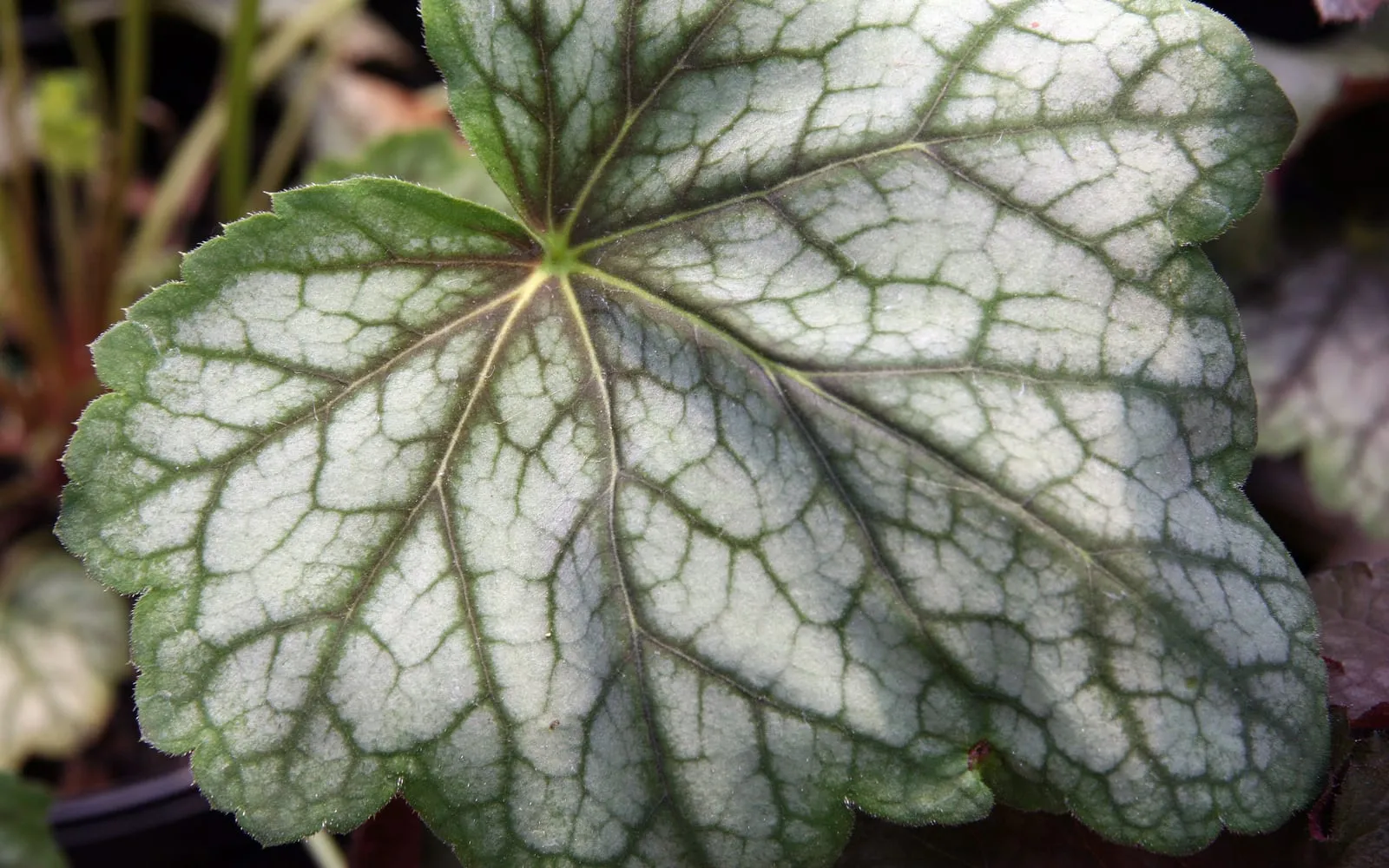
Heuchera americana is one of the main species behind the modern hybrids, contributing the marbled and silver-veined leaves.
Appearance and character
An evergreen perennial with foliage at 20 to 30 cm and flower stems reaching 30 to 60 cm.
Leaves are rounded to heart-shaped with shallow lobes and a scalloped edge, 5 to 12 cm across, held on long stalks from a central crown.
Leaf colour is the point. Modern cultivars run through lime, chartreuse, amber, caramel, orange, coral, red, deep purple, near-black, silver and pewter, often with darker veins, silver marbling or a purple reverse.
Colour changes through the year in most cultivars, with the new spring growth brightest and the winter foliage bronzing or deepening in cold.
Flowers open from May to July on thin wiry stems well above the leaves, in airy panicles of small bell-shaped florets in white, cream, pink or coral.
The flowers are small and the display is delicate rather than showy, apart from the Heuchera sanguinea types bred for red bells.
The crown is a short thick stem that lengthens as the plant ages and pushes the rosette upwards out of the soil.
Heucherella is the cross with tiarella and carries more deeply cut leaves.
Where it is from
Eastern North America, from Ontario and Vermont south to Louisiana and Texas, growing in dry to moist woodland, on rocky slopes and on bluffs.
Give it dappled woodland shade, leaf litter, free drainage and no standing water.
The genus is named after Johann Heinrich von Heucher, an eighteenth-century German botanist and physician.
Garden heucheras have been transformed since the 1980s. Modern cultivars are complex hybrids of Heuchera americana, Heuchera villosa, Heuchera micrantha and Heuchera sanguinea, bred largely in the United States for foliage colour.
Heuchera villosa contributed heat and humidity tolerance and larger leaves, and cultivars with villosa in their parentage are noticeably tougher in sun.
The root is high in tannin, which is where alum root comes from, and it was used by several North American peoples as an astringent.
Heuchera sanguinea from Arizona and New Mexico is the parent of the older red-flowered coral bells grown for their blooms rather than their leaves.
How it grows
Plant in autumn or spring into moist, humus-rich, free-draining soil.
Choose partial shade for most cultivars. Dark purple and bronze leaves take more sun than lime, amber and peach ones, which scorch.
Avoid deep shade, where the colours fade, and avoid a hot dry position in full sun.
Improve heavy soil with grit and compost. Heuchera rots in cold wet clay and drainage matters as much as moisture.
Plant with the crown at soil level and no deeper.
Mulch every spring with compost or leaf mould, keeping it clear of the crown.
Lift and replant every three years. The crown rises as the plant ages, leaving a bare woody stem. Dig it up in autumn or spring, trim the old woody base, and replant with the rosette back at soil level. This restores the plant completely.
Divide at the same time to make more plants, splitting the crown into sections each with roots and leaves.
Remove tired and marked leaves in early spring rather than cutting the whole plant down, since it is evergreen and the foliage is the point.
Deadhead the flower stems after flowering, or leave them if you like the seed heads.
Treat for vine weevil with a biological nematode drench in late August or early September, and again in spring, particularly for container plants.
Water container plants regularly and repot every two years into fresh compost.
Propagate by division in spring or autumn, which is easy and reliable.
Through the seasons
Winter is when heuchera earns its place, holding coloured evergreen foliage at the front of a bare border, often deepening in the cold.
Spring pushes the brightest new leaves in April, and this is the time to tidy old foliage, feed, mulch and divide.
Summer flowers from May to July on wiry stems, and the job is watering in dry spells.
Autumn is the best time to lift and replant crowns that have risen, and to apply nematodes against vine weevil.
Care difficulty
Easy, with two specific jobs that most people skip.
Nothing about growing it is demanding. It is hardy, evergreen, tolerant of shade, needs no staking and has no serious diseases.
Vine weevil is the real threat and it is entirely preventable with a nematode drench twice a year, which matters most in containers.
Lifting and replanting every three years is the other job, and skipping it produces the loose woody plants that people assume are dying of something.
Watering
Water in dry spells through the growing season. Heuchera tolerates short dry periods better than astilbe and dislikes prolonged drought.
Container plants need regular watering all year and must not be allowed to sit in a saucer of water.
Water at the base rather than over the foliage, which marks the leaves.
Free drainage matters as much as moisture. A heuchera in cold wet winter clay rots at the crown.
Mulch in spring to hold moisture, keeping it clear of the crown itself.
Warning signs, diseases and pests
A plant that wilts, goes limp and lifts out of the soil with almost no roots is vine weevil. The larvae are white grubs with brown heads, about 1 cm long, and they eat the roots from autumn through spring. Adults leave neat notches in the leaf edges. Apply a biological nematode drench in late summer and again in spring, and check every plant you buy.
A bare woody stem with a tuft of leaves on top is the crown rising out of the soil, which is normal ageing. Lift the plant, trim the woody base and replant with the rosette at soil level.
Bleached or scorched foliage is too much sun, particularly on lime, amber and peach cultivars. Move it into shade.
Colours fading to plain green is too much shade. Move it into dappled light.
Rot at the crown over winter is waterlogging. Add grit and improve drainage.
White powdery coating on the leaves is powdery mildew, which follows dry roots in shade. Water and mulch.
Rust-coloured pustules on the undersides of the leaves is heuchera rust, which has become more common. Remove affected leaves, improve air movement, and destroy a badly affected plant.
Ragged holes in the leaves is slug or snail damage, which is usually minor.
Growing environment
Partial shade for most cultivars. Dark-leaved forms take more sun, pale ones need more shade, and deep shade dulls every colour.
Moist, humus-rich, free-draining soil. Improve clay with grit and compost.
Fully hardy to about -30 deg C, and the evergreen foliage bronzes in a cold winter and recovers in spring.
Allow 30 to 45 cm per plant.
It suits the front of a shady border, a north-facing bed, a woodland edge, a container, a path edge or ground cover under shrubs.
Plant in groups of three or five of the same cultivar rather than one of each colour, which reads as a muddle.
Grow it with the plants that share the conditions. Hosta, fern, tiarella, brunnera, astilbe, epimedium and hellebore all work, and heuchera foliage carries the planting through winter when hosta has vanished.
Its wildlife value is modest and real. Bees work the small bells, and the evergreen rosettes give shelter to insects through winter.
Choose cultivars with Heuchera villosa in their parentage for tougher plants that take more sun and heat.
Feeding
Feed once in spring with a balanced general fertiliser as the new growth starts.
Mulch every spring with compost or leaf mould, keeping it off the crown.
Feed container plants with a liquid feed every two weeks from May to August, and repot into fresh compost every two years.
Avoid high-nitrogen feeds, which give soft growth and duller leaf colour.
A tired-looking plant is more often a risen crown or vine weevil than a nutrient shortage. Check the roots first.
Troubleshooting
It wilted and lifted straight out of the ground. Vine weevil larvae have eaten the roots. Look for white grubs with brown heads in the compost. Apply nematodes in late summer and again in spring, and treat every container plant as a precaution.
There is a bare woody stem with leaves only on top. Normal ageing. The crown rises out of the soil. Lift it, trim the woody base and replant with the rosette at soil level. Do this every three years.
The leaves have scorched and bleached. Too much sun, especially on pale cultivars. Move it into partial shade.
The colour has faded to green. Too much shade. Move it into dappled light where the pigment develops.
Should I cut it back in autumn? No. Heuchera is evergreen and the foliage is the point. Remove tired and marked leaves in early spring instead.
How often should I divide it? Every three years, at the same time as lifting and replanting the risen crown. Split the crown into pieces with roots and leaves attached.
Which cultivars take the most sun? Dark purple and bronze ones, and anything with Heuchera villosa in its parentage. Lime, amber and peach cultivars need shade.
Orange pustules have appeared under the leaves. Heuchera rust. Remove affected leaves, improve air movement, and destroy a badly affected plant rather than trying to save it.
Is it safe for children and pets? Yes. It is not listed as harmful by the RHS and not recorded as toxic by the ASPCA.