
Outdoor plant
Photinia
Photinia fraseri
Also known as Red Robin, Red tip photinia, Christmas berry
How to grow Photinia x fraseri. Clipping to force the red flush, treating the leaf spot that defoliates it, why chalk turns it yellow, and disposing of the clippings safely.
At a glance
- Difficulty
- Easy
- Water
- Regularly for the first two summers, then rarely
- Light
- Full sun for the strongest red, tolerating partial shade
- Temperature
- Hardy to about -12 deg C, and cold wind scorches the leaves
- Hardiness
- USDA 7-9, RHS H5, hardy to -15 C
- Type
- Evergreen shrub or small tree, fast-growing
- Height
- 2-4 m as a hedge, and up to 5 m unpruned
- Native to
- A garden hybrid of two east Asian species
- Best month
- April in the Northern Hemisphere, October in the Southern Hemisphere
Entomosporium leaf spot decides whether this plant is worth growing where you are. The fungus needs prolonged leaf wetness, so it is mild in dry summers and destructive in humid ones, and it wiped out the red tip photinia trade across the American south in the 1980s and 1990s. Space the plants for airflow, never water overhead, and expect trouble anywhere with warm wet springs.
Hardiness zones describe winter cold alone. Summer heat, humidity, rainfall and the length of the growing season decide as much, so treat the range as the outer limit rather than as a recommendation.
Every month named in this guide is for the temperate Northern Hemisphere. If you garden in the Southern Hemisphere, shift each one by six months, so April becomes October. Closer to the equator the wet and dry seasons matter more than the calendar, and the shift stops being a useful guide.
Harmful if eaten
- Do not eat
- The leaves, and the seeds inside the berries
- Harm from
- Eating it
- Affects
- People, cats, dogs and horses
Photinia belongs to the rose family and its leaves contain cyanogenic glycosides, the same class of compound found in cherry laurel, apple pips and plum stones. Crushed or wilted leaves release small amounts of hydrogen cyanide, and the risk in a garden is low because the quantity is far below that of cherry laurel and because nothing finds the leaves palatable. Eating a quantity of foliage causes drooling, vomiting, breathing difficulty and weakness. The realistic hazard is to grazing animals rather than to people or pets. Hedge clippings thrown over a fence into a paddock have poisoned horses and livestock, and wilted clippings are more dangerous than fresh growth on the bush because the wilting releases the compound. Never dump photinia prunings where an animal can reach them, and take them to green waste promptly rather than leaving a heap beside a field. Do not transport a large quantity of fresh clippings in a sealed car boot, for the same reason given for cherry laurel, although photinia is a much smaller concern. The small red berries are not a significant poisoning risk and birds eat them freely.
Sources: RHS potentially harmful garden plants, ASPCA toxic and non-toxic plants
About
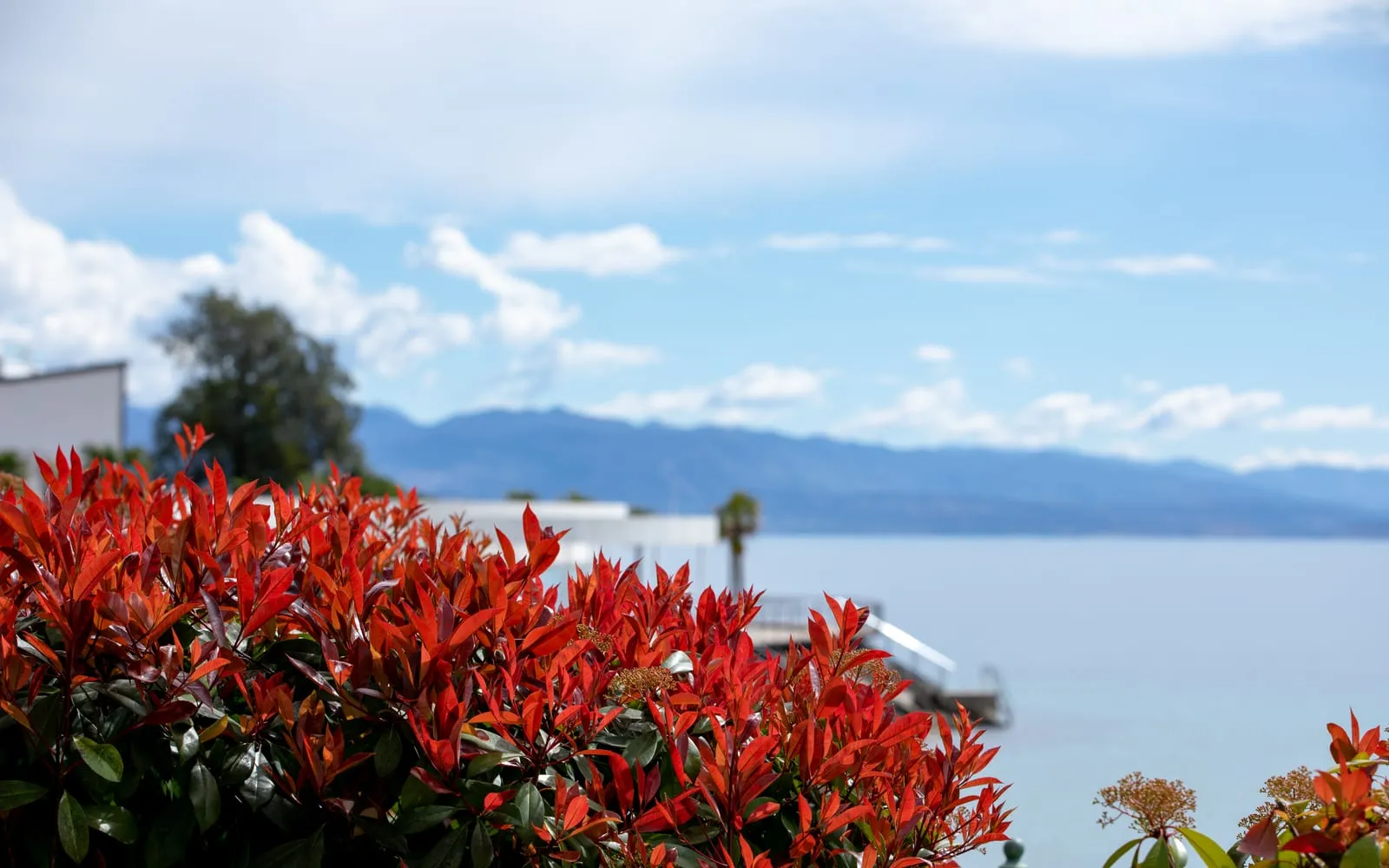
Photinia ‘Red Robin’ has been planted along more suburban driveways in the last twenty years than almost anything else because of the April flush. Every new leaf emerges a brilliant lacquered scarlet and holds that colour for weeks before hardening to dark green.
The trick people miss is that clipping produces the colour. Each cut forces a new flush of red growth, so a hedge trimmed two or three times a season stays red for most of the year, while an unpruned bush goes red once in spring and then sits green.
The reason people fall out of love with it is leaf spot. In a wet season the leaves develop dark red-purple blotches, yellow, and drop, and a hedge can be half bare by August. That is the one thing to understand before planting a lot of it.
Appearance and character
A vigorous evergreen shrub or small tree, dense and upright, reaching 4 to 5 m if left alone and usually kept between 2 and 4 m.
New leaves are the whole point. They emerge glossy scarlet to bright crimson, 8 to 15 cm long, and darken through bronze to deep glossy green over four to six weeks.
Mature leaves are leathery, oblong with a pointed tip and finely toothed edges, dark green above and paler beneath.
Flowers open in May in flat corymbs of small creamy-white blooms about 10 cm across. The smell is unpleasant, sharply sweet in the way hawthorn is, and many gardeners clip them off.
Berries follow in autumn on unpruned plants, small and red, which is where the name Christmas berry comes from. A regularly clipped hedge rarely produces any.
Stems are reddish on new growth and grey-brown when woody.
Varieties differ mainly in leaf. ‘Red Robin’ is the standard, ‘Little Red Robin’ stays under 1 m, and ‘Pink Marble’ is variegated in cream and pink.
Where it is from
A garden hybrid rather than a wild plant. Photinia x fraseri arose in 1940 at the Fraser Nurseries in Alabama as a cross between Photinia glabra from Japan and Photinia serratifolia from China and Taiwan.
‘Red Robin’ itself was raised in New Zealand and reached Britain in the 1970s, becoming ubiquitous from the 1990s onward.
Both parents come from warm temperate east Asia, which explains the hardiness limit. Photinia is reliable to about -12 deg C and suffers in an exposed inland garden in a hard winter.
The rose family membership explains three things at once. The flowers smell like hawthorn, the leaves carry cyanogenic glycosides, and the plant is susceptible to fireblight.
Its very wide planting in a short period is also why leaf spot has become such a visible problem, since the disease spreads readily between neighbouring hedges.
How it grows
Plant in autumn or spring into fertile, free-draining soil. Photinia dislikes both waterlogging and shallow chalk.
Space plants 60 to 90 cm apart for a hedge.
Clip two or three times a year to keep the red coming. Trim first in April or May after the frosts, again in midsummer, and stop by the end of August so late growth hardens before winter.
Use secateurs on a specimen shrub and shears on a hedge. Shears cut through the large leaves and leave brown edges, which matters less on photinia than on laurel because the new flush covers it quickly.
Feed after each clipping to fuel the new flush.
Water thoroughly through the first two summers.
Mulch each spring, keeping it clear of the stems.
Renovate an overgrown plant by cutting back hard into old wood in spring. Photinia reshoots freely from bare stems.
Dispose of clippings promptly and never leave a heap where livestock or horses can reach it.
Through the seasons
Winter is when cold damage shows. Foliage browns on an exposed side in a hard frost or a cutting east wind, and it recovers in spring.
Spring is the display. The red flush comes through in April, and the first clip follows once the frosts have finished.
Summer brings the flowers in May and the second clip. Watch for leaf spot from early summer, particularly in a wet season.
Autumn is the wind-down. Stop clipping by the end of August, clear fallen leaves, and plant new stock.
Care difficulty
Easy to grow and increasingly troublesome to keep looking well.
Leaf spot is the problem that defines this plant now. It is worse in wet seasons, in still air and on stressed plants, and a badly affected hedge sheds most of its leaves.
Soil is the other decider. Photinia yellows on shallow chalk and rots in wet ground, and it thrives on fertile free-draining neutral to slightly acid soil.
Clipping is straightforward and the timing is forgiving.
Cold exposure browns the foliage in an inland garden and rarely kills the plant.
Watering
Water thoroughly through the first two summers after planting.
Established plants need water only in a prolonged drought, and a hedge under the rain shadow of a wall needs more attention than one in the open.
Water at the base rather than over the foliage. Overhead watering wets the leaves and spreads leaf spot.
Avoid waterlogged ground, which photinia will not tolerate. On heavy clay, plant on a raised ridge and add grit.
Mulch in spring to conserve moisture and reduce stress, which makes the plant less prone to leaf spot.
Warning signs, diseases and pests
Photinia leaf spot is the thing you will meet. Small dark red or purple spots appear on both leaf surfaces, enlarge into grey-centred blotches with dark margins, and the leaves yellow and fall. It is caused by the fungus Entomosporium, it thrives in wet weather and stagnant air, and it hits stressed plants hardest. Rake up and destroy every fallen leaf, since that is where the fungus overwinters. Improve airflow by thinning and by not planting hedges too tightly. Water at the base and never overhead. Feed and mulch so the plant is not stressed. Clip in dry weather. Badly affected plants recover with this regime over a season or two, and a hedge that keeps defoliating in a wet garden may be the wrong plant for the site.
Yellow leaves with green veins mean chlorosis on chalky or alkaline soil. Apply sequestered iron and mulch with ericaceous material. Photinia will never be happy on thin chalk.
Brown scorched foliage on one side after winter is cold and wind damage. Cut back to live wood in spring.
Fireblight blackens shoots from the tip back, leaving them hanging as though scorched. Cut out well into healthy wood, disinfect tools between cuts, and burn the prunings.
Leaves dropping in quantity with no spots usually means waterlogging or drought at the root.
Honey fungus kills photinia and is fatal.
Growing environment
Full sun gives the strongest red colour. Partial shade produces a duller flush and a looser plant.
Fertile, free-draining soil, neutral to slightly acid. Add organic matter at planting.
Avoid shallow chalk, where it yellows, and waterlogged clay, where it dies.
Shelter from cold drying east wind, which scorches the foliage in an exposed inland garden. It does well in mild and coastal areas.
Space hedge plants 60 to 90 cm apart, and resist planting them tighter, since airflow is part of the defence against leaf spot.
It works as a hedge, a screen, a clipped ball in a large pot or a standard by a door.
Consider whether something else suits the site better where the garden is wet, chalky, cold and exposed, or where a neighbouring photinia hedge is already diseased.
Feeding
Feed twice a year, in spring and again in early summer, with a balanced or ericaceous fertiliser.
Feed after each clipping to fuel the new red flush.
Mulch each spring with compost or composted bark, keeping it off the stems.
Sequestered iron corrects yellowing on alkaline soil.
Avoid feeding after August, since soft late growth is damaged by frost.
Troubleshooting
The leaves have dark red spots and are falling off. Photinia leaf spot. Clear and destroy every fallen leaf, improve airflow, water at the base only, feed and mulch to reduce stress, and clip in dry weather.
How do I get more red leaves? Clip it. Every cut forces a new flush, so trim two or three times between April and August and feed after each one.
The whole plant has gone yellow. Usually chlorosis on chalky soil. Apply sequestered iron and mulch with ericaceous material, and accept it will never thrive on thin chalk.
It browned on one side over winter. Cold wind scorch. Cut back to live wood in spring, and give it shelter in an exposed inland garden.
When should I stop clipping? By the end of August, so the last flush hardens before the frosts.
Can I cut an overgrown one hard back? Yes. Photinia reshoots freely from old wood. Cut in spring and feed.
Blackened shoot tips hanging like they have been burnt. Fireblight. Cut well into healthy wood, disinfect the secateurs between cuts, and burn the prunings.
Are the clippings dangerous? To livestock, yes. The leaves contain cyanogenic glycosides and wilted clippings are worse than growth on the bush. Never throw them into a paddock.