
Outdoor plant
Common rhododendron
Rhododendron ponticum
Also known as Pontic rhododendron, Rhododendron ponticum
How to recognise Rhododendron ponticum, why it sterilises woodland, telling it from garden rhododendrons, removing it, and the honey that poisoned an army.
At a glance
- Difficulty
- Difficult
- Water
- Never water it. This is a plant to remove rather than grow
- Light
- Full sun to deep shade, which is part of the problem
- Temperature
- Very hardy, to -20 deg C
- Hardiness
- USDA 6-9, RHS H6, hardy to -20 C
- Type
- Evergreen shrub, long-lived and layering as it spreads
- Height
- 5-8 m
- Native to
- Iberia, the Black Sea coast and the Caucasus
- Best month
- November in the Northern Hemisphere, May in the Southern Hemisphere
High rainfall, humidity and acid soil are what it wants, and where it gets all three it becomes almost impossible to remove. It carries Phytophthora ramorum, the pathogen behind sudden oak death in California and Oregon and behind larch death across Britain, which makes it a plant health problem as well as a conservation one. It is listed under Schedule 9 in Britain and controlled in Ireland, Belgium and New Zealand.
Hardiness zones describe winter cold alone. Summer heat, humidity, rainfall and the length of the growing season decide as much, so treat the range as the outer limit rather than as a recommendation.
Every month named in this guide is for the temperate Northern Hemisphere. If you garden in the Southern Hemisphere, shift each one by six months, so November becomes May. Closer to the equator the wet and dry seasons matter more than the calendar, and the shift stops being a useful guide.
Poisonous if eaten
- Do not eat
- Every part, including the nectar and any honey made from it
- Harm from
- Eating it
- Affects
- People, cats, dogs and horses
Every part of Rhododendron ponticum is poisonous, and so is honey made from its flowers. The plant contains grayanotoxins, which bind to sodium channels in nerve and muscle cells. Eating leaves or flowers causes drooling, vomiting, abdominal pain, a slowed and irregular heartbeat, low blood pressure, weakness and, in a large dose, collapse. The ASPCA lists Rhododendron as toxic to cats, dogs and horses, and the RHS lists it among plants that are harmful if eaten. Livestock poisoning is the commonest real incident, since sheep, goats and cattle browse the foliage when other grazing is short, and rhododendron is a recognised cause of death in hill sheep. Honey made from the nectar carries the toxin and is known as mad honey. Xenophon recorded a Greek army falling ill after eating honeycomb near Trabzon in 401 BC, and Pompey's troops were reportedly defeated in 67 BC after being left poisoned honeycomb deliberately. Mad honey poisoning still occurs in Turkey and Nepal today, and British honey is not affected because bees here have plenty of alternatives and the flowering season is short. Wear gloves when clearing it and wash your hands, and never leave cut foliage where livestock can reach it.
Sources: ASPCA (Rhododendron), RHS potentially harmful garden plants
About
Rhododendron ponticum is the handsomest problem in British conservation. In May and June a hillside of it in flower is spectacular, which is exactly why Victorian landowners planted it across estates from Cornwall to Argyll as game cover and ornament.
What it does afterwards is the issue. The evergreen canopy is so dense that almost nothing survives beneath it, the leaf litter is slow to break down and suppresses germination, and a mature stand leaves bare ground with no ground flora, no tree regeneration and very little invertebrate life. Ancient oak woodland in Wales, Scotland and Ireland has been hollowed out this way.
It also spreads three ways at once. A million seeds a year from a mature bush, branches that root wherever they touch the ground, and stumps that resprout for years after cutting. That combination is what makes clearance so expensive.
Appearance and character
A large evergreen shrub reaching 5 to 8 m, forming impenetrable thickets of arching interlocking stems.
Leaves are the reliable identifier. Long and narrow, 6 to 18 cm, leathery and stiff, dark glossy green above and paler beneath, with a smooth untoothed edge that rolls slightly under.
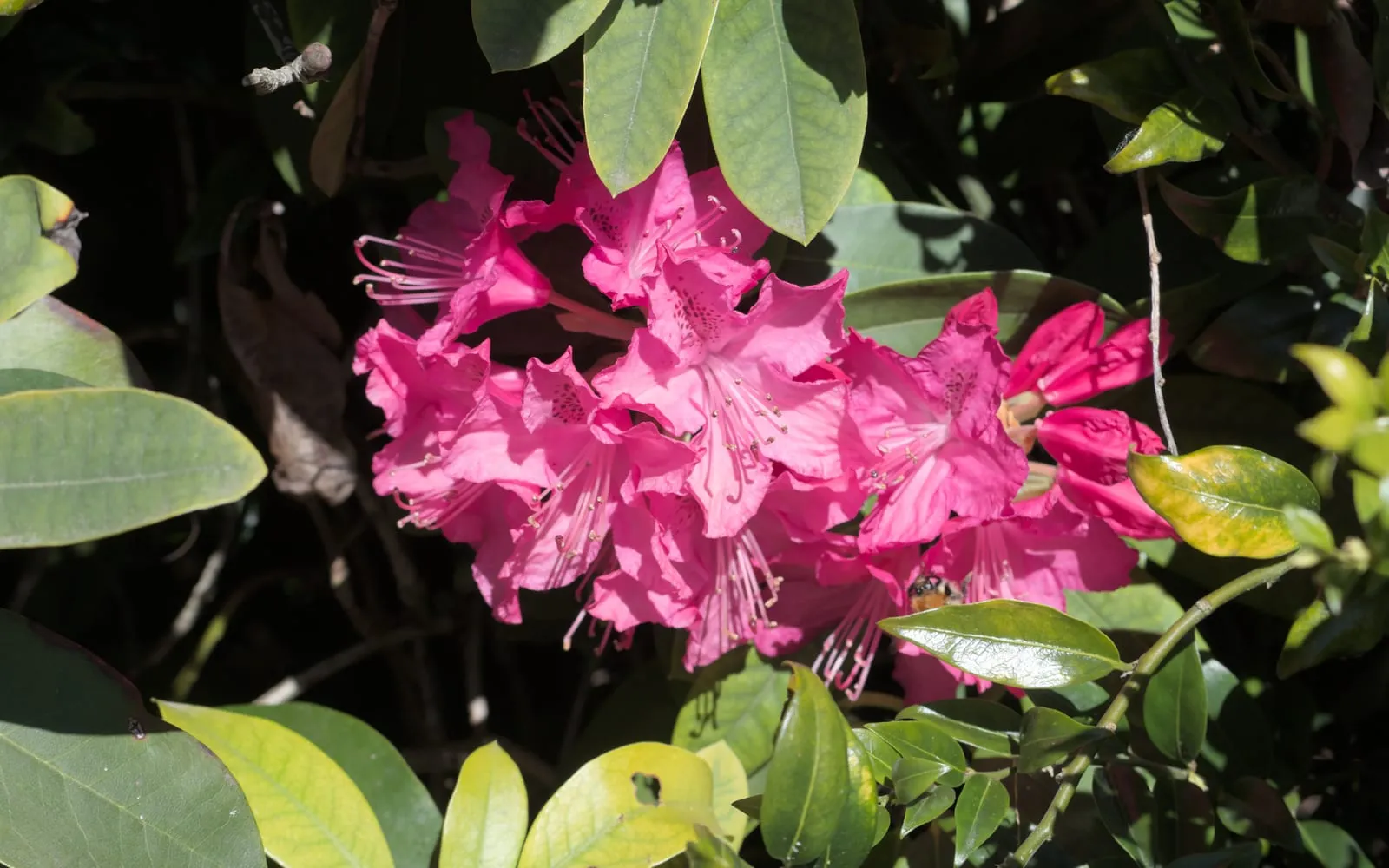
Flowers open in May and June in rounded trusses of ten to fifteen blooms, each funnel-shaped and about 5 cm across, in pinkish-purple to violet with a scatter of brownish or greenish spots inside the upper lobe.
Those spots are a useful check. Most garden hybrids have been bred away from them or have far bolder markings.
Stems arch outward and downward, and where a stem rests on the ground it roots and forms a new plant. A single original bush becomes a thicket covering many square metres by this route alone.
Seed capsules are small, brown and woody, splitting to release enormous numbers of dust-fine seeds that blow considerable distances.
Bark is smooth and grey-brown, becoming stringy on old stems.
Telling it from a garden rhododendron matters when deciding what to remove. Ponticum has narrow leathery leaves, that particular washed pinkish-purple, spots in the throat, and enormous vigour. Named garden hybrids are usually more compact with broader leaves and stronger, cleaner colours. Where a rhododendron has been grafted, ponticum was often the rootstock, so a purple-flowered sucker appearing beside a red hybrid is ponticum taking over.
Where it is from
Southern Spain and Portugal, and separately the Black Sea coast of Turkey, Georgia and the Caucasus, where it grows as an understorey shrub in humid forest.
It reached Britain in 1763 from the Iberian population and was planted widely through the nineteenth century, both as ornament and as cover for pheasants.
The British population is not pure. Genetic work has shown that most of it carries introgression from the North American Rhododendron catawbiense and Rhododendron maximum, which is thought to have contributed the extra cold-hardiness that lets it thrive here as it does not in its native range.
Its requirements limit where it can spread. It needs acid soil and reasonable rainfall, which is why it dominates in western Britain, Wales, Scotland and Ireland and is far less of a problem on the chalk and limestone of the south and east.
It is a significant host of Phytophthora ramorum, the pathogen behind sudden oak death and the disease that has killed millions of larch across Britain, and clearing rhododendron is part of controlling that outbreak.
How it grows
Understanding the three routes of spread is what makes clearance make sense.
Seed is produced in vast quantity, is dust-fine and wind-blown, and germinates on bare peaty ground, on rotting stumps and in moss.
Layering happens wherever an arching stem touches soil. This is how a thicket expands outward and why the extent underground is always greater than it looks.
Resprouting from cut stumps is vigorous and continues for years, which is why cutting alone never works.
To remove it, choose the method by scale. Small seedlings and young plants pull up by hand on damp ground. Larger plants need the stump treating.
Cut the stem low and apply an approved herbicide to the freshly cut surface within a few minutes, while the cut is still live. This stem treatment is the standard approach and is far more effective than foliar spraying a large bush.
Stem injection into standing stems is used on large mature plants and avoids the tangle of cutting first.
Winch or excavate the stumps where the ground allows and where the site justifies the cost.
Follow up for at least five years. Missed seedlings, regrowth from stumps and layers all appear, and a site abandoned after one clearance reverts.
Do not burn cut material near standing plants. Piles of brash should be stacked and left, or chipped.
Restore the site afterwards. Bare peaty ground under a cleared stand is exactly what ponticum seed needs, so replanting or encouraging natural regeneration matters.
Wear gloves throughout and keep livestock away from cut foliage.
Through the seasons
Winter is the main clearance season. The ground is firm, there is no nesting bird risk, and cut-stump treatment works well while the plant is still moving resources.
Spring brings the new growth. Avoid heavy clearance work from March to August because of nesting birds.
Summer is flowering in May and June, which is the easiest time to map an infestation from a distance, and seed sets from late summer.
Autumn is when follow-up survey pays. Seedlings from that year’s seed are findable, and clearance work can resume once nesting has finished.
Care difficulty
Difficult, and it is one of the most expensive habitat problems in Britain.
Three simultaneous routes of spread mean that any single method fails on its own.
Scale is the other issue. A serious infestation covers hectares of steep wooded ground, and clearance is a job for contractors with a multi-year plan.
The follow-up is what most efforts underestimate. Five years of return visits is the minimum, and ten is common.
Small garden infestations are manageable. A single bush cut low and stump-treated, with the layers traced and removed, is a weekend’s work.
Watering
There is nothing to water. Everything here is about removal.
Damp acid ground with reasonable rainfall is what it favours, so western Britain and Ireland carry the worst infestations.
It will not establish on chalk or limestone, which is why the problem is regional.
Drying a site out is not a control method.
Warning signs, diseases and pests
Regrowth from cut stumps is the commonest failure and the reason cutting alone never works. Treat the cut surface with an approved herbicide within minutes of cutting, or plan to return repeatedly for several years.
Layered stems mean the plant is larger than it looks. Trace every arching branch to where it touches the ground and check for rooting before assuming a bush is a single plant.
Seedlings appearing across a cleared site for years afterwards are normal. The seed is wind-blown and germinates on bare ground, so restoring vegetation cover is part of the control.
Phytophthora ramorum uses rhododendron as a reservoir and spreads from it to larch, oak and other trees. Infected material may be subject to statutory notice, and clearance in an affected area should follow Forestry Commission guidance.
Purple-flowered shoots appearing beside a named garden rhododendron are ponticum rootstock suckering. Remove them at the point of origin or the graft will be lost.
Livestock browsing a hedge or eating cut foliage is a genuine poisoning risk, particularly for sheep and goats in winter.
Legal duties fall on the landowner. Rhododendron ponticum is listed on Schedule 9 of the Wildlife and Countryside Act 1981, so planting it or causing it to grow in the wild is an offence.
Growing environment
Knowing where it thrives helps you assess the risk on a given site.
Acid soil is essential. It grows on peat, on acid sands and on acid loams, and not on chalk or limestone.
High rainfall and humidity suit it, which is why western Britain, Wales, Scotland, the Lake District and Ireland carry the heaviest infestations.
It grows in full sun and in deep shade, which is what lets it invade closed woodland rather than only clearings.
Oak woodland, birch woodland, conifer plantations, coastal cliffs and old estate policies are all typical habitats.
It does not persist in grazed grassland or on very dry thin soil.
Survey a wooded site in May and June, when the flowers make the extent obvious from a distance.
Feeding
Nothing here needs feeding. The relevant point is what happens after clearance.
Bare peaty ground under a cleared stand is the ideal seedbed for the next generation, so re-establishing cover matters more than anything else.
Encouraging natural regeneration of native trees, or replanting, shades out seedlings over time.
Fencing to control grazing helps native regeneration and keeps livestock away from any regrowth.
Troubleshooting
How do I tell it from my garden rhododendron? Ponticum has narrow leathery leaves, washed pinkish-purple flowers with brownish spots in the throat of the upper lobe, and great vigour. Garden hybrids are usually more compact with broader leaves and stronger colours.
Purple flowers have appeared on my red rhododendron. Ponticum was used as a grafting rootstock, and it is suckering from below the graft. Remove those shoots at the point of origin.
I cut it down and it grew back. Cutting alone never works. Treat the freshly cut stump with an approved herbicide within minutes, or expect to return for several years.
How long does clearance take? Five years of follow-up as a minimum, and often ten, because of stump regrowth, layered stems and a wind-blown seed bank.
Why is it such a problem when it looks so good? The evergreen canopy shades out everything beneath, the leaf litter suppresses germination, and a mature stand leaves woodland with no ground flora and no tree regeneration.
Is it illegal to have it? Having it is not an offence. Planting it or causing it to grow in the wild is, under Schedule 9 of the Wildlife and Countryside Act 1981.
Is it dangerous to animals? Yes. Every part contains grayanotoxins and it is a recognised cause of death in sheep and goats. Never leave cut foliage where livestock can reach it.
What is mad honey? Honey made from rhododendron nectar, which carries the same toxin. It poisoned a Greek army in 401 BC and still causes cases in Turkey and Nepal today.