
Outdoor plant
Japanese pieris
Pieris japonica
Also known as Lily-of-the-valley bush, Andromeda, Forest flame
How to grow pieris, Pieris japonica. Scarlet new growth in spring, why frost and chalk both ruin it, and the grayanotoxins that make it dangerous to livestock.
At a glance
- Difficulty
- Moderate
- Water
- Regular in dry spells, and rainwater in hard-water areas
- Light
- Partial shade with shelter, and it scorches in full sun and wind
- Temperature
- Fully hardy, though late frost destroys the young growth
- Hardiness
- USDA 5-8, RHS H5, hardy to -20 C
- Type
- Evergreen shrub, long lived and slow growing
- Height
- 1.5-4 m
- Native to
- Japan, eastern China and Taiwan
- Best month
- March in the Northern Hemisphere, September in the Southern Hemisphere
Acid soil is not negotiable and on chalk the leaves yellow within a season. The red spring growth is tender and a late frost blackens it, so give the plant shelter from morning sun and cold wind. Andromeda lace bug mottles the leaves silver and is worse in full sun and in warm climates, and it is a routine problem across the American south-east.
Hardiness zones describe winter cold alone. Summer heat, humidity, rainfall and the length of the growing season decide as much, so treat the range as the outer limit rather than as a recommendation.
Every month named in this guide is for the temperate Northern Hemisphere. If you garden in the Southern Hemisphere, shift each one by six months, so March becomes September. Closer to the equator the wet and dry seasons matter more than the calendar, and the shift stops being a useful guide.
Poisonous if eaten
- Do not eat
- All parts, including the nectar and any honey made from it
- Harm from
- Eating it
- Affects
- People, cats, dogs and horses
Pieris contains grayanotoxins, the same class of compound found in rhododendron and mountain laurel, and it is one of the genuinely dangerous plants sold routinely for ordinary gardens. Grayanotoxins act on sodium channels in nerve and muscle. Eating any part of the plant causes salivation, vomiting, abdominal pain, a slow or irregular heartbeat, low blood pressure, weakness and in severe cases convulsions and cardiac collapse. Livestock are the commonest victims, and sheep, goats, cattle and horses have all been killed by browsing pieris or by eating garden clippings thrown into a field. Never dispose of pieris prunings anywhere an animal can reach them. Cats and dogs that chew the leaves need veterinary attention rather than watching. The ASPCA lists Pieris japonica as toxic to cats, dogs and horses. Honey made from grayanotoxin-bearing plants is the historical "mad honey" that poisoned Xenophon's army, and it remains a real if rare hazard where hives sit near large plantings. None of this makes it unsuitable for a garden, and it does mean keeping it away from grazing boundaries and treating any ingestion as a call to a doctor or a vet rather than a wait and see.
Sources: RHS potentially harmful garden plants, ASPCA toxic and non-toxic plants
About
Pieris flowers in March and nobody buys it for the flowers.
They are pretty enough, hanging in creamy strings like lily of the valley, which is where one of the common names comes from. What sells the plant is what happens a few weeks later, when the new shoots emerge in a red so bright it reads as flower rather than foliage, and hold that colour for weeks before fading through pink and cream to green.
The cultivar ‘Forest Flame’ is the one most people mean when they say pieris, and the red on it is startling.
The catch is that pieris is fussy in two specific ways and easy in every other. It demands acid soil, absolutely, and it demands shelter from late frost and cold wind, because that spectacular new growth is soft and a May frost turns it black overnight.
On chalk it cannot be grown in the ground at all. In an exposed east-facing position it gets burned most years. Put it in a sheltered partly shaded spot in acid soil and it will sit there for thirty years asking for nothing but a mulch.
It is also seriously poisonous, so take care before planting it along a boundary with a paddock.
Appearance and character
An evergreen shrub reaching 1.5 to 4 m depending on the cultivar, upright and rounded, with the branches arranged in loose tiers.
Leaves are lance-shaped, 3 to 10 cm long, leathery, glossy and dark green when mature, arranged in whorls at the ends of the shoots.
New growth is the reason to grow it. It emerges in April and May in scarlet, bronze or salmon depending on cultivar, soft and glowing, and fades through pink and cream to green over several weeks.
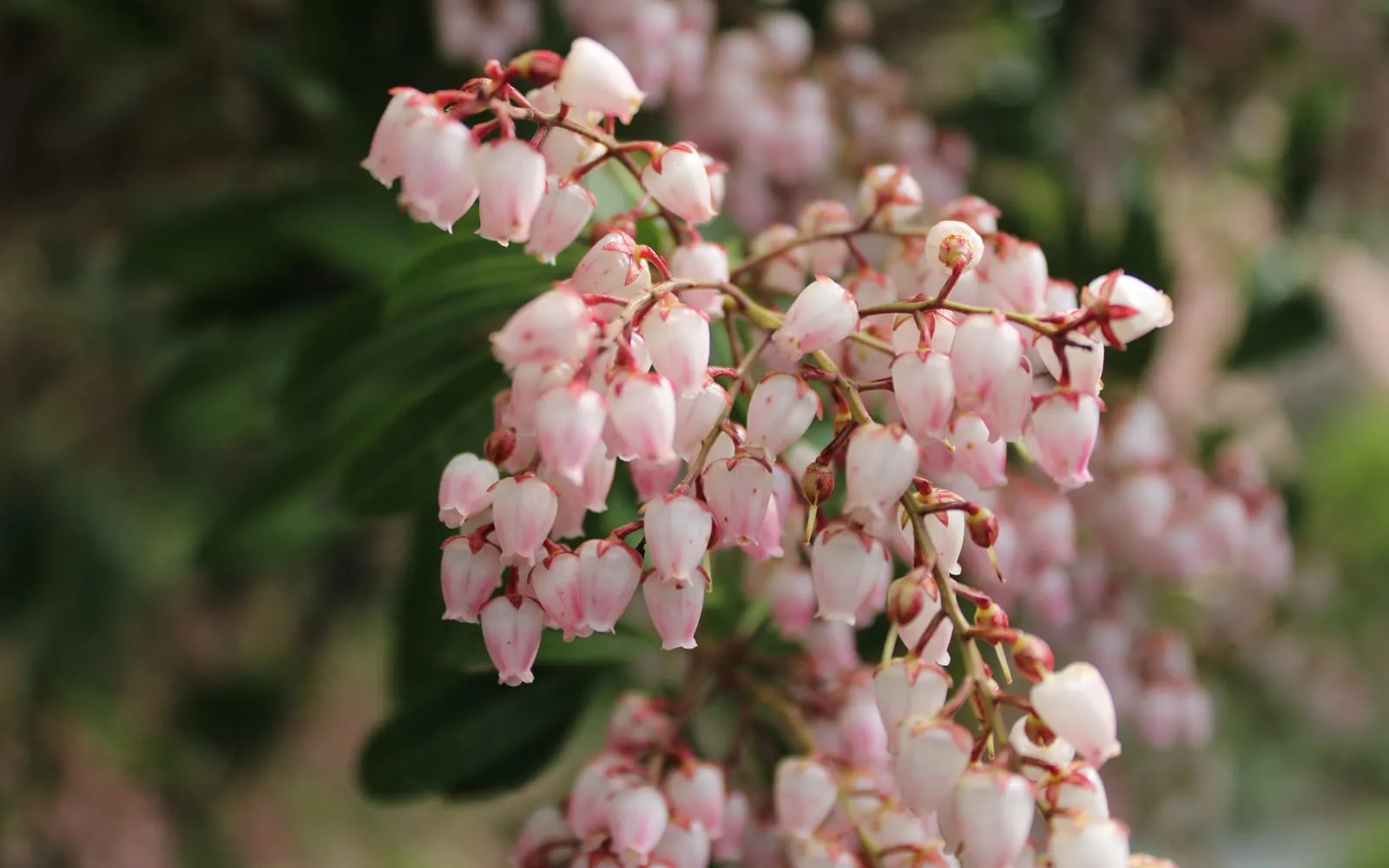
Flowers open in March and April in drooping panicles 8 to 15 cm long, made of small urn-shaped bells in white or pink, closely resembling lily of the valley.
Flower buds form the previous autumn and stand through the winter as reddish strings, which give a second season of interest.
Variegated cultivars exist. ‘Little Heath’ and ‘Flaming Silver’ both carry cream leaf margins and are smaller and slower.
Growth is slow and comes in distinct flushes rather than continuously.
Where it is from
Japan, eastern China and Taiwan, growing in mountain woodland and on acid slopes as an understorey shrub.
That habitat sets the requirements. Dappled shade, acid leaf-littered soil, moisture without waterlogging and shelter from wind.
It reached Britain in 1870 and became a standard shrub in acid-soil gardens in the twentieth century.
The related Pieris formosa var. forrestii from western China is the parent of ‘Forest Flame’ along with japonica, and it contributes the intensity of the red new growth.
Pieris is named after the Pierides, the Muses of Greek mythology, and the American species Pieris floribunda carries the alternative name andromeda from an older classification.
The grayanotoxins that make it poisonous are a family trait shared with rhododendron, azalea and mountain laurel across Ericaceae.
How it grows
Test the soil pH first. Pieris needs pH 4.5 to 6 and yellows badly above 6.5.
On chalk or alkaline soil, grow it in a large container of ericaceous compost. This works well and pieris is a good container plant.
Plant in autumn or spring into acid soil with plenty of leaf mould or composted bark worked in.
Choose the position for shelter above everything else. Somewhere with dappled shade, protection from north and east wind, and out of the first sun of the morning, so that a frosted shoot thaws slowly rather than being burned by direct sun.
Avoid full sun, which scorches the leaves and bleaches the colour.
Avoid deep shade, which reduces flowering and dulls the red.
Plant no deeper than it was in the pot. The roots are fine, shallow and easily rotted.
Mulch every spring with leaf mould, composted bark or pine needles, kept off the stem.
Do not dig or fork around it. The root system is shallow and fibrous and resents disturbance.
Prune very little. Deadhead the spent flower panicles after flowering, which tidies the plant and puts its energy into growth.
Cut back a leggy or overgrown plant in late spring after flowering, into old wood if necessary. Pieris regrows from old wood better than most ericaceous shrubs, and it takes a season or two.
Water with rainwater in a hard-water area, especially in containers.
Propagate from semi-ripe cuttings in late summer with bottom heat.
Keep prunings away from any boundary where livestock can reach them.
Through the seasons
Winter holds the developing flower panicles as reddish strings, and the evergreen foliage carries the plant.
Spring is the season. Flowers open in March and April, and the red new growth follows in April and May. This is when frost does the damage.
Summer is quiet. The new growth hardens to green and the job is watering and mulching.
Autumn sets next year’s flower buds and is the better planting time.
Care difficulty
Moderate. The routine care is minimal and two site requirements are absolute.
It needs acid soil and it needs shelter. Both are decided before planting and neither can be corrected afterwards.
Given those, it is long-lived, slow, tidy and almost pest-free, needing a mulch and an occasional deadhead.
The commonest disappointment is a plant that survives on marginal soil for years while looking yellow and thin, which is a slower failure than an outright death and harder to diagnose.
Watering
Water regularly through dry spells, particularly for the first three years, and keep the shallow roots damp.
Established plants on acid soil in shade manage on rainfall in a temperate climate and need help in a long drought.
Container plants need watering all year and must never dry out.
Use rainwater wherever the mains supply is hard, since calcium in tap water raises the pH of container compost within a couple of seasons.
Never let it stand in water. Phytophthora root rot follows waterlogging.
Warning signs, diseases and pests
Yellow leaves with green veins is lime-induced chlorosis. The soil or the water is too alkaline. Sequestered iron and an ericaceous feed hold it for a season, and the durable answer is a container of ericaceous compost.
Blackened, limp new growth after a cold clear night in April or May is frost damage. Cut the affected shoots back to healthy wood and the plant flushes again. Fleece a small plant when frost is forecast, and site the next one out of the morning sun.
Brown scorched leaf edges and bleached foliage is sun or wind burn. Move it or provide shelter.
A grey-white mottling on the upper leaf surface with black specks underneath is pieris lace bug. It is common wherever summers are warm and it disfigures the plant badly. Improve the growing conditions, since stressed plants in sun suffer worst, and treat with an appropriate insecticide if it is severe.
Sudden wilting and death of a whole plant is Phytophthora root rot. Improve drainage and do not replant an ericaceous shrub in the same spot.
Poor flowering is usually deep shade or a hard prune at the wrong time, since the buds form the previous autumn.
Honey fungus attacks pieris and is fatal.
Growing environment
Partial shade with shelter. Dappled light under high trees is ideal. Avoid full sun, deep shade and any exposed east-facing position.
Acid, moist, humus-rich and free-draining soil, pH 4.5 to 6.
Fully hardy as a plant, and the young growth is frost-tender, so the shelter matters more than the hardiness rating suggests.
Allow 1.5 to 3 m of spread depending on cultivar. ‘Little Heath’ stays under a metre and suits a small garden or a pot.
It suits a sheltered woodland border, a north or west-facing bed, an acid-soil shrubbery or a large container.
Grow it with the plants that want the same conditions. Camellia, rhododendron, azalea, skimmia, fern and hosta all share the shade and the acid soil, and camellia has the same morning-sun problem.
Keep it well away from any boundary with grazing land, and never throw prunings over a fence.
Its wildlife value is limited and the early flowers do feed bumblebee queens in March. Where hives are kept nearby, a large planting is worth thinking about because of the grayanotoxins in the nectar.
Feeding
Feed once in spring with an ericaceous slow-release fertiliser applied over the root area.
Mulch every spring with leaf mould, composted bark or pine needles, which matters more than the feed.
Feed container plants with a liquid ericaceous feed every two weeks from April to August and top-dress each spring.
Avoid mushroom compost, lime and general-purpose fertilisers containing calcium.
Yellowing is a pH problem before it is a nutrient one. Sequestered iron is a holding measure rather than a cure.
Troubleshooting
The new red growth went black overnight. Late spring frost. Cut back to healthy wood and it will flush again. Fleece a small plant when frost is forecast and site the next one sheltered and out of the early morning sun.
The leaves are yellow with green veins. Lime-induced chlorosis. The soil or the water is too alkaline. Use rainwater, mulch with leaf mould, apply sequestered iron, and move it to a container of ericaceous compost if the soil is chalky.
Can I grow pieris on chalk? Not in the ground. Grow it in a large container of ericaceous compost and water it with rainwater.
Is it poisonous? Seriously so. All parts contain grayanotoxins, which affect the heart and nervous system. It has killed sheep, goats and horses. Never throw prunings where livestock can reach them, and contact a vet if a pet eats any.
The leaves have gone grey and mottled. Pieris lace bug. Look for black specks on the undersides. It is worst on stressed plants in sun, so improve the position first.
When should I prune it? After flowering in late spring. Deadhead the spent panicles and take out any leggy growth, cutting into old wood if you need to.
It has stopped flowering. Usually too much shade, or pruning after the buds formed in autumn. Move it into dappled light and prune only in late spring.
Which cultivar should I choose? ‘Forest Flame’ for the brightest red new growth, ‘Little Heath’ for a small garden or a pot, and ‘Katsura’ for dark wine-red shoots and pink flowers.
Should I deadhead it? Yes. Removing the spent flower panicles tidies the plant and puts its energy into the new growth.