
Outdoor plant
French Hydrangea
Hydrangea macrophylla
Also known as Bigleaf hydrangea, Mophead hydrangea, Lacecap hydrangea
How to grow bigleaf hydrangeas, Hydrangea macrophylla. The soil chemistry behind blue and pink, why spring pruning costs you the flowers, and the difference between mopheads and lacecaps.
At a glance
- Difficulty
- Easy
- Water
- Generously through summer. The name means water vessel
- Light
- Morning sun with afternoon shade. Full shade reduces flowering
- Temperature
- Hardy to about -15 deg C. Late frosts damage the flower buds
- Hardiness
- USDA 6-9, RHS H5, hardy to -15 C
- Type
- Deciduous shrub
- Height
- 1-2 m
- Native to
- Coastal Japan
- Best month
- June in the Northern Hemisphere, December in the Southern Hemisphere
Flower colour follows soil pH rather than the label. Acid soil below about pH 5.5 frees aluminium and gives blue, alkaline soil gives pink, and no amount of feeding changes a white cultivar. Mophead and lacecap hydrangeas flower on last year wood, so a hard winter or a spring tidy-up costs you the flowers, and the remontant cultivars such as Endless Summer were bred to flower on new growth as well. Hydrangea paniculata and Hydrangea arborescens flower on this year growth and are hardier by several zones.
Hardiness zones describe winter cold alone. Summer heat, humidity, rainfall and the length of the growing season decide as much, so treat the range as the outer limit rather than as a recommendation.
Every month named in this guide is for the temperate Northern Hemisphere. If you garden in the Southern Hemisphere, shift each one by six months, so June becomes December. Closer to the equator the wet and dry seasons matter more than the calendar, and the shift stops being a useful guide.
Toxic to pets if eaten
- Do not eat
- Buds and leaves
- Harm from
- Eating it and handling it
- Affects
- Cats, dogs and horses
The ASPCA lists Hydrangea as toxic to dogs, cats and horses through a cyanogenic glycoside, with vomiting, depression and diarrhoea, and notes that actual cyanide poisoning is rare and the usual outcome is gastrointestinal upset. The RHS places Hydrangea in category C as a skin allergen, and handling the foliage causes contact dermatitis in some people. Buds and leaves carry the highest concentration. Serious cases in animals are uncommon and generally involve a dog that has eaten a substantial quantity rather than a nibbled leaf. Dried hydrangea flowers used in arrangements retain the compound, so keep them out of reach in a house with a cat that chews. Wear gloves when pruning if your skin reacts, and wash afterwards.
Sources: ASPCA (Hydrangea), RHS potentially harmful garden plants
About
A hydrangea is a soil test you can see from across the garden. The same plant flowers blue on acid ground and pink on alkaline, and the mechanism is well understood: below about pH 5.5 aluminium in the soil becomes soluble, the roots take it up, and it binds with a pigment in the petals to produce blue. Above pH 6.5 the aluminium stays locked in the soil and the pigment shows pink.
Nothing about the plant changes. Move a blue hydrangea to chalk and it flowers pink the following year.
White varieties sit outside this entirely, since they have no pigment to shift, and they stay white on any soil.
Appearance and character
A rounded deciduous shrub reaching 1 to 2 m, with large oval, glossy, coarsely toothed leaves in fresh green.
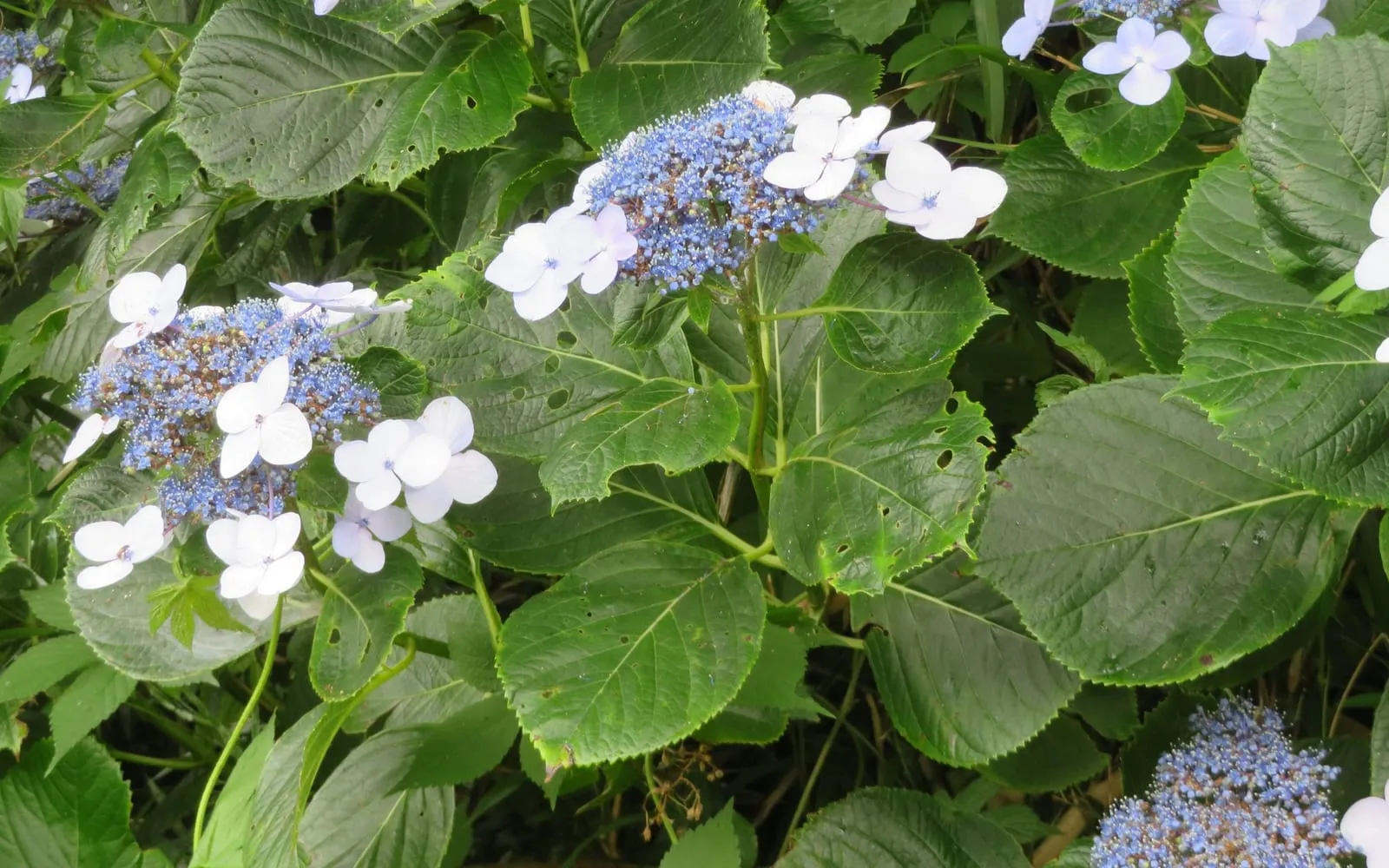
Two flower forms are sold and they behave rather differently. Mopheads carry dense globes made almost entirely of large showy sterile florets. Lacecaps carry a flat plate of tiny fertile flowers in the centre ringed by a few large sterile ones, which makes them far better for bees, since a mophead offers almost no nectar.
Colour runs through blue, violet, pink, red and white, and the shifting is a feature of the blue and pink varieties only.
Flower heads dry on the plant and hold their shape through winter, fading to parchment. They look striking in frost and they also protect the buds beneath them, which is the practical reason for leaving them on.
Where it is from
Coastal Japan, on the Pacific side of Honshu and the southern islands, growing in woodland edges and on sheltered slopes near the sea.
That habitat explains the two firm requirements. Soil there stays moist all summer, and the plant is shaded for part of the day. A hydrangea in full sun on dry soil wilts by lunchtime every day of summer.
The name comes from Greek for water vessel, and it describes the seed capsule rather than the plant’s thirst, though it fits the thirst too.
Japanese gardeners have grown it for centuries, and it reached Europe in the late eighteenth century.
How it grows
A deciduous shrub that flowers on wood produced the previous summer. Buds for next June form in late summer and sit on the stems all winter.
Pruning follows from that, and it is where nearly all disappointment comes from. Cutting the bush back in early spring, which feels tidy and looks right, removes every flower bud for the coming year.
Prune in April instead, and lightly. Cut each old flower head back to the first strong pair of buds below it, and remove a couple of the oldest stems at the base to keep the bush renewing.
The exceptions are Hydrangea paniculata and Hydrangea arborescens flower on the current season’s growth and can be cut back hard in spring. If your hydrangea has cone-shaped flower heads rather than globes or plates, it is probably one of these.
Layering works easily, and a low branch pegged into the soil in summer roots by the following spring.
Through the seasons
Winter is for leaving it alone. The dead flower heads stay on, sheltering the buds beneath from frost.
Spring is pruning, in April once the risk of hard frost has passed. Cut back to the first fat pair of buds under each old head. Feed and mulch now.
Summer is flowering, from June through August, and watering. This is the season that decides whether the plant thrives. Water deeply and often.
Autumn sets next year’s buds and colours the leaves. Leave the flower heads in place, and take cuttings in September if you want more plants.
Care difficulty
Easy, with one rule and one habit.
The rule is pruning in April rather than February or March, and taking off very little.
The habit is watering. A hydrangea in a dry summer wilts every afternoon, and repeated wilting kills the flower buds forming for next year even if the plant survives. Mulch thickly and water before it flags rather than after.
Everything else about the plant is forgiving.
Watering
Water generously through summer. In dry spells that means a thorough soak two or three times a week rather than a daily sprinkle, delivered at the base.
Mulch in spring with compost or leaf mould, 5 to 8 cm deep, over damp soil. This does more to keep a hydrangea happy than any amount of extra watering later.
Container plants need daily attention in July and are considerably harder to keep than plants in the ground.
Rainwater is worth collecting if you want blue flowers, since tap water in hard-water areas is alkaline and pushes the soil the other way.
Afternoon wilting in a heatwave is not always drought, and a plant that recovers by evening in moist soil is protecting itself. Persistent wilting in the morning means it needs water.
Warning signs, diseases and pests
Late frost is the most common cause of a hydrangea that grows well and does not flower. The buds are exposed all winter, and a hard frost in April after the buds have swollen destroys them. Leaving the old flower heads on until April helps, and so does a sheltered position away from an east-facing wall where morning sun thaws frozen tissue too fast.
Powdery mildew coats the leaves in dry weather, particularly on plants with dry roots. Water and mulch.
Vine weevil grubs eat the roots of container-grown plants and cause sudden collapse. Treat with nematodes in spring and autumn.
Capsid bug feeds on shoot tips and leaves small ragged holes with distorted growth around them. Damage is cosmetic on an established shrub.
Grey mould rots flower heads in a wet summer. Remove affected heads.
Yellowing leaves with green veins on chalky soil is iron deficiency rather than disease. Feed with a sequestered iron product, or accept pink flowers and a happier plant.
Growing environment
Morning sun with afternoon shade is the ideal, and the east side of a building suits it well. Full sun on dry soil causes constant wilting. Deep shade gives you leaves and few flowers.
Hardy to about -15 deg C, though the flower buds are less hardy than the plant and a spring frost is more damaging than a winter one.
Soil should be moisture-retentive and rich in organic matter. Dig in plenty of compost before planting, and keep mulching every year.
For blue flowers you need acid soil below pH 5.5. Adding aluminium sulphate helps on neutral ground and will not work on chalk, where the calcium permanently locks aluminium away. Growing in a container of ericaceous compost is the reliable route to blue in a chalky garden.
For pink flowers on acid soil, add garden lime.
Shelter from cold winds and from early morning sun protects the buds.
Feeding
A balanced slow-release fertiliser in March, applied over damp soil and watered in, plus an annual mulch of compost.
A second light feed in June helps on poor or sandy soils.
Avoid high-nitrogen fertiliser, which produces large leaves and fewer flowers, and avoid feeding after July, since soft late growth gets frosted.
Feeds sold for rhododendrons and camellias suit blue hydrangeas, since they are formulated for acid conditions and avoid the phosphorus that ties up aluminium.
Troubleshooting
Lots of healthy growth and no flowers. Either pruned at the wrong time or the buds were frosted. Prune in April, cutting back only to the first strong pair of buds, and leave the old heads on through winter.
Flowers came out pink and I wanted blue. The soil is not acid enough. Use ericaceous compost in a container, water with rainwater, and treat with aluminium sulphate. On chalk, accept pink.
Wilting every afternoon. Too much sun, too little water, or both. Mulch thickly and move it in autumn if the position is wrong.
Yellow leaves with green veins. Iron deficiency on alkaline soil. Apply sequestered iron.
Flower heads gone brown and papery in autumn. Normal. Leave them on the plant until April.
Whole plant collapsed in a pot. Vine weevil grubs. Check the rootball and treat with nematodes.
Cone-shaped flower heads and it does not change colour. It is a different species, most likely Hydrangea paniculata, which flowers on new wood and can be pruned hard in spring.