
Outdoor plant
Astilbe
Astilbe x arendsii
Also known as False goat's beard, False spiraea
How to grow astilbe, Astilbe x arendsii. The perennial for damp shade, why it browns and dies in dry soil, and whether to leave the seed heads through winter.
At a glance
- Difficulty
- Moderate
- Water
- Regular, and it must never dry out
- Light
- Partial shade for preference, and full sun only where the soil stays wet
- Temperature
- Fully hardy, to about -35 deg C
- Hardiness
- USDA 4-8, RHS H7, hardy to -35 C
- Type
- Herbaceous perennial, long lived and dying back each winter
- Height
- 40-120 cm depending on cultivar
- Native to
- A garden hybrid group raised in Germany from Chinese and Japanese species
- Best month
- July in the Northern Hemisphere, January in the Southern Hemisphere
Astilbe needs constant moisture. It is hardy to -35 C and dies in a fortnight of dry soil, browning at the leaf edges and never recovering that season, so it belongs beside water or on ground that never dries. Full sun works only where the soil stays wet. It also wants a cold winter and performs poorly in zone 9 and warmer.
Hardiness zones describe winter cold alone. Summer heat, humidity, rainfall and the length of the growing season decide as much, so treat the range as the outer limit rather than as a recommendation.
Every month named in this guide is for the temperate Northern Hemisphere. If you garden in the Southern Hemisphere, shift each one by six months, so July becomes January. Closer to the equator the wet and dry seasons matter more than the calendar, and the shift stops being a useful guide.
Not known to be toxic
Astilbe is not listed by the RHS as a potentially harmful garden plant and is not recorded by the ASPCA as toxic to cats, dogs or horses. No part of it is a recognised poisoning hazard and it is a sound choice for a garden used by children and pets. The young shoots of some Asian species in the genus have been eaten as a vegetable in China and Japan, and the roots have been used medicinally, neither of which makes the garden hybrids a food plant. Where a plant is unlisted by both sources rather than positively assessed, the correct reading is that no hazard has been recorded rather than that one has been ruled out, so there is no reason to encourage anybody to eat it. The one practical caution attached to astilbe has nothing to do with toxicity. It is planted heavily around ponds and in bog gardens, where the real hazard to a small child is the water rather than the planting.
Sources: RHS potentially harmful garden plants, ASPCA toxic and non-toxic plants
About
Astilbe is one of the few good flowering perennials for damp shade, and it dies in dry soil faster than almost anything else in a border.
That is the whole of it. Give it ground that stays moist through July and August and it produces upright feathery plumes in white, cream, pink, salmon and deep crimson above handsome ferny foliage, in a position where most flowering plants sulk. Let it dry out once and the leaves crisp brown at the edges, the plumes shrivel, and the plant often does not recover.
Pond margins, bog gardens, damp clay, the shaded side of a house and heavy ground that lies wet in winter are all positions it suits. Dry shade under a tree is the one shady place it will not grow.
The foliage is worth as much as the flowers. It emerges bronze or copper in spring, matures to a divided ferny green, and holds up all season where the roots stay damp.
The dead flower plumes turn a warm russet brown and stand through the winter, which is an argument for leaving them rather than cutting them down in autumn.
Appearance and character
A herbaceous perennial reaching 40 to 120 cm depending on cultivar, forming a clump that dies back completely each winter.
Leaves are divided two or three times into toothed oval leaflets, giving a ferny texture, mid to dark green and glossy. New growth in spring is often bronze, copper or deep red.
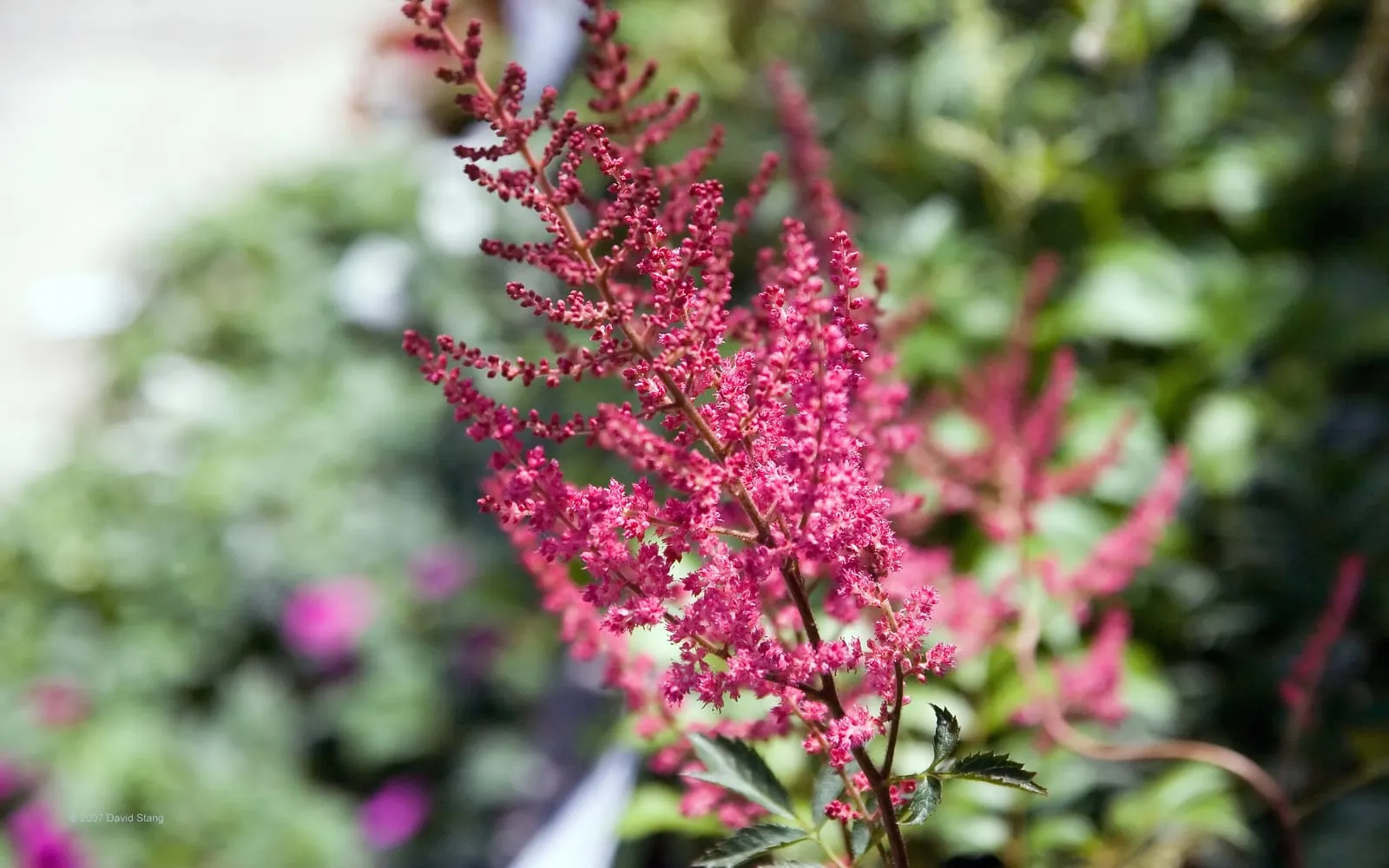
Flower plumes rise above the foliage from June to August, upright and narrowly conical, 15 to 30 cm long, made of thousands of tiny flowers on branched stems.
Colours run from pure white and cream through pale pink, salmon and coral to deep carmine and near-red, and the stems are often dark and contrast with the plume.
The plumes dry on the plant into a warm rust brown and stand through autumn and winter, holding shape under frost.
Height varies widely by cultivar. ‘Fanal’ reaches 60 cm with deep red plumes, ‘Bressingham Beauty’ reaches 90 cm in pink, and the dwarf Astilbe chinensis var. pumila makes 25 cm ground cover with mauve spikes.
Spread is by a slowly expanding rhizome rather than by runners.
Where it is from
A garden hybrid group rather than a wild plant, raised in Germany by Georg Arends in the early twentieth century by crossing several Asian species including Astilbe chinensis, Astilbe japonica and Astilbe thunbergii.
The wild parents grow in mountain ravines, stream sides and damp woodland across China, Japan and Korea, which is exactly the habitat the garden plants demand.
Arends worked at Ronsdorf near Wuppertal and released the first hybrids around 1907. The group carries his name and most cultivars in European nurseries descend from that work.
Astilbe chinensis var. taquetii ‘Superba’ is later flowering and noticeably more drought-tolerant than the arendsii hybrids, which makes it the one to choose on marginal soil.
The name comes from Greek, meaning without brightness, describing the dull individual flowers of the wild species. The garden hybrids make the name look unfair.
Astilbe is in Saxifragaceae, alongside saxifrage, heuchera and tiarella, which is why its foliage sits comfortably with them.
How it grows
Plant in autumn or spring into soil that stays reliably moist.
Enrich the ground generously with compost, leaf mould or well-rotted manure before planting, and dig it in deeply. Organic matter holds the water the plant depends on.
Choose partial shade for preference. Astilbe grows in full sun where the soil stays wet, such as a pond margin, and scorches in sun anywhere else.
Avoid dry shade under trees, which combines the worst of both.
Plant the crown at soil level, spacing 45 to 60 cm apart for the taller cultivars.
Mulch thickly every spring with compost or leaf mould. This does more for an astilbe than any other single job, because it keeps the roots cool and holds moisture into the summer.
Water through every dry spell without exception, and check container plants daily in summer.
Feed once in spring with a balanced fertiliser.
Leave the dead plumes standing through the winter. They hold their shape and colour, they look well under frost, and cutting them in October removes months of interest for no benefit.
Cut the old foliage and plumes down in late February or March before the new shoots emerge.
Divide every three or four years in spring or autumn, since the crown rises out of the soil as it ages and the centre flowers thinly. Replant the outer sections at the correct depth.
Choose Astilbe chinensis cultivars if your soil is only moderately moist, since they tolerate drier ground than the arendsii hybrids.
Through the seasons
Winter shows the russet dead plumes standing above bare ground, which is worth keeping.
Spring pushes bronze and copper new foliage in April, and this is the month to cut last year’s stems down, mulch and feed.
Summer flowers from June to August depending on cultivar. Keep the soil damp through the flowering period.
Autumn dries the plumes to rust brown and is a good planting and dividing season.
Care difficulty
Moderate, and it comes down to one requirement.
Astilbe needs constantly moist soil. Everything else about it is easy, since it is hardy, long-lived, unattractive to slugs, and needs no staking or deadheading.
On the right ground it is close to trouble-free. On dry ground it fails, and no amount of watering from a can in August substitutes for soil that holds moisture.
Preparing the soil properly with organic matter and mulching every spring is what makes the difference, more than any watering routine.
Watering
Water regularly and never let it dry out. This is the whole of astilbe care.
The plant shows drought within days, with brown crisping at the leaf edges, and a severely dried plant often fails to recover even when watered.
Soak thoroughly rather than sprinkling, and water in the evening in hot weather.
Container plants need checking daily in summer and are best avoided unless you can be reliable about it.
Mulch thickly every spring, which conserves far more water than watering adds.
Standing water is fine. Astilbe grows happily at a pond margin in permanently wet soil.
Warning signs, diseases and pests
Brown crisp edges to the leaves, spreading inwards, is drought. Water immediately, mulch heavily, and move the plant in autumn if the position is wrong.
Whole plant browning and collapsing in July is severe drought and often terminal.
Scorched pale foliage in an open position is too much sun with soil that is not wet enough.
Thin flowering on an old clump with the crown standing proud of the soil is congestion and age. Divide it in spring and replant at the right depth.
Notched leaf edges with a plant that wilts and pulls out easily is vine weevil, whose larvae eat the roots. It is a particular problem in containers. Use a biological nematode drench in late summer.
White powdery coating in dry shade is powdery mildew, which follows drought at the roots.
Leaves eaten in ragged holes is unusual, since slugs mostly leave astilbe alone.
Failure to reappear in spring after a dry summer is usually a plant that died in August rather than one lost to winter.
Growing environment
Partial shade for preference. Full sun works only where the soil is permanently wet, such as a pond margin or bog garden.
Moist to wet, humus-rich soil. Heavy clay that lies damp suits it well. Dry sand and dry shade do not.
Fully hardy to about -35 deg C.
Allow 45 to 60 cm per plant for the taller cultivars and 30 cm for the dwarf forms.
It suits a pond margin, a bog garden, a damp shady border, a woodland edge, a north facing bed or heavy clay that stays wet.
Grow it with the plants that want the same conditions. Hosta, ligularia, rodgersia, primula, fern, iris and hardy geranium all share damp shade, and hosta foliage sits well against the astilbe plumes.
Do not plant it under a large tree, where the roots take the moisture and the canopy takes the light.
Its wildlife value is moderate. Bees and hoverflies work the plumes, and the standing dead stems give overwintering shelter to insects, which is a further reason not to cut them in autumn.
Feeding
Feed once in spring with a balanced general fertiliser as the new shoots emerge.
Mulch every spring with compost, leaf mould or well-rotted manure, which matters more than the feed because it holds moisture.
Feed container plants with a liquid feed every two weeks from May to August.
Avoid high-nitrogen feeds, which produce leaf at the expense of the plumes.
A plant that looks weak is nearly always too dry rather than short of nutrients.
Troubleshooting
The leaves have gone brown and crisp at the edges. Drought. Astilbe shows it within days. Water immediately and mulch heavily, and move it in autumn if the position is too dry.
Can I grow it in dry shade? No. Dry shade is the one shady position astilbe will not tolerate. Try epimedium, hardy geranium or Euphorbia amygdaloides var. robbiae instead.
Can it grow in full sun? Only where the soil is permanently wet, such as a pond margin. Anywhere else it scorches.
Should I cut the dead flowers off? Not in autumn. The dried plumes turn russet brown, hold their shape through winter and look well under frost. Cut them down in late February.
It flowers less than it used to. The clump is congested and the crown has risen out of the soil. Divide it in spring, discard the woody centre and replant the outer pieces at the right depth.
Which cultivar tolerates drier soil? The Astilbe chinensis types, particularly var. taquetii ‘Superba’, which flowers later and stands drier ground than the arendsii hybrids.
How often should I divide it? Every three or four years, in spring or autumn.
It wilted and pulled straight out of the pot. Vine weevil larvae eating the roots. Look for white grubs with brown heads and treat with nematodes in late summer.
Is it safe around children and pets? Yes. It is not listed as harmful by the RHS and not recorded as toxic by the ASPCA. If it is beside a pond, the water is the hazard rather than the plant.