
Outdoor plant
Japanese skimmia
Skimmia japonica
Also known as Skimmia
How to grow skimmia, Skimmia japonica. Why you need a male and a female plant for berries, the yellowing that means the wrong soil, and its use in winter containers.
At a glance
- Difficulty
- Moderate
- Water
- Regular in dry spells, and never let it dry out in a container
- Light
- Partial to full shade, and full sun scorches and yellows it
- Temperature
- Fully hardy, to about -15 deg C
- Hardiness
- USDA 6-9, RHS H5, hardy to -15 C
- Type
- Evergreen shrub, long lived and slow growing
- Height
- 1-1.5 m
- Native to
- Japan, China, Korea and the Philippines
- Best month
- December in the Northern Hemisphere, June in the Southern Hemisphere
Most plants are either male or female, so berries need one of each and a male such as Rubella will never fruit whatever you do to it. Acid to neutral soil is needed and on chalk the leaves go yellow between the veins. Full sun bleaches the foliage to a sickly pale green, so shade is where it looks best.
Hardiness zones describe winter cold alone. Summer heat, humidity, rainfall and the length of the growing season decide as much, so treat the range as the outer limit rather than as a recommendation.
Every month named in this guide is for the temperate Northern Hemisphere. If you garden in the Southern Hemisphere, shift each one by six months, so December becomes June. Closer to the equator the wet and dry seasons matter more than the calendar, and the shift stops being a useful guide.
Toxic if eaten
- Do not eat
- The berries and the leaves
- Harm from
- Eating it
- Affects
- People, cats and dogs
Skimmia contains alkaloids including skimmianine, which is found through the plant and concentrated in the leaves and fruit. Eating the berries causes vomiting, abdominal pain and diarrhoea, and larger quantities have caused convulsions in animal studies. The RHS lists Skimmia japonica as harmful if eaten. The practical concern is the shape of the plant rather than the strength of the poison, because skimmia is a low dome carrying bright red berries at the height of a small child's hands, and it is sold heavily as a Christmas container plant into households with children. Site it out of easy reach where toddlers use the garden, or grow a male cultivar such as 'Rubella', which produces no berries at all and has better winter flower buds anyway. Cats and dogs that chew the foliage may vomit. No human fatalities are recorded and the usual outcome of eating a few berries is a stomach upset, so treat it as a reason to site the plant thoughtfully rather than a reason to avoid it.
Sources: RHS potentially harmful garden plants, ASPCA toxic and non-toxic plants
About
Skimmia is bought in December for the berries and disappoints in February when there are none.
Most skimmias are separately male and female, and a female plant only sets fruit if a male is flowering nearby. Garden centres sell berried female plants in winter as a finished article, and the buyer plants one on its own, gets a year of nothing, and blames the soil.
Buy a male at the same time. One male covers up to six females within a few metres, and the male cultivar ‘Rubella’ is arguably the better plant anyway, since it carries dense heads of deep red flower buds from autumn right through winter and opens them white and strongly scented in spring.
The other reliable failure is soil. Skimmia wants moist, acid to neutral, humus-rich ground in shade. On chalk it turns yellow and stays yellow. In sun it scorches and yellows. In dry soil under a wall it sulks. Get those conditions right and it is a neat, slow, undemanding evergreen that needs no pruning at all.
Skimmia japonica subsp. reevesiana is the exception on the sex question. It carries both sexes on the same plant and berries on its own, and it is the fussiest of the lot about acid soil.
Appearance and character
An evergreen shrub reaching 1 to 1.5 m, forming a dense rounded dome without any pruning.
Leaves are oval to lance-shaped, 6 to 12 cm long, leathery, glossy mid to dark green, and clustered towards the ends of the shoots. Crushed foliage is aromatic.
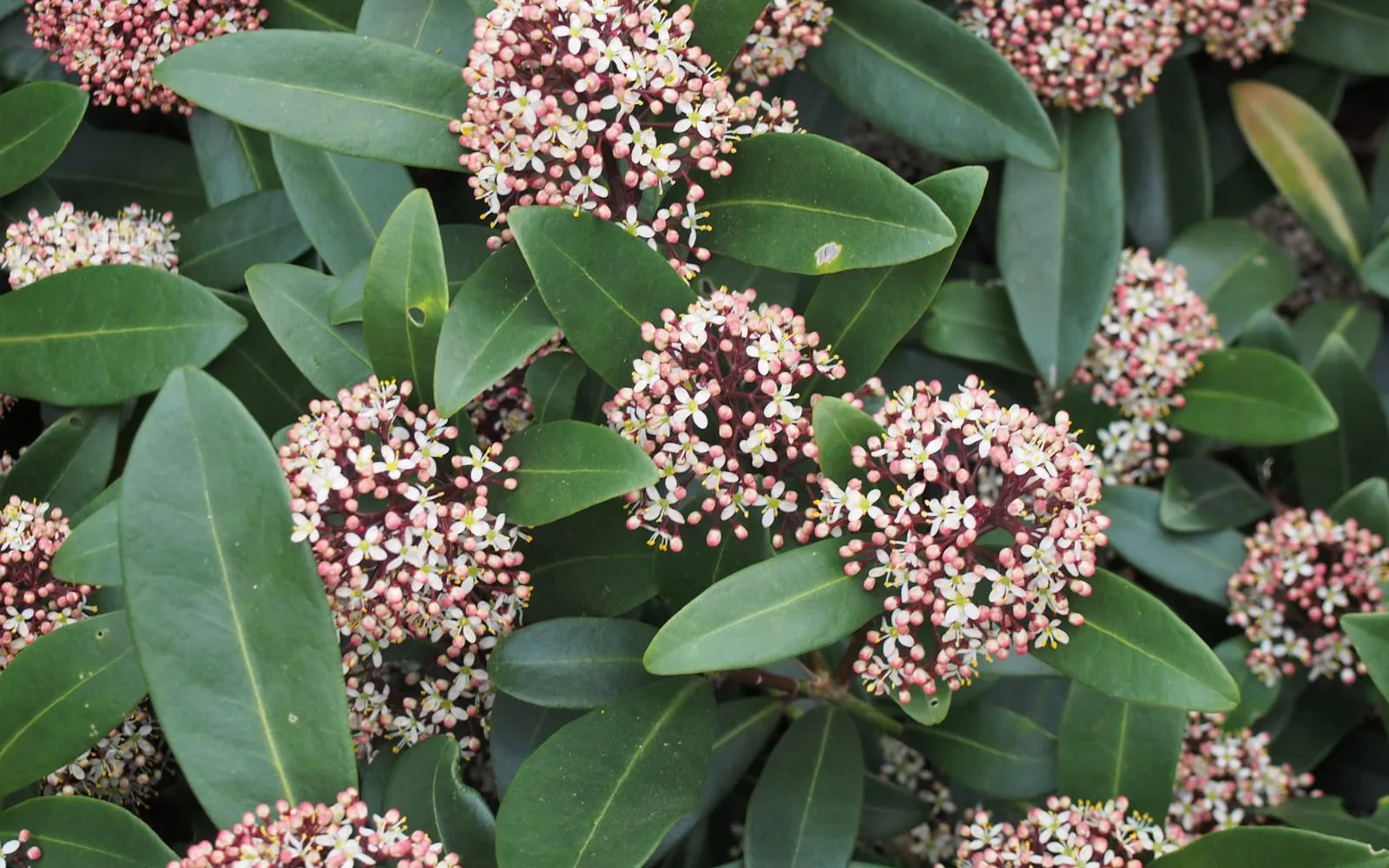
Flower buds form in autumn and stand through the winter in dense terminal heads. On ‘Rubella’ they are deep red and are the main reason to grow it.
Flowers open in April, small, creamy white, in panicles 5 to 8 cm across, with a strong sweet scent that carries.
Male flowers are larger and more strongly scented. Female flowers are smaller and less showy, and only they produce fruit.
Berries ripen from autumn on pollinated female plants, 8 to 10 mm across, glossy scarlet, and they last on the plant through winter and often into the following summer because birds largely ignore them.
Growth is slow. A skimmia takes years to reach its full size and stays in scale in a small garden.
Where it is from
Japan, China, Korea and the Philippines, growing as an understorey shrub in moist woodland and on shaded mountain slopes.
Give it shade, leaf litter, a soil that never bakes and never floods, and acid to neutral pH.
It reached Britain in the middle of the nineteenth century during the wave of Japanese plant introductions and became a standard shrub for shady Victorian gardens.
The name comes from shikimi, the Japanese name for a related plant.
Skimmia belongs to Rutaceae, the citrus family, which the aromatic leaves and the alkaloid content both reflect.
Its modern commercial life is as a winter container plant. Berried females and red-budded ‘Rubella’ males are produced in enormous numbers for Christmas displays, and a great many are thrown away in spring rather than planted out.
How it grows
Check the soil pH before planting. Skimmia wants pH 5 to 7 and yellows badly above that.
On chalk or strongly alkaline soil, grow it in a container of ericaceous compost instead of fighting the ground.
Plant in autumn or spring in partial or full shade, into soil enriched with leaf mould, composted bark or garden compost.
Avoid full sun. Skimmia in an open sunny position scorches at the leaf edges and goes a pale yellow-green that looks like disease and is light damage.
Avoid dry soil at the foot of a wall or under a greedy tree.
Buy a male and a female together if you want berries. ‘Rubella’ or ‘Fragrans’ as the male, and ‘Nymans’ or ‘Veitchii’ as the female. Plant the male within about 5 m.
Choose Skimmia japonica subsp. reevesiana if you only want one plant, and give it acid soil.
Prune almost nothing. It makes a good dome on its own. Remove a wayward shoot after flowering if you must.
Mulch every spring with leaf mould or composted bark, keeping it off the stem.
Water in dry spells and never let a container dry out.
Propagate from semi-ripe cuttings in late summer, which root slowly but reliably.
Keep container plants in ericaceous compost and top-dress them every spring, since skimmia in a pot exhausts its compost within two or three years.
Through the seasons
Winter is when it earns its place, with red flower buds on the males and scarlet berries on the females right through the season.
Spring opens the flowers in April with a strong sweet scent, and this is feeding and mulching time.
Summer grows slowly, and the job is keeping it watered.
Autumn sets the new flower buds and colours the berries, and it is the better planting season.
Care difficulty
Moderate, and the difficulty is entirely about matching the site.
Given shade, moisture and acid to neutral soil it is one of the easiest evergreens in cultivation, needing no pruning and living for decades.
Given chalk, sun or dry ground it yellows and sits there looking ill for years without dying, which is a slower and more frustrating outcome than a clean failure.
The berry question is the other half of the difficulty and it is solved at the point of purchase rather than in the garden.
Watering
Water regularly through dry spells, particularly for the first three years.
Established plants in the right soil in shade manage on rainfall in a temperate climate.
Container plants need watering all year and must never dry out. This is the commonest way a Christmas skimmia dies.
Use rainwater in a hard-water area, since tap water raises the pH of container compost over a couple of seasons and produces exactly the yellowing the plant is prone to.
Mulch heavily, which does more than watering to keep the roots in the conditions they want.
Warning signs, diseases and pests
Yellow leaves across the whole plant is the standard skimmia complaint and it has two causes. Alkaline soil or hard tap water gives yellowing with greener veins, and too much sun gives an overall pale yellow-green with scorched edges. Move the plant into shade, switch to rainwater, mulch with leaf mould and apply sequestered iron as a holding measure.
No berries on a female plant means no male nearby. Buy one and plant it within about 5 m.
No berries at all, ever, on a plant with showy red buds means you have a male. That is normal and ‘Rubella’ is a male cultivar.
Brown limpet-like bumps on the stems and leaf undersides, with sticky leaves and black mould, is scale insect. Treat in midsummer when the crawlers are moving.
Notched leaf edges with a plant that wilts and collapses is vine weevil, whose larvae eat the roots. It is a serious problem in containers. Use a biological nematode drench in late summer.
Scorched brown leaf margins in summer is sun or wind damage.
Sudden collapse in wet ground is Phytophthora root rot. Improve drainage.
Honey fungus attacks skimmia and is fatal.
Growing environment
Partial to full shade. It is one of the better evergreen shrubs for a dark corner, and it dislikes full sun.
Moist, humus-rich, acid to neutral soil. Add leaf mould or composted bark at planting and mulch every year.
Avoid chalk, avoid alkaline clay and avoid the dry rain shadow of a wall.
Fully hardy to about -15 deg C, and tolerant of cold and wind.
Allow 1 to 1.5 m of spread, and it takes many years to get there.
It suits a shady border, a north-facing bed, a woodland edge, a winter container, a front garden or the base of a north wall.
Grow it with the plants that want the same things. Camellia, pieris, rhododendron, fern, hosta and epimedium all share the shade and the acid soil.
Site it out of reach where toddlers use the garden, or grow the berry-free male ‘Rubella’ instead, which has better winter interest anyway.
Its wildlife value is modest. Bees work the spring flowers and the berries are largely ignored by birds, which is why they last so long.
Feeding
Feed once in spring with an ericaceous or general slow-release fertiliser, applied over the root area.
Mulch every spring with leaf mould or composted bark, which matters more than the feed because it keeps the soil moist and slightly acid.
Feed a container plant with a liquid ericaceous feed every two weeks from April to August, and top-dress with fresh compost each spring.
Avoid mushroom compost and anything containing lime.
Yellowing is a pH problem before it is a nutrient problem. Sequestered iron treats the symptom.
Troubleshooting
Why has my skimmia not produced berries? Either it is a male, or it is a female with no male nearby. Skimmia is usually separately sexed. Buy a male such as ‘Rubella’ and plant it within 5 m of the females.
Which one should I buy if I only want one plant? Skimmia japonica subsp. reevesiana, which carries both sexes and berries on its own. It needs acid soil.
The leaves have gone yellow. Alkaline soil, hard tap water, or too much sun. Move it into shade, mulch with leaf mould, water with rainwater and apply sequestered iron as a stopgap.
Can I grow it on chalk? Not in the ground. Use a container of ericaceous compost and water it with rainwater.
My Christmas skimmia died by March. Almost always drying out in the pot, or being kept indoors. Skimmia is a hardy outdoor shrub and should not be treated as a houseplant.
Are the berries poisonous? Yes. Skimmia contains skimmianine and the berries cause vomiting and stomach pain if eaten. They sit at toddler height. Site it out of reach or grow a male cultivar with no fruit.
When do I prune it? Barely ever. It makes a neat dome on its own. Remove a wayward shoot after flowering.
The leaves are sticky and there is black mould underneath. Scale insect on the stems. Treat in midsummer when the young crawlers are active.
It collapsed suddenly in a pot. Vine weevil larvae eating the roots, or waterlogging. Tip it out and look for white grubs with brown heads.