
Houseplant
Mexican Snowball
Echeveria elegans
Also known as Hens and chicks, Mexican gem, White Mexican rose
How to grow Echeveria elegans. Keeping the rosette tight, why you must not touch the leaves, watering without rotting the centre, and beheading a stretched plant.
At a glance
- Difficulty
- Easy
- Water
- Every one to two weeks in summer, monthly in winter
- Light
- Full direct sun, six hours. Anything less and it stretches
- Temperature
- 0-35 deg C. Survives brief frost only if bone dry
- Humidity
- Dry air. Do not mist
- Hardiness
- USDA 9-11, RHS H2, hardy to 5 C
- Type
- Evergreen succulent perennial
- Height
- 8-15 cm
- Native to
- The semi-desert of central Mexico
- Best month
- October in the Northern Hemisphere, April in the Southern Hemisphere
Semi-desert Mexico, at altitude, so it wants bright light and a dry winter rather than heat. Outdoors year round in USDA 9 to 11. Under glass in a cool dry winter it colours far better than it does in a warm room.
Hardiness zones describe winter cold alone. Summer heat, humidity, rainfall and the length of the growing season decide as much, so treat the range as the outer limit rather than as a recommendation.
Every month named in this guide is for the temperate Northern Hemisphere. If you garden in the Southern Hemisphere, shift each one by six months, so October becomes April. Closer to the equator the wet and dry seasons matter more than the calendar, and the shift stops being a useful guide.
Not known to be toxic
Non-toxic, and this is one of the few entries in these guides where the ASPCA listing matches our species exactly rather than a relative. The ASPCA files Echeveria elegans under the common name hens and chickens and rates it non-toxic to dogs, cats and horses. Echeveria does not appear on the RHS list of potentially harmful garden plants. That exactness matters here because succulents are a group where common names are chaotic and where hazardous plants sit alongside harmless ones. Jade plant, in the same family as this one, is listed toxic. Euphorbias sold on the same shelf have a caustic sap. Checking the botanical name rather than trusting a shelf label reading succulent is the sensible habit, and here the answer comes back clean.
Sources: ASPCA (Hens and Chickens, Echeveria elegans), RHS potentially harmful garden plants
About
Echeveria elegans is the pale blue-grey rosette that appears on every succulent display, and its appeal is geometric. The leaves spiral outward from the centre in a tight symmetrical pattern, and a well-grown plant looks manufactured.
Keeping it looking that way depends almost entirely on light. A plant that gets six hours of direct sun stays tight and compact with pink-edged leaves. The same plant on a north-facing windowsill stretches into something loose and pale within weeks, and it never tightens up again.
The powdery bloom on the leaves is a living structure rather than dust. Touching it leaves fingerprints that stay for the life of the leaf.
Appearance and character
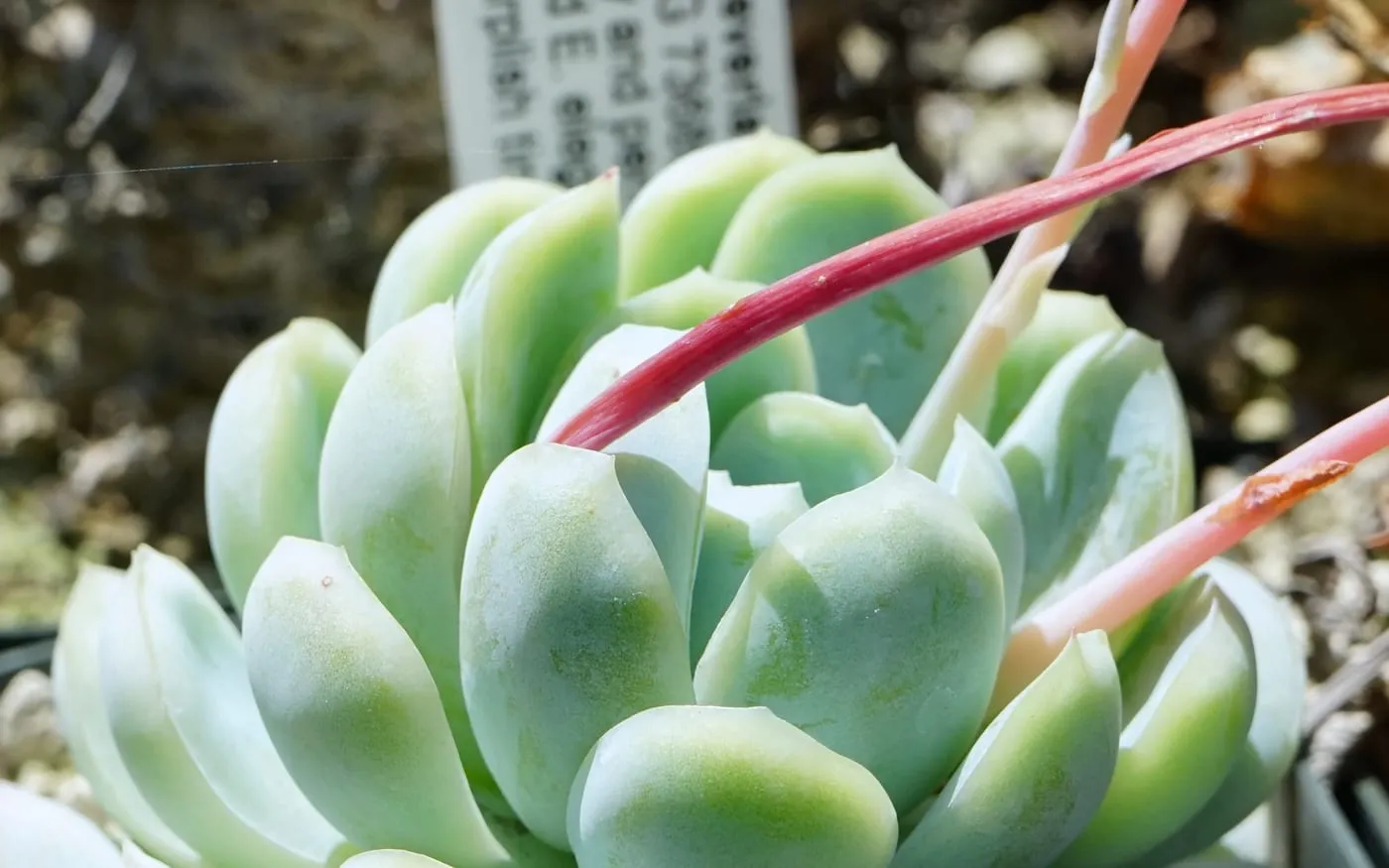
A dense rosette 8 to 15 cm across of thick, fleshy, spoon-shaped leaves in pale blue-grey, each with a fine translucent edge that catches the light and gives the plant its name.
The surface carries a whitish waxy coating called farina, which the plant secretes as sunscreen and water protection. It does not regrow on a leaf once rubbed off, though new leaves come with their own, so handle the plant by the pot.
In strong light the leaf edges flush pink. This is a healthy response to sun rather than stress.
Offsets appear around the base and form clusters, which is where the hens and chicks name comes from, though that name is more properly attached to Sempervivum.
Flowers come in late spring on a long arching stem held well above the rosette, as small pink bells with yellow tips. Unlike some succulents, the rosette survives flowering.
Where it is from
The semi-desert regions of central Mexico, on rocky limestone slopes at altitude, in bright sun with sharp drainage and low rainfall concentrated into a short wet season.
Altitude means intense light and large swings between day and night temperature, which is why the plant colours up best when it gets real sun and some coolness at night.
Rocky slopes mean water runs off within minutes. The roots never sit wet, and that is the condition hardest to reproduce in a pot of ordinary compost.
The wet season followed by months of drought is the rhythm the plant expects, and it is reproduced by drenching thoroughly and then letting the compost dry out completely.
How it grows
An evergreen succulent perennial. Growth runs from spring to autumn and slows almost to nothing in winter.
New leaves emerge from the centre of the rosette and the outermost leaves shrivel and die as the plant reabsorbs them, which means a slow steady loss of lower leaves is normal.
Offsets form on short stems around the base. Detach them once they are a reasonable size, let the cut surface dry for a few days, and press them into gritty compost.
Leaf propagation works too. Twist a healthy leaf off cleanly so the whole base comes away, leave it to callus for several days, then lay it on top of dry compost. A tiny rosette and roots form at the base over several weeks.
Beheading is the standard fix for a stretched plant. Cut the rosette off with 2 to 3 cm of stem, let it callus for a week, and root it in fresh compost. The remaining stump usually sprouts multiple offsets.
Repot every two or three years in spring into fresh gritty compost.
Through the seasons
Spring restarts growth. Repot now, remove offsets, and give the plant its first feed in May. Increase watering gradually.
Summer is the growing season. Water every one to two weeks, and put the plant outside in full sun once nights stay above about 8 deg C. Outdoor summering produces far better colour and compactness than a windowsill.
Autumn slows it down. Bring it in before the wet weather sets in, and reduce watering.
Winter is a dry rest. Water roughly monthly at most, keep it in the brightest position available, and accept that a dim winter has too little light to keep a rosette perfectly tight. Some stretching over winter is normal and can be corrected by beheading in spring.
Care difficulty
Easy, with two failure modes that account for nearly everything.
Water in the rosette rots the centre. It sits in the cup formed by the leaves, cannot evaporate, and the growing point turns to mush. Always water the compost at the side of the plant, and never mist or water from overhead.
Poor light causes etiolation, meaning the stem lengthens and the leaves space out and point upward instead of forming a flat rosette. It is cosmetic rather than fatal, and it cannot be reversed. The remedy is more light for the future and beheading to restart the shape.
Watering
Drench the compost thoroughly, then let it dry out completely before watering again. In summer that is roughly every one to two weeks; in winter, monthly or less.
Water at the soil line and keep it out of the rosette entirely. This single habit prevents the most common cause of death.
Judge by the leaves rather than a schedule. Slightly soft or wrinkled lower leaves mean the plant is ready for water. Firm plump leaves mean it needs none.
Translucent, soft, mushy leaves mean overwatering, and by the time they appear the roots are usually affected.
Bottom watering, standing the pot in a saucer for twenty minutes, is a good way to keep the rosette dry.
Never leave standing water in the saucer afterwards.
Warning signs, diseases and pests
Rot is the main killer and it comes in two forms. Water sitting in the rosette rots the growing point from the centre outward. Waterlogged compost rots the roots and then the stem base. Both are usually fatal by the time they are visible, so take healthy offsets or leaves immediately as insurance.
Etiolation shows as a lengthening stem with widely spaced leaves pointing upward rather than outward. It is a light problem. Move the plant into full sun and behead it in spring to restart the rosette.
Mealybugs hide in the rosette centre and between the leaf bases, appearing as white cottony specks. They are awkward to reach, so apply alcohol with a fine paintbrush rather than flooding the rosette.
Vine weevil grubs eat the roots and cause sudden collapse. Nematodes control them.
Shrivelled lower leaves are normal ageing. Pull them away gently when they dry.
Farina rubbed off by handling leaves permanent shiny patches. New leaves come with their coating intact.
Pale flat colour with no pink edging means not enough light.
Growing environment
Full direct sun for at least six hours. A south-facing windowsill is right, and this is a plant that wants the sun on it rather than near it. Anything less and it stretches, usually within a fortnight.
Temperatures from 0 to 35 deg C are tolerated. It survives brief light frost if the compost is completely dry, and wet plus cold kills it. Colder than USDA 9 it lives indoors over winter.
Dry air suits it. Do not mist, and do not put it with humidity-loving plants.
Compost must be gritty and sharply drained. A cactus and succulent mix, or a general compost cut half and half with grit or perlite, is right. Ordinary multipurpose compost holds too much water.
Use a shallow pot with drainage holes, and terracotta over plastic. The root system is small and a deep pot holds wet compost below it.
A gravel top-dressing keeps the lower leaves off damp compost and looks right.
Feeding
Very little. A cactus and succulent fertiliser at half strength, once in May and once in July, is the whole programme.
Stop entirely from autumn through winter.
Over-feeding produces soft floppy pale growth that loses the compact form, which is exactly the look you are trying to avoid.
Fresh compost after repotting supplies enough for the first season, so skip feeding in a year when you have repotted.
Troubleshooting
Rosette stretched with gaps between the leaves. Etiolation from too little light. Move to full sun. It will not tighten back up, so behead the rosette in spring and re-root it.
Centre gone soft and brown. Water sat in the rosette. Take any healthy offsets now. Water at the soil line in future.
Translucent mushy leaves. Overwatering. Let it dry out completely and check the compost drains.
Wrinkled shrivelled leaves. Underwatering. A good drench plumps them within a few days.
Shiny patches where the powdery coating has gone. Farina rubbed off by handling. It does not regrow on that leaf. Handle the plant by the pot.
Pale with no pink edges. Not enough direct sun.
Lower leaves drying and dying. Normal. The plant reabsorbs them as it grows.
Leaf cutting rotted instead of rooting. It was placed on damp compost before the base had callused. Let cuttings dry for several days first, and keep the compost dry until roots appear.
Mexican Snowball problem guides
Not sure what is wrong? See the common houseplant pests guide.