
Edible
Leek
Allium porrum
Also known as Garden leek, Allium ampeloprasum var. porrum
How to grow leeks, Allium porrum. Dropping seedlings into dibbed holes for a long white shank, earthing up, and dealing with leek moth and allium rust.
At a glance
- Difficulty
- Easy
- Water
- Weekly in dry weather through summer
- Light
- Full sun to light shade
- Temperature
- Very hardy. It stands in the ground through frost and snow
- Hardiness
- USDA 5-9, RHS H5, hardy to -15 C
- Type
- Biennial, grown as an annual and harvested in its first winter
- Height
- 40-60 cm
- Native to
- The eastern Mediterranean and the Middle East
- Best month
- February in the Northern Hemisphere, August in the Southern Hemisphere
Cold is what leek is for. It stands in frozen ground all winter and is harvested as needed, which is the whole point of the crop. The season is the constraint instead, since a leek wants 30 weeks or more from sowing, so a short summer means starting under cover. A cold check in spring makes an overwintered plant bolt.
Hardiness zones describe winter cold alone. Summer heat, humidity, rainfall and the length of the growing season decide as much, so treat the range as the outer limit rather than as a recommendation.
Every month named in this guide is for the temperate Northern Hemisphere. If you garden in the Southern Hemisphere, shift each one by six months, so February becomes August. Closer to the equator the wet and dry seasons matter more than the calendar, and the shift stops being a useful guide.
Toxic to pets if eaten
- Safe to eat
- The whole plant, for people
- Do not eat
- Every part, for cats, dogs and horses
- Harm from
- Eating it
- Affects
- Cats, dogs and horses
Leeks are food for people and poisonous to pets, which is true of the whole onion genus. The ASPCA lists Allium species as toxic to cats, dogs and horses. The organosulfur compounds damage red blood cells and cause Heinz body haemolytic anaemia, and the effect is cumulative rather than requiring a single large dose. Symptoms appear a day or more after eating and include vomiting, weakness, pale gums, rapid breathing and dark urine. Cats are the most susceptible of the three, and dogs are the most likely to actually eat something. Cooking does not reduce the toxicity, so leftovers and stock matter as much as raw trimmings. Leek is a realistic risk in a way that some plant toxicities are not, because a dog will happily eat a discarded leek top from a compost heap or a bowl of leek and potato soup. Keep trimmings out of reach, and be careful about giving pets leftovers containing leek, onion, garlic or shallot. For people the plant is entirely safe and has been a staple crop for several thousand years. Horses turned out on a plot where leeks have been left in the ground are also at risk.
Sources: ASPCA (Leek, Allium), RHS potentially harmful garden plants
About
Leeks are the crop that fills the hungry gap. They stand in the ground through a whole temperate winter, unbothered by frost, snow or waterlogging, and you lift them as you need them from November until March, when there is very little else to lift.
The technique that makes them worth growing is one of the odder jobs in the kitchen garden. You make a deep narrow hole with a dibber, drop a seedling in, fill the hole with water and walk away. The soil washes in around the roots on its own, and the loose earth in the hole gives the long blanched white shank that is the only part most people want.
Everything else is straightforward. Firm soil, steady watering, and a watch for leek moth, which has spread rapidly across northern Europe in the last twenty years.
Appearance and character
A biennial grown as an annual, forming a fan of leaves above a thick cylindrical stem, and reaching 40 to 60 cm.
The edible part is not a bulb. It is a shank of tightly rolled leaf bases, which is why a leek is solid all the way through and why it does not swell like an onion.
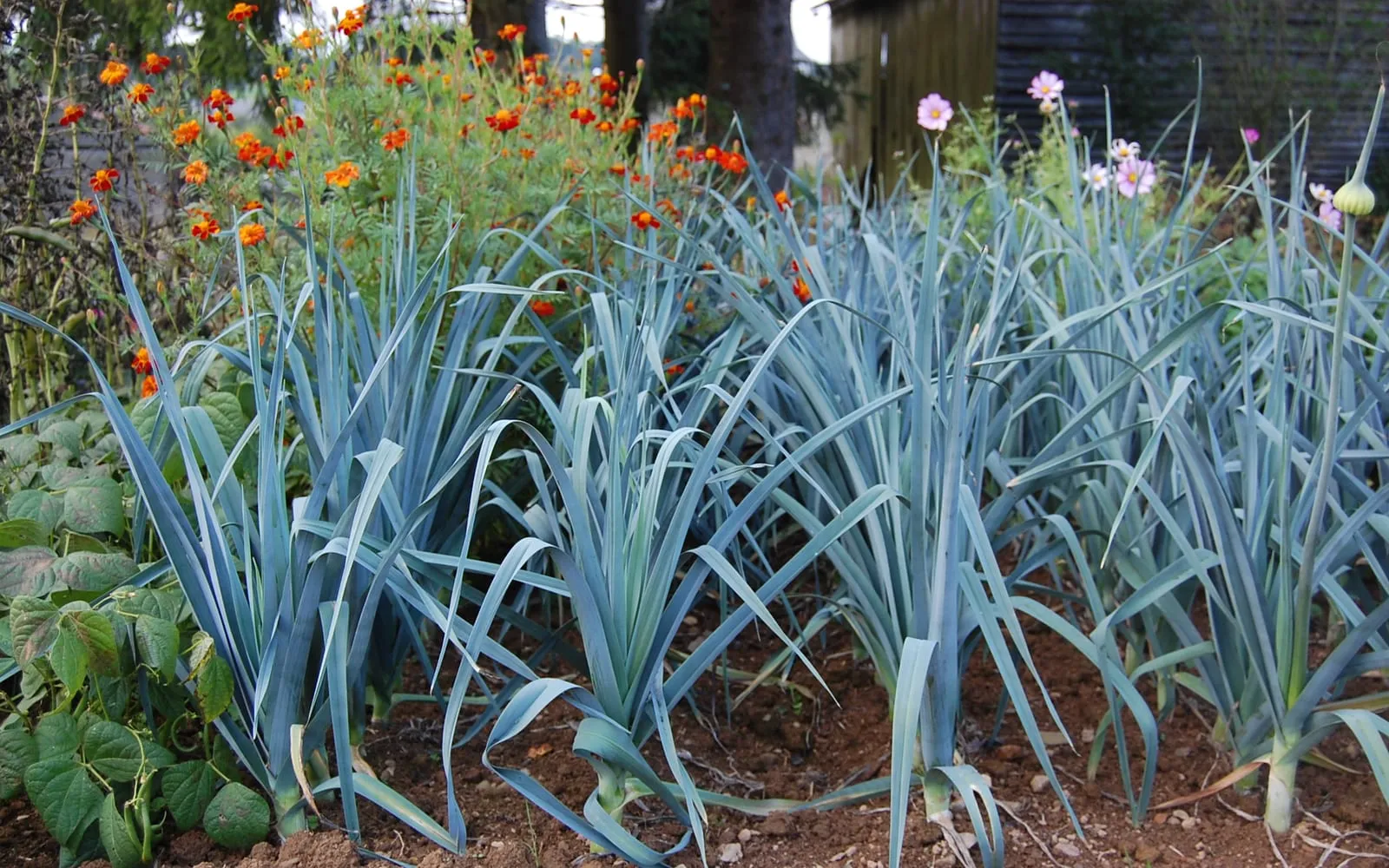
Leaves are flat, broad and strap-shaped, folded along the midrib, and range from mid-green to a strong blue-grey depending on variety. They fan out in a single plane rather than all round.
The white section is created by exclusion of light, either by planting deep or by drawing soil up around the stem. A leek grown on the surface is green almost to the base.
Flowers appear only in the second year if the plant is left, a dense globe of pale purple on a stem up to 1.5 m, and they are worth leaving for the bees on a plant that has bolted anyway.
Varieties divide by season. ‘Zermatt’ and ‘Pancho’ are early and slim for autumn, ‘Musselburgh’ is the reliable maincrop, and ‘Bandit’ and ‘Apollo’ stand hardest through late winter.
Where it is from
The eastern Mediterranean and the Middle East, derived from the wild Allium ampeloprasum, which still grows around the Mediterranean and on a few British cliffs.
Cultivation is ancient. Leeks were grown in Egypt and Mesopotamia, they appear in the Bible, and the Roman emperor Nero was mocked as Porrophagus, the leek-eater, for eating them to improve his voice.
The Romans brought them to Britain, and the leek became a staple of the medieval poor because it stands through winter and needs no storage.
The Welsh association is old and its origin unclear. One account has Welsh soldiers wearing leeks in their caps at the battle of Heathfield in 633 to distinguish themselves, and Shakespeare treats the custom as long established.
The plant’s tolerance of cold and wet is what earned it its place, and it is the reason a winter vegetable plot still finds room for them.
How it grows
Sow seed in a seedbed or in modules from February to April, thinly, about 1 cm deep. A February sowing under cover gives the longest season.
Transplant when the seedlings are pencil-thick and about 20 cm tall, usually in June.
Trim the roots to about 2 cm and the leaf tips by a third before planting, which makes handling easier and reduces water loss.
Dib and drop. Make a hole 15 to 20 cm deep with a dibber, drop one seedling in so it hangs by its leaves, and fill the hole with water. Do not backfill with soil. The watering washes enough earth around the roots, and the space in the hole is what produces the long white shank.
Space plants 15 cm apart in rows 30 cm apart. Closer spacing gives more, smaller leeks, which many people prefer.
Plant into firm ground. Leeks want soil that was manured the previous autumn and has settled, rather than freshly dug fluffy ground.
Earth up from late summer if you want more white, drawing dry soil up around the stems a little at a time. Take care not to let soil fall between the leaves.
Water steadily through summer. A check to growth is what causes bolting.
Lift from November onward with a fork, working the plant loose rather than pulling, since the shank breaks.
Leave the rest in the ground. Leeks store better in the soil than anywhere else and stand until March.
Through the seasons
Winter is harvest and sowing. Lift as needed from November through to March, and start the first sowing under cover in February.
Spring is sowing and growing on. Sow outdoors from March, and keep the seedbed weeded and watered.
Summer is transplanting. Move the seedlings into their dibbed holes in June, water them in, and watch for leek moth from May.
Autumn is earthing up and the first pull. Draw soil up around the shanks, and start lifting early varieties from October.
Care difficulty
Easy. Leeks are among the most forgiving vegetables and they occupy ground for a long time, which is the main cost of growing them.
The transplanting method looks strange and is the whole technique.
Leek moth has changed the picture in the last two decades. It was confined to the south coast and is now found across most of England and into Wales and Scotland, and it is the pest most likely to spoil a crop.
Rust is common in mild wet summers and is usually survivable.
Frost, snow and wet do nothing to them at all.
Watering
Water the seedbed and the modules consistently while the plants are small.
Water thoroughly after transplanting, which is what settles the soil around the roots.
Water weekly in dry weather through summer. Steady growth is what prevents bolting.
Reduce watering in autumn as growth slows.
Mulch between the rows to hold moisture and suppress weeds, keeping the mulch away from the shanks.
Warning signs, diseases and pests
Leek moth is the pest to know about now. Small caterpillars mine inside the leaves, leaving whitish windowpane streaks, then tunnel down into the shank where they cause rotting. There are two generations, from May and from August. Cover the crop with insect-proof mesh from May, which is the only reliable defence, and remove and destroy affected plants. Rotate the ground.
Allium rust produces bright orange pustules on the leaves, worst in mild wet summers and on plants fed too much nitrogen. It looks alarming and a moderate attack barely reduces the crop. Remove badly affected leaves, avoid overhead watering, space plants more widely, and do not compost the debris.
Allium leaf miner leaves lines of white dots on the leaves in spring and autumn, and the larvae tunnel into the shank. Mesh is again the defence.
White rot is the serious soil disease. Leaves yellow and wilt, and the base of the plant carries a fluffy white fungal growth with small black dots. It persists in soil for fifteen years or more. Destroy affected plants, never compost them, and do not grow any allium on that ground again.
Bolting, where a flower stem rises in the first year, follows a check to growth, usually cold or drought after transplanting. The plant is still edible if used promptly.
Thin weak plants usually mean loose soil, poor spacing or competition from weeds.
Growing environment
Full sun to light shade. Leeks tolerate less sun than most vegetables.
Deep, fertile, firm, well-drained soil. Dig in well-rotted manure the previous autumn and let the ground settle.
Avoid freshly dug loose ground, which gives poor anchorage and thin shanks.
Rotate the ground. Do not follow onions, garlic or leeks with more alliums, both for rust and for white rot.
Allow 15 cm between plants and 30 cm between rows, and expect them to occupy the bed from June until March.
Insect-proof mesh over the crop from May, which is now close to essential wherever leek moth has arrived.
They grow well in a deep raised bed and poorly in containers, since the roots want depth and firmness.
Feeding
Dig in well-rotted manure or compost the previous autumn. That is the main feed.
A nitrogen-rich feed in midsummer helps a crop that is growing slowly.
Stop feeding by late summer. Soft late growth is more prone to rust and to rot.
Avoid heavy nitrogen through the season, which produces lush leaves, thin shanks and worse rust.
A dressing of sulphate of potash in autumn improves winter hardiness.
Troubleshooting
Why do I fill the hole with water instead of soil? The water washes just enough earth around the roots to hold the plant, and the empty space in the hole is what lets the shank swell long and white. Backfilling with soil gives a shorter, greener leek.
How do I get a longer white section? Plant deeper, and earth up from late summer by drawing dry soil around the stems a little at a time.
Whitish streaks in the leaves and rotting shanks. Leek moth. Cover the crop with insect-proof mesh from May, destroy affected plants, and rotate.
Bright orange spots on the leaves. Allium rust. A moderate attack does little harm. Remove the worst leaves, space plants more widely, avoid nitrogen and do not compost the debris.
A flower stem has appeared in the first year. Bolting, caused by a check to growth from cold or drought. The leek is still usable if you eat it soon.
Fluffy white growth at the base with black dots. White rot. Destroy the plants, never compost them, and grow no alliums on that ground again for many years.
When can I start lifting them? From October or November for early varieties, and through to March for late ones. They keep better in the ground than out of it.
Are leeks safe for my dog? No. Like all alliums they damage red blood cells in cats, dogs and horses, and cooking does not help. Keep trimmings and leftovers out of reach.
Leek problem guides
Not sure what is wrong? See the common vegetable pests guide.