
Houseplant
Flamingo Flower
Anthurium andraeanum
Also known as Anthurium, Painter's palette, Tailflower
How to care for Anthurium andraeanum, the flamingo flower. Light, chunky compost, humidity, watering and repeat flowering.
At a glance
- Difficulty
- Moderate
- Water
- When the top 3 cm dries, roughly weekly in summer
- Light
- Bright indirect light. Direct sun burns the spathes
- Temperature
- 18-28 deg C. Below 15 deg C stops flowering
- Humidity
- 60% or higher. It struggles in dry heated rooms
- Hardiness
- USDA 11-12, RHS H1b, hardy to 15 C
- Type
- Evergreen perennial epiphyte
- Height
- 40-70 cm
- Native to
- Wet rainforest in the western Andes of Colombia and Ecuador
- Best month
- February in the Northern Hemisphere, August in the Southern Hemisphere
Rainforest Colombia and Ecuador, growing on trees rather than in soil. It wants a coarse open mix, high humidity and steady warmth, and it stops flowering below about 18 deg C. Outdoors year round only in USDA 11 and 12.
Hardiness zones describe winter cold alone. Summer heat, humidity, rainfall and the length of the growing season decide as much, so treat the range as the outer limit rather than as a recommendation.
Every month named in this guide is for the temperate Northern Hemisphere. If you garden in the Southern Hemisphere, shift each one by six months, so February becomes August. Closer to the equator the wet and dry seasons matter more than the calendar, and the shift stops being a useful guide.
Harmful if eaten
- Do not eat
- Every part, the leaves and stalks most of all
- Harm from
- Eating it and handling it
- Affects
- People, cats and dogs
Every part contains insoluble calcium oxalate raphides. The ASPCA lists Anthurium as toxic to cats and dogs, with oral irritation, burning of the mouth and tongue, drooling, vomiting and difficulty swallowing. People react the same way, and the sap can irritate skin on handling. The burning starts at once, so animals rarely take more than one bite and serious cases are uncommon. Rinse the mouth, offer something cold, and contact a vet or doctor if breathing or swallowing is affected. The glossy red spathe is exactly the kind of thing a cat bats at, so place the plant where it cannot be reached rather than relying on the taste to deter a determined animal.
Sources: ASPCA (Flamingo Flower, Anthurium andraeanum), RHS potentially harmful garden plants
About
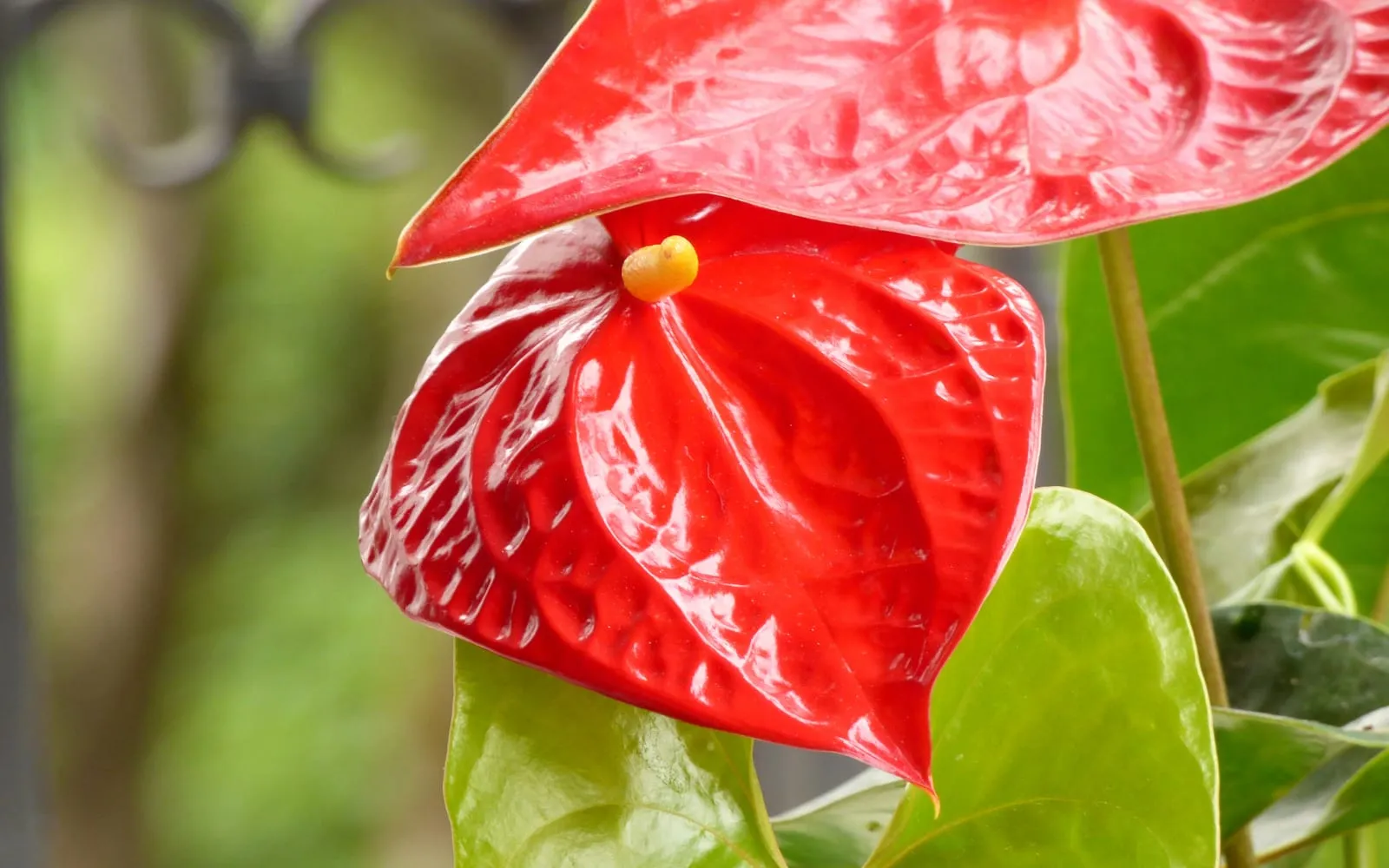
The scarlet heart everyone calls the flower is a leaf. It is a spathe, a modified bract, and its lacquered shine comes from a thickened cuticle rather than from petals. The real flowers are the hundreds of tiny bumps packed along the yellow tail in front of it, and each of those bumps is a complete flower with its own stamens and stigma.
Knowing this changes how you treat the plant. A spathe is leaf tissue, so it lasts for six to eight weeks rather than the few days a petal would manage, and it responds to light and feeding the way a leaf does.
Most anthuriums sold as houseplants fail for one reason. They are potted in dense peat-based compost that suits a fern, and their roots want the airy conditions of a tree branch.
Appearance and character
Large heart-shaped leaves, deep green and leathery, held on long stalks rising from a short thick stem at compost level. A mature plant reaches 40 to 70 cm.
The spathe emerges folded and pale, opens over several days, and holds its colour for six to eight weeks before fading and greening at the edges. Scarlet is the classic, and breeders have produced white, pink, coral, burgundy and a dark near-black.
Its surface is puckered and quilted between the veins, and glossy enough to throw a highlight, which is where the plastic-looking reputation comes from.
The spadix is the yellow or cream tail standing proud of the spathe. Watch it closely and you can see a band of open flowers moving slowly along its length.
Aerial roots push out from the stem above the compost, thick and pale. They are normal and a sign of a healthy plant.
Where it is from
The wet western slopes of the Andes in Colombia and Ecuador, in rainforest at moderate altitude, growing as an epiphyte on tree trunks and branches rather than in the ground.
Everything difficult about anthurium care follows from that. Epiphyte roots are adapted to a thin layer of moss and debris in a fork of a tree, drenched by rain several times a day and drained within minutes, with air moving through constantly.
Pack those roots into wet peat and they suffocate. The plant does not wilt dramatically to tell you; it yellows slowly over months while the roots turn to brown mush.
Humidity in that habitat sits high and constant. A heated living room in January, at 30% relative humidity, is the hardest condition this plant faces.
Temperatures stay warm and even, which is why flowering stops below about 15 deg C.
How it grows
An evergreen perennial that grows from a short upright stem, adding leaves from the top while the base slowly lengthens and sheds its oldest foliage.
Flowering runs continuously in good conditions. A well-grown plant produces a new spathe every six to eight weeks, so at any one time it carries two or three at different stages.
Over a few years the stem lifts clear of the compost on a mass of aerial roots and the plant looks bare at the base. Fix it by repotting deeper, burying the lower stem in fresh bark mix so the aerial roots take up water.
Offsets appear at the base of an established plant, and dividing them off in spring is the reliable way to propagate. Each division needs its own roots and at least two leaves.
Berries sometimes form on the spadix if the flowers get pollinated. They contain viable seed and take a long time to grow on.
Through the seasons
Spring brings the strongest growth. Repot now if the mix has broken down, divide off any offsets, and start fortnightly feeding.
Summer is peak flowering. Water roughly weekly, keep humidity up, and shade the plant from direct midday sun.
Autumn slows growth but flowering often continues. Reduce feeding from October.
Winter is the hard season indoors. Flowering usually pauses. Keep the plant above 15 deg C, well away from radiators and cold glass, water sparingly, and work at humidity. Most anthurium losses happen between December and February.
Care difficulty
Moderate, and the difficulty is concentrated in two things you can fix once and then forget.
The compost is the first. Ordinary potting compost holds too much water around roots built for a tree branch. Repotting into a coarse mix of orchid bark, perlite and a little compost solves most anthurium problems permanently.
Humidity is the second and harder one. Below about 50% the leaf tips brown and new spathes come out small and misshapen. Grouping plants, standing the pot on wet gravel, or keeping it in a bathroom all help.
Getting it to reflower is a common frustration. Most plants need brighter light plus phosphorus rather than anything exotic.
Watering
Water when the top 3 cm of the mix feels dry, roughly weekly in summer and every ten to fourteen days in winter.
Water thoroughly and let it drain freely. In a coarse bark mix most of the water runs straight through, which is exactly right. Empty the saucer afterwards.
Use rainwater or filtered water where possible. Anthuriums brown at the leaf edges in response to hard water and to chlorine.
Never let the pot stand in water. Root rot in this species is quiet and slow, and by the time the leaves yellow the damage is well advanced.
Yellow lower leaves with a sour smell from the compost mean rot. Wilting with dry, light compost means thirst, and recovery follows a soak.
Warning signs, diseases and pests
Brown crispy leaf tips are the commonest complaint and point to dry air first, hard water second and over-feeding third.
Leaves yellowing from the bottom up, with compost that stays wet, means root rot from a mix that is too dense. Repot into bark.
No flowers on a healthy-looking plant almost always means too little light. Move it closer to a window, out of direct sun.
Small, deformed or greenish spathes suggest too much nitrogen or not enough light. Switch to a higher-phosphorus feed.
Mealybugs gather where the leaf stalks meet the stem, as white fluff in the crevices. Remove them with a cotton bud dipped in surgical spirit.
Scale insects appear as brown discs on stalks and leaf undersides.
Thrips scar young spathes with silvery streaks and distort the emerging leaves. Remove the worst affected growth and improve airflow.
Bacterial blight shows as water-soaked patches with yellow haloes spreading along the leaf veins. There is no cure, so remove affected leaves promptly, keep water off the foliage, and isolate the plant.
Growing environment
Bright indirect light. An east-facing windowsill is close to perfect, and a spot a metre back from a south-facing window works. Direct sun bleaches and burns the spathes.
Too little light is the usual reason for a plant that grows leaves and no flowers.
Keep it between 18 and 28 deg C. Growth stalls below 15 deg C and cold damages the foliage below about 12 deg C.
Humidity of 60% or more suits it. A tray of damp gravel under the pot, a group of plants together, or a humidifier all beat misting, which raises humidity for only a few minutes.
The growing medium should be coarse and open. Two parts orchid bark to one part perlite and one part houseplant compost gives roots the air they need. Some growers use straight orchid bark with regular feeding.
Choose a pot only slightly larger than the root ball. Anthuriums flower better when snug.
Feeding
Feed fortnightly from April to September with a fertiliser higher in phosphorus than nitrogen, at a quarter to half the stated strength. A tomato feed or an orchid feed both work.
High-nitrogen general feeds produce large leaves and few spathes, which is the opposite of what most people want.
Stop feeding from October to March, or reduce to once a month if the room stays warm and the plant keeps flowering.
Flush the pot with clean water every couple of months to clear accumulated salts, which matter more in a bark mix than in compost.
Repot every two years. Bark breaks down, compacts and starts holding water, and fresh compost keeps anthurium roots healthy.
Troubleshooting
It has not flowered since I bought it. Light first. Move it to bright indirect light. Then switch to a phosphorus-rich feed fortnightly through summer. Most plants respond within a couple of months.
Brown tips on nearly every leaf. Dry air, or hard tap water. Raise the humidity with a gravel tray and switch to rainwater.
Leaves yellowing from the bottom. Compost too dense and too wet. Repot into a coarse bark and perlite mix and water less often.
The red part is turning green. Ordinary ageing on a spathe that has been open for weeks. Cut the stalk off at the base. If new spathes open green, the plant needs more light and less nitrogen.
Thick white roots are growing out of the stem above the soil. Aerial roots, and a healthy sign. Repot a little deeper to cover them, or wrap them in damp moss.
The plant has gone bare and leggy at the base. Normal after a few years. Repot deeper, burying the lower stem, or take the top off with its aerial roots and root it as a cutting.
Silvery streaks and distorted new growth. Thrips. Remove affected leaves, improve airflow, and check new growth regularly.
Is it safe with a cat? No. It carries the same calcium oxalate as its relatives and causes painful mouth irritation. Put it somewhere a cat cannot reach.
Flamingo Flower problem guides
Not sure what is wrong? See the common houseplant pests guide.