
Outdoor plant
Zonal Geranium
Pelargonium zonale
Also known as Horseshoe geranium, Bedding geranium, Pelargonium
How to grow zonal geraniums, Pelargonium zonale. Overwintering, deadheading, why they are not geraniums at all, and the watering habit that causes blackleg.
At a glance
- Difficulty
- Moderate
- Water
- When the top few centimetres dry out
- Light
- Full sun. Six hours minimum for flowering
- Temperature
- Frost tender. Keep above 5 deg C over winter
- Hardiness
- USDA 9-11, RHS H2, hardy to 2 C
- Type
- Tender evergreen perennial, often grown as a bedding annual
- Height
- 40-80 cm
- Native to
- The Eastern Cape and Western Cape of South Africa
- Best month
- May in the Northern Hemisphere, November in the Southern Hemisphere
This is the plant most people call a geranium, and it is not one. True hardy geraniums are cranesbills, die back each winter and take -20 C, while pelargoniums come from South Africa and are killed by the first frost. Overwinter them frost-free and nearly dry, since wet compost in a cold greenhouse rots them faster than cold does. In zone 10 they grow as woody evergreen shrubs all year.
Hardiness zones describe winter cold alone. Summer heat, humidity, rainfall and the length of the growing season decide as much, so treat the range as the outer limit rather than as a recommendation.
Every month named in this guide is for the temperate Northern Hemisphere. If you garden in the Southern Hemisphere, shift each one by six months, so May becomes November. Closer to the equator the wet and dry seasons matter more than the calendar, and the shift stops being a useful guide.
Harmful to pets if eaten
- Do not eat
- Leaves and stems
- Harm from
- Eating it and handling it
- Affects
- Cats, dogs and horses
The ASPCA lists Pelargonium species, filed under the common name geranium, as toxic to dogs, cats and horses through geraniol and linalool, with vomiting, loss of appetite, depression and dermatitis. The same page confirms the naming confusion, noting that the plants everyone calls geraniums belong to Pelargonium and differ from the true Geranium genus, which is the hardy cranesbill of temperate borders and is not listed as toxic. That distinction matters if you are checking a plant against a pet safety list, because searching the wrong name gives the wrong answer. Severity is low in practice. A dog that chews a leaf is likely to be sick and no worse. Contact with the foliage causes skin irritation in some people and some animals, and scented-leaf pelargoniums, which carry far more essential oil, are the more likely culprits.
Sources: ASPCA (Geranium, Pelargonium species), RHS potentially harmful garden plants
About
The plant everyone calls a geranium belongs to a different genus. Pelargonium comes from South Africa, is tender, and flowers all summer in a pot. Geranium is the hardy cranesbill of temperate borders, dies back each winter, and needs no protection. An eighteenth-century classification lumped them together, the correction came in 1789, and the wrong name has outlasted the right one by more than two centuries.
The distinction is practical rather than pedantic. Leaving a “geranium” outside over winter kills a pelargonium and does nothing at all to a cranesbill.
Pelargonium zonale is the wild parent behind the zonal bedding geraniums sold by the tray every May, named for the dark horseshoe band across each leaf.
Appearance and character
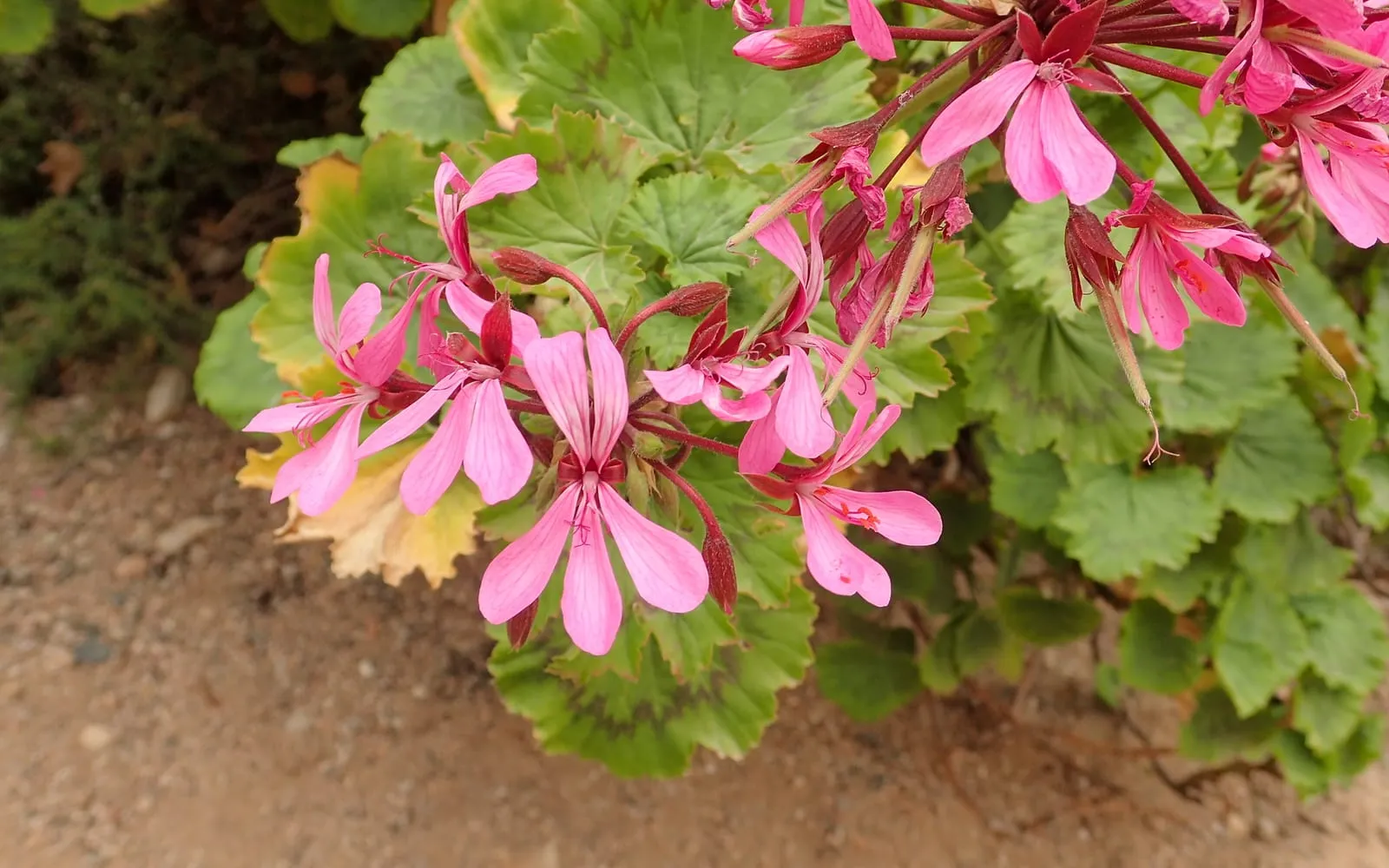
A bushy plant with rounded, slightly velvety, scallop-edged leaves, most of which carry a darker horseshoe-shaped zone. The intensity of that marking varies with light and is strongest on plants in full sun.
Flowers come in rounded clusters on long stalks held above the foliage, in red, pink, salmon, white and every shade between, and they keep coming from May until the first frost provided the dead heads are removed.
The leaves smell sharply of something between resin and pepper when brushed, and the scent is the plant’s defence against grazing.
Stems are soft and green when young, going woody and brittle at the base with age. Old plants become leggy and bare below, which is why they are usually started again from cuttings every few years.
Where it is from
The Eastern and Western Cape of South Africa, on rocky slopes and scrub in a climate of wet winters and hot dry summers.
Two things follow. The plant has no frost tolerance whatsoever, because it never met a frost. And it is adapted to drying out, storing water in fleshy stems and leaves, which is why overwatering kills far more pelargoniums than drought.
The Cape flora is famously nutrient-poor, so the plant flowers well on a lean diet and produces leaves at the expense of flowers when overfed.
How it grows
A tender evergreen perennial that never goes dormant. In its homeland it grows all year. Anywhere that frosts it is either treated as a bedding annual and discarded in autumn, or lifted and overwintered frost-free.
Flowering is continuous from late spring until the cold stops it, and it depends entirely on deadheading. Each cluster that goes to seed tells the plant it has done its job, and removing spent heads promptly keeps flowers coming.
Snap the whole flower stalk off at its base rather than picking off individual faded petals. A stub left behind rots and invites grey mould.
Cuttings are very easy. Take non-flowering shoot tips 8 to 10 cm long in August or September, strip the lower leaves, and push them into gritty compost. They root within three weeks, and this is the traditional way to carry stock through winter in a fraction of the space the parents need.
Through the seasons
Spring is for starting off. Bring overwintered plants back into growth in March, cut them back by half, repot into fresh compost and increase watering. Do not plant out until all frost risk has passed, which means late May.
Summer is the display. Deadhead weekly, feed fortnightly, and water only when the compost dries.
Autumn is the decision point. Take cuttings in early September. Lift whole plants before the first frost, cut them back by half, and keep them barely moist somewhere frost-free and bright.
Winter is survival on minimal water. A cool bright windowsill, a frost-free greenhouse or an unheated porch all work at around 5 to 10 deg C. Water perhaps once a month, just enough to stop the stems shrivelling.
Care difficulty
Moderate, and both difficulties are about water.
Overwatering causes blackleg, a stem base rot that turns the lower stem black and soft and kills the plant outright. It is commonest in spring and in winter storage, when the plant is barely growing and the compost stays wet. Let the compost dry between waterings.
Overwintering is the second. A pelargonium left outdoors in a temperate winter dies. Bringing it in and then watering it as though it were still growing kills it just as effectively.
Get those right and the plant flowers for five months without complaint.
Watering
Water thoroughly when the top few centimetres of compost have dried, then let it dry again before the next. Pelargoniums store water in their stems and tolerate dryness far better than sogginess.
Water the compost rather than the foliage. Wet leaves and flowers invite grey mould and rust.
Containers in full sun in July may need water daily. The same plant in September may need it weekly. Judge by the compost rather than the calendar.
In winter storage, water sparingly, roughly monthly. The plant should be kept just this side of shrivelling.
Standing water in a saucer is the fastest route to blackleg. Empty it.
Warning signs, diseases and pests
Blackleg is the classic pelargonium killer. The stem blackens and softens at compost level and the plant collapses, usually after a spell of cold wet compost. There is no cure. Take cuttings from healthy upper growth immediately and start again in fresh compost and a clean pot.
Pelargonium rust shows as rings of brown powdery pustules on the leaf undersides with yellow spots above, and it spreads fast in humid still air. Remove affected leaves at the first sign, bin them, improve ventilation, and avoid wetting the foliage.
Grey mould rots flowers and stems in damp weather, and it feeds on dead flower heads left on the plant, which is a practical reason to deadhead properly.
Vine weevil grubs eat the roots of container plants and cause sudden collapse. Nematodes in spring and autumn control them.
Whitefly build up under glass. Sticky traps and biological control both work.
Yellowing lower leaves with dry compost is usually underwatering or a plant needing a feed. The same symptom with wet compost points at root rot.
Growing environment
Full sun. Six hours of direct light is the minimum for good flowering, and shade gives leaves and very little else.
Frost tender, with damage starting around 2 deg C. Keep plants above 5 deg C over winter. They tolerate summer heat well and are among the best plants for a hot south-facing wall or a windowbox that bakes.
Compost should drain freely. A soil-based compost with added grit suits them better than a peat-free multipurpose that holds water. Pots should be snug rather than generous, since a large pot holds more water than the roots can use.
Moderate fertility is right. Rich compost produces lush foliage and few flowers.
Shelter from heavy rain helps. Flower heads spoil quickly when soaked, which is why pelargoniums under an eave or in a porch look better than those in an open bed during a wet August.
Feeding
A high-potassium liquid feed fortnightly from May to September. Tomato feed is ideal and considerably cheaper than anything sold as geranium food.
Stop feeding entirely from October to March. Feeding a plant that is resting builds salts and encourages soft growth that rots.
Avoid high-nitrogen fertiliser at any point in the year. It gives you a large green plant with hardly any flowers.
Repot overwintered plants into fresh compost in spring rather than feeding them harder.
Troubleshooting
Stem black and soft at the base, plant collapsed. Blackleg from overwatering. Take cuttings from the healthy top growth now and discard the parent.
Lots of leaves, almost no flowers. Too much nitrogen, too little sun, or both. Switch to a high-potassium feed and move it into full sun.
Brown powdery rings under the leaves. Pelargonium rust. Remove and bin affected leaves, improve airflow, and keep the foliage dry.
Leggy and bare at the bottom. Age. Cut the plant back by half in spring, and take cuttings to replace it.
Flowers stopped in midsummer. Deadheading has been missed. Snap off every spent stalk at its base and flowering resumes within a fortnight.
Died over winter indoors. Usually watered as though it were still growing. Keep it cool, bright and nearly dry from November to February.
Checked a pet safety list and found nothing. You searched for Geranium. The plant is a Pelargonium, and that is the entry that carries the toxicity listing.