
Edible
Blackcurrant
Ribes nigrum
Also known as Cassis, Black currant
How to grow blackcurrants, Ribes nigrum. Planting deep to make a stool, pruning a third out each winter, big bud mite and reversion, and the wartime vitamin C story.
At a glance
- Difficulty
- Easy
- Water
- Weekly in dry weather from flowering to picking
- Light
- Full sun for the best crop, tolerating light shade
- Temperature
- Very hardy. It needs winter chilling to flower well
- Hardiness
- USDA 3-8, RHS H7, hardy to -35 C
- Type
- Deciduous shrub, productive for around fifteen years
- Height
- 1.5-1.8 m
- Native to
- Northern and central Europe and northern Asia
- Best month
- July in the Northern Hemisphere, January in the Southern Hemisphere
The chill requirement is the highest of the common soft fruits at 1600 to 2000 hours below 7 deg C, so blackcurrant is close to unfruitful in mild-winter regions no matter how well it grows. Ribes species also host white pine blister rust, and several US states still restrict or ban planting them near commercial pine.
Hardiness zones describe winter cold alone. Summer heat, humidity, rainfall and the length of the growing season decide as much, so treat the range as the outer limit rather than as a recommendation.
Every month named in this guide is for the temperate Northern Hemisphere. If you garden in the Southern Hemisphere, shift each one by six months, so July becomes January. Closer to the equator the wet and dry seasons matter more than the calendar, and the shift stops being a useful guide.
Not known to be toxic
- Safe to eat
- The fruit, and the leaves as a tea
Non-toxic. Blackcurrants are a food crop and the ASPCA does not list Ribes nigrum among plants harmful to cats, dogs or horses. The berries are safe raw, though they are sharp enough that few people eat many that way, and the leaves have a long traditional use as a tea. Blackcurrants hold roughly four times the vitamin C of oranges by weight, which is why the British government promoted them heavily during the Second World War when citrus imports stopped, distributing blackcurrant syrup free to children. That programme is the origin of the drink Ribena and of the plant's continued prominence in temperate gardens. Growing them was banned across large parts of the United States for much of the twentieth century, because Ribes species host part of the life cycle of white pine blister rust, a disease of timber pines. That restriction concerns forestry rather than human safety, and it applies nowhere outside North America.
Sources: ASPCA toxic and non-toxic plants, RHS potentially harmful garden plants
About
Blackcurrants are planted differently from every other fruit bush. The plant goes in 5 to 8 cm deeper than it grew in the pot, deliberately burying the lowest buds, because blackcurrants fruit best on young shoots rising from below ground and deep planting is what produces them.
That single instruction shapes the rest of the plant’s life. A blackcurrant is managed as a stool, a cluster of stems from ground level, rather than as a bush on a leg like a gooseberry or redcurrant.
Pruning follows the same logic. Cut about a third of the oldest stems to the base each winter and the bush renews itself indefinitely.
Appearance and character
A multi-stemmed deciduous shrub reaching 1.5 to 1.8 m, with stems arising directly from below soil level.
Leaves are lobed and toothed like a small maple leaf, and they release a strong resinous blackcurrant scent when crushed. That smell is the surest identification in the garden.
Flowers are small, greenish and dull, hanging in short drooping strings in April. They are easily damaged by frost.
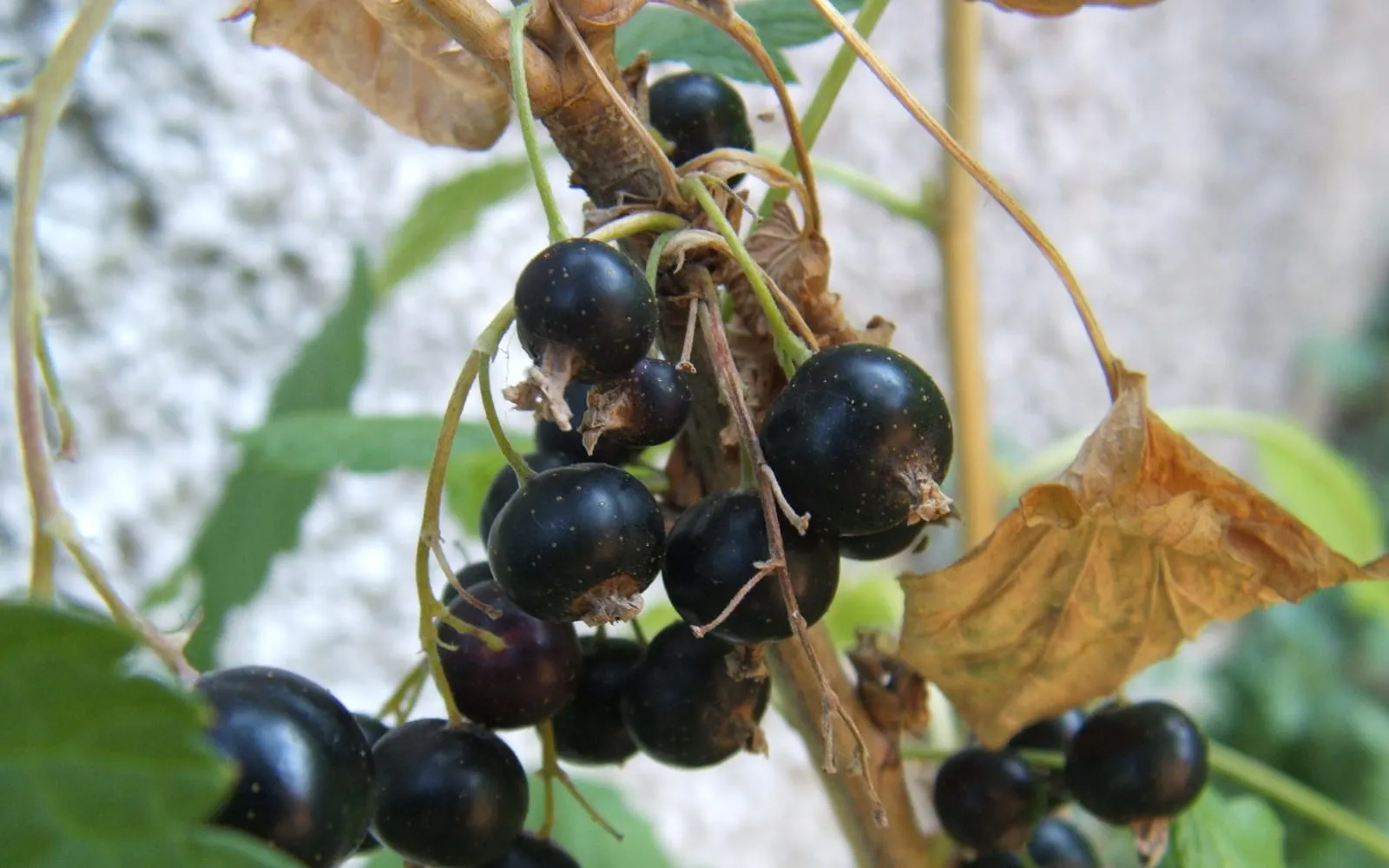
Fruit hangs in strigs, short trusses of glossy black berries each carrying a withered tuft at the tip, ripening from July.
Old wood is pale grey-brown and one-year shoots are noticeably paler and smoother, which is how you tell what to cut in winter.
Where it is from
Northern and central Europe and northern Asia, from Scandinavia across Russia to Siberia, where it grows in damp woodland, on stream banks and in wet scrub.
It was grown in Britain from the seventeenth century, mainly as a medicinal plant before it became a fruit crop, and its reputation for treating coughs and sore throats predates any knowledge of vitamin C.
Blackcurrants need real winter cold to break dormancy and flower well, they want moisture at the roots, and they tolerate heavy ground that other fruit dislikes.
Warm winters cut the crop, and southern England has occasionally had poor blackcurrant years for that reason.
The damp woodland habitat is why they accept light shade and want organic matter in quantity.
How it grows
Plant bare-root bushes from November to March, 1.5 m apart, setting them 5 to 8 cm deeper than the soil mark on the stem.
Cut every stem down to two buds above the ground after planting. This sacrifices the first year’s crop and builds a properly stooled bush that will produce for fifteen years.
New shoots arise from the base each year. Fruit is carried mainly on shoots produced the previous season, which is why the pruning is a rolling renewal.
From the third winter, cut about a quarter to a third of the stems out at ground level each year, choosing the oldest, darkest and least productive, along with anything weak, damaged or lying on the soil.
Prune in winter while dormant, between November and February, or immediately after picking if that suits you better.
Propagation is simple. Take hardwood cuttings of pencil-thick one-year wood in autumn, 20 cm long, and push them two thirds deep into a spare piece of ground. Most root by the following autumn.
Through the seasons
Winter is planting and pruning. Plant bare-root bushes, take out a third of the old wood, feed and mulch heavily.
Spring brings flowering in April, which is vulnerable to frost. Fleece a small bush on a cold night, and watch for big bud.
Summer is the crop. Water steadily from flowering, net against birds before the fruit colours, and pick whole strigs in July when the berries at the top of the strig are fully black.
Autumn is for taking cuttings and clearing fallen leaves. Mulch once the ground is wet.
Care difficulty
Easy. Blackcurrants are among the most reliable and least demanding fruit in a temperate garden.
The pruning is simple once the principle is understood, and a bush that is never pruned still fruits, just less and lower down.
Big bud mite and the reversion virus it carries are the one serious problem, and they are managed by buying certified stock and removing affected plants.
Birds are the practical nuisance and netting is essential.
Frost at flowering can reduce a crop, and the flowers are inconspicuous enough that people rarely notice the damage until the fruit fails to set.
Watering
Water weekly during dry weather from flowering through to picking. That period determines the size of the berries.
Mulch thickly each winter with well-rotted manure, which holds moisture through the summer and feeds the bush at the same time.
Blackcurrants have shallow roots and dislike drying out, so do not rely on rain in a dry June.
Avoid deep hoeing near the stems, which damages the surface roots.
Do not let the ground become waterlogged, despite the demand for moisture.
Warning signs, diseases and pests
Big bud is caused by the blackcurrant gall mite. Affected buds swell into round fat globes over winter instead of staying slim and pointed, and they fail to open in spring. Pick off and burn the swollen buds in winter. The real problem is what the mite carries, which is reversion virus.
Reversion is the disease that ends a blackcurrant’s useful life. The leaves become narrower with fewer main veins and fewer lobes, the flowers turn brighter and more magenta than the usual dull green, and the crop collapses over two or three seasons. There is no cure. Dig out and burn affected bushes and replant with certified stock elsewhere.
American gooseberry mildew coats shoot tips and fruit in a white felt that turns brown and felted. Cut out affected shoots, thin the bush for airflow, and avoid heavy nitrogen.
Currant blister aphid causes raised red or yellow blisters on the upper leaf surface. It looks alarming and rarely affects the crop.
Birds strip the fruit as it colours and will also take the buds in winter.
A bush that fruits only at the tips of tall bare stems has not been pruned for years. Renew it by taking out a third of the wood each winter for three years.
Spotted wing drosophila lays eggs in fruit while it is still ripening, and berries that looked sound can collapse within a day. It has been established across North America and Europe since 2008 and remains a quarantine priority in Australia and New Zealand.
Growing environment
Full sun for the heaviest crop, and blackcurrants tolerate light shade better than most fruit.
Deep, fertile, moisture-retentive soil, slightly acid, with as much well-rotted manure as you can supply. They are hungry plants and heavy ground suits them.
Shelter from wind, and avoid frost pockets because the April flowers are vulnerable.
Space bushes 1.5 m apart in the row.
Netting or a fruit cage is effectively essential from June.
Choose a modern variety. ‘Ben Sarek’ is compact and suits small gardens, ‘Ben Connan’ crops heavily on a small bush, and the Ben series generally flowers late enough to dodge frost and carries mildew resistance.
Feeding
Feed generously. Blackcurrants are among the hungriest fruit bushes and respond directly to nitrogen, unlike most fruit.
Apply a nitrogen-rich fertiliser in late winter, before growth starts.
Mulch thickly with well-rotted manure every winter. This is the single most best thing you can do for the crop.
Add sulphate of potash in spring on light soils.
Avoid lime. Blackcurrants prefer slightly acid ground.
Troubleshooting
Fat round buds in winter that never open. Big bud mite. Pick them off and burn them, and watch for reversion virus, which the mite carries.
Narrow leaves with fewer veins and brighter flowers, and no fruit. Reversion virus. There is no cure. Dig the bush out and burn it, and replant certified stock in fresh ground.
Fruit only at the tops of tall bare stems. Years without pruning. Take out a third of the oldest stems at ground level each winter for three years.
White felt on the shoot tips and berries. American gooseberry mildew. Cut out affected shoots and thin the bush for airflow.
The birds took everything. Net before the fruit starts to colour, not after.
Flowers but no fruit. Frost at flowering in April. Fleece a small bush overnight, and choose a late-flowering variety such as one of the Ben series.
How deep do I plant? Deeper than it grew in the pot, by 5 to 8 cm, burying the lowest buds so new stems come from below ground.
Should I cut it all down after planting? Yes. Cutting to two buds sacrifices one year and produces a far better bush for the following fifteen.
Blackcurrant problem guides
Not sure what is wrong? See the common vegetable pests guide.