
Outdoor plant
Wall Cotoneaster
Cotoneaster horizontalis
Also known as Rock cotoneaster, Herringbone cotoneaster, Fishbone cotoneaster
How to grow wall cotoneaster, Cotoneaster horizontalis. The herringbone branching that identifies it, training it flat against a wall, berries for birds and the law on planting it in the wild.
At a glance
- Difficulty
- Easy
- Water
- Rarely once established
- Light
- Full sun to partial shade, and it fruits best in sun
- Temperature
- Fully hardy, to about -25 deg C
- Hardiness
- USDA 5-8, RHS H6, hardy to -25 C
- Type
- Deciduous shrub, long lived and slow to build
- Height
- 0.5-1 m free-standing, and 2-3 m if trained up a wall
- Native to
- Western China, on rocky mountain slopes in Sichuan and Yunnan
- Best month
- October in the Northern Hemisphere, April in the Southern Hemisphere
Almost any soil, cold, wind and drought are taken without complaint, and birds spread the berries for miles. That combination has made several species legal problems. Listing under Schedule 9 of the Wildlife and Countryside Act in Britain makes it an offence to plant it or cause it to grow in the wild, and cotoneasters are also declared weeds in New Zealand and parts of Australia and invasive on limestone through the American Pacific north-west.
Hardiness zones describe winter cold alone. Summer heat, humidity, rainfall and the length of the growing season decide as much, so treat the range as the outer limit rather than as a recommendation.
Every month named in this guide is for the temperate Northern Hemisphere. If you garden in the Southern Hemisphere, shift each one by six months, so October becomes April. Closer to the equator the wet and dry seasons matter more than the calendar, and the shift stops being a useful guide.
Harmful if eaten
- Do not eat
- The berries and the seeds inside them
- Harm from
- Eating it
- Affects
- People, cats and dogs
Cotoneaster berries are listed by the RHS as harmful if eaten, and they contain cyanogenic glycosides in the seed in the same way that apple pips and cherry stones do. The quantity involved is small. A child who eats one or two berries is very unlikely to come to harm, and the usual outcome of eating more is stomach upset rather than poisoning, partly because the seeds pass through whole unless they are chewed. That said, the berries are red, abundant, at child height and produced in enormous numbers, so this is a plant worth knowing about in a garden with small children. Birds eat the berries in quantity with no ill effect, which is how the plant spreads. Cotoneaster is not listed by the ASPCA as toxic to cats or dogs, and a dog eating a few windfall berries is a minor concern rather than an emergency. Seek advice if a child has eaten a large handful, particularly if the berries were chewed.
Sources: RHS potentially harmful garden plants, ASPCA toxic and non-toxic plants
About
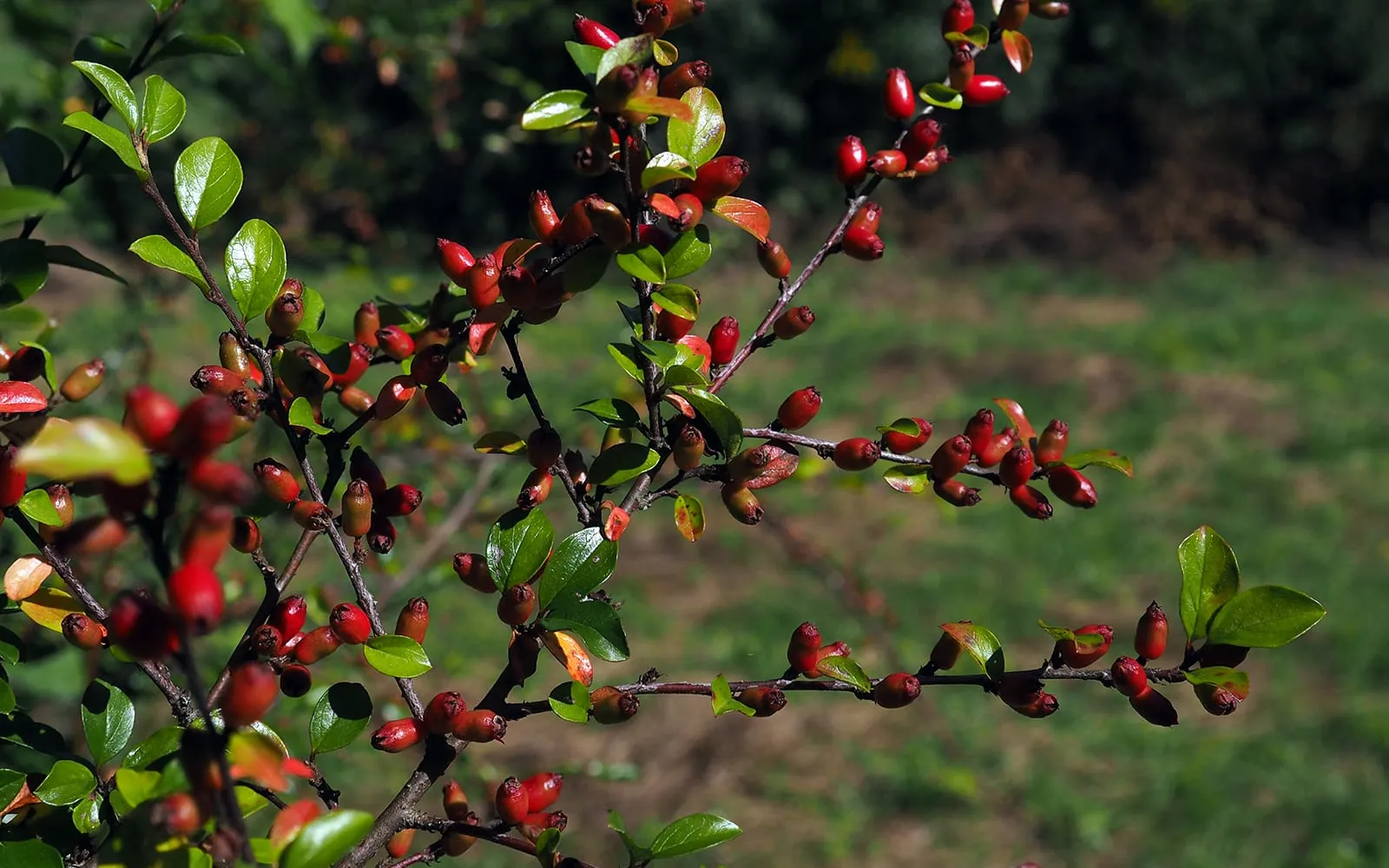
Wall cotoneaster is the shrub with the herringbone branches, flat against a wall or spilling over a low bank, red with berries from September.
It does a job few other plants manage. It will grow flat against a cold north or east wall, in poor dry soil at the foot of it, and still fruit heavily. Gardeners reach for it when nothing else will cover a difficult vertical surface without support wires.
Its berries are among the best bird food in an autumn garden, taken by blackbirds, thrushes, waxwings and blackcaps.
That last quality is also why the plant has a legal dimension in Britain. Birds carry the seed, the shrub establishes on limestone cliffs and grassland, and it crowds out scarce native plants there. New Zealand and several Australian states list cotoneasters as weeds for the same reason. Several species are listed under Schedule 9 of the Wildlife and Countryside Act 1981 in Britain, making it an offence to plant them or cause them to grow in the wild. Check the current listing before planting one near open countryside, since the schedule has been amended more than once.
Appearance and character
A stiff deciduous shrub, usually 0.5 to 1 m tall as a free-standing plant and spreading two or three times as wide, and reaching 2 to 3 m if trained up a wall.
The branching is the identification. Shoots divide in one flat plane into regular opposite side branches, producing the fishbone or herringbone pattern the plant is named for. No other common cotoneaster does this so precisely.
Leaves are tiny, no more than 1 cm, round to oval, glossy dark green above, held in two neat rows along the spray. They turn red and orange before falling and hang on late.
Flowers appear in May and June and are easy to miss, small, pinkish-white, five-petalled and barely opening. Bees find them regardless and the plant hums in early summer.
Berries ripen bright scarlet from September, round, about 5 mm across, sitting directly on the stems rather than in clusters, and persisting until the birds take them.
The plant is deciduous, and in a mild winter it holds its leaves long enough to look semi-evergreen.
Where it is from
Western China, in Sichuan and Yunnan, growing on rocky mountain slopes and cliff faces.
It was collected by Père Armand David and introduced to Britain in the 1870s.
The cliff habitat is the whole explanation for its garden behaviour. A plant adapted to grow flat against rock in thin soil takes to a garden wall without being asked, tolerates drought and poor ground, and is entirely hardy.
It is now naturalised across much of Britain, particularly on limestone, and is recorded as a problem on species-rich calcareous grassland where it shades out smaller native plants.
How it grows
Plant between autumn and early spring, in sun or partial shade, in any soil that is not waterlogged.
Set it about 30 to 45 cm from a wall, angling the rootball towards the wall, and the plant leans towards it and fastens itself flat without wires or ties.
It does not climb. It has no tendrils, suckers or aerial roots, and it grows flat against a surface and stacks its sprays upwards.
Prune as little as possible. The herringbone pattern is the ornament, and hacking at it with shears destroys the character and removes the berries.
Where a cut is needed, take whole branches out at a fork rather than shortening them. Do this in late winter, accepting that anything you remove costs you berries.
Do not clip it as a formal hedge. It is not that kind of plant.
Propagate from semi-ripe cuttings in summer, or lift the self-sown seedlings that appear underneath it.
Through the seasons
Winter shows the bare herringbone at its clearest, and the last berries go to thrushes and waxwings. This is the time for any structural pruning.
Spring brings small glossy leaves along the sprays in April.
Summer is the flowering, which is inconspicuous to look at and loud with bees. Fruit begins to set behind it.
Autumn is the point of the plant. Berries turn scarlet from September and the leaves colour red and orange around them. Pull any seedlings you find.
Care difficulty
Easy. It survives drought, chalk, clay, shade, wind, salt and neglect.
Nothing about it needs regular attention. It requires no feeding, no watering once established, no support and no annual pruning.
The two common failures are fireblight, which can kill a plant outright, and over-pruning, which is self-inflicted and much more common.
It is slow to start. A young plant sits and does very little for two seasons before it begins to spread, and this is normal rather than a sign of a problem.
Watering
Water through the first summer after planting, particularly at the foot of a wall, which is one of the driest positions in any garden.
After that it needs nothing. The plant grows naturally on cliffs and is thoroughly drought tolerant.
Remember the rain shadow of a wall when planting. Soil 30 cm from a house wall can stay dry through a wet week, so a new plant there needs watching for longer than one in an open border.
Waterlogging is the one soil condition it dislikes. It will not thrive in a wet hollow.
Warning signs, diseases and pests
Fireblight is the serious disease. It is caused by Erwinia amylovora, and it kills shoots from the tip backwards, leaving blackened leaves that hang on as though scorched. Cut affected branches out at least 60 cm into healthy wood, disinfect tools between cuts, and burn the prunings. It spreads in warm wet weather and can move to apples, pears and hawthorn, so it matters more near an orchard.
Cotoneaster webber moth caterpillars spin dense silk webbing over whole sprays in early summer and strip the leaves inside it, leaving brown patches that look like scorch until you see the webbing. Cut out and bin the affected sprays. The plant recovers.
Woolly aphid appears as tufts of white fluff along the stems, most often in the joints. It is unsightly, rarely serious, and can be washed off with a jet of water.
Silver leaf and honey fungus both attack cotoneaster and both can be fatal. Silver leaf gives a silvery sheen to the leaves and a dark stain in cut wood, and honey fungus produces white fungal sheets under the bark at the base.
Sparse berries usually mean too much shade or too much pruning. Berries form on older wood, so a plant cut back hard each year will never fruit well.
Seedlings under the plant and in nearby paving should be pulled, both because they are hard to remove later and because of the legal position on spread into the wild.
Growing environment
Full sun to partial shade. It will grow on a north wall and it fruits far better with some sun.
Any soil, including chalk, heavy clay, sand and builder’s rubble. It is one of the most reliable shrubs for thin alkaline ground.
Exposure is no obstacle. It stands coastal salt wind and cold, and it is used on motorway banks for exactly that reason.
Classic positions are flat against a wall, over a low retaining wall where it can cascade, on a steep bank as ground cover, or beside steps.
Allow it room to spread sideways. A plant given 2 m of wall will fill it, and one squeezed into 60 cm will look wrong.
Consider the native alternatives if you garden near limestone grassland or open countryside. Guelder rose, spindle and hawthorn all give berries for birds without the invasive record, and hawthorn is covered in its own guide here.
Feeding
No feeding is needed on ordinary soil.
Mulch with compost in the spring after planting, which helps more by conserving moisture at the foot of a wall than by supplying nutrients.
Avoid nitrogen-rich feeds, which push leafy growth at the expense of flowers and therefore berries.
A plant fruiting poorly is nearly always short of sun or has been pruned too hard, rather than being short of food.
Troubleshooting
Is this the herringbone one? Look at the branching. C. horizontalis divides in one flat plane into regular opposite side shoots, like a fish skeleton. If the stems arch in all directions, it is a different cotoneaster.
Does it need wires or trellis to climb? No. Plant it 30 to 45 cm from the wall and angle it towards the surface, and it grows flat against it unaided.
Can I clip it into shape? Better not to. Shearing destroys the herringbone and removes the wood that carries berries. Take out whole branches at a fork in late winter if you must reduce it.
Hardly any berries this year. Too much shade, or too much pruning. Berries come on older wood, so a plant cut back annually will never fruit properly.
Whole sections have gone brown and are covered in webbing. Cotoneaster webber moth. Cut out the webbed sprays and bin them. The plant recovers.
Blackened shoots that look burnt and stay on the plant. Fireblight. Cut back at least 60 cm into clean wood, disinfect tools between cuts, and burn the prunings.
Is it illegal to plant? Several Cotoneaster species are listed under Schedule 9 of the Wildlife and Countryside Act 1981, which makes planting them or causing them to grow in the wild an offence. Growing one in a garden remains lawful. Check the current schedule before planting near open countryside, since it has been amended more than once.
Are the berries dangerous to children? They are listed as harmful if eaten. One or two are very unlikely to cause harm, a large chewed handful warrants advice, and the main realistic outcome is stomach upset.