
Outdoor plant
English Holly
Ilex aquifolium
Also known as Holly, Common holly, Christ's thorn
How to grow English holly, Ilex aquifolium. Planting, clipping, hedging, why your holly has no berries, and how poisonous those berries are.
At a glance
- Difficulty
- Moderate
- Water
- Rain is enough once it is established
- Light
- Full sun to deep shade
- Temperature
- Fully hardy, down to about -20 deg C
- Hardiness
- USDA 6-9, RHS H6, hardy to -20 C
- Type
- Evergreen tree or large shrub
- Height
- Up to 15 m, far less in most gardens
- Native to
- Western and southern Europe, North Africa, Western Asia
- Best month
- December in the Northern Hemisphere, June in the Southern Hemisphere
Shade and salt wind are both fine and hot dry summers are not, so it wants a maritime or humid climate rather than a continental one. Berries need a female plant and a male within flying distance of a bee. It is a listed noxious weed in Oregon and Washington and a problem in New Zealand and coastal British Columbia, where birds drop it into native forest and the shade-tolerant seedlings persist. American holly, Ilex opaca, is the equivalent to plant through the eastern United States.
Hardiness zones describe winter cold alone. Summer heat, humidity, rainfall and the length of the growing season decide as much, so treat the range as the outer limit rather than as a recommendation.
Every month named in this guide is for the temperate Northern Hemisphere. If you garden in the Southern Hemisphere, shift each one by six months, so December becomes June. Closer to the equator the wet and dry seasons matter more than the calendar, and the shift stops being a useful guide.
Toxic if eaten
- Do not eat
- The berries
- Harm from
- Eating it
- Affects
- People, cats, dogs and horses
The berries are the risk and children at Christmas are who they reach. They contain saponins, which strip the lining of the gut and bring on vomiting, diarrhoea, stomach pain and drowsiness. A small child can be unwell after swallowing as few as two, and the National Capital Poison Center advises treating any deliberate handful as worth a call. The leaves are spiny and bitter enough that they rarely get eaten. Cats, dogs and horses react the same way, though the ASPCA's entry covers the American species Ilex opaca rather than this one; the genus shares the same saponins and the advice does not change. Keep cut sprigs off low tables, out of reach in wreaths and garlands, and sweep up dropped berries.
Sources: National Capital Poison Center, ASPCA (American holly)
About
Holly is a native European tree that most people only think about for two weeks a year. It makes one of the best evergreen hedges available, takes clipping without complaint, grows in shade that defeats almost everything else, and feeds birds through the part of winter when there is nothing else left.
It is also slow, and that is the honest catch. A holly hedge is a decade of patience. What you get at the end of it is a barrier that keeps its leaves, blocks noise and wind, shrugs off salt spray and pollution, and outlives you.
If you are here because your holly has no berries, skip to the troubleshooting. Your plant is almost certainly male.
Appearance and character
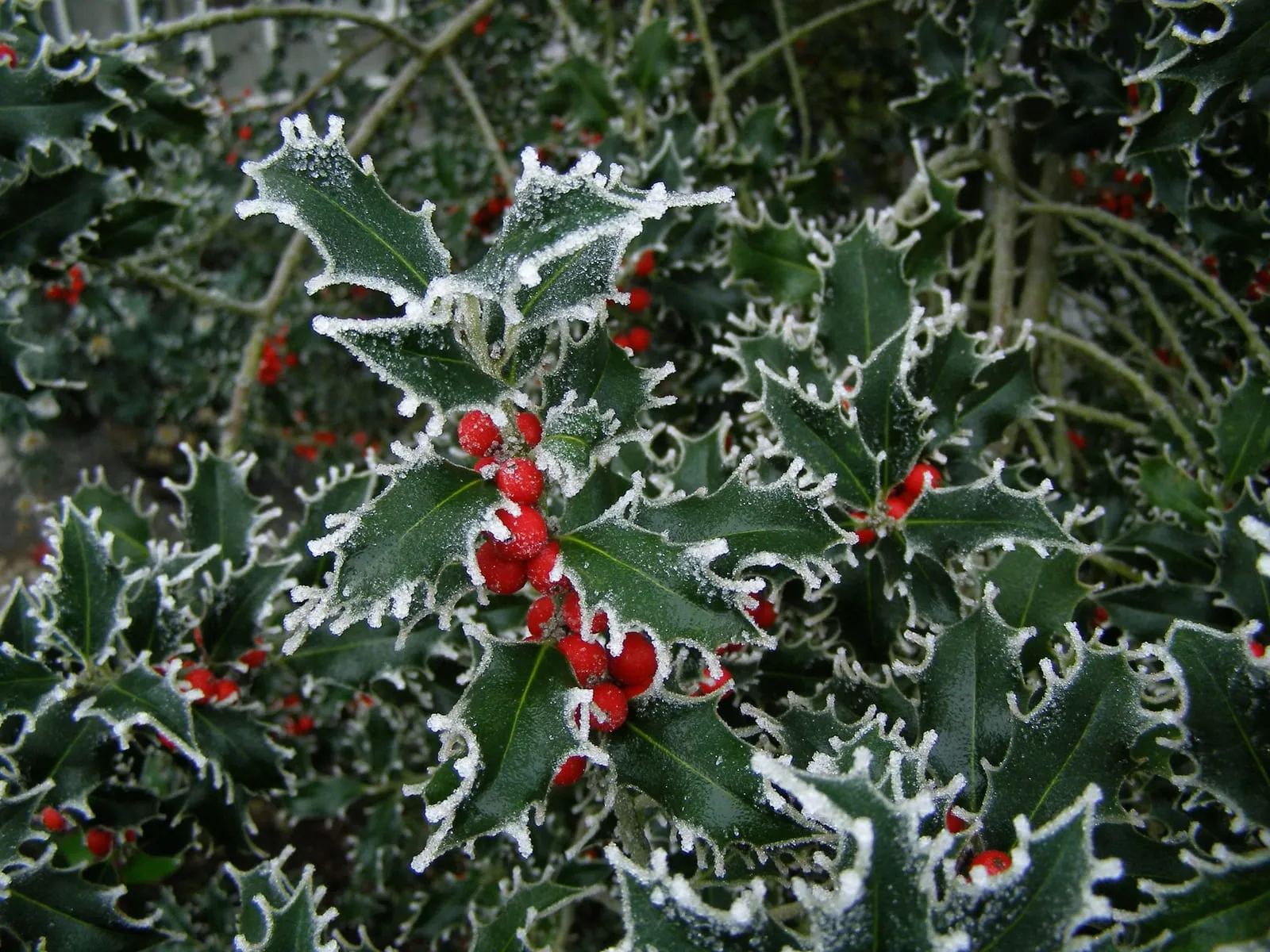
Dark glossy leaves with a hard waxy cuticle, small white flowers in May, and on female plants the red berries that follow.
The spines are the interesting part. Look up a mature holly and you will find the leaves near the ground are fiercely spiny while the ones above about two and a half metres are smooth-edged ovals with a single point. The plant grows armour where deer and cattle can reach and stops paying for it higher up. It is a good thing to show a child in a wood.
The berries are technically drupes and they are poor food. Birds strip rowan, hawthorn and elder first and come to holly when there is nothing else, which is exactly why the berries are still there at Christmas. Mistle thrushes will guard a laden holly and drive other birds off it for weeks.
Holly wood is the whitest of any European timber, and the leaves take years to rot down because of that tough cuticle.
Where it is from
Western and southern Europe, North Africa and western Asia, and native throughout Britain and Ireland. It grows as an understorey tree in oak and beech woodland.
Growing up beneath a canopy is why it tolerates shade better than nearly any other evergreen you can plant, and why it has no particular soil preference. It handles acid woodland floor and thin chalk equally well, provided the ground drains.
How it grows
An evergreen tree or large shrub, reaching 15 m over a very long life, though a garden plant clipped as a hedge or a specimen sits far below that. Expect around 10-20 cm of growth a year once established, and less than that in shade.
Holly is dioecious. Male and female flowers are borne on separate plants, so berries need a female plant with a male somewhere within range of a bee. Nothing about a plant out of flower tells you which you have.
The cultivar names mislead, and this catches out experienced gardeners. ‘Golden King’ is female and bears berries. ‘Golden Queen’ is male and never will. Buy by the label’s stated sex, or buy a plant in berry in autumn and take the evidence in front of you. ‘J.C. van Tol’ is self-fertile and berries without a partner, which makes it the sensible choice where there is only room for one.
Through the seasons
Winter is when it earns its keep. Berries hold on the plant, and the evergreen cover gives shelter to birds. Cut sprigs for the house if you want, which does the plant no harm.
Spring brings the new growth flush, and small white flowers in May. Feed now. Do not clip a hedge in spring unless you are willing to lose the year’s berries.
Summer is the time to clip. Late July and August, after flowering, is the traditional window and it lets the cuts close before autumn.
Autumn is planting season, and the best time to buy, because a plant in berry is a plant whose sex you can see. Plant while the ground is still warm so roots move before winter.
Care difficulty
Moderate, and all of it sits in the first two years and in one decision.
The decision is sex, and getting it wrong costs you a decade before you find out. The first two years are about watering, because a newly planted holly can sit and do nothing visible for a full season while it puts roots down, and it is easy to conclude it is dead and neglect it.
After that a holly in the ground is close to unkillable.
Watering
Water a new holly weekly through its first two growing seasons, and more often in a dry spell. Evergreens planted in spring are the most vulnerable, because they carry a full head of leaves losing water while the roots are still in the shape of the pot they came from.
Once established it is drought-tolerant and rain will do.
Holly in a container is a different plant and needs watering all year, winter included. Wind on a frozen day pulls water out of evergreen leaves that frozen compost cannot replace, and the plant browns off from what looks like cold but is thirst.
Warning signs, diseases and pests
Holly leaf miner leaves pale yellow-brown blotches winding through the leaves. It is the larva of a small fly, Phytomyza ilicis, that lives nowhere but holly. It is cosmetic. The tree is not harmed, the blotches are not spreading to anything else, and no treatment is worth the trouble. Pick off the worst leaves if it bothers you.
Holly leaf blight is the one that matters, caused by Phytophthora ilicis. It shows as black blotches on leaves, blackened stem tissue, and heavy leaf drop, usually after a wet mild winter and worst on hedges packed tightly together. Clear and burn the fallen leaves, thin the growth to move air through the plant, and avoid clipping in wet weather.
Holly aphid, Aphis ilicis, curls and distorts the new spring growth and coats it in honeydew. It is unsightly and rarely worth intervening over, since predators arrive and deal with it.
Leaf scorch and browning after a hard winter usually means wind and frozen ground rather than disease, and the plant grows out of it.
Growing environment
Holly grows from full sun to deep shade, which is an unusually wide range for an evergreen. The trade-off is berries. Flowering and fruiting are best in full sun or light shade, so a holly planted for berries wants light, and a holly planted as a screen at the dark end of a garden will be perfectly happy without ever fruiting much.
Variegated cultivars need more light than green ones to hold their colouring, and they grow more slowly.
It is fully hardy to about -20 deg C, and takes coastal exposure, salt-laden wind and urban pollution better than most trees. Almost any soil suits it as long as it drains, from acid through neutral to chalk.
It resents root disturbance and establishes badly from large plants. Buy a small pot-grown holly rather than a big one and it will overtake the big one within a few years.
Feeding
A balanced slow-release granular fertiliser once in spring, scattered around the root zone and watered in, is all a specimen holly needs.
A clipped hedge is a different case. You remove growth twice a year and take the nutrients with it, so feed in spring and again after the summer clip. Variegated cultivars are less vigorous and benefit more than green-leaved ones.
Mulch with well-rotted compost or bark, keeping the material clear of the trunk so it does not sit against the bark and rot it. Holly is not fussy about pH and needs no lime or ericaceous treatment.
Troubleshooting
No berries. Your plant is male, or it is female with no male nearby, or it is too young. Check the cultivar name against a nursery list rather than guessing from it, since ‘Golden King’ is female and ‘Golden Queen’ is male. Plant a male within a few hundred metres, or replace with the self-fertile ‘J.C. van Tol’.
Berries one year and none the next. A spring clip removed the flowering wood. Clip in late summer instead.
Blotchy pale tunnels in the leaves. Holly leaf miner. Harmless. Leave it.
Leaves going black and dropping heavily. Holly leaf blight, especially after a wet winter. Clear and burn fallen leaves and open up the plant to let air through.
Leaf drop in May and June. Normal. Evergreen does not mean the leaves last forever, and holly sheds its oldest leaves as the new flush comes through.
Green shoots on a variegated plant. Reversion. Cut those shoots right out as soon as you see them, because they grow faster than the variegated growth and will take the plant over.
Nothing happening at all in the first year. Usually normal. Holly puts roots down before it puts on top growth. Keep watering.
Browning after a cold snap, especially in a pot. Wind and frozen compost, not frost damage as such. Water it whenever the compost thaws.