
Outdoor plant
Cabbage Tree
Cordyline australis
Also known as Cabbage palm, Torbay palm, New Zealand cabbage tree, Ti kouka
How to grow cabbage palm, Cordyline australis. Why it is not a palm, tying the leaves up for winter, what to do when the trunk rots after a hard frost and how it regrows from the base.
At a glance
- Difficulty
- Easy
- Water
- Rarely in the ground, and weekly in a pot in summer
- Light
- Full sun, and it thins and leans in shade
- Temperature
- Hardy to about -5 to -10 deg C, and cut down by harder winters
- Hardiness
- USDA 9-11, RHS H4, hardy to -8 C
- Type
- Evergreen tree, long lived and slow to branch
- Height
- Up to 12 m in New Zealand, and commonly 3-5 m elsewhere
- Native to
- New Zealand, in open country, wetland margins and forest edges
- Best month
- November in the Northern Hemisphere, May in the Southern Hemisphere
It comes from New Zealand and takes damp ground and salt wind without difficulty, so winter wet is not the killer here that it is for most tender plants. Cold drying wind is, and below about -8 C the leaves brown and the growing point can rot. Tie the leaves up over the crown through winter in a marginal climate to keep water out of the centre.
Hardiness zones describe winter cold alone. Summer heat, humidity, rainfall and the length of the growing season decide as much, so treat the range as the outer limit rather than as a recommendation.
Every month named in this guide is for the temperate Northern Hemisphere. If you garden in the Southern Hemisphere, shift each one by six months, so November becomes May. Closer to the equator the wet and dry seasons matter more than the calendar, and the shift stops being a useful guide.
Not known to be toxic
Cordyline australis is not listed by the RHS as a potentially harmful garden plant and is not recorded by the ASPCA as toxic to cats, dogs or horses. In New Zealand the plant is a traditional food, and the cooked stem and root of ti kouka were an important carbohydrate source for Maori, which is where the name cabbage tree comes from. The important caution is a naming one rather than a chemical one. Several houseplants sold as Cordyline, particularly Cordyline fruticosa, the ti plant or Hawaiian ti, are listed by the ASPCA as toxic to cats and dogs because they contain saponins, and eating them causes vomiting, sometimes with blood, and drooling. Those are different species from the hardy outdoor cabbage tree, and a pet owner reading a warning about Cordyline needs to know which plant it applies to. The genuine hazard from a garden specimen is physical. The leaf tips are stiff and sharp and sit at eye level on a young plant, so site it away from paths where children run.
Sources: ASPCA toxic and non-toxic plants, RHS potentially harmful garden plants
About
The cabbage tree gives a temperate front garden an instant subtropical look, which is why so many seaside towns are full of them. Torquay adopted it so thoroughly that one of its common names in Britain is Torbay palm.
It is not a palm. It is a monocot in the asparagus family, closer to a yucca or a dracaena than to anything with fronds, and the difference matters because it explains how the plant behaves after damage.
A palm has a single growing point and dies if you lose it. A cordyline does not. Cut one down, or let a hard winter kill the top, and it usually regrows from dormant buds at the base, often as several stems where there was one.
That resilience is the thing to hold on to, because these plants look catastrophic after a bad winter and are frequently dug up while still alive.
Appearance and character
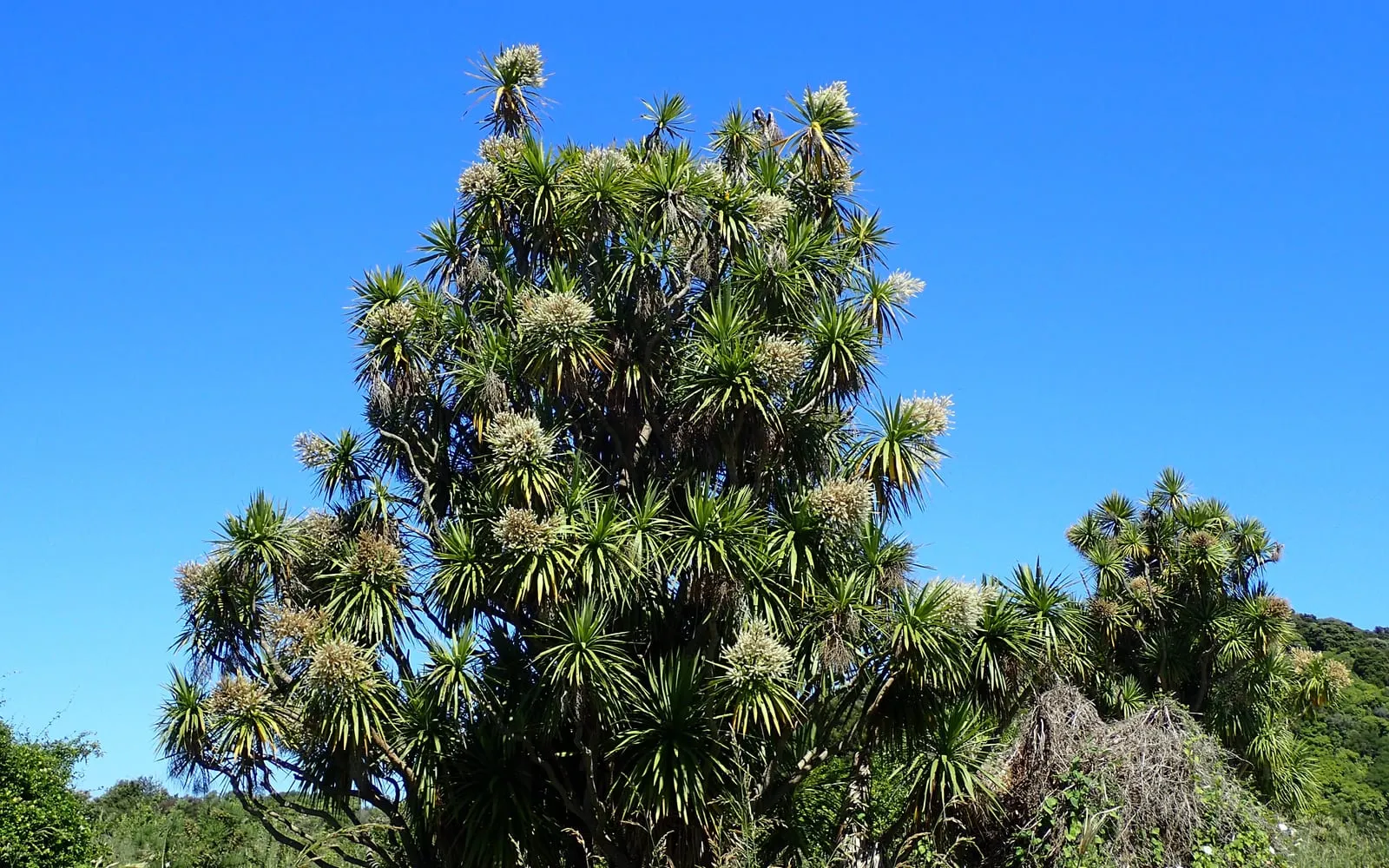
An evergreen tree growing as a single unbranched stem topped by a dense rosette of leaves, reaching 12 m in New Zealand and more commonly 3 to 5 m in cooler climates.
Leaves are long and strap-shaped, 30 to 90 cm, stiff, grey-green, arching outwards and downwards, with a sharp point. Bronze, purple and variegated cultivars are widely sold and are generally less hardy than the green species.
The trunk is pale grey-brown, rough and fibrous rather than woody in the usual sense, and it thickens slowly.
Branching begins only after the plant flowers. A one-stemmed cordyline that suddenly becomes a candelabra has flowered, and that is normal rather than a problem.
Flowers appear on mature plants in early summer as large branching panicles of small creamy-white blooms, and the scent is powerful and sweet, filling a garden on a warm evening.
Small pale blue-white berries follow, and seedlings appear around established plants in mild areas.
Old dead leaves hang down in a brown skirt beneath the rosette unless they are pulled off.
Where it is from
New Zealand, across both main islands, growing in open country, on wetland margins, in damp hollows and along forest edges.
It is one of the most recognisable trees in the New Zealand landscape and is frequently left standing in cleared farmland.
Maori cultivated it as ti kouka and used the cooked stems and roots as a carbohydrate source, and the fibrous leaves for cordage and weaving.
It reached Britain in the 1820s and took hold in the mild wet west and along the south coast, where the climate is close enough to its native range to suit it.
It tolerates damp ground naturally, and what causes trouble is winter wet combined with cold rather than moisture in the growing season.
How it grows
Plant in late spring, which gives a full season of root growth before the first winter. Autumn planting is a common cause of losses.
Choose full sun and free-draining soil. Improve heavy ground with grit, and avoid positions where water stands in winter.
Young plants are the vulnerable ones. A cordyline under about a metre is far more easily killed by cold than an established specimen with a thick trunk.
Protect through winter for the first few years in colder or inland gardens. The standard method is to gather the leaves upward into a loose bundle and tie them with soft twine.
That does two useful things at once. It keeps frost off the growing point in the centre of the rosette, and it stops rain collecting in the crown and freezing there, which is what rots the plant.
Add a thick dry mulch of straw or bark over the root zone in cold areas, and wrap the trunk with fleece where winters are hard.
Remove dead brown leaves by pulling them downwards, or cut them close to the stem for a tidier finish.
Cut a damaged trunk back to healthy tissue in late spring rather than in autumn. New shoots usually appear from the base or lower stem within a few months.
Through the seasons
Winter is the risk. Tie the leaves up, keep the crown dry, and expect some leaf browning in any case.
Spring is when you find out what survived. Wait until May before deciding a plant is dead, since regrowth from the base is often late.
Summer is growth and, on mature plants, the scented flower panicles.
Autumn is the time to improve drainage and prepare protection rather than to plant, prune or feed.
Care difficulty
Easy in a mild coastal garden and moderate inland.
The plant needs very little attention in the growing season. It is drought tolerant once established, needs no pruning, and has few pests outdoors.
Everything difficult about it happens in winter, and almost all of it comes down to the combination of cold and wet rather than cold alone. A cordyline in sharply drained soil survives temperatures that kill one sitting in wet clay.
Bronze and variegated cultivars are noticeably less hardy than the plain green species and are better grown in pots that can be moved under cover.
Watering
Water regularly through the first two summers after planting.
Established plants in the ground rarely need watering in a temperate climate.
Container plants need consistent water through summer and much less in winter. A pot that stays sodden through a cold winter is the most reliable way to kill one.
The distinction that matters is between summer moisture, which the plant is used to, and winter waterlogging, which it is not.
Warning signs, diseases and pests
Winter damage is the main event. Leaves brown from the tips, the rosette collapses, and in a bad case the top of the trunk goes soft. Do not dig the plant up. Cut back to firm tissue in late spring and wait, because dormant buds along the stem and at the base very often break into new growth.
Cordyline slime flux is a bacterial infection that follows frost damage. The trunk develops a soft rotten patch that oozes a dark, foul-smelling liquid. Cut the stem right down below the affected area, dispose of the material rather than composting it, and allow the plant to regrow from the base.
A trunk that has gone soft and hollow all the way down is dead, and the base may still shoot. Give it until midsummer before giving up.
Leaf spot causes brown or purple blotches in wet seasons and is cosmetic.
Scale insects and mealybug affect plants grown under glass or indoors rather than outdoor specimens.
A brown skirt of dead leaves is normal and not a disease. Pull it off.
Sudden multiple branching is not a symptom of anything. It follows flowering.
Growing environment
Full sun. Shade produces sparse, drawn growth and a leaning stem.
Free-draining soil is the requirement that matters most. Sandy and gravelly soils suit it, and heavy clay needs grit worked in and preferably a raised position.
Shelter from cold drying wind helps, particularly inland. Coastal wind and salt are tolerated well.
Mild areas of the west and south are where it thrives. In a cold inland garden treat it as a plant needing winter protection, or grow it in a pot.
Give it space and site it away from paths, doorways and play areas. The leaf tips are stiff and sharp and sit at eye level on a young plant.
It works well in a large container, which also allows it to be moved into shelter for winter. Use a soil-based compost and make sure the pot drains freely.
Feeding
A balanced general-purpose fertiliser in spring is sufficient for a plant in the ground.
Container plants benefit from a monthly balanced liquid feed through the growing season and a top-dressing of fresh compost each spring.
Stop feeding by late summer. Late nitrogen produces soft growth that is much more easily damaged by the first frosts.
A plant with pale leaves in a pot has usually exhausted its compost. One with brown leaf tips in the ground is more likely reacting to cold or drought than to a nutrient shortage.
Troubleshooting
A hard winter has killed it. Should I dig it up? Probably not, and certainly not yet. Cut back to firm tissue in late spring and wait until midsummer. Cordylines regularly regrow from dormant buds at the base after the whole top has died.
The trunk is oozing smelly brown liquid. Slime flux, a bacterial rot following frost damage. Cut the stem down below the rot, bin the material, and let it reshoot from the base.
How do I protect it over winter? Gather the leaves upwards into a loose bundle and tie them with soft twine, which keeps the growing point dry and frost-free. Mulch the roots, and fleece the trunk in cold areas.
Is it a palm? No. It is closer to a yucca or a dracaena. That is good news, because unlike a true palm it can regrow after the top is destroyed.
It suddenly split into several heads. It has flowered. Branching after flowering is normal for this plant.
There is a brown skirt of dead leaves under the top. Normal. Pull them downwards or cut them close to the stem.
Is it poisonous to cats and dogs? The hardy outdoor cabbage tree is not listed as toxic. Be careful with the name though, since the indoor Cordyline fruticosa, the ti plant, is listed by the ASPCA as toxic to cats and dogs.
Which are the hardiest? The plain green species. Bronze, purple and variegated cultivars are noticeably more tender and suit pots that can be moved under cover.