
Pest
Mealybug
Pseudococcidae
Also called Mealy bug, White fluff on houseplants
Mealybugs look like small blobs of cotton wool in leaf axils, roots and joints. Their waxy covering blocks many sprays, so repeated wiping and isolation matter more than one treatment.
At a glance
- Type
- Pest
- Cause
- Insect
- Severity
- Weakens the plant
- Affects
- Houseplants, Herbs and edibles
- Active
- All year
- Established in
- Worldwide
What you are seeing
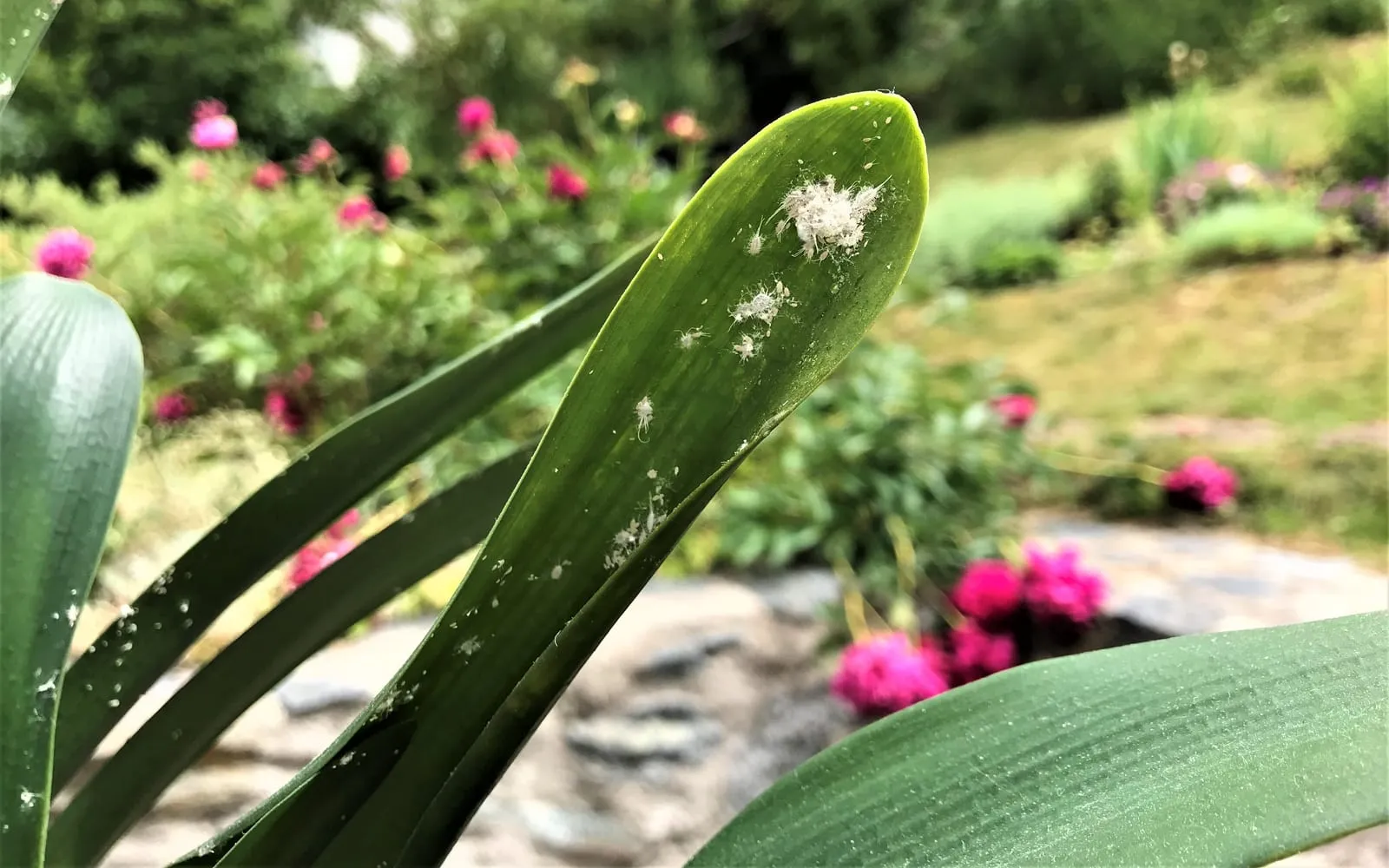
- Small blobs of white waxy fluff wedged into leaf joints, stem forks and the crown of the plant
- A pale oval insect under the fluff, segmented, with short filaments round its edge, which moves slowly when prodded
- Sticky honeydew on the leaves below, and on the shelf or floor under the pot
- Black sooty mould developing on the honeydew
- New growth small, pale and puckered while the rest of the plant looks well
- White fluff on the roots and the inside of the pot when a plant is knocked out, which is a different species
Before you treat anything
Surgical spirit is flammable and an irritant. Use it in a ventilated room, away from any flame, and keep it off your skin and out of reach of children. Test it on one leaf and wait a day before treating a whole plant, because it marks the waxy bloom on echeverias and browns the fronds of ferns.
What you are looking at
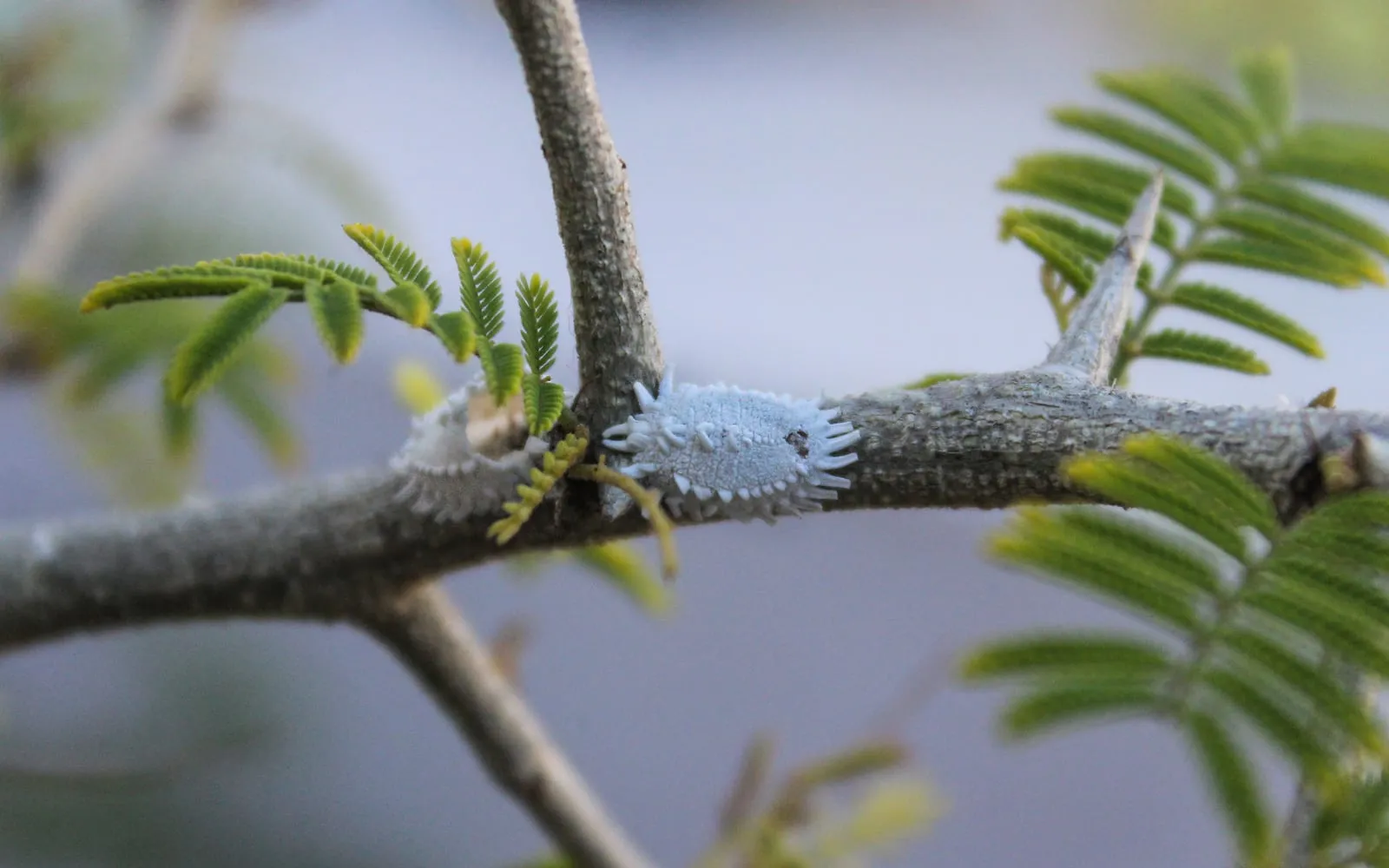
Blobs of white fluff, two or three millimetres across, pushed into the angle where a leaf meets a stem. They look like specks of cotton wool or a patch of mould, and most people treat them as one of the two for several weeks before finding out otherwise.
Pull the fluff apart with a pin. Underneath is a soft, flat-oval insect, pale pink or grey, plainly segmented across the back, with a fringe of short waxy filaments round the edge and sometimes a pair of longer ones at the tail. Prod it and it moves, slowly. A scale insect in the same position would not.
The wax is the animal’s own secretion and it is the reason for everything that follows. It is water-repellent, so a spray runs off it, and it forms a sealed sac around the eggs.
Where they hide
They sit wherever two surfaces meet and the air is still. Leaf axils and stem forks first, then the underside of a leaf along the midrib, the crown of a cactus or a succulent, the sheaths of an orchid, the underside of the pot rim and the drainage holes. A plant that looks clean from three feet away can be carrying two hundred insects in places nobody looks.
One group has given up on the foliage entirely. Root mealybugs live in the compost, feeding on the roots, and produce white powdery deposits against the inside of the pot. The plant sulks, stops growing and slowly declines, and because nothing shows above the surface the owner usually treats it for something else for a year.
Why they keep coming back
A female produces one to two hundred eggs inside a waxy sac, and the crawlers that hatch from it are small, mobile and pale enough to be invisible against a leaf. Indoors, with no cold season to interrupt them, generations overlap continuously and there is never a point at which the population is only adults.
That is why a single treatment fails. Whatever you apply reaches the insects you can see and nothing else, and ten days later the eggs hatch. Anyone who cleans a hoya thoroughly, declares it dealt with and finds fluff again a fortnight later has met the arithmetic rather than made a mistake.
Four rounds, a week apart, is the shape of a treatment that works.
What the damage amounts to
They feed on phloem sap and a light infestation costs an established plant almost nothing. What builds up is chronic. Growth slows, new leaves come through small and puckered, older leaves yellow and drop, and after a year the plant has stopped looking like itself.
Honeydew is the visible nuisance. It falls onto the leaves below and onto the furniture, black sooty mould grows on it, and the mould blocks light without infecting anything. Wash it off with plain water once the insects above it have gone.
Small plants, seedlings and cuttings can be killed outright. So can anything carrying root mealybug, which removes the root system while the leaves are still telling you the plant is merely unhappy.
What to do about them
Get a cotton bud and a bottle of surgical spirit. Touch each insect directly. The alcohol dissolves the wax on contact and the animal dies where it sits, and you can see that it has worked because the white blob collapses to a wet smear. It takes ten minutes on a hoya and it is more reliable than anything sold in a bottle.
Work through every crevice while you are there, and go back weekly for a month. Wash a firm-leaved plant down in the shower between rounds to take off the honeydew and any crawlers.
Where a whole shoot is coated, cut it out. On a fast-growing plant this costs a few weeks and removes a source that would otherwise reinfest everything you have just cleaned.
When you repot, look at the roots. If they carry white powder, wash every trace of the old compost off under a tap, scrub or replace the pot, and start again in fresh compost. Nothing applied to the leaves gets anywhere near a root mealybug.
Be willing to give up on one plant to save the rest. A heavily infested specimen with mealybugs in every crevice sitting on a shelf of clean plants is a decision rather than a patient.
Why no spray is listed here
The wax coating repels water, so a water-based spray beads off the insect and runs down the leaf. Getting a spray to work at all means wetting it to the point of running, into crevices a droplet cannot reach, on the underside of every leaf, repeatedly. That is a poor use of a product that also kills anything else soft-bodied it lands on.
Fatty acid and plant oil products work by smothering, which means the same coverage problem with the same result, and they will kill introduced Cryptolaemus larvae as readily as the pest. A cotton bud does not.
What it gets mistaken for
Woolly aphid produces similar white fluff but sits on woody stems and branch cracks of apples, pyracantha and cotoneaster outdoors rather than in the leaf axils of a houseplant, and the insects beneath it are aphids with cornicles.
Scale insects are immobile brown or yellowish domes stuck to a stem or a vein, with no wax fringe, and they do not move at all when pushed.
Powdery mildew is a flat film across the surface of a leaf blade rather than a raised blob in a joint, and it wipes off in a clear track rather than smearing.
The white flecks in an aphid colony are shed skins, and they blow away when you breathe on them.
A white crust on the surface of the compost or the outside of a terracotta pot is mineral salts from hard water and fertiliser. It is chalky rather than fluffy, and there is nothing under it.
What to do, in order
Start here
Prevention, and the changes that stop the problem returning. Most of these pages should end at this tier.
- Quarantine every new plant for a month
- Almost every infestation arrives on a plant from a shop, a swap or a cutting. Keep new arrivals in another room and look into the leaf joints weekly. A month is long enough for eggs already present to hatch and show themselves.
- Look in the crevices once a month
- They sit where two surfaces meet, so run through the leaf axils, the stem forks, the underside of the midrib, the crown of a succulent and the rim of the pot. Ten seconds a plant catches an infestation at five insects rather than five hundred.
- Check the roots whenever you repot
- Root mealybugs are a separate group that live entirely below the surface and never appear on the foliage. The plant stops growing and nobody can see why. Slide the root ball out and look for white powdery deposits against the inside of the pot.
- Keep prone plants apart
- Crawlers walk between touching leaves, so a shelf of cacti or a tray of orchids with foliage in contact behaves as one plant. A hand's width between pots slows the spread to something you can get ahead of.
- Go easy on nitrogen
- Soft, sappy, heavily fed growth carries larger colonies than firm growth does. A balanced feed at the rate on the bottle, and none at all through the darkest months, gives the plant tougher tissue to defend.
Then reach for a barrier
Netting, hand removal and water. Nothing here harms anything except the target.
- Touch each one with a cotton bud dipped in surgical spirit
- The wax that makes a spray useless dissolves on contact with alcohol, and the insect underneath dies immediately. This is slow, it is precise, and on a houseplant it beats everything else. Test one leaf first, since surgical spirit marks the bloom on some succulents and scorches ferns.
- Repeat weekly for a month
- Eggs sit in a waxy sac and survive anything applied to the adults, so a single thorough pass is always followed by a second wave ten days later. Four rounds a week apart clears what one round never will.
- Wash the plant down
- On a firm-leaved plant, a jet of tepid water in the shower removes most of the loose colonies and the honeydew with them. Follow with the cotton bud for the ones lodged in the crown.
- Cut out a badly infested shoot
- A stem carrying dozens is a source that will reinfest everything you clean, and on a fast-growing plant it costs less than the treatment would. Bag it rather than leaving it beside the pot.
- For root mealybug, wash the roots and start again
- Knock the plant out, wash every trace of compost off the roots under a tap, discard the old compost and the pot or scrub the pot out, and repot into fresh. Nothing applied to the leaves reaches them.
Then bring in the predators
Encourage what already lives in the garden, and buy predators in where the problem is under glass and nothing will arrive on its own.
- Introduce Cryptolaemus montrouzieri under glass
- The mealybug destroyer is a small dark ladybird whose larvae eat little else. It needs about 20 degrees C and good light, so a conservatory or a heated greenhouse suits it and a north-facing sitting room does not.Sold by licensed biocontrol suppliers across Europe, North America, Australia and New Zealand, where it is already approved for release. Buy from a supplier in your own country: importing a live agent yourself is an offence in most of them.
- Learn to recognise its larva before you clean the plant
- Cryptolaemus larvae are covered in white waxy filaments and look remarkably like large mealybugs, which is the point of the disguise. They are longer, they move purposefully, and people who have just paid for them wipe them off by mistake every year.
- Use Leptomastix dactylopii against citrus mealybug
- A parasitoid wasp that lays in the mealybug and leaves a swollen brown mummy behind. It works on Planococcus citri specifically, needs warmth, and suits a greenhouse citrus or vine rather than a windowsill.
Biological controls are live organisms and their sale and release are regulated country by country. An agent sold freely in one place may be unapproved in another, so buy from a licensed supplier where you live and never import or move one yourself.
In pictures
Plants affected
Guides that name it among the problems to watch for. The list is the plants it is characteristic of rather than everything it will feed on.
A common houseplant pest
This is one of the pests and problems that houseplant owners meet most often. See it alongside the others, with a quick table for telling them apart, on the houseplant pests guide.
Common houseplant pests