
Houseplant
Moth Orchid
Phalaenopsis amabilis
Also known as Moon orchid, Phalaenopsis, Phal
How to grow a moth orchid, Phalaenopsis. Watering an epiphyte, reading the roots, the temperature drop that triggers a new spike, and where to cut the old one.
At a glance
- Difficulty
- Easy
- Water
- When the roots turn silvery-white, usually weekly
- Light
- Bright indirect light. An east window is close to ideal
- Temperature
- 18-28 deg C by day. A cool autumn spell triggers flowering
- Humidity
- 50-70 per cent preferred. Ordinary rooms are usually acceptable
- Hardiness
- USDA 11-12, RHS H1b, hardy to 15 C
- Type
- Evergreen epiphytic perennial
- Height
- 30-60 cm
- Native to
- Southeast Asia, Northern Australia
- Best month
- November in the Northern Hemisphere, May in the Southern Hemisphere
Lowland tropical forest across south-east Asia, growing on trunks in deep shade. A drop of about 6 deg C between day and night for two or three weeks is what triggers a flower spike, which is why a plant in a room of even temperature stays in leaf. Outdoors year round only in USDA 11 and 12.
Hardiness zones describe winter cold alone. Summer heat, humidity, rainfall and the length of the growing season decide as much, so treat the range as the outer limit rather than as a recommendation.
Every month named in this guide is for the temperate Northern Hemisphere. If you garden in the Southern Hemisphere, shift each one by six months, so November becomes May. Closer to the equator the wet and dry seasons matter more than the calendar, and the shift stops being a useful guide.
Not known to be toxic
Non-toxic. The ASPCA lists Phalaenopsis as non-toxic to dogs, cats and horses, and moth orchids do not appear on the RHS list of potentially harmful garden plants. This is the answer most people come looking for, because an orchid is a common gift and it usually arrives in a house without anyone asking. No part of the plant carries a toxin, and a cat that chews a leaf or eats a fallen flower will come to no harm from it. The whole Orchidaceae family has a good safety record, and vanilla, which is the seed pod of an orchid, is eaten worldwide. The only sensible caution has nothing to do with the plant. Orchids are often sold in decorative pots with ornamental gravel, moss or florist's wire, and those are a choking or obstruction risk for an animal that chews. The plant is safe; the packaging may not be.
Sources: ASPCA (Phalaenopsis orchid, Phalaenopsis sp), RHS potentially harmful garden plants
About
Moth orchids have a reputation for difficulty that they no longer deserve. Mass propagation has made them cheap, and they are among the easiest flowering houseplants to keep alive. What they are is unfamiliar, because almost every instinct built up on other houseplants is wrong here.
The plant grows on trees rather than in soil. Its roots are green, photosynthetic, and covered in a spongy layer that absorbs water in minutes and then needs air. Putting that in a pot of compost drowns it, which is why orchids come in bark and clear plastic.
Flowers last two to four months, which is longer than almost anything else you can buy in a pot.
Appearance and character
A short central stem carrying broad, thick, glossy leaves in opposite pairs, usually four to six at a time. There is no bulb, no cane and no branching, so the plant is compact and stays that way.
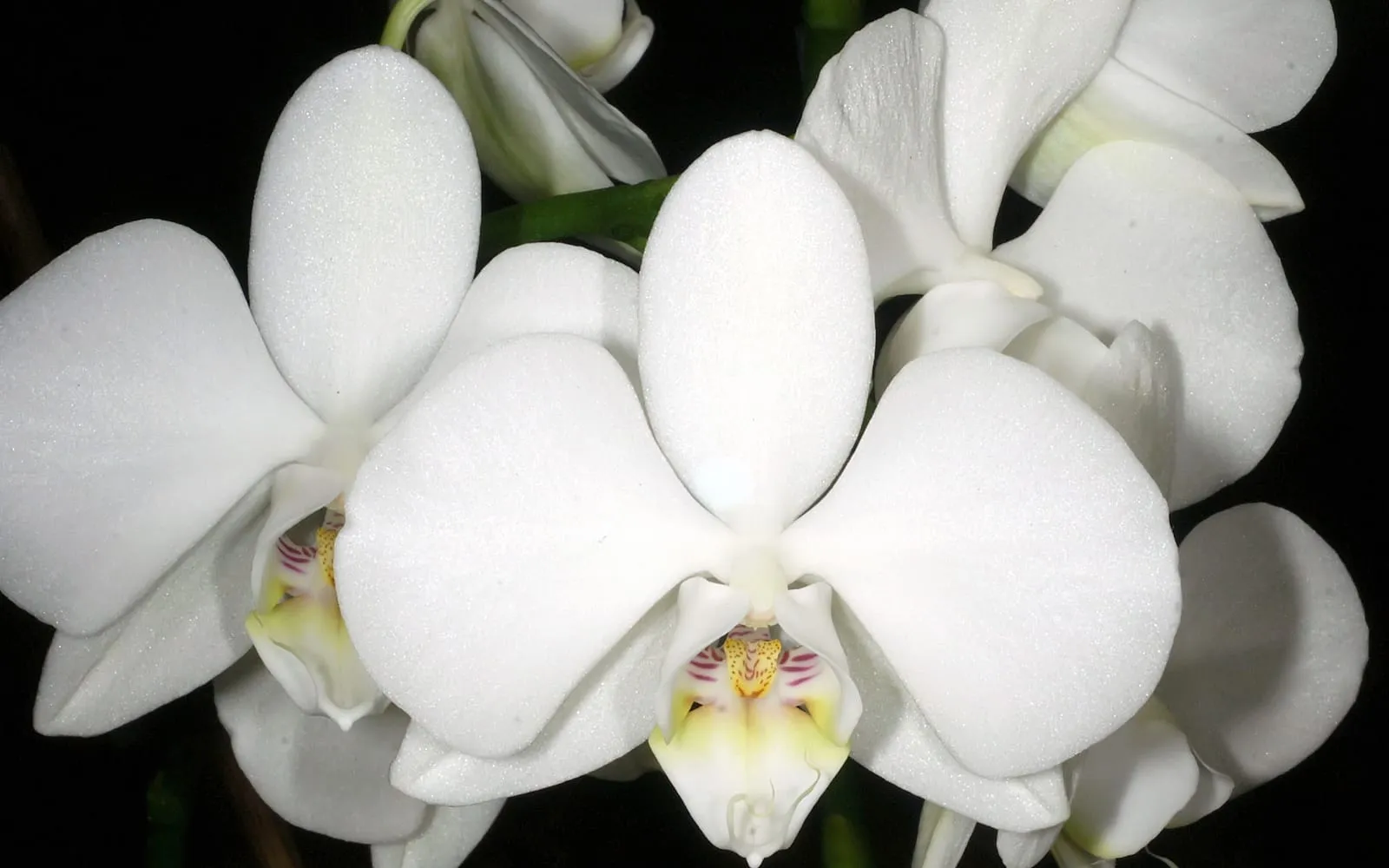
Flower spikes arch out from between the lower leaves and carry a succession of wide flat blooms, opening from the base of the spike outward over several weeks. Flowers are white, pink, yellow, spotted, striped or nearly red depending on the hybrid.
Roots are the most informative part of the plant. Healthy roots are firm and bright green when wet, silvery-white when dry, with a green growing tip. That colour change is the watering indicator, and it is why the pot is transparent.
Aerial roots wander out of the pot and into the air. They are working normally and should be left alone rather than tucked back into the bark.
Where it is from
Southeast Asia and northern Australia, from India through Indonesia and the Philippines to Queensland, growing as an epiphyte on tree trunks and branches in warm humid lowland forest.
Epiphyte means it perches on another plant without parasitising it. The roots grip bark, take moisture from rain and humid air, and dry out between downpours within a few hours.
That drying cycle is the thing to reproduce. Roots that stay wet rot; roots that never get wet shrivel.
Light under a forest canopy is bright and filtered, never direct. Temperatures are warm and steady, with a modest drop at night, and it is a deeper autumn version of that drop which triggers flowering.
How it grows
An evergreen monopodial orchid, meaning it grows from a single point at the top of the stem rather than spreading sideways. Each new leaf appears above the last, and the oldest leaf at the bottom eventually yellows and falls.
A healthy plant produces two or three new leaves a year. Fewer than that means too little light or feed.
Flower spikes emerge from between the leaves, most often in autumn and winter. They are triggered by a drop in night temperature to around 15 to 17 deg C for three to four weeks, which usually happens on its own in a heated house in October.
When flowering finishes there is a choice. Cut the spike right back to the base and the plant puts its energy into leaves and roots, giving a stronger spike next season. Cut it just above a node partway up the spike and it will often branch into a secondary flowering within a couple of months, at the cost of some vigour.
Repot every two years into fresh bark, since bark breaks down and holds water as it does, and old bark is a common hidden cause of root rot.
Through the seasons
Spring is for repotting, done just after flowering finishes. Fresh bark, a clear pot, and trimming away any dead roots.
Summer is the growing season. Water weekly, feed at quarter strength with most waterings, and watch for new leaves. Keep it out of direct sun, which is strongest now.
Autumn is the trigger. Cooler nights of 15 to 17 deg C for three or four weeks initiate the flower spike. A windowsill in an unheated room does this naturally. Once a spike appears, stake it loosely as it lengthens.
Winter is flowering. Keep the plant away from cold glass and from radiators, water a little less, and avoid moving it once the buds have formed.
Care difficulty
Easy, and the difficulty is unlearning rather than learning.
Do not plant it in compost. Do not water it on a fixed schedule. Do not cut off the aerial roots. Do not let water sit in the crown where the leaves meet.
The last of those is the one that kills plants. Water pooling in the leaf junction rots the growing point, and since the plant grows from that single point, the damage is fatal. Water in the morning, and tip the plant to drain after watering.
Given a bark mix, an east window and a weekly soak, this plant is undemanding.
Watering
Water when the roots turn from green to silvery-white, which is usually about weekly and varies with the season and the room.
Soak it. Stand the pot in tepid water for fifteen minutes so the bark and roots take up what they need, then lift it out and let it drain completely. Watering from the top works too, provided you drench it thoroughly and drain it.
Tip the plant over after watering to shed anything sitting in the crown.
Never leave the pot standing in water. Bark that stays saturated rots the roots within weeks.
Use tepid water. Rainwater is ideal, and tap water is acceptable in most areas.
The clear pot is a tool rather than packaging. Look at the roots before watering and the guesswork disappears.
Warning signs, diseases and pests
Crown rot is the fatal one. Water sits in the junction where the leaves meet the stem, the tissue blackens and softens, and the growing point dies. There is no recovery, since a monopodial orchid has only one. Water in the morning and drain the crown every time.
Root rot from waterlogged or decomposed bark shows as brown mushy roots and limp wrinkled leaves. Unpot the plant, cut away every dead root with sterilised scissors, and repot into fresh coarse bark.
Limp wrinkled leaves are confusing because they have opposite causes. Check the roots. Brown and mushy means overwatering; shrivelled grey and dry means the plant has not been getting enough.
Bud blast, where developing buds yellow and drop before opening, is caused by a sudden change. Cold draughts, a move to a different room, or ethylene gas from a nearby bowl of ripening fruit will all do it.
Mealybugs hide under the leaves and in the crown as white cottony patches.
Scale insects appear as small brown bumps on the leaf undersides.
Sticky clear droplets on the flower spike are usually normal sap rather than pests, though check for insects if they persist.
Growing environment
Bright indirect light. An east-facing windowsill is close to ideal. A north window works with slower growth, and a south window needs the plant set back or shaded. Leaves should be a mid grass green; very dark green means too little light, and yellowish or red-tinged means too much.
Warmth of 18 to 28 deg C by day. Avoid dropping below 15 deg C except for the deliberate autumn cool spell that triggers the spike.
Humidity of 50 to 70 per cent is preferred, and most rooms are acceptable. A kitchen or bathroom with reasonable light suits it well.
The growing medium must be coarse bark, or a bark and perlite mix. Never ordinary compost. The roots need air as much as water.
Clear pots let you see the roots and let them photosynthesise, and both are useful.
Keep it away from fruit bowls. Ripening fruit releases ethylene, which makes buds drop.
Feeding
An orchid fertiliser at quarter strength with most waterings during active growth, which growers summarise as weakly, weekly.
Use a balanced or slightly nitrogen-heavy formula while leaves are growing, and switch to a higher potassium feed once a spike appears.
Flush the pot through with plain water once a month to clear the mineral salts that build up in bark. Skipping this is a common cause of root tip damage.
Reduce feeding in winter when growth slows, without stopping entirely if the plant is in flower.
Never feed a dry plant. Water first, then feed.
Troubleshooting
No flowers for over a year. It needs a temperature drop. Give it three or four weeks of nights at 15 to 17 deg C in autumn, in good light, and a spike usually follows.
Limp wrinkled leaves. Check the roots rather than guessing. Brown and mushy means overwatering and rotted roots. Dry and shrivelled means underwatering.
Black soft patch where the leaves meet the stem. Crown rot from water sitting in the junction. This is usually fatal. Water in the morning and tip the plant to drain.
Buds yellowing and dropping before opening. Bud blast, from a draught, a sudden move, or ethylene from ripening fruit nearby. Keep conditions stable.
Roots growing out of the pot into the air. Normal and healthy. Leave them.
Should I cut the flower spike? Cut to the base for a stronger plant and a better spike next year. Cut above a node partway up for a quicker secondary flowering from the same spike.
Leaves very dark green. Too little light. Move it to a brighter position.
White crust on the bark and roots. Fertiliser salts. Flush the pot through with plain water monthly.
Moth Orchid problem guides
Not sure what is wrong? See the common houseplant pests guide.