
Outdoor plant
Firethorn
Pyracantha coccinea
Also known as Pyracantha, Scarlet firethorn
How to grow pyracantha, Pyracantha coccinea. Firethorn berries for autumn colour, training it flat against a wall, and living with thorns that puncture rather than scratch.
At a glance
- Difficulty
- Easy
- Water
- Rarely once established
- Light
- Full sun to shade, and it fruits best with several hours of sun
- Temperature
- Fully hardy, to about -20 deg C
- Hardiness
- USDA 6-9, RHS H6, hardy to -20 C
- Type
- Evergreen shrub, long lived and vigorous
- Height
- 3-5 m
- Native to
- Southern Europe and south-west Asia, from Italy east to the Caucasus
- Best month
- October in the Northern Hemisphere, April in the Southern Hemisphere
Hot summers and cold winters both suit it, which is why it grows across so wide a range. Fireblight is the disease that kills it, entering through the flowers in warm humid weather and running down the branch, and scab disfigures the berries in wet summers. Saphyr and the other resistant cultivar series were bred for both. Berries form on last year wood, so summer pruning has to leave that growth alone.
Hardiness zones describe winter cold alone. Summer heat, humidity, rainfall and the length of the growing season decide as much, so treat the range as the outer limit rather than as a recommendation.
Every month named in this guide is for the temperate Northern Hemisphere. If you garden in the Southern Hemisphere, shift each one by six months, so October becomes April. Closer to the equator the wet and dry seasons matter more than the calendar, and the shift stops being a useful guide.
Harmful if eaten
- Do not eat
- The seeds inside the berries
- Harm from
- Handling it and eating it
- Affects
- People
Pyracantha has a worse reputation than it deserves for poisoning and a better one than it deserves for safety. The flesh of the berries is not toxic. The seeds inside contain cyanogenic glycosides in the same way as apple pips and cherry stones, so they are a hazard when crushed and chewed in quantity and not when swallowed whole. A child who eats a few berries is likely to have a stomach ache at worst, and the RHS lists pyracantha in its lower category of harmful plants for this reason. The ASPCA does not list Pyracantha as toxic to cats, dogs or horses. Birds eat the berries in enormous quantity with no ill effect. The real hazard is the thorns, which are hard woody spines up to 2.5 cm long that go straight in rather than scratching. Pyracantha punctures are notorious for becoming infected and for causing plant thorn synovitis when a fragment breaks off in a joint, and eye injuries from working under a wall-trained plant are well documented. Wear thick gloves, long sleeves and eye protection when pruning it, and take a deep puncture near a joint seriously.
Sources: RHS potentially harmful garden plants, ASPCA toxic and non-toxic plants
About
Pyracantha does three things at once, which is more than most shrubs manage.
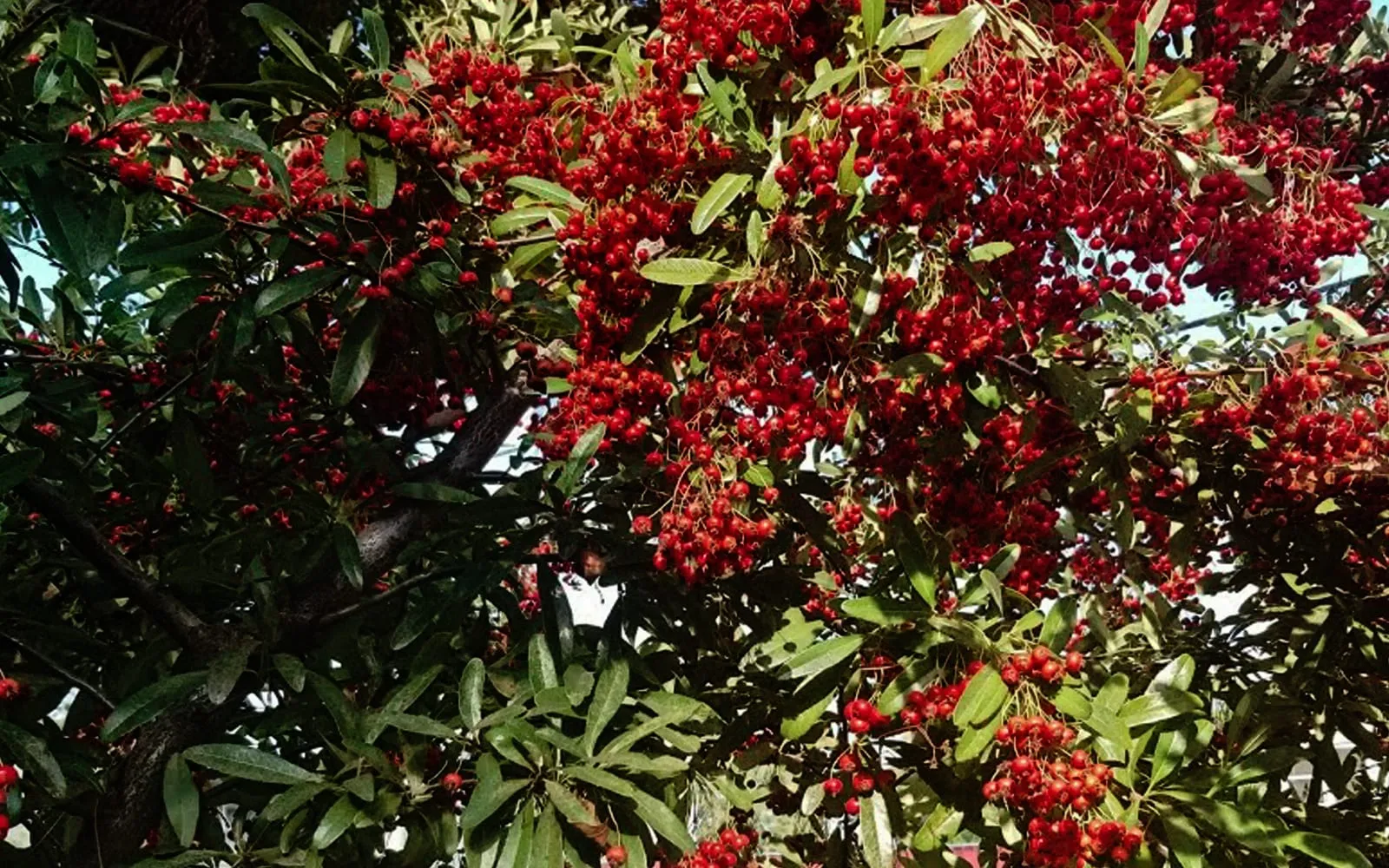
It is evergreen, so a north wall covered in it is furnished all year. It flowers in May and June in dense creamy heads that bees work hard. It then carries scarlet, orange or yellow berries from September through to the new year, and the mass of fruit on a well-grown plant is the reason anybody puts up with the rest of it.
The rest of it is the thorns. These are hard woody spines rather than the hooked prickles of a rose, they run to 2.5 cm, and they go straight into whatever they meet. Anyone who has pruned a wall-trained pyracantha has been stabbed by one, and the wounds have a reputation for turning septic.
That same armament makes it the best security hedge available. A pyracantha along a boundary or under a ground floor window is a deterrent that nothing gets through, and it looks like a shrub rather than a fence.
Its great virtue is shade tolerance. Very few evergreens with good berries will fruit on a north or east wall, and pyracantha does, which is why it ended up on so many suburban house fronts.
Appearance and character
An evergreen shrub reaching 3 to 5 m, with stiff spreading branches that train flat against a wall without complaint.
Spines are the identification and the hazard. They are modified side shoots, hard and woody, up to 2.5 cm long, and set along the branches at intervals.
Leaves are oval to lance-shaped, 2 to 4 cm long, glossy dark green above, with a finely toothed or almost smooth margin. They stay on all year.
Flowers open in May and June in dense flat corymbs 3 to 5 cm across, creamy white with a boss of stamens and a hawthorn-like scent that some people dislike.
Berries ripen from September, 5 to 8 mm across, in tight clusters, and they are the whole point of the plant. Scarlet in the species, and cultivars run through orange to deep yellow.
New growth is downy and slightly grey before it hardens to green.
Bark is grey-brown and the older branches go gnarled.
Where it is from
Southern Europe and south-west Asia, from Italy and the Balkans east through Turkey to the Caucasus and northern Iran.
It grows in scrub, on rocky hillsides, at woodland edges and on limestone, in hot dry summers and cold winters, which is why it copes with so wide a range of climates.
It came into European cultivation in the sixteenth century and became a standard wall shrub in the nineteenth.
Several Asian species are also grown and hybridised here. Pyracantha rogersiana and Pyracantha atalantioides both appear in the trade, and most modern cultivars are hybrids selected for disease resistance rather than pure coccinea.
The name is Greek. Pyr for fire and akanthos for thorn, describing the berries and the spines together, which is where firethorn comes from.
Scab and fireblight are both serious problems on the older cultivars, and the modern Saphyr and ‘Soleil d’Or’ types were bred specifically for resistance. This matters more than the berry colour when choosing one.
How it grows
Plant in autumn or spring, container-grown, into any reasonable soil.
It grows in full sun through to full shade, and it fruits in proportion to the light it gets. A north wall gives a respectable crop and a south or west wall gives a heavy one.
Position it with the thorns in mind. Beside a path, a gate, a doorway or a washing line it will draw blood every year.
For a wall-trained plant, fix horizontal wires at 45 cm intervals, plant 30 to 45 cm out from the wall, and tie the main stems into a fan.
Wall-trained pyracantha needs watering. The soil at the foot of a wall stays dry even in wet weather, and this is the commonest reason a wall plant fails to fruit.
For a hedge, plant at 60 cm spacing and expect a dense impenetrable barrier within four or five years.
Prune in summer, after flowering and before the fruit colours, which is usually late June or July. This is the timing that matters, because the berries form where the flowers were and cutting in spring removes the crop.
Cut the new growth back to two or three leaves from the older wood, which exposes the developing berries and keeps the shape flat.
Tidy again in late summer if needed, taking care not to cut the fruiting spurs.
Renovate an overgrown plant by cutting hard back into old wood in late winter. It regrows readily and loses a season of fruit.
Wear gauntlets, long sleeves and eye protection every time. Goggles are worth it on a wall-trained plant where the branches are at face height.
Bag the prunings carefully. Loose pyracantha clippings on a lawn or path find bare feet and bicycle tyres.
Through the seasons
Winter carries the berries into January in most years, and this is the season for hard renovation.
Spring puts on fast new growth, which should be left alone until after flowering.
Summer flowers in May and June, and the main pruning falls immediately after in late June or July.
Autumn colours the berries from September, and thrushes and blackbirds start on them once the frosts arrive.
Care difficulty
Easy to grow and unpleasant to handle.
It tolerates any soil, sun or deep shade, drought once established, cold, wind and coastal exposure. It regrows from hard cutting. It needs no feeding in the ground.
The difficulties are the thorns, the pruning timing and two diseases. Cut it at the wrong time and you get no berries. Grow an old susceptible cultivar and scab may blacken the whole crop.
Choosing a scab-resistant and fireblight-resistant cultivar at the point of purchase removes most of the trouble before it starts.
Watering
Water through the first summer after planting.
A wall-trained plant needs watering for several years and in dry spells afterwards, because the strip at the base of a wall is in permanent rain shadow.
A free-standing plant in open ground needs nothing once established and tolerates drought well.
Mulch generously at the foot of a wall, which does more than watering to keep the roots supplied.
Warning signs, diseases and pests
Sooty black scabby patches on the berries and dark blotches on the leaves, with early leaf fall, is pyracantha scab, caused by Venturia inaequalis forma pyracanthae. It ruins the display. Clear fallen leaves and fruit, improve air movement, and replace a badly affected plant with a Saphyr or other resistant cultivar.
Shoots dying back from the tip with blackened leaves hanging on, often bent into a shepherd’s crook, is fireblight, caused by Erwinia amylovora. Cut affected branches out at least 60 cm into healthy wood, disinfect tools between cuts, and burn the prunings.
Silvery winding trails inside the leaves is pyracantha leaf miner. It is disfiguring and does no real harm.
No berries at all is nearly always pruning at the wrong time. Cut after flowering rather than in spring.
Few berries on a wall plant with plenty of growth is usually shade or drought at the base of the wall.
Berries gone by November is birds, which is the plant working as intended.
Yellowing leaves on very chalky soil is chlorosis, which is uncommon in pyracantha since it grows on limestone in the wild.
Honey fungus attacks it and is fatal.
Growing environment
Full sun to full shade. It is one of the best evergreen wall shrubs for a north or east aspect.
Any reasonable soil, including chalk, clay and dry ground. It wants free drainage more than fertility.
Fully hardy to about -20 deg C, and tolerant of wind, pollution and coastal salt.
Allow 2 to 4 m of spread for a free-standing shrub, or 45 cm of depth against a wall with wires.
It suits a house wall, a security hedge, a boundary, a screen, a north-facing courtyard or a position under a ground-floor window.
Do not plant it beside a path, a gate, a doorway or anywhere people brush past.
Its wildlife value is high. The flowers feed bees and hoverflies in May and June, the berries feed blackbirds, thrushes, redwings, fieldfares and waxwings through autumn and winter, and the thorny evergreen growth is among the best nesting cover in a garden.
Choose the berry colour to suit the wall. Red is the classic, orange reads warmer against grey stone, and the yellow cultivars are left alone by birds for longest.
Feeding
None needed for a free-standing plant on ordinary soil.
Feed a wall-trained plant with a general balanced fertiliser in spring, since the dry impoverished strip at the foot of a wall gives it little to work with.
Mulch every spring with compost or bark, keeping it clear of the stem.
Avoid high-nitrogen feeds, which push soft growth that fireblight enters more easily and that produces leaf rather than fruit.
Troubleshooting
Why has it not produced any berries? Pruning at the wrong time. Pyracantha fruits where it flowered, so cutting in spring removes the crop. Prune after flowering in late June or July.
When should I prune it? After flowering, late June or July, cutting the new growth back to two or three leaves from the older wood. That exposes the berries and keeps the shape.
The berries have gone black and scabby. Pyracantha scab. Clear fallen leaves and fruit, improve air movement, and replace a badly affected plant with a scab-resistant Saphyr cultivar.
Whole branches have died back with blackened leaves still attached. Fireblight. Cut out at least 60 cm into healthy wood, disinfect tools between cuts, and burn the prunings.
Are the berries poisonous? The flesh is not toxic. The seeds contain cyanogenic glycosides like apple pips and are a hazard only if crushed and eaten in quantity. The thorns are the more serious risk.
A thorn went in and the joint is still swollen. See a doctor. Pyracantha punctures infect readily and a fragment left in a joint causes a persistent inflammation that sometimes needs surgery.
Can I cut an overgrown one hard back? Yes. Cut into old wood in late winter and it regrows, at the cost of a season’s fruit.
It hardly grows and never fruits on my north wall. Check whether it is dry. The strip at the foot of a wall gets almost no rain. Water it and mulch it heavily.
Which cultivar should I buy? One bred for scab and fireblight resistance, such as the Saphyr series or ‘Soleil d’Or’. That matters more than the berry colour.