
Edible
Redcurrant
Ribes rubrum
Also known as Red currant, Whitecurrant
How to grow redcurrants, Ribes rubrum. Why they are pruned on a spur system rather than as a stool, growing them as cordons on a shaded wall, and netting against bullfinches.
At a glance
- Difficulty
- Easy
- Water
- Weekly in dry weather while the fruit swells
- Light
- Full sun to partial shade, including a north-facing wall
- Temperature
- Very hardy, to -20 deg C
- Hardiness
- USDA 3-8, RHS H7, hardy to -35 C
- Type
- Deciduous shrub, cropping for twenty years or more
- Height
- 1.2-1.5 m
- Native to
- Western Europe, including native Britain
- Best month
- August in the Northern Hemisphere, February in the Southern Hemisphere
Cold winters suit it, and it needs 800 to 1500 chill hours to flower evenly. Summer heat is the other end of the range, since the fruit scorches above about 30 deg C and the bush is happier with afternoon shade in a warm climate. The white pine blister rust restrictions that apply to Ribes in parts of the United States cover this species too.
Hardiness zones describe winter cold alone. Summer heat, humidity, rainfall and the length of the growing season decide as much, so treat the range as the outer limit rather than as a recommendation.
Every month named in this guide is for the temperate Northern Hemisphere. If you garden in the Southern Hemisphere, shift each one by six months, so August becomes February. Closer to the equator the wet and dry seasons matter more than the calendar, and the shift stops being a useful guide.
Not known to be toxic
- Safe to eat
- The fruit
Non-toxic. The ASPCA does not list Ribes rubrum among plants harmful to cats, dogs or horses, and the fruit is a food crop for people. Redcurrants are sharp rather than sweet and are usually cooked into jelly, which is the traditional accompaniment to lamb and to game, or used in summer pudding. Whitecurrants are the same species with a recessive gene that removes the red pigment, and they are sweeter and equally safe. The leaves and stems are not eaten and present no known hazard. A dog that eats a quantity of fallen fruit may have an upset stomach in the way it would with any fruit, and there is no toxic effect. One point concerns not safety but legality and history. Ribes species host part of the life cycle of white pine blister rust, and growing them was restricted or banned in parts of the United States for much of the twentieth century. No such restriction has ever applied in Europe, where redcurrants have been grown without interruption since the sixteenth century.
Sources: ASPCA toxic and non-toxic plants, RHS potentially harmful garden plants
About
Redcurrants and blackcurrants look like the same plant and are pruned in opposite ways, which is the single most common reason a redcurrant bush stops producing.
Blackcurrants fruit on last year’s wood and are cut as a stool, taking a third of the old stems to the ground each winter. Redcurrants fruit on short permanent spurs on old wood, and cutting them to the ground removes the entire fruiting structure. They are pruned like a gooseberry instead, on a leg, with the side shoots shortened back to spurs.
Get that right and a redcurrant is among the most productive things in a garden for the space, and it will crop on a north-facing wall where almost no other fruit will.
Appearance and character
A deciduous shrub, upright and fairly open, reaching 1.2 to 1.5 m, grown on a short clear leg of 10 to 15 cm before the branches begin.
Leaves are lobed with three or five points, mid-green, and unlike blackcurrant leaves they have no scent when crushed. That is the quickest way to tell the two apart out of season.
Flowers open in April in small hanging greenish-yellow racemes, inconspicuous and worked by early bees.
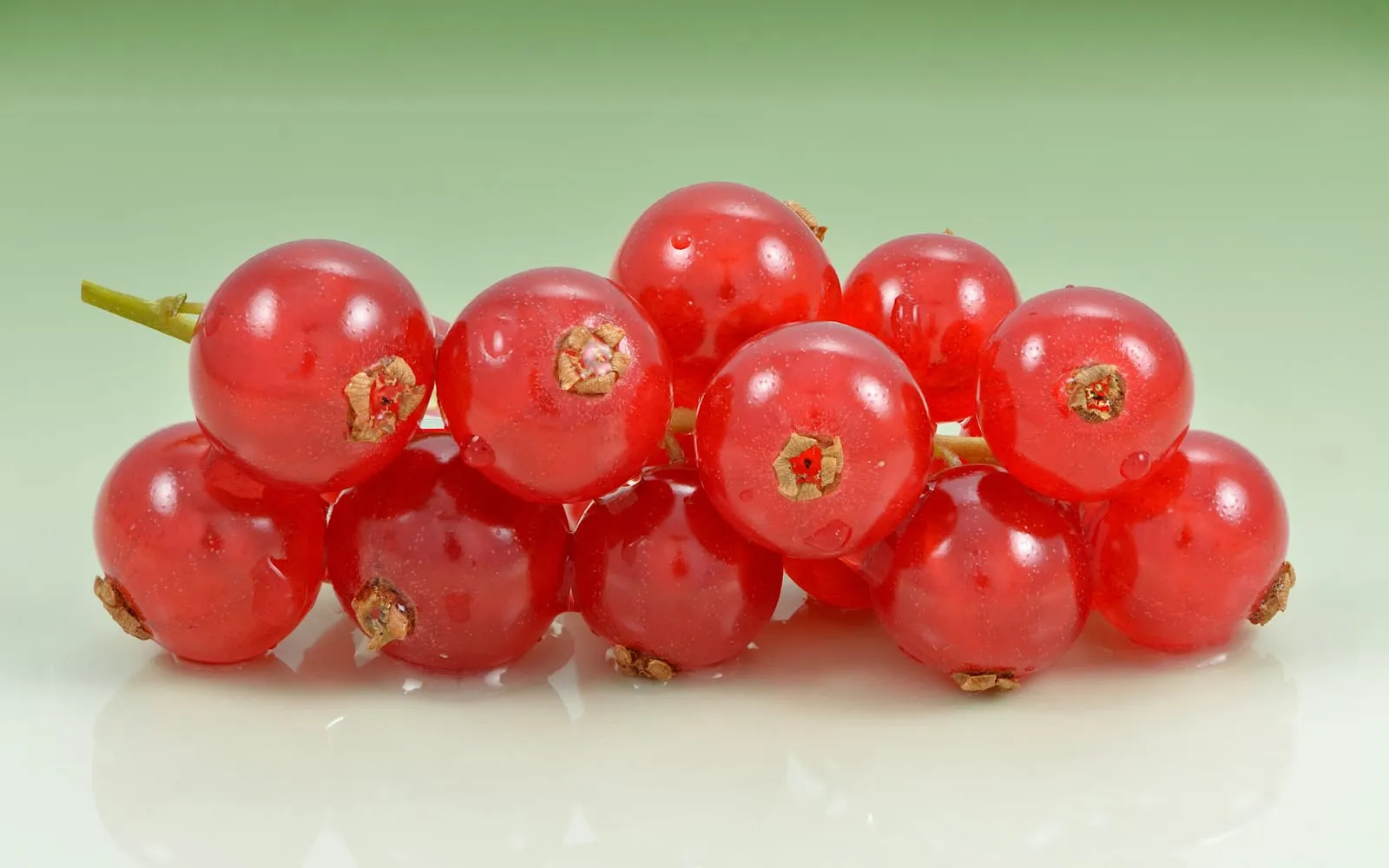
Fruit ripens in July and August in hanging strigs, which is the proper word for the strings of berries. Each berry is translucent scarlet, 8 to 10 mm across, with the dried flower remnant still at the tip and the seeds visible inside.
Whitecurrants are the same species, and ‘White Versailles’ and ‘Blanka’ are sweeter and less sharp than the red forms.
Growth is upright and the wood is pale brown and brittle.
The plant crops for twenty years or more and is one of the longest-lived soft fruits.
Where it is from
Western Europe, including Britain, where redcurrant grows wild in damp woodland and along stream banks, though many wild plants are garden escapes.
Its natural habitat is cool, damp and shaded, which is precisely why the plant tolerates a north-facing wall and dislikes a hot dry border. Very few fruits will crop in that position.
Cultivation in Britain dates from the sixteenth century, and the redcurrant became a standard kitchen garden plant far earlier than the blackcurrant, which was regarded with suspicion for a long time.
The fruit is high in pectin, which is why redcurrant jelly sets so readily and why redcurrant juice is added to other preserves that will not set on their own.
Redcurrant jelly with lamb and with game is an English tradition of some age, and Cumberland sauce is built on it.
How it grows
Plant bare-root bushes from November to March, 1.5 m apart, keeping the clear leg above soil level. Planting deep produces suckers and destroys the shape.
Rub off any buds on the leg and remove suckers as they appear.
Prune as a spur system, not as a stool. Fruit is carried on short spurs on two-year-old and older wood, so the permanent framework is what produces the crop.
Prune in winter, between November and February. Build an open goblet with eight to ten main branches, shorten each leader by about a quarter, and cut every side shoot back to two or three buds from its base. Those stubs become the fruiting spurs.
Prune again in June or July, shortening the current season’s side shoots to about five leaves. This lets light and air into the bush and helps the fruit ripen.
Train as a cordon where space is short. A single vertical stem tied to a wire, with all side shoots spurred back, takes 40 cm of wall and crops heavily. Cordons against a north wall are the classic use.
Net the bush well before the fruit colours. Birds take redcurrants very readily and the crop hangs conspicuously.
Pick whole strigs rather than individual berries, using scissors or by pinching the stalk, which is much faster and damages the fruit less.
Propagate from hardwood cuttings in autumn, rubbing off the lower buds so the cutting forms a clear leg.
Through the seasons
Winter is planting and the main pruning. Plant bare-root bushes, prune to an open goblet on a leg, and mulch with manure.
Spring brings the flowers in April. Watch for bullfinch damage to the buds before that, and for currant blister aphid on the new leaves.
Early summer is the summer prune. Shorten the side shoots in June or July, and net the bush as the fruit begins to colour.
Midsummer is the harvest, through July and August. Pick whole strigs, and cut out any dead wood afterwards.
Care difficulty
Easy, provided the pruning is right.
Pruning it like a blackcurrant is the mistake that matters, and it removes the fruiting spurs entirely. A bush treated that way crops less every year.
Birds are the other constant. Bullfinches strip the fat buds in winter and blackbirds take the fruit in July.
The plant itself is hardy, shade-tolerant, long-lived and largely untroubled by disease.
Currant blister aphid is alarming to look at and does very little.
Watering
Water weekly in dry weather while the fruit is swelling, from flowering through to picking.
Mulch thickly each winter or early spring with well-rotted manure or compost.
The roots are shallow, so avoid deep hoeing near the stem and rely on mulch for weed control.
Irregular watering causes the fruit to split, though redcurrants are less prone to it than gooseberries.
Do not let the ground become waterlogged.
Warning signs, diseases and pests
Bullfinches strip the fat fruit buds through winter, which removes the crop before the season starts. In rural gardens this is the single biggest cause of failure. Net from midwinter, not just in summer.
Currant blister aphid produces raised red or yellowish blisters on the upper surface of the leaves in spring, with aphids underneath. It looks dramatic and has almost no effect on the crop. The damage stops once the aphids move to their summer hosts.
Gooseberry sawfly attacks redcurrants as readily as gooseberries. Pale green caterpillars with black spots start low in the centre of the bush and eat outward, and they can strip it in under a week. Check the middle of the bush from late April and pick them off.
Coral spot produces pink-orange pustules on dead and dying wood. Cut back to clean healthy growth.
Fewer berries each year on an otherwise healthy bush usually means it has been pruned as a stool, which removes the fruiting spurs. Rebuild a permanent framework over two or three winters.
Leaf spot causes brown blotches and early leaf fall in wet seasons.
Split fruit follows uneven watering.
Spotted wing drosophila lays eggs in fruit while it is still ripening, and berries that looked sound can collapse within a day. It has been established across North America and Europe since 2008 and remains a quarantine priority in Australia and New Zealand.
Growing environment
Full sun gives the heaviest and sweetest crop, and redcurrants also crop acceptably in partial shade and even on a north-facing wall, which makes them one of the most useful fruits for a difficult position.
Moisture-retentive but well-drained soil, neutral to slightly acid.
Space bushes 1.5 m apart, or cordons 40 cm apart.
A north or east-facing wall suits cordons very well and extends the season, since the fruit ripens later and hangs longer.
Netting or a fruit cage, in winter against bullfinches and in summer against blackbirds.
Good air movement helps, and the summer prune provides it.
Avoid a hot dry border, where the plant scorches and crops poorly.
Feeding
Feed with a potassium-rich fertiliser such as sulphate of potash in late winter.
Mulch with well-rotted manure or compost every winter.
Avoid heavy nitrogen, which produces soft sappy growth and encourages aphids.
Magnesium deficiency, showing as yellowing between the veins on older leaves, is common on light soil and corrects with Epsom salts.
A general-purpose fertiliser in spring suits a bush on poor ground.
Troubleshooting
Do I prune it like a blackcurrant? No, and this is the mistake that ruins the crop. Redcurrants fruit on permanent spurs on old wood. Prune them like a gooseberry, on a leg, cutting side shoots back to two or three buds.
The buds disappeared over winter. Bullfinches. Net the bush from midwinter as well as in summer.
Red blisters on the leaves. Currant blister aphid. It looks alarming and does almost nothing to the crop.
The bush has been stripped to bare stems. Gooseberry sawfly, which eats redcurrants as readily. Check the centre of the bush from late April and pick the caterpillars off.
Can I grow it on a north-facing wall? Yes, as a cordon, and it is one of the very few fruits that crops properly there.
How do I pick them? Take whole strigs by pinching or cutting the stalk, rather than picking individual berries. It is far quicker and the fruit keeps better.
What is the difference from a whitecurrant? The same species without the red pigment. Whitecurrants are sweeter and grown identically.
The crop gets smaller every year. Almost always because the bush has been cut as a stool. Rebuild a permanent branch framework over two or three winters.
Redcurrant problem guides
Not sure what is wrong? See the common vegetable pests guide.