
Houseplant
Rubber Plant
Ficus elastica
Also known as Rubber fig, Rubber tree, Indian rubber bush
How to care for Ficus elastica. Why it drops leaves when you move it, what the red sheath on new growth is, how to stop it becoming a bare pole, and the latex problem.
At a glance
- Difficulty
- Easy
- Water
- When the top 3-4 cm dries, every 7-10 days in summer
- Light
- Bright indirect light. Variegated forms need more than plain green ones
- Temperature
- 16-27 deg C. Below 12 deg C causes leaf drop
- Humidity
- Fine in ordinary room air
- Hardiness
- USDA 10-12, RHS H1b, hardy to 12 C
- Type
- Evergreen tree
- Height
- 2-3 m indoors, over 30 m in the wild
- Native to
- Rainforest of north-east India, Myanmar, Malaysia and Indonesia
- Best month
- April in the Northern Hemisphere, October in the Southern Hemisphere
North-east India and south-east Asia, where it is a strangler fig reaching 30 m and its aerial roots are trained into the living root bridges of Meghalaya. Outdoors year round in USDA 10 and warmer.
Hardiness zones describe winter cold alone. Summer heat, humidity, rainfall and the length of the growing season decide as much, so treat the range as the outer limit rather than as a recommendation.
Every month named in this guide is for the temperate Northern Hemisphere. If you garden in the Southern Hemisphere, shift each one by six months, so April becomes October. Closer to the equator the wet and dry seasons matter more than the calendar, and the shift stops being a useful guide.
Harmful if eaten
- Do not eat
- The milky latex in every stem and leaf
- Harm from
- Eating it, handling it and sap in the eyes
- Affects
- People, cats and dogs
Cutting or breaking any part of a rubber plant releases a milky white latex, and that latex is the hazard rather than the leaf tissue itself. The ASPCA lists Ficus as toxic to cats and dogs, causing oral and skin irritation, vomiting and drooling. The RHS places Ficus in its harmful-if-eaten category and also flags it as a skin and eye irritant. On skin the latex causes a contact dermatitis that worsens with repeated exposure, and people who handle these plants often can become sensitised over time. In the eye it stings sharply, so wear gloves when pruning and keep your hands away from your face until you have washed. The latex contains proteins that cross-react with natural rubber latex allergy, so anyone with that allergy should avoid pruning this plant. Eating a leaf causes mouth irritation and an upset stomach rather than serious poisoning.
Sources: ASPCA (Rubber Tree, Ficus benjamina), RHS potentially harmful garden plants
About
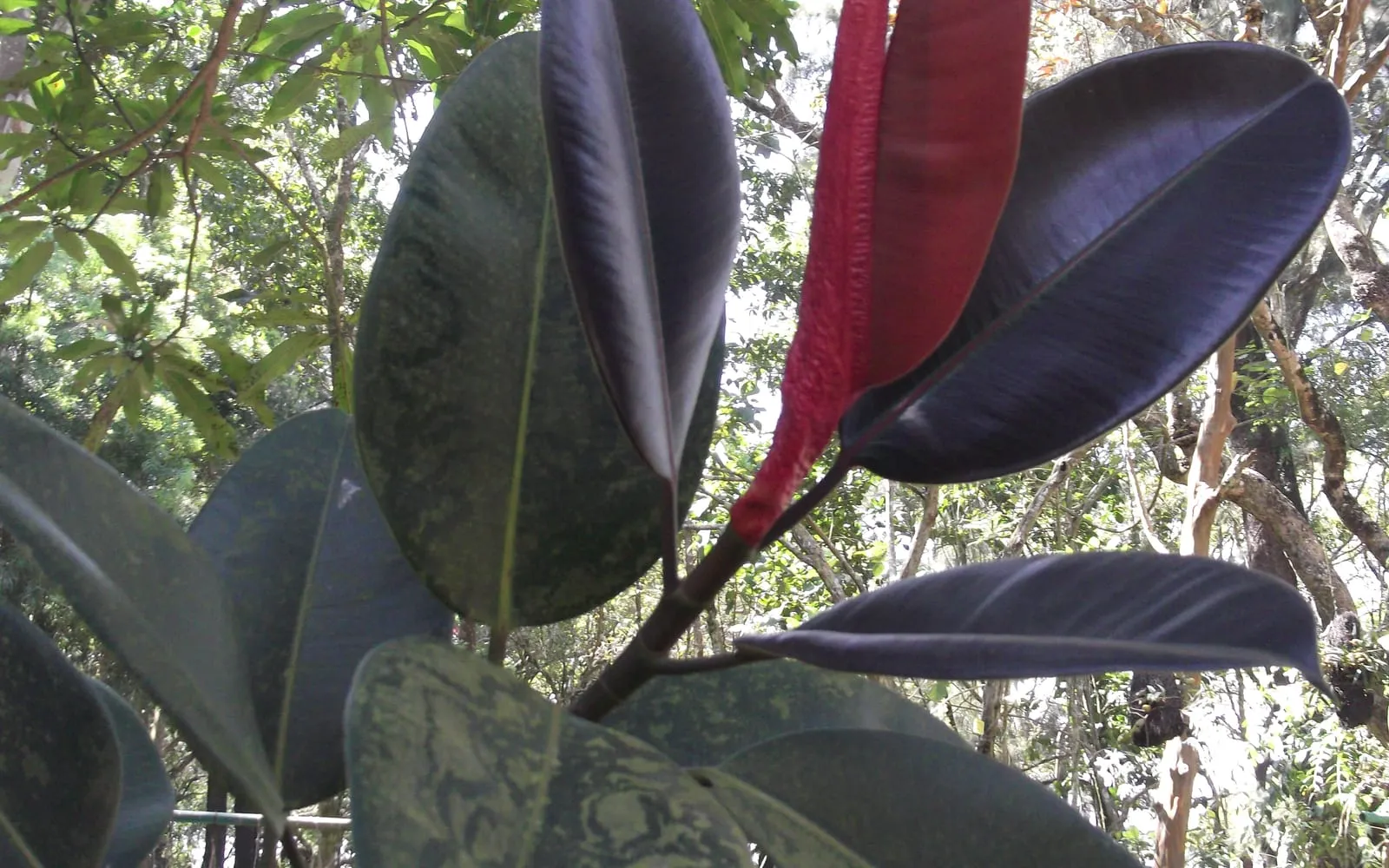
The bright red spike at the top of a rubber plant is a stipule, a protective sheath wrapped around the next leaf. It lengthens, splits, and drops to the floor as the leaf unrolls, and finding those dried red papery cases on the carpet is the sign that your plant is growing well.
Rubber plants have a reputation for sulking that is mostly earned. Move one across a room and it may drop half its lower leaves within a fortnight. The plant is not fragile; it is slow to re-equip. Each leaf is built for a specific light level, and rebuilding takes weeks.
The name comes from the latex, which was tapped commercially for rubber before Hevea brasiliensis displaced it. That same latex is the reason to wear gloves when pruning.
Appearance and character
Large oval leaves, 20 to 30 cm long, thick and leathery with a high gloss and a pale or red midrib. New leaves emerge rolled inside the red stipule and unfurl over a few days.
Indoors it forms a single upright stem and keeps going up. Left unpruned it becomes a bare pole with a tuft of leaves on top, which is the commonest complaint about the plant and entirely preventable.
‘Robusta’ has broad plain dark green leaves and is the standard form. ‘Tineke’ carries cream and grey-green variegation with pink new growth. ‘Ruby’ is strongly pink-flushed, and ‘Abidjan’ is so dark it reads as burgundy-black in low light.
In the wild it becomes a strangler fig over 30 metres tall, dropping aerial roots that thicken into secondary trunks. Nothing of that happens in a living room, though a mature indoor plant will sometimes produce a stray aerial root.
Where it is from
Rainforest across north-east India, Myanmar, Malaysia and the islands of Indonesia, growing as a hemiepiphyte that starts life in a fork of another tree and sends roots down to the ground.
Its habitat is warm, humid and bright without much direct sun, since the plant spends its early life inside the canopy rather than above it. That is the light level to aim for indoors.
Rain there is heavy and frequent and the substrate drains fast. The plant is built for a thorough soaking followed by a dry spell, which is why steady small waterings suit it poorly.
Temperatures never drop far, and this is where indoor plants suffer. Below 12 deg C the leaves drop, and a plant left touching cold glass through a January night can lose several.
How it grows
An evergreen tree growing from a single terminal bud at the top of the stem. All new growth comes from that one point unless you interrupt it.
Cutting the top out is what forces branching. The plant responds by activating dormant buds lower down, usually producing two or three side shoots below the cut. Prune in spring, cut just above a leaf node, and expect latex to run for a minute or two.
Growth is quick in summer, adding a leaf every couple of weeks in good light, and stops entirely in winter.
Propagation works from tip cuttings with two or three leaves. Let the cut end stop bleeding, dip it in rooting hormone, and put it in damp compost somewhere warm. Air layering is the better method for a tall bare plant, since it gives you a well-rooted new plant and lets you cut the parent back at the same time.
Through the seasons
Spring is the time to prune, repot and start feeding. Cutting the top out now gives the plant a full season to branch and fill in.
Summer brings the fastest growth. Water every seven to ten days, feed monthly, and turn the pot a quarter every few weeks so it grows evenly.
Autumn slows growth. Stop feeding from October and stretch the intervals between waterings.
Winter is a holding period. Water every two to three weeks, keep the plant away from cold glass and radiators, and expect no new leaves. Some lower leaf drop is normal as light levels fall.
Care difficulty
Easy, provided you accept two things about how it behaves.
It resents being moved. Choose a position with the right light and leave it there. Every relocation costs leaves while the plant re-equips, and repeated moves leave it permanently thin at the bottom.
It grows straight up unless you stop it. A rubber plant that has never been pruned will reach the ceiling as a bare stick with foliage at the top. Cutting the growing tip out at about a metre, and again later, is what produces a full plant.
Overwatering is the usual killer, as with most glossy-leaved houseplants. The compost should dry down several centimetres between waterings.
Watering
Water when the top 3 to 4 cm of compost feels dry, which means every seven to ten days in summer and every two to three weeks in winter.
Water thoroughly until it runs from the drainage holes, then empty the saucer. A deep soak followed by a drying period suits the plant far better than frequent sips.
Yellowing lower leaves that drop are the classic overwatering sign, and they are also what a plant does after being moved, so check the compost before assuming.
Drooping leaves with dry, light compost mean thirst, and the plant recovers within a day of a soak.
Cut watering back hard in winter. Cold wet compost is the fastest route to root rot.
Wipe the leaves with a damp cloth every few weeks. Dust settles heavily on surfaces this large and cuts the light reaching the plant.
Warning signs, diseases and pests
Lower leaves yellowing and dropping is the standard distress signal and has several causes. Wet compost points to overwatering, a recent move points to adjustment, and a cold draught points to position.
Leaves dropping suddenly in quantity, without yellowing, usually mean cold shock or a sharp change in light.
Brown crispy edges suggest dry air, underwatering or a build-up of fertiliser salts. Flush the pot with clean water.
Brown soft patches in the middle of leaves come from direct sun scorching them through glass.
Variegated forms reverting to plain green means too little light. Cut back to variegated growth and move the plant brighter.
Scale insects are the pest to watch for, appearing as small brown limpets along stems and leaf midribs, often with sticky honeydew below them. Scrape them off and wipe the leaves down.
Spider mites arrive in dry heated rooms, leaving fine webbing and a stippled leaf surface.
Mealybugs show as white fluff in leaf joints and come off with surgical spirit on a cotton bud.
A soft, dark, foul-smelling stem base means root rot. Turn the plant out and cut away everything soft before repotting.
Growing environment
Bright indirect light. A position near an east-facing window, or a metre or two back from a south-facing one, suits it well. Plain green forms cope with less light than the variegated ones, which need good light to hold their colour.
Direct midday sun through glass burns brown patches into the leaves.
Keep it between 16 and 27 deg C. Below 12 deg C it drops leaves, so keep the foliage from touching cold window glass in winter.
Ordinary room humidity is fine. This is one of the few large-leaved tropical houseplants that does not need a gravel tray.
Use free-draining houseplant compost with a couple of handfuls of orchid bark or perlite mixed in. A heavy compost holds too much water around the roots.
Keep it out of draughts from external doors and away from radiators.
Repot every two or three years in spring, into a pot one size up. A rubber plant kept slightly snug grows more slowly and stays more manageable indoors.
Feeding
A balanced liquid houseplant feed at half strength, once a month from April to September.
Stop between October and March. Unused fertiliser accumulates as salts and burns the root tips.
Do not feed a plant that has just been repotted, since fresh compost carries enough nutrients for the first couple of months.
Brown leaf margins on a plant that is watered properly usually indicate too much feed. Flush the pot with several times its volume of clean water.
Troubleshooting
It dropped a lot of leaves after I moved it. Normal. Each leaf is adapted to a particular light level and the plant sheds those it can no longer support. Choose the position carefully and leave it there. New growth resumes in a few weeks.
It is a bare stick with leaves only at the top. It has never been pruned. Cut the top out in spring, just above a leaf node, and it will branch below the cut. Air layer the section you remove to get a second plant.
Lower leaves are yellowing and falling. Check the compost first. Wet compost means overwatering, and a recent move or a cold draught explain most of the rest.
A red spike has appeared at the top. That is the stipule protecting a new leaf. It splits and drops as the leaf opens, and it means the plant is growing.
My variegated plant is going plain green. Not enough light. Prune back to variegated growth and move it to a brighter spot.
White sap ran out when I cut it. Latex, and it is a skin and eye irritant. Wear gloves, keep it off your face, and wash your hands. Anyone with a natural rubber latex allergy should not prune this plant at all.
Sticky patches on the leaves and the floor below. Scale insects. Look along the stems and the leaf midribs for small brown limpets, scrape them off, and wipe the foliage down.
Can I cut it back hard? Yes, in spring. It tolerates hard pruning and reshoots from dormant buds on the old wood.
Rubber Plant problem guides
Not sure what is wrong? See the common houseplant pests guide.