
Disorder
Oedema
Also called Edema, Corky scab, Water blisters, Intumescence
Raised watery blisters that dry into rough corky scabs on leaf undersides and stems. Not a fungus and not a pest, whatever the search results say. A watering and light problem with a straightforward fix.
At a glance
- Type
- Disorder
- Cause
- Growing conditions
- Severity
- Cosmetic
- Affects
- Houseplants, Garden plants, Herbs and edibles
- Active
- October to April
What you are seeing
- Small raised blisters on the undersides of leaves, clear and watery at first
- Blisters drying into rough, tan or rust-brown corky scabs
- Corky ridges and lines running along leaf stalks and stems
- Bumps arranged along the veins or scattered evenly, on the older leaves
- Yellow pinprick dots showing through on the upper surface opposite each bump
- Damage that appears over a few days in dull damp weather and then stops
- Nothing that rubs off, no insect underneath, no powder and no smell
What you are looking at
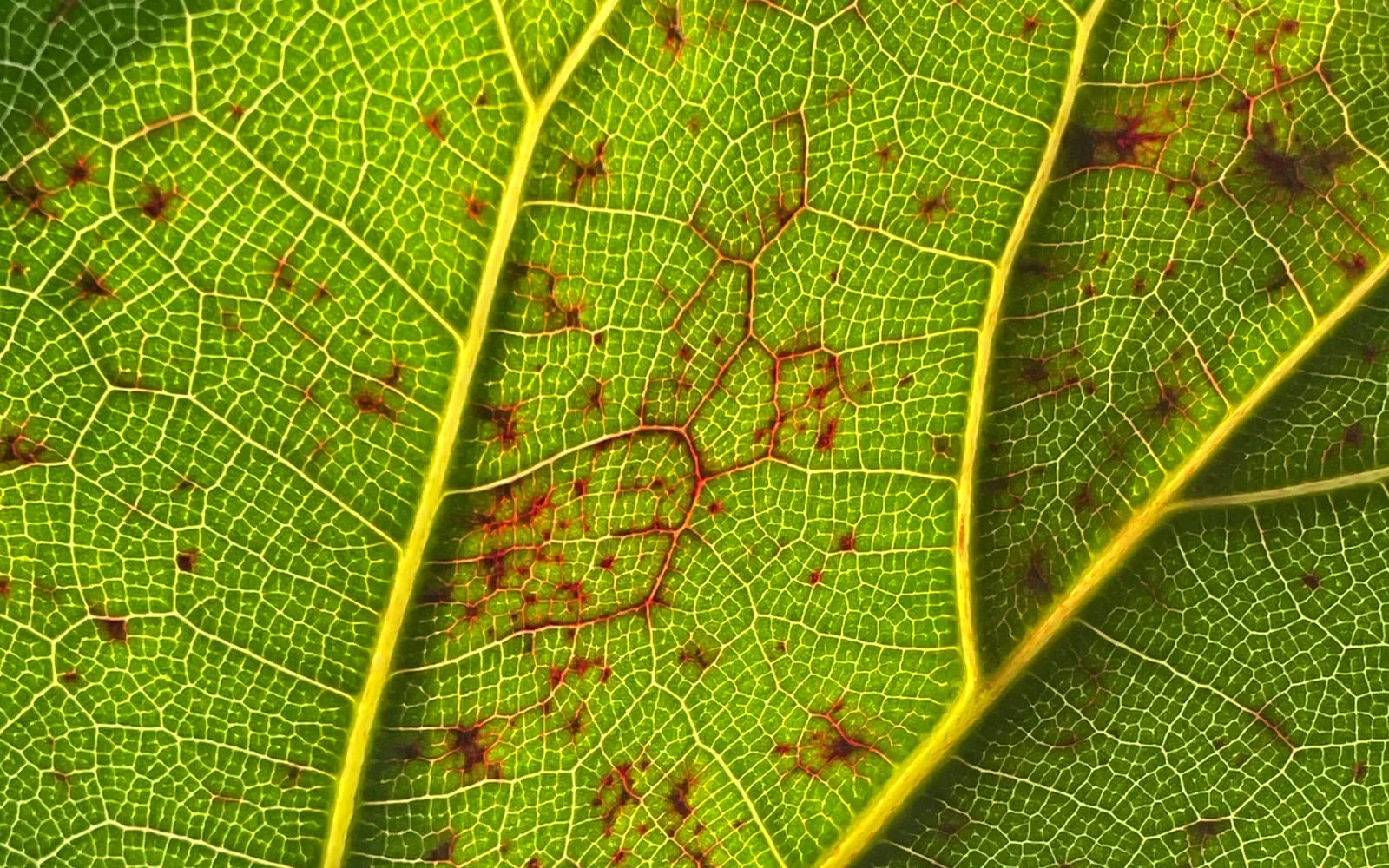
Turn the leaf over. Small raised bumps stand up from the surface, scattered or following the veins. New ones look like clear water blisters, slightly glassy. Older ones have dried into rough tan or rust-brown corky patches with a texture like fine sandpaper.
The same corky ridges run along the leaf stalks and down the stems, and on the upper surface of the leaf you may see small yellow dots showing through, one opposite each bump.
Try to rub one off. It will not come, because it is part of the leaf. There is no insect under it, no powder, no fuzz and no smell. A thumbnail run across it catches on the texture and nothing lifts.
Pelargoniums show it most and get blamed for it least, along with camellias, ivies, succulents such as jade plants and peperomias, tomatoes under glass and brassicas in a wet spring.
What is happening inside the leaf
The roots are supplying water faster than the leaves can give it off.
Water enters the plant under pressure from the roots and leaves it as vapour through the pores in the leaf surface. That second half depends on light, warmth and moving air. Take those away, leave the compost wet and warm, and the balance tips. Cells in the leaf keep filling, swell past what their walls can take, and burst.
The plant then does what plants do with a wound, sealing the ruptured area with corky scar tissue. That cork is the bump you are looking at, and it is permanent.
Everything follows from the imbalance. Dull weather, short winter days, a cold still conservatory, a saucer left full, a plant moved away from the window, an unheated greenhouse on a mild damp morning in March. Each of those slows transpiration while the roots carry on as before.
Some plants are built to show it. Pelargoniums, peperomias and thick-leaved succulents have the leaf structure that makes bursting likely, which is why the same watering regime produces bumps on a pelargonium and nothing on the fern beside it.
Why the search results are wrong
Search these symptoms and much of what comes back names a fungal or bacterial disease and recommends a fungicide.
There is no organism here. Nothing is infecting the plant, nothing is spreading from leaf to leaf, and nothing will pass to the plant next to it. A plant with oedema in a room full of houseplants stays the only one with oedema unless the others are watered the same way.
Two observations settle it in the garden rather than in a laboratory. Oedema appears over a few days during a spell of dull damp weather and then stops dead, where a disease keeps producing new symptoms week after week. And the marks are raised and corky rather than sunken and dead, which no leaf spot is.
The one thing worth ruling out is scale insect, since a row of brown lumps on a leaf underside is a fair description of both. A scale lifts off with a thumbnail and leaves clean leaf surface behind. Oedema does not lift at all.
What to do about it
Cut the watering back, particularly from October to March.
Water in the morning rather than the evening.
Move the plant somewhere brighter for the winter.
Get air moving, by spacing plants out, opening a vent on a mild day or running a small fan in a conservatory.
Empty the saucer, and stand the pot on feet rather than on a cold wet floor.
Repot into a coarser, free-draining mix if the compost never dries.
Leave the marked leaves where they are, because the plant needs them and they will not recover their colour.
Put the fungicide away.
What it gets mistaken for
Scale insects sit on the surface as separate objects and lift off with a thumbnail.
Rust raises pustules that break open and leave coloured powder on a fingertip.
Leaf spots are flat, dead and defined, and they multiply through the season.
Downy mildew grows visible fuzz on the leaf underside beneath a pale patch on top.
Red spider mite stipples the surface finely and webs the shoot tips.
Limescale from hard water sits on top of the leaf as a chalky deposit and wipes away with a damp cloth.
Physical damage from packing, handling or a leaf pressed against glass makes irregular one-off marks that match the shape of whatever pressed on them.
What to do, in order
Start here
Prevention, and the changes that stop the problem returning. Most of these pages should end at this tier.
- Water less, and water in the morning
- This is the whole of the fix. Oedema happens when the roots push water into the leaves faster than the leaves can give it off, so the cells swell and burst. Cutting the watering back, especially through dull weather and through the winter, removes the pressure. Watering early in the day also means the plant does its drinking when the light and the warmth are there to use it.
- Let the compost dry further between waterings in winter
- A pelargonium in October needs a fraction of the water it needed in July, because it is transpiring a fraction as much. Most cases on houseplants come from a watering routine that carried on unchanged into the dark half of the year.
- Give it more light
- A plant in poor light transpires slowly, so the water it takes up has nowhere to go. Moving it to a brighter windowsill through the winter does as much as reducing the watering, and the two together settle it.
- Get air moving around the plant
- Still, saturated air stops the leaves losing water. Spacing plants apart on the windowsill or the greenhouse bench, opening a vent on a mild day and running a small fan in a conservatory all help the leaves transpire.
- Watch the gap between soil temperature and air temperature
- The classic set-up is warm wet compost under cool damp air, which is a greenhouse or a conservatory on a mild, overcast, still day in spring. Warm roots pump; cool leaves hold. Ventilating and raising the air temperature closes the gap.
- Leave the marked leaves on the plant
- The corky tissue is a scar and will never turn green again, but the leaf around it works normally and the plant needs it. Stripping affected leaves off a pelargonium in February removes the foliage it is living on.
- Stop looking for something to spray
- No fungus, bacterium or insect is involved, so no fungicide or insecticide will do anything at all. A good deal of the advice returned for these symptoms names a disease, and following it means treating a plant that is not ill for a condition it does not have.
Then reach for a barrier
Netting, hand removal and water. Nothing here harms anything except the target.
- Raise the pot off a cold wet surface
- A pot standing in a saucer of water, or directly on a cold conservatory floor, keeps the compost saturated and the roots cold. Pot feet and an emptied saucer are a five-minute fix.
- Repot into something that drains, if it never dries out
- Fine, peat-heavy compost in a pot with no room left in it holds water for weeks. A coarser mix with grit or bark in it, in a pot with a clear drainage hole, lets the roots take up water at a rate the leaves can keep pace with.
Plants affected
Guides that name it among the problems to watch for. The list is the plants it is characteristic of rather than everything it will feed on.
A common houseplant pest
This is one of the pests and problems that houseplant owners meet most often. See it alongside the others, with a quick table for telling them apart, on the houseplant pests guide.
Common houseplant pests