
Houseplant
Staghorn fern
Platycerium bifurcatum
Also known as Elkhorn fern, Platycerium
How to grow staghorn fern, Platycerium bifurcatum. Mounting it on a board, why the brown shield fronds must be left alone, and watering by soaking.
At a glance
- Difficulty
- Moderate
- Water
- By soaking every one to two weeks, less in winter
- Light
- Bright indirect light, and it scorches in direct sun
- Temperature
- 15 to 24 deg C, and it tolerates a brief dip to 5 deg C
- Hardiness
- USDA 9-12, RHS H1c, hardy to 5 C
- Type
- Evergreen epiphytic fern, long lived and slow growing
- Height
- 60-90 cm across
- Native to
- Eastern Australia, New Guinea and Java, growing on trees and rocks
- Best month
- May in the Northern Hemisphere, November in the Southern Hemisphere
An epiphyte growing on trunks rather than in soil. The two leaf types do different jobs, with the flat shield leaves collecting litter and the antlers doing the photosynthesis, so browning shields are the plant working rather than failing. Outdoors year round in USDA 9 and warmer.
Hardiness zones describe winter cold alone. Summer heat, humidity, rainfall and the length of the growing season decide as much, so treat the range as the outer limit rather than as a recommendation.
Every month named in this guide is for the temperate Northern Hemisphere. If you garden in the Southern Hemisphere, shift each one by six months, so May becomes November. Closer to the equator the wet and dry seasons matter more than the calendar, and the shift stops being a useful guide.
Not known to be toxic
Staghorn fern is not listed by the RHS as a potentially harmful garden plant and is not recorded by the ASPCA as toxic to cats, dogs or horses. Ferns as a group are among the safer houseplants and the true ferns, which include Platycerium, carry no recognised poisoning hazard. That matters, since several plants sold as ferns are not ferns at all, and asparagus fern, Asparagus setaceus, is listed by the ASPCA as toxic to cats and dogs. Where a plant is unlisted by both sources rather than positively assessed, read that as no hazard recorded rather than a hazard ruled out. The one practical caution is mechanical rather than chemical. A large mounted staghorn fern becomes heavy, particularly after soaking, and a mount that fails brings the whole thing down, so fix it to a solid wall fastening rather than to plasterboard alone. Fern spores are released in quantity from mature fronds and are a recognised respiratory irritant in enclosed spaces for a small number of people.
Sources: RHS potentially harmful garden plants, ASPCA toxic and non-toxic plants
About
The brown papery fronds at the back of a staghorn fern are alive, and cutting them off is the commonest way the plant is damaged.
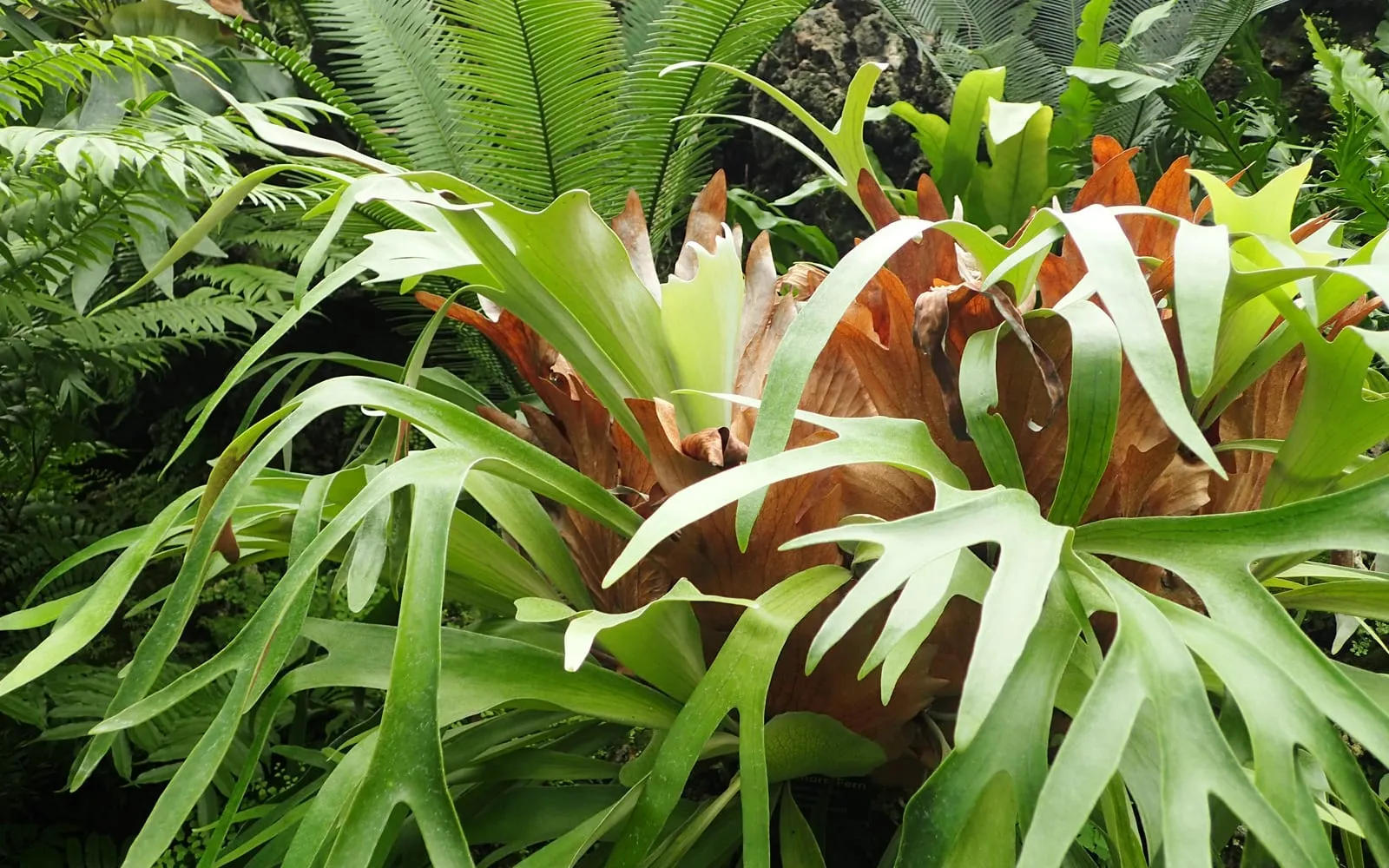
A staghorn produces two entirely different kinds of frond. The green antler-shaped ones hanging forward are the fertile fronds that everybody notices. Behind them, pressed flat against the mount, are the shield fronds, which start green and turn brown and papery as they age.
Those brown shields are the plant’s root system and its larder. In the wild they clasp a tree trunk, catch falling leaves and debris, hold moisture, and slowly rot down into a compost that feeds the fern. New shields grow over the old ones and the pad thickens year by year.
Peeling them off because they look dead removes the plant’s anchorage and its nutrient supply.
The other thing to know is that this is an epiphyte. It grows on trees rather than in soil, which is why the natural way to grow it is mounted on a board and watered by soaking rather than potted and watered from a can.
It is one of the more striking houseplants once established, and a mature specimen on a wall looks like nothing else.
Appearance and character
An evergreen epiphytic fern reaching 60 to 90 cm across, growing on a support rather than in soil.
Shield fronds are flat, rounded, and pressed against the mount, overlapping each other. They emerge pale green and turn brown and papery within a few months, and they stay on the plant permanently, building up into a thick pad.
Fertile fronds are the antler-shaped ones, arching out and downward, 30 to 90 cm long, grey-green, forking repeatedly into strap-like lobes.
The fertile fronds are covered in a fine silvery-white down of star-shaped hairs, which reduces water loss and should not be wiped off. It is often mistaken for mildew or mealybug.
Spores form in brown velvety patches on the undersides of the frond tips on mature plants, which is normal and not a pest.
The plant spreads by producing offsets, called pups, from the edge of the shield pad.
Growth is slow, and a mounted plant takes several years to look established.
Platycerium bifurcatum is the common and easiest species, and Platycerium superbum and Platycerium veitchii are grown by collectors.
Where it is from
Eastern Australia, New Guinea and Java, growing as an epiphyte on tree trunks and branches and occasionally on rocks in humid subtropical forest.
It takes nothing from the tree it grows on. The shield fronds catch falling leaves, bark and debris, which rot down between the fronds and the bark, and the fern’s roots take nutrients and moisture from that accumulated compost.
That arrangement is why the brown shields matter and why it does not want to be in a pot of ordinary compost.
It is in Polypodiaceae and is a true fern, reproducing by spores.
Platycerium bifurcatum is the hardiest and most tolerant of the eighteen or so species and is the one almost always sold as a houseplant.
Staghorn ferns became a Victorian conservatory subject and returned to fashion in the last twenty years as mounted wall plants.
In parts of Australia they grow large enough to be substantial features on rainforest trees, with pads a metre or more across.
The name describes the fertile fronds, which fork like antlers.
How it grows
Mount it on a board for the best results, which is how it grows in the wild.
Take a piece of untreated hardwood or a slab of cork bark, place a handful of damp sphagnum moss on it, sit the fern on the moss with the shield fronds against the board, and tie it on with fishing line or nylon thread passed around the board and over the shield pad.
Use a soft tie and do not cut into the fronds. The plant grips the board itself within a year or two and the ties can then be removed.
Alternatively grow it in a hanging basket or a pot of very open bark-based orchid compost, which is easier and less striking.
Never pot it into ordinary houseplant compost, which holds too much water around the crown.
Hang or fix it in bright indirect light. An east-facing wall, a north-facing room with good light, or a bright bathroom all suit it, and direct sun scorches the fronds.
Water by soaking. Take the mounted plant down, submerge the shield pad and moss in a sink or bucket of tepid water for 10 to 20 minutes until saturated, let it drain completely, and rehang it.
Soak every one to two weeks in summer and every two to four weeks in winter, judging by weight and by the feel of the moss rather than by a schedule.
Do not water into the crown where the new fronds emerge, since water sitting there rots the growing point.
Let it dry noticeably between soakings. A staghorn tolerates drying out far better than staying wet.
Mist the fronds in dry indoor air, or keep it in a bathroom, since it wants humidity.
Feed monthly from April to September by adding a weak balanced liquid feed to the soaking water, at quarter to half strength.
Leave the brown shield fronds alone. They are alive, they anchor the plant and they feed it. Remove only fronds that have gone black and slimy.
Do not wipe the silvery down off the fertile fronds. It is the plant’s water-conserving layer and it does not grow back on a wiped frond.
Remove pups from the edge of the pad in spring to make new plants, cutting them off with a portion of the shield attached and mounting them separately.
Fix the mount to a solid wall fastening, since a large soaked plant is heavy.
Through the seasons
Winter is a rest period. Soak every two to four weeks, stop feeding, and keep it away from cold glass and radiators.
Spring starts into growth, and this is the time to remove and mount pups and to resume feeding.
Summer is the main growth period, soaking every one to two weeks and feeding monthly.
Autumn slows down, and this is the point to reduce soaking and stop feeding.
Care difficulty
Moderate. Nothing about it is demanding once the growing method is understood, and the method is unlike other houseplants.
The mistakes are all conceptual rather than difficult. Treating it as a potted plant, watering it from a can, cutting off the brown fronds, and wiping the down off the leaves are the four, and none of them recurs once you know.
Overwatering and water sitting in the crown are the two things that kill it.
It is slow, so a mounted plant takes a few years to look like the specimens in photographs.
Watering
Water by soaking rather than pouring. Submerge the pad and moss for 10 to 20 minutes, drain completely, and rehang.
Soak every one to two weeks in summer and every two to four weeks in winter.
Judge by weight. A dry mounted staghorn is noticeably lighter than a freshly soaked one, and lifting it is the most reliable test.
Never let water sit in the crown where the new fronds emerge.
Let it dry noticeably between soakings, since it tolerates drought far better than waterlogging.
Use tepid water, and rainwater in a very hard-water area.
Mist the fronds between soakings in dry indoor air, avoiding the crown.
Warning signs, diseases and pests
Brown papery fronds at the back is normal. Those are the shield fronds and they are alive. Leave them.
Black slimy patches at the base of the fronds or in the crown is rot from overwatering or from water sitting in the crown. Cut away the affected tissue, reduce the soaking frequency, and keep water out of the growing point.
Brown crisp frond tips is dry air. Increase humidity by misting, grouping plants or moving it to a bathroom.
Whole fertile fronds browning and dropping is either drought or, on an old frond, normal ageing.
Brown limpet-like bumps on the fronds, particularly along the veins, is scale insect, which is the commonest staghorn pest. Wipe them off with a cotton bud dipped in dilute alcohol and check regularly, since they are easily missed among the down.
Fine silvery-white felting on the fronds is the plant’s own protective down rather than a pest. Do not wipe it off.
Brown velvety patches on the undersides of the frond tips is spore production on a mature plant, which is normal.
Pale scorched patches is direct sun. Move it out of it.
No growth for a long period is normal in winter, and in summer it usually means insufficient light or feeding.
Growing environment
Bright indirect light. An east-facing position, a bright north room or a bathroom with a window all suit it, and direct midday sun scorches the fronds.
Mounted on a board with sphagnum moss, or in a basket of open bark-based orchid compost. Never in ordinary potting compost.
15 to 24 deg C, tolerating a brief dip to around 5 deg C. Keep it away from radiators and cold draughts.
Humidity matters. A bathroom, a kitchen or regular misting all help, and centrally heated living rooms are dry.
Allow 60 to 90 cm of spread for a mature plant, and a mount that projects clear of the wall.
It suits a bathroom wall, a bright hallway, a conservatory, a shaded greenhouse or a sheltered outdoor position in summer.
Stand it outside in deep shade through July and August in a warm summer, which suits it well, and bring it in before the nights turn cold.
Grow it with other epiphytes that want the same treatment. Orchids, tillandsia and bromeliads all share the light, humidity and soak-and-drain watering.
Neither the RHS nor the ASPCA records it as harmful, which makes it a reasonable choice in a household with animals, and mounting it on a wall puts it out of reach anyway.
Feeding
Feed monthly from April to September by adding a weak balanced liquid feed to the soaking water at quarter to half strength.
Do not feed from October to March.
Do not push fertiliser into the shield pad, which is where the plant makes its own compost.
Tuck a small quantity of well-rotted leaf mould or a banana skin behind the shield fronds once a year if you want to imitate the natural feeding, which is a traditional practice and works.
Do not overfeed. The plant is adapted to a poor and intermittent nutrient supply.
Troubleshooting
The fronds at the back have gone brown and papery. Should I cut them off? No. Those are the shield fronds, they are alive, and they anchor the plant and supply its nutrients. Remove only fronds that have gone black and slimy.
What is the white fuzz on the leaves? The plant’s own covering of fine star-shaped hairs, which reduces water loss. It is often mistaken for mildew or mealybug. Do not wipe it off, since it does not grow back on that frond.
How do I water it? By soaking. Take it down, submerge the pad and moss for 10 to 20 minutes, drain it completely, and rehang. Every one to two weeks in summer and every two to four in winter.
How do I know when it needs water? Lift it. A dry mounted staghorn is noticeably lighter than a soaked one, which is more reliable than any schedule.
Can I grow it in a pot? In a basket of open bark-based orchid compost, yes. Never in ordinary potting compost, which holds too much water around the crown.
How do I mount one? Put a handful of damp sphagnum moss on a board of untreated hardwood or cork bark, sit the fern on it with the shield fronds against the board, and tie it on with fishing line over the shield pad. It grips the board itself within a year or two.
There are brown bumps along the fronds. Scale insect, the commonest staghorn pest. Wipe them off with a cotton bud dipped in dilute alcohol, and check regularly since they hide in the down.
Brown velvety patches have appeared under the frond tips. Spores on a mature plant, which is normal and a sign it is doing well.
Can it go outside? Yes, in deep shade through July and August in a warm summer, which suits it. Bring it in before the nights turn cold.
Staghorn fern problem guides
Not sure what is wrong? See the common houseplant pests guide.