
Disorder
Nutrient deficiencies
Also called Chlorosis, Iron deficiency, Magnesium deficiency
Yellow leaves at the bottom of the plant mean something different from yellow leaves at the top. The rule that halves the diagnosis, and why most yellowing is not a shortage at all.
At a glance
- Type
- Disorder
- Cause
- Feeding or nutrients
- Severity
- Weakens the plant
- Affects
- Garden plants, Herbs and edibles, Houseplants
- Active
- All year
What you are seeing
- Yellowing between the veins while the veins themselves stay green
- Yellowing that begins on the oldest leaves at the base of the plant
- Yellowing that begins on the newest leaves at the top of the plant
- A whole plant pale green, small-leaved and slow, with no pattern within the leaf
- Brown scorched margins on older leaves with the centre still green
- Reddish or purple tints on stems and leaf undersides
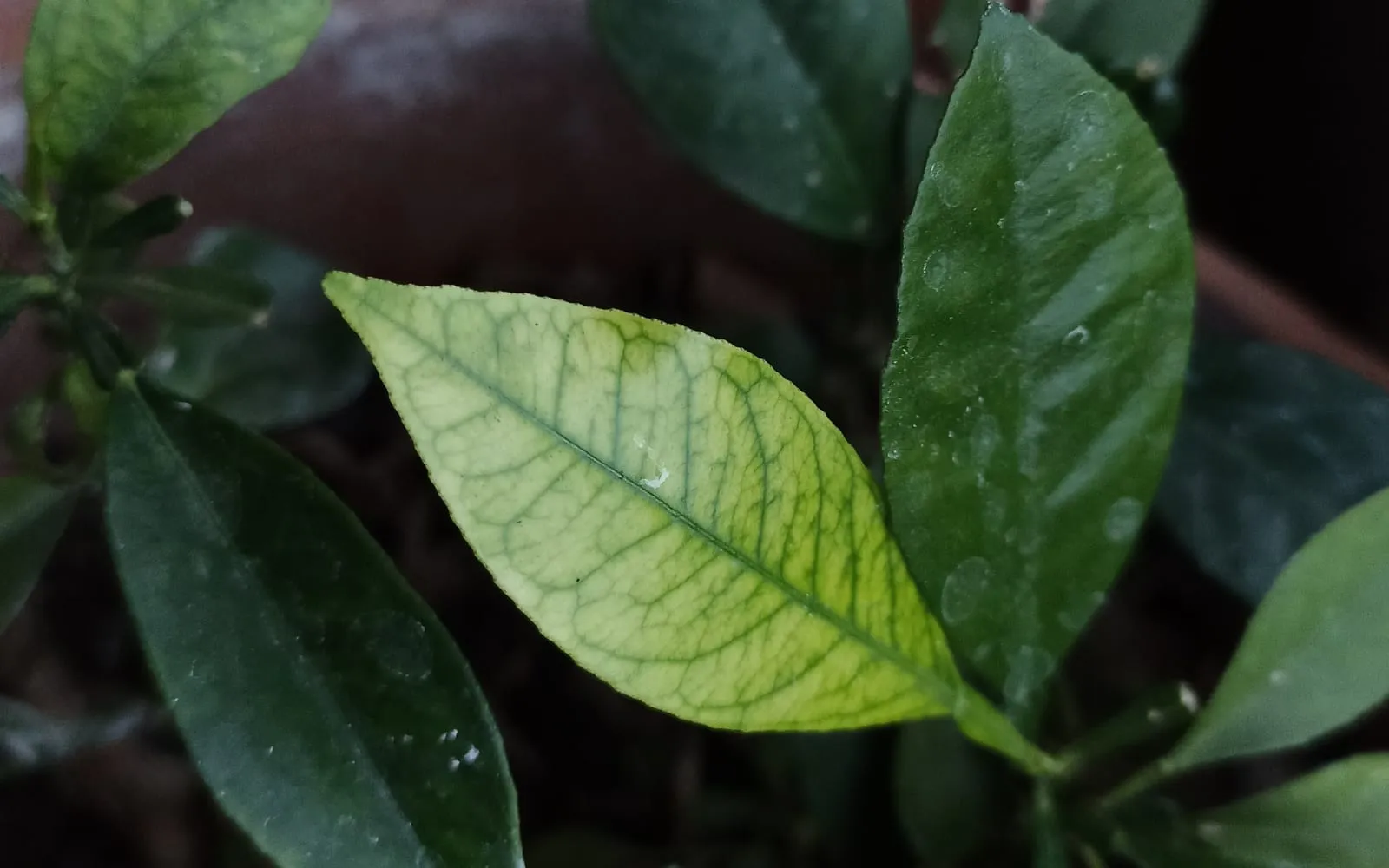
- New leaves coming through nearly white with a fine green vein network
Before you treat anything
Fertilisers are chemicals with instructions, and the instructions exist because the wrong rate does harm. Store them out of reach of children and pets, and keep sulphate of iron off paving, where it stains permanently.
Start with where on the plant it is
Almost every diagnosis on this page turns on one question. Are the yellow leaves at the bottom of the plant, or the top?
Nitrogen, phosphorus, potassium and magnesium are mobile inside a plant. When supply runs short, the plant dismantles them out of its older leaves and moves them to the growing tip, because new growth is worth more than old. So a shortage of any of those shows on the oldest leaves first, at the base, while the top of the plant still looks well.
Iron, calcium, manganese, sulphur and boron are immobile. Once they are built into a leaf they stay there. A shortage therefore shows on the newest leaves, at the top of the plant, while the older leaves below are perfectly green.
That single distinction eliminates half the possibilities before you have looked at anything else.
Then look at the pattern within the leaf
Uniformly pale, whole plant, oldest leaves worst. Nitrogen. The plant is small, the leaves are small, growth has slowed, and there may be red or purple tints on the stems. Common in containers that were potted in spring and never fed, on sandy soil after heavy rain, and wherever fresh woodchip has been dug in.
Yellow between the veins, oldest leaves, green herringbone of veins standing out, often with orange or red at the margins. Magnesium. Tomatoes fed hard with a high-potassium feed get this every August, because potassium competes with magnesium at the root. Also common on light acid soils after a wet spell.
Yellow between the veins, newest leaves, with a fine green net of small veins, going almost white in bad cases. Iron. Almost always caused by high pH rather than by an absence of iron in the soil, which is why it turns up on camellias, rhododendrons, blueberries and citrus grown on chalk or watered with hard tap water.
Brown scorched margins on older leaves with the centre still green, and poor flowering and fruiting. Potassium. Light, sandy and chalky soils, and pot plants in old compost.
Dull dark leaves with purple tints and a stunted plant. Phosphorus, which is rare in British gardens and usually a sign of very acid or very cold wet soil rather than an absent nutrient.
Most yellow leaves are not a shortage
This is the part the search results tend to skip.
Roots take nutrients up from solution. Everything that stops that happening produces symptoms identical to a shortage, and in a British garden those causes are far commoner than an empty soil.
Waterlogged soil holds no oxygen, so the roots stop working. Cold soil in spring slows uptake to a crawl, which is why brassicas and sweetcorn look purple and miserable in April and fine by June. High pH locks up iron and manganese. Vine weevil grubs, root rot and a pot-bound root ball all remove the plant’s capacity to take up anything.
In every one of those cases, feeding does nothing and often makes matters worse, because fertiliser salts draw water back out of damaged roots.
So before you buy anything, check the compost is not saturated, tip a container plant out and look at the roots, and test the pH. Then feed.
What to do about it
Fix the cause rather than the colour. Correct the pH, improve the drainage, repot the plant, or accept that the plant is in the wrong place and move it.
For a container plant, the answer is usually fresh compost and a balanced liquid feed from six weeks after potting. For a border, it is organic matter worked in and mulched on, year after year, rather than a bag of anything.
Where a specific shortage is confirmed, treat it directly. Chelated or sequestered iron for lime-induced chlorosis, on plants you cannot move. Magnesium sulphate, sold as Epsom salts, at about 20 grams per litre as a foliar spray for magnesium on tomatoes, alongside easing back the tomato feed that caused it. A general balanced fertiliser for nitrogen.
Use a foliar feed when you want a quick answer. It bypasses the soil chemistry completely and greens a plant up in a fortnight, which buys time while the real correction takes effect.
Water ericaceous plants with rainwater. A camellia or a blueberry that has been fine for three years and yellows in the fourth has usually been drinking hard tap water throughout.
Why the last two tiers are empty
Nothing can be introduced to eat a nutrient shortage, so the biological tier does not apply.
The last tier is for plant protection products, and a fertiliser is not one. Everything on this page is a feeding or soil decision rather than a pesticide, so there is nothing to check against an approvals database.
What it gets mistaken for
Overwatering yellows the oldest leaves exactly as a nitrogen shortage does, and a finger in the compost tells the two apart in seconds.
Rust yellows leaves from the bottom of the plant upwards. Turn one over. Pustules mean rust, a clean underside means it is worth looking at feeding.
Red spider mite dulls and yellows a leaf with a fine even stippling across the upper surface, and there is nothing about the pattern that follows the veins.
Viruses produce mosaics, mottles and ring patterns that are irregular rather than following the vein structure, often with distorted growth, and there is no treatment. A plant with a yellow mosaic and puckered new leaves is a plant to remove rather than feed.
Natural leaf ageing accounts for a great deal. A monstera or a rubber plant that sheds its lowest leaf every couple of months, while everything above it is growing well, is doing what it is supposed to do.
What to do, in order
Start here
Prevention, and the changes that stop the problem returning. Most of these pages should end at this tier.
- Test the soil pH before adding anything
- Nutrients present in the soil but locked up by pH are far commoner than nutrients that are absent. A cheap kit tells you in ten minutes whether the iron is missing or merely unavailable, and it stops a season of feeding a problem that feeding cannot fix.
- Match the plant to the ground you have
- A camellia, a rhododendron or a blueberry on chalk will be yellow every year whatever you pour on it, because those plants cannot take up iron above about pH 7. Grow them in containers of ericaceous compost, or grow something else and stop fighting.
- Start feeding containers after six weeks
- Bagged compost carries enough fertiliser for around six weeks of growth and no more. Most container plants declared deficient in July were potted in April and never fed, and a balanced liquid feed at the rate on the bottle solves it.
- Water ericaceous plants with rainwater
- Tap water in a hard water area raises the pH of the compost over a season, and a camellia or a blueberry that was fine last year goes yellow this year. A water butt is the fix, and it costs nothing to run.
- Add organic matter rather than fertiliser
- Compost, leaf mould and well-rotted manure improve the structure that lets roots reach nutrients in the first place, and they release what they contain slowly. On most British garden soil that does more over five years than any bag of feed.
- Do not dig fresh woodchip or sawdust into soil
- Micro-organisms breaking down raw woody material take nitrogen out of the soil to do it, and the plants go pale. Use it as a surface mulch, where it has almost no effect on the soil beneath.
- Stop overfeeding
- Too much of one nutrient blocks the uptake of another. Heavy potassium feeding on tomatoes induces magnesium shortage, and a build-up of fertiliser salts scorches leaf margins in a way that looks exactly like a deficiency. Feed at the stated rate and no more.
Then reach for a barrier
Netting, hand removal and water. Nothing here harms anything except the target.
- Repot a container plant into fresh compost
- A houseplant in the same exhausted compost for three years is short of everything and cannot be fed out of it, because the structure has broken down and the roots have nowhere to work. Fresh compost is the treatment.
- Use a foliar feed for a quick correction
- Nutrients sprayed onto the leaves bypass the root and the soil pH entirely, so a chelated iron or a magnesium spray greens a plant up within a fortnight. It is a stopgap that buys time while the underlying cause is dealt with.
- Check the roots before you feed
- A plant with rotted roots, vine weevil grubs or a pot-bound ball cannot take up what is already there. Every one of those produces yellow leaves, and feeding makes all three worse.
- Flush a pot that has a white crust on it
- Chalky deposits on the compost surface or the outside of a terracotta pot mean accumulated salts. Water heavily until it runs freely from the base, three or four times, to wash them through.
Plants affected
Guides that name it among the problems to watch for. The list is the plants it is characteristic of rather than everything it will feed on.
A common tomato problem
This is one of the problems tomato growers meet most often. See it alongside the other pests, diseases and disorders on the tomato guide.
Common tomato problemsA common rose problem
This is one of the pests, diseases and disorders that rose growers meet most often. See it alongside the others on the common rose problems guide.
Common rose problems