
Outdoor plant
Chinese Wisteria
Wisteria sinensis
Also known as Wisteria, Chinese kidney bean
How to grow Wisteria sinensis. The two-stage prune that produces flowers, why a seedling may never bloom in your lifetime, which way the stems twine, and where it is a listed invasive.
At a glance
- Difficulty
- Moderate
- Water
- Weekly through the first two summers, then in drought only
- Light
- Full sun. Six hours minimum for good flowering
- Temperature
- Fully hardy, to about -20 deg C. Late frost damages the buds
- Hardiness
- USDA 5-9, RHS H6, hardy to -25 C
- Type
- Deciduous woody climber, very long-lived
- Height
- 10-20 m if unrestrained
- Native to
- Woodland and riverbanks of central and eastern China
- Best month
- February and July in the Northern Hemisphere, August and January in the Southern Hemisphere
Cold is no obstacle and the flower buds are the vulnerable part, so a late frost after they swell costs a season. Twice-yearly pruning, in late summer and again in winter, is what forces flowering, and an unpruned plant makes growth for decades and flowers little. Chinese and Japanese wisteria are serious invasive plants through the American south-east, where they pull down mature trees, and American wisteria, Wisteria frutescens, is the species to plant there instead.
Hardiness zones describe winter cold alone. Summer heat, humidity, rainfall and the length of the growing season decide as much, so treat the range as the outer limit rather than as a recommendation.
Every month named in this guide is for the temperate Northern Hemisphere. If you garden in the Southern Hemisphere, shift each one by six months, so February becomes August. Closer to the equator the wet and dry seasons matter more than the calendar, and the shift stops being a useful guide.
Toxic if eaten
- Do not eat
- The seeds and pods most of all, and the bark
- Harm from
- Eating it
- Affects
- People, cats and dogs
The seeds and pods are the hazard. They contain wisterin, a glycoside, along with a lectin, and both are concentrated in the velvety pods that follow a good flowering year. The RHS lists Wisteria as harmful if eaten, and the ASPCA lists it as toxic to dogs and cats. Two seeds have been enough to make a child seriously unwell, with vomiting, abdominal pain, diarrhoea and dehydration coming on within an hour or two. Recovery is usually complete with fluids, and the risk is a hospital trip rather than a lasting one. The pods are the practical problem because they look like broad beans and hang within reach on a wall-trained plant. Sweep them up if you have small children, and remove them at the summer prune. The bark and roots are also toxic and are far less likely to be eaten. Flowers and foliage present little risk.
Sources: ASPCA (Wisteria), RHS potentially harmful garden plants
About
Wisteria has one famous problem and it has a precise answer. A plant that grows vigorously and never flowers is either an unpruned plant or a seedling, and the two are fixed differently.
The pruning answer is a cut twice a year, once in late summer and once in midwinter. Everything the plant does is aimed at climbing, and pruning is how you redirect it into flowering spurs. There is no substitute and no shortcut.
The seedling answer is harsher. Wisteria raised from seed takes ten to twenty years to flower and sometimes never does. Grafted plants flower within three to five. If you bought an unnamed cheap wisteria with no visible graft union near the base, you may be waiting a very long time.
Appearance and character
A deciduous woody climber with twining stems that thicken over decades into gnarled trunks the width of a leg.
Leaves are pinnate, 20 to 30 cm long, with nine to thirteen leaflets, opening a soft fresh green and turning butter yellow in autumn.
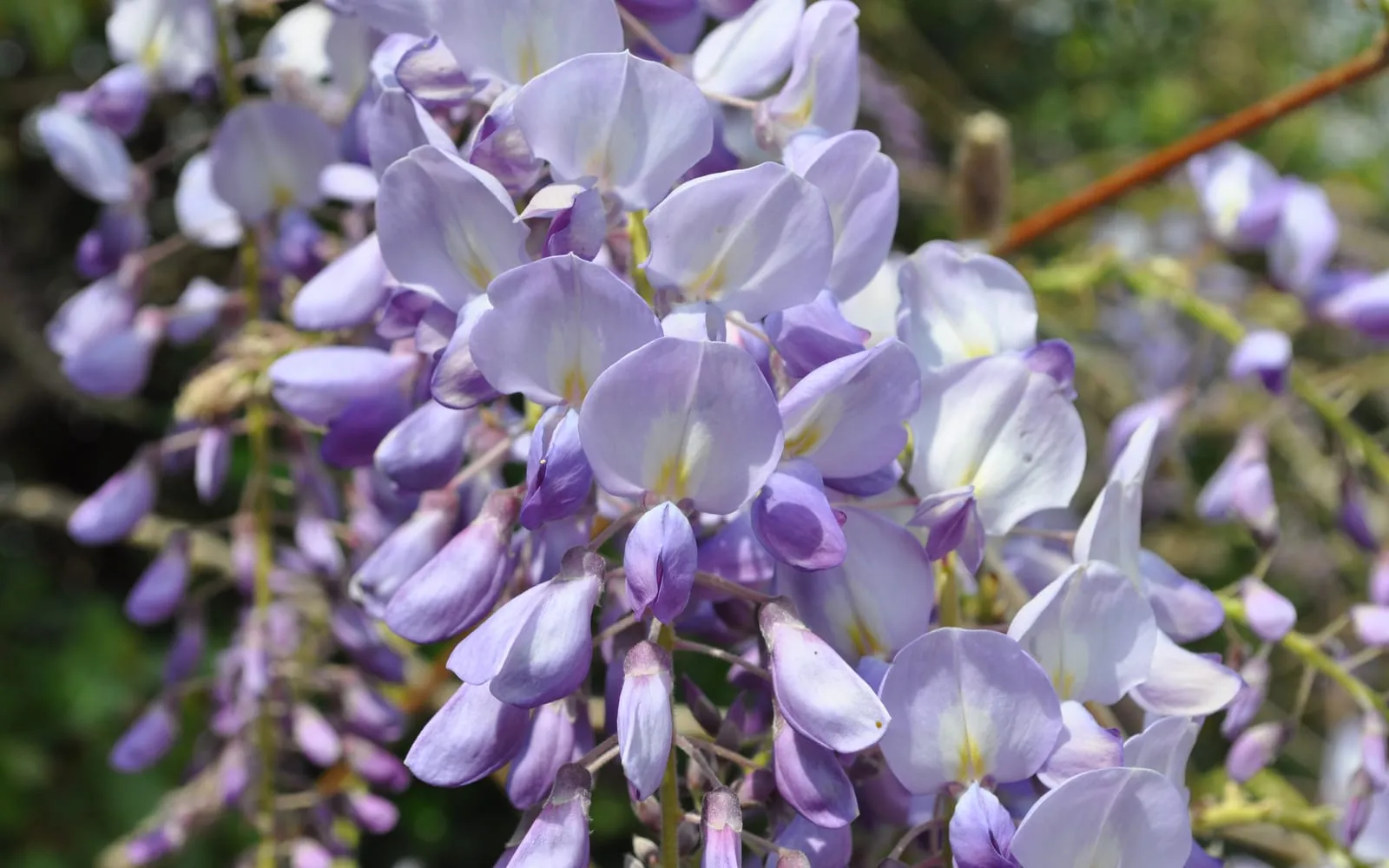
The flowers hang in racemes 20 to 30 cm long, lilac to violet-blue and heavily scented, opening in May before or alongside the leaves. On Wisteria sinensis all the flowers in a raceme open more or less at once, so the whole plant blooms in a single overwhelming week.
Velvety green pods follow, 10 to 15 cm long, ripening brown and splitting explosively in dry weather with an audible crack.
Two checks tell the Chinese species from the Japanese. W. sinensis twines anticlockwise when viewed from above and W. floribunda twines clockwise. Japanese wisteria also carries much longer racemes, 30 to 60 cm and sometimes far more, which open gradually from the base rather than all together.
Where it is from
Woodland and riverbanks in central and eastern China, scrambling through trees to reach light at the canopy.
Climbing to the canopy is the behaviour you are fighting in a garden. The plant invests everything in extension growth until it reaches full light, and only then switches to flowering. Pruning fools it into believing it has arrived.
Its native soil is deep, fertile and moisture-retentive, and wisteria grows poorly on thin dry chalk.
Winters there are cold, so hardiness is rarely the issue. Late spring frost is, because it damages the flower buds after they have swelled.
Wisteria sinensis has escaped cultivation across the south-eastern United States and is listed as an invasive species in several states, smothering native woodland and girdling trees. Readers there should consider the North American Wisteria frutescens, which is better behaved and flowers on the current season’s growth.
How it grows
A deciduous climber that produces two kinds of growth. Long whippy extension shoots race outward through summer, several metres in a season. Short stubby spurs carry the flower buds.
The whole aim of pruning is to convert those extension shoots into spurs.
Flower buds form in summer on short spurs and sit through winter as fat rounded buds, distinctly plumper than the pointed leaf buds beside them. Learning to tell them apart makes winter pruning straightforward.
Stems twine around anything within reach and thicken relentlessly. A wisteria will crush a drainpipe, lift roof tiles, block gutters and strangle a young tree. Give it a support built of galvanised wire on vine eyes, or heavy timber, and check annually that nothing has been engulfed.
Propagation is by grafting or by layering. Cuttings root poorly and seedlings take a generation to flower.
Through the seasons
Spring brings the flowers in May, before or with the leaves. Feed with sulphate of potash as growth starts. Late frosts can brown the buds, and a sheltered wall reduces the risk.
Summer is when the plant runs. Do the first prune in July or August, cutting every whippy side shoot back to five or six leaves. New growth continues afterward and can be shortened again.
Autumn brings yellow leaf colour and the ripening pods. Remove pods if children use the garden.
Winter is the second prune, in January or February when the framework is bare. Cut the shoots you shortened in summer back again to two or three buds. This is when the flower spurs are made.
Care difficulty
Moderate, and the difficulty is a skill rather than a fragility. The plant is tough, hardy and long-lived, and it needs an owner who prunes twice a year and means it.
The two-stage prune is the whole discipline. Summer removes bulk and lets light onto the ripening wood. Winter shortens those stubs into flowering spurs. Miss the winter cut and you get leaves. Miss both and you get a green monster on the front of the house.
The second difficulty is structural. People underestimate the weight and the strength. A mature wisteria trained along a house wall can pull a trellis off its fixings and lift the edge of a roof, and the damage arrives slowly enough that nobody notices until it is expensive.
Watering
Water weekly through the first two summers after planting, giving a deep soak rather than a sprinkle. Establishment is the period that matters.
Established plants need water only in prolonged drought. A wisteria against a house wall sits in a rain shadow, so it dries out far more than open ground and benefits from a soak in a dry summer.
Drought stress in July and August can cause bud drop the following spring, since that is when next year’s flower buds are forming.
Mulch generously each spring with compost or well-rotted manure to hold moisture, keeping it clear of the stem.
Container-grown wisteria needs regular watering and is a demanding way to grow the plant.
Warning signs, diseases and pests
Vigorous growth with no flowers is the classic complaint. Check for a graft union near the base first. If there is one, the plant needs pruning rather than patience. If not, it is a seedling and may take fifteen years.
Buds forming and then browning and dropping in spring means late frost damage.
Yellowing leaves between green veins is chlorosis from alkaline soil locking up iron. Feed with a sequestered iron product and mulch with acidic compost.
Wisteria scale is a large flat dark brown scale, up to 10 mm, clustered on the stems, and it is spreading in southern England. Heavy infestations weaken the plant. Scrub off what you can reach in winter.
Brown scale and its accompanying sooty mould show as sticky leaves with black deposits.
Powdery mildew coats leaves greyish-white in a dry summer.
Sudden death of a whole mature plant, with white fungal sheets under the bark at the base and black bootlace strands in the soil, is honey fungus. There is no treatment. Remove the stump and roots.
Leaves opening and then hanging limp suggests root damage or waterlogging.
Growing environment
Full sun, with six hours minimum. A south or west-facing wall is the classic position and gives the best flowering. Shade produces leaves and few racemes.
Deep, fertile, moisture-retentive soil that still drains. Improve thin or sandy ground with plenty of organic matter before planting. Very alkaline chalk causes persistent chlorosis.
Fully hardy to about -20 deg C. Shelter from early morning sun in a frost pocket, since rapid thawing damages frosted buds more than the frost itself.
Build the support before you plant. Horizontal galvanised wires at 30 cm spacings on vine eyes, held 5 cm clear of the wall, will carry a mature plant. Trellis panels rarely last.
Keep it away from gutters, drainpipes, roof edges and young trees.
Plant at least 45 cm out from the wall to escape the driest ground, and lean the plant in toward its support.
Feeding
Feed once in spring with sulphate of potash, at roughly a handful per square metre around the base. Potassium promotes flowering.
Avoid high-nitrogen fertilisers and avoid planting wisteria in a lawn edge that gets lawn feed. Nitrogen produces the leafy growth you are trying to suppress and is a common reason for a well-pruned plant that still refuses to flower.
Mulch each spring with garden compost or well-rotted manure, kept off the stem.
Bonemeal at planting helps establishment.
A plant growing strongly and flowering poorly usually needs less feeding and more pruning, not the reverse.
Troubleshooting
It grows like mad and never flowers. Look at the base for a graft union, a swollen kink in the stem near ground level. If it is there, the plant needs the two-stage prune. If it is not, you have a seedling that may take ten to twenty years.
How exactly do I prune it? Twice. In July or August cut every long whippy side shoot back to five or six leaves from the main framework. In January or February cut those same stubs back again to two or three buds. Repeat every year.
Which buds are the flowers? In winter, the flower buds are noticeably fatter and rounder than the slim pointed leaf buds. Cut to leave the fat ones.
The buds went brown in April. Late frost. Choose a position sheltered from early morning sun, and accept an occasional lost year.
The leaves are yellow with green veins. Iron chlorosis from alkaline soil. Apply sequestered iron and mulch with acidic organic matter.
Which wisteria do I have? Watch which way a young shoot twines. Anticlockwise from above means W. sinensis, clockwise means W. floribunda. Chinese racemes are shorter and open all at once, Japanese ones are longer and open from the base down.
Are the pods dangerous? Yes, mildly. The seeds cause vomiting and stomach pain and have made children unwell. Sweep the pods up and remove them at the summer prune if young children use the garden.
Can I cut an old overgrown one back hard? Yes. Wisteria tolerates severe renovation. Cut the framework back hard in winter, accept losing a year or two of flowers, and retrain the regrowth into a proper structure.