
Edible
Pear
Pyrus communis
Also known as European pear, Common pear
How to grow pears, Pyrus communis. Quince rootstocks, why pears flower earlier than apples and lose more to frost, picking before they are ripe, and pear rust.
At a glance
- Difficulty
- Moderate
- Water
- Weekly for the first three years, then in droughts only
- Light
- Full sun, ideally against a warm wall in the north
- Temperature
- Hardy in wood, and the early blossom is frost-tender
- Hardiness
- USDA 4-8, RHS H6, hardy to -25 C
- Type
- Deciduous tree, long-lived and slower to crop than apple
- Height
- 3 m on Quince C to 12 m on a seedling rootstock
- Native to
- Eastern Europe and western Asia
- Best month
- October in the Northern Hemisphere, April in the Southern Hemisphere
Pear flowers a week or two ahead of apple on 600 to 900 chill hours, which puts the blossom into the frost window in more springs than not. Autumn warmth decides the rest, since a cool late summer leaves the flesh gritty around the core. Two cultivars from compatible groups are needed for a worthwhile set.
Hardiness zones describe winter cold alone. Summer heat, humidity, rainfall and the length of the growing season decide as much, so treat the range as the outer limit rather than as a recommendation.
Every month named in this guide is for the temperate Northern Hemisphere. If you garden in the Southern Hemisphere, shift each one by six months, so October becomes April. Closer to the equator the wet and dry seasons matter more than the calendar, and the shift stops being a useful guide.
Edible, with limits
- Safe to eat
- The flesh and skin of the fruit
- Do not eat
- The pips, and the leaves
- Harm from
- Eating it
- Affects
- People, cats, dogs and horses
The fruit is food and the pips are not, as with all members of the rose family that carry stone-fruit chemistry. Pear seeds contain amygdalin, a cyanogenic glycoside that releases hydrogen cyanide when the seed is chewed and the contents meet gut enzymes. The quantity in a few pips swallowed whole is negligible, since the hard coat passes through intact. The ASPCA does not list the pear separately, and treats the related Prunus and Malus species as toxic on the same basis, naming the seeds, leaves and stems rather than the fruit. The practical points are the same as for apple. Do not let wilted or frosted prunings reach grazing animals, since the cyanogenic compounds are released as the tissue breaks down, and core the fruit before feeding it to a dog or a horse. Windfall pears eaten in quantity by a horse cause colic through fermentation and sugar rather than through cyanide.
Sources: ASPCA toxic and non-toxic plants, RHS potentially harmful garden plants
About
The old saying runs that you plant pears for your heirs. It was true of trees on seedling rootstocks, which took a decade or more to crop and lived for centuries. Modern quince rootstocks have collapsed that timescale to three or four years.
Pears are the harder half of the apple-and-pear pairing in a cool climate, for one reason. They flower two to three weeks earlier, which puts the blossom squarely in the path of late April frosts.
Learn the picking rule before planting. A pear ripened on the tree is grainy and brown at the core. Pick it firm and ripen it indoors.
Appearance and character
A deciduous tree with a distinctly upright, narrow head compared with an apple, and darker, more fissured bark.
Leaves are oval, glossy, finely toothed and leathery, deeper green than an apple’s, colouring red and orange in autumn.
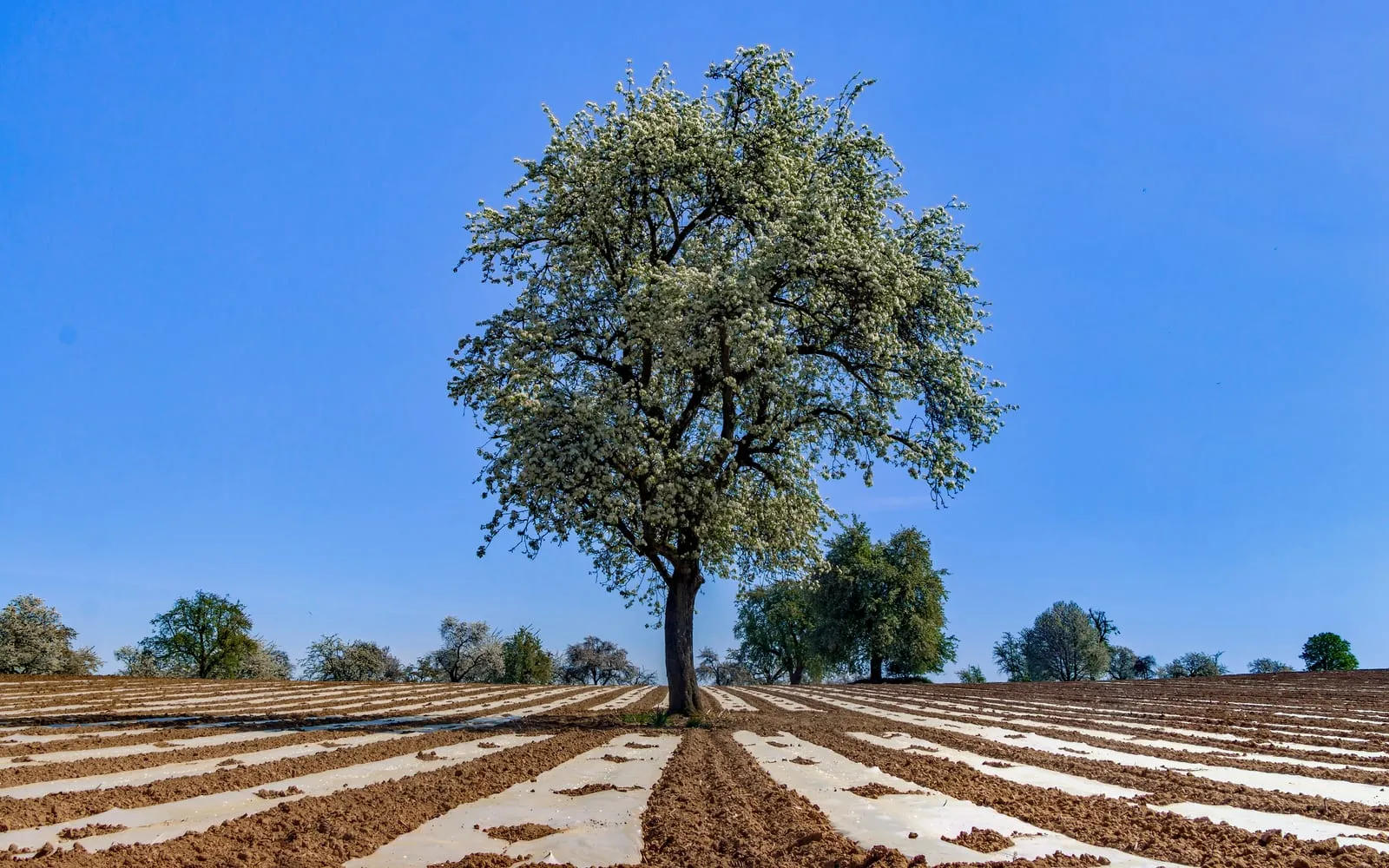
Blossom is pure white with dark anthers, opening in April before the leaves are fully out, in dense clusters that cover the tree.
Fruit is the familiar tapering shape in most varieties, and round in some, with skin in green, yellow, russet brown or flushed red.
Trained forms suit pears particularly well. An espalier on a warm south or west wall is the traditional and still the best way to grow them where summers are cool.
Where it is from
Eastern Europe and western Asia, in a broad band from the Caucasus through Asia Minor, where the wild pear still grows in woodland and scrub.
Cultivation goes back at least three thousand years, and the Romans grew dozens of named varieties and spread them across their empire, including into Britain.
The great age of pear breeding was in Belgium and France between about 1750 and 1850, which is where ‘Doyenne du Comice’, ‘Beurre Hardy’ and most of the classic dessert pears came from.
Asian pears are a different species, Pyrus pyrifolia, round and crisp and eaten firm, and they are not interchangeable in cultivation or in the kitchen.
The wild origin is warmer and more continental than the maritime climates pears are now grown in, which is why they want the sunniest, most sheltered spot available and repay a wall.
How it grows
Buy a grafted tree. Pears are grown on quince rootstocks, which control size and bring cropping forward. Quince C gives a tree of about 3 m and suits cordons and small gardens, and Quince A gives 4 to 5 m and is the general-purpose choice.
Some varieties, including ‘Williams’ and ‘Doyenne du Comice’, are incompatible with quince and are sold with an interstem of a compatible variety grafted between. Buy from a nursery rather than guessing.
Pollination works as it does for apples. Most pears need a different variety flowering at the same time, and varieties are grouped by flowering period. ‘Conference’ is partly self-fertile and crops after a fashion alone, and it does far better with a partner.
Plant bare-root from November to March with the graft union clear of the soil, and stake for the first few years.
Fruit forms on spurs that build up over years, so pear pruning is gentler than apple pruning and aimed at maintaining an open framework.
Thin the fruitlets in June to one or two per cluster.
Through the seasons
Winter is planting and pruning. Plant bare-root trees, and prune free-standing trees while dormant.
Spring brings very early blossom, from mid-April. Fleece small trees or wall trained forms when frost threatens, and feed and mulch in February.
Summer is thinning and training. Thin the fruitlets in June, and prune trained forms in August.
Autumn is the harvest, from late August for early varieties to October for late ones. Pick firm, and store the late varieties cool and dark.
Care difficulty
Moderate, and slightly harder than apples wherever springs are frosty, for reasons of climate rather than technique.
Frost at blossom is the main problem, and it is the reason a sheltered warm site matters so much for pears.
Pear rust has spread rapidly across northern Europe in the last twenty years and is now the commonest complaint.
Picking and ripening confuse people. A pear picked ripe is already going over inside, so the crop is taken firm and finished indoors.
Once established, the trees themselves are long-lived, hardy in wood, and need less pruning than apples.
Watering
Water newly planted trees weekly through their first three summers.
Pears are less drought-tolerant than apples and want moisture-retentive soil. Established trees still benefit from watering in a prolonged dry summer, especially those trained against a wall, where the soil at the foot stays dry.
A wall-trained pear needs watering in most summers, since the wall keeps rain off the root zone.
Mulch each spring with compost, keeping it clear of the trunk.
Irregular watering produces small hard fruit and can cause splitting.
Warning signs, diseases and pests
Pear rust is now the most common problem in European gardens. Bright orange spots appear on the upper leaf surface from midsummer, with brown warty growths beneath. The fungus alternates between pear and juniper, so removing nearby junipers helps where that is possible. Pick off affected leaves, rake up and bin fallen ones, and accept some level of it. Trees tolerate it better than their appearance suggests.
Pear midge causes young fruitlets to blacken and drop in May and June. Cut one open and you find small white maggots inside. Collect and destroy every affected fruitlet before the larvae reach the soil, and cultivate the ground beneath in winter.
Scab produces dark blotches on leaves and cracked corky patches on the fruit, worse in wet springs.
Pear and cherry slugworm are small black slug-like sawfly larvae that graze the upper leaf surface into a skeleton.
Frost damage shows as blackened flower centres. Cut a blossom open after a cold night to check.
Fruit that stays small and hard usually means drought or a lack of thinning.
Grainy brown flesh at the core means the fruit was left on the tree too long.
Japanese beetle skeletonises the leaves in visible feeding groups and brown marmorated stink bug leaves dimpled, corky patches on the fruit. The beetle is well established across the United States and newly arrived in northern Italy and Switzerland; the stink bug is already established across North America and a growing list of European countries. Neither occurs in Australia or New Zealand, where a find is reportable.
Plum curculio cuts a crescent-shaped scar into young green fruit and is confined to North America east of the Rocky Mountains. Jar branches over a sheet in the cool morning after petal fall to catch adults, which play dead and drop when disturbed.
Apple maggot fly also takes pears in North America, tunnelling through the flesh from a faint surface dimple rather than boring to the core the way codling moth does. Hang sticky red sphere traps from mid-June.
Growing environment
Full sun and shelter. Pears want the warmest position in the garden, and a south or west-facing wall is ideal in cool-summer regions.
Deep, fertile, moisture-retentive but well-drained soil. Pears tolerate heavier ground than apples and dislike thin dry soil.
Avoid frost pockets absolutely. The early blossom makes this the single most important siting decision.
Match the rootstock to the space. Quince C for cordons and small gardens, Quince A for a free-standing tree.
Espaliers and fans against a wall are the classic answer where space is short, and they crop well.
Plant at least two compatible varieties where space allows, or check what neighbouring gardens hold.
Feeding
Apply a general-purpose fertiliser in late winter before growth starts.
Add sulphate of potash in early spring, which supports flowering and fruit quality and is the more useful of the two on an established tree.
Mulch with well-rotted manure or compost in spring, kept clear of the trunk.
Avoid heavy nitrogen, which encourages soft growth, scab and rust, and delays cropping.
Wall-trained trees need more attention than free-standing ones, since the soil at the foot of a wall is both drier and poorer.
Troubleshooting
Blossom every year and almost no fruit. Frost at flowering, or no compatible pollination partner. Pears flower early, so protect small trees on cold April nights and check the flowering group.
Bright orange spots all over the leaves. Pear rust. Remove affected leaves, bin fallen ones, and remove nearby junipers if you can. Trees cope with it.
Small fruitlets blackening and dropping in May. Pear midge. Cut one open to confirm the maggots, then collect and destroy every affected fruitlet.
The flesh is brown and grainy at the core. Left on the tree too long. Pick pears firm and ripen them indoors.
How do I know when to pick? Lift the fruit horizontally to the branch. If the stalk parts cleanly, it is ready to pick, even though it is not yet ready to eat.
The pear went from rock hard to mush in a day. That is pear behaviour. Check them daily and eat them at the brief point where the flesh yields at the neck.
The tree is enormous. Grown on a seedling or vigorous rootstock, or the graft union was buried. Use Quince C or A and keep the union clear of the soil.
When will it start cropping? Three to five years on Quince C or A. Trees on seedling rootstocks can take a decade.
Pear problem guides
Not sure what is wrong? See the common vegetable pests guide.
- Pear rust, now widespread across Europe
- Frost damage to early blossom
- Scab
- Pear and cherry slugworm
- Japanese beetle across the US, newly arrived in northern Italy and Switzerland
- Brown marmorated stink bug, established across North America and Europe
- Plum curculio, a North America-only weevil that scars young fruit
- Apple maggot fly, a North America-only fly distinct from codling moth
- Bitter pit, less common than on apple and the same calcium shortage