
Edible
Courgette
Cucurbita pepo
Also known as Zucchini, Summer squash, Marrow
How to grow courgettes, Cucurbita pepo. Why two plants are plenty, hand pollination, powdery mildew, and the bitterness that can make a home-saved fruit dangerous.
At a glance
- Difficulty
- Easy
- Water
- Generously, every two or three days in hot weather
- Light
- Full sun
- Temperature
- 18-24 deg C. Killed by the lightest frost
- Hardiness
- USDA 10-11, RHS H1c, hardy to 2 C
- Type
- Tender annual
- Height
- 60-90 cm tall and up to 1.2 m across
- Native to
- Central America and Mexico, with the courgette selected in Italy
- Best month
- May in the Northern Hemisphere, November in the Southern Hemisphere
Warm soil at sowing and insects at flowering are the whole of it. Below 15 deg C the seed rots, and in a wet season the bees stay in and the young fruit yellows and drops from the stalk end for want of pollen. The first flush of flowers is male, so an early plant with no fruit is behaving normally.
Hardiness zones describe winter cold alone. Summer heat, humidity, rainfall and the length of the growing season decide as much, so treat the range as the outer limit rather than as a recommendation.
Every month named in this guide is for the temperate Northern Hemisphere. If you garden in the Southern Hemisphere, shift each one by six months, so May becomes November. Closer to the equator the wet and dry seasons matter more than the calendar, and the shift stops being a useful guide.
Edible, with limits
- Safe to eat
- Fruit, flowers, shoot tips and seeds
- Harm from
- Eating it
- Affects
- People
Courgettes are food, with one rare exception. The wild ancestors of Cucurbita produce cucurbitacins, bitter compounds that defend the fruit, and breeding removed them from cultivated varieties. A plant grown from home-saved seed can revert, particularly where it has crossed with an ornamental gourd, and the fruit then contains cucurbitacins again. The warning sign is unmistakable, since an affected courgette is intensely bitter on the first bite. Eating it causes violent vomiting and diarrhoea, and cases severe enough for hospital treatment appear in the medical literature under the name toxic squash syndrome. The rule is simple. Taste a small raw piece of any courgette grown from saved seed, and if it is bitter, spit it out and discard the whole fruit and the plant that bore it. Bought seed of a named variety is not a realistic risk. The leaves and stems carry fine bristles that irritate bare forearms, so wear sleeves when picking.
Sources: RHS potentially harmful garden plants, ASPCA toxic and non-toxic plants
About
Two courgette plants feed a family through August. Three is a mistake you make once, and the glut is the reason so many allotment sheds have a marrow nobody wants sitting by the door.
A courgette and a marrow are the same plant. The difference is when you pick. Cut the fruit at 10 to 15 cm and the plant keeps producing, and leave one to swell into a marrow and it slows down and starts to shut up shop.
Sow indoors in April, plant out at the end of May, and pick every other day from July until the first frost.
Appearance and character
A big, open, coarse plant with large lobed leaves on hollow prickly stalks, often marbled with silver-white along the veins. That marbling is varietal patterning rather than mildew, and the two get confused constantly.
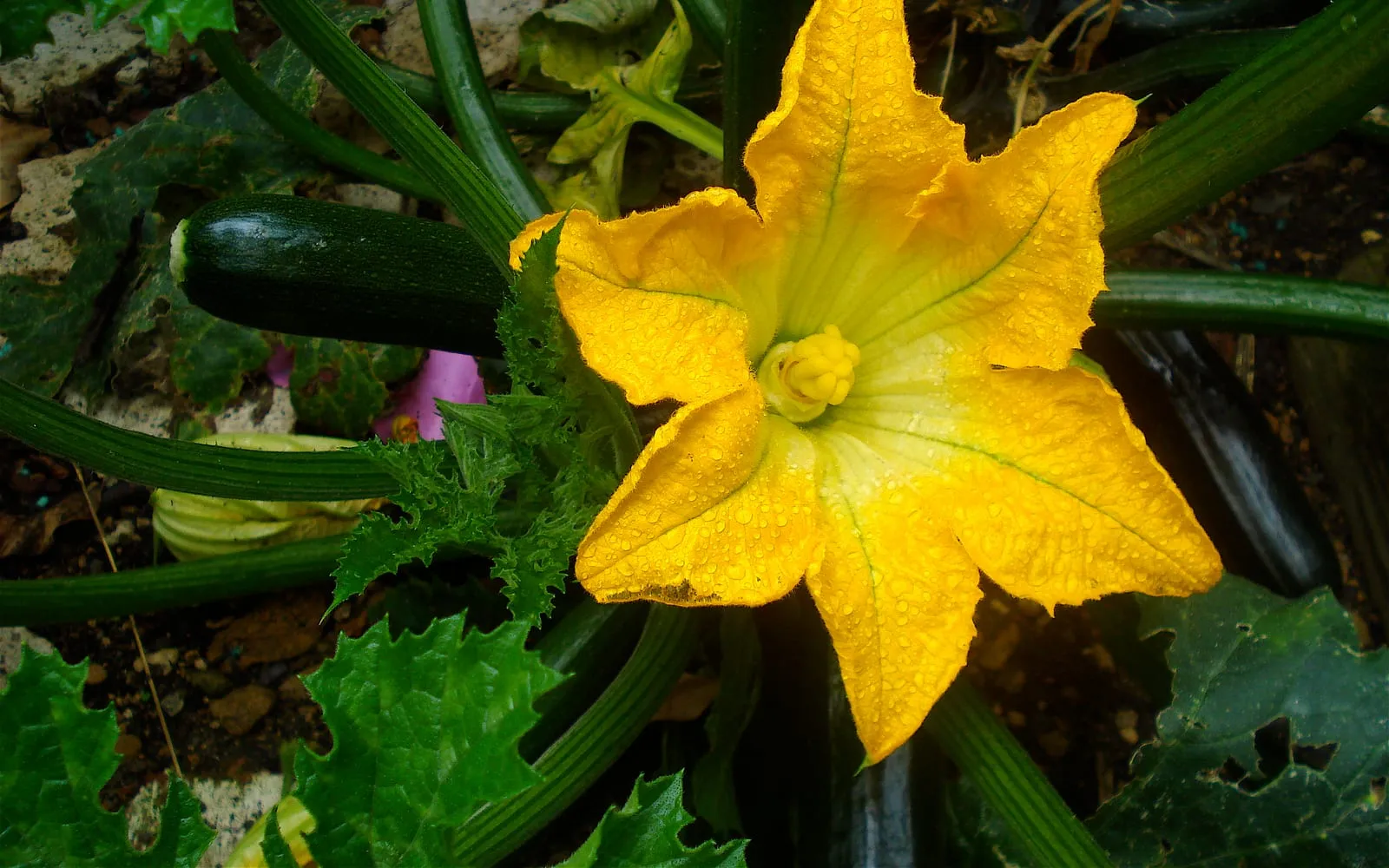
Flowers are large golden trumpets. Male and female flowers appear separately on the same plant, and the female is the one with a miniature fruit already formed behind the petals.
Fruit is cylindrical, in dark green, pale green, striped or yellow, and there are round varieties the size of a cricket ball.
Bush varieties stay in a clump about a metre across. Trailing varieties, mostly the marrows and winter squash forms, run several metres and need space or training.
The whole plant is covered in short stiff bristles that catch on skin.
Where it is from
Central America and Mexico, where Cucurbita pepo was among the earliest domesticated crops, cultivated for at least eight thousand years. The seeds and the hard-shelled fruits came first, and the tender summer squash came much later.
The courgette itself was selected in Italy in the nineteenth century, which is why the Italian name travelled with it into English as zucchini and the French one as courgette.
Its origin explains the appetite. This is a plant of warm, rich, seasonally wet ground, and it grows fast, transpires hard and demands both water and feeding to match.
Frost kills it outright at any stage. In a cool temperate climate the season runs from the last frost in May to the first in October, and nothing extends it except a greenhouse.
How it grows
Sow indoors from mid-April, one seed per 9 cm pot, set on its edge rather than flat so water drains off it and the seed is less likely to rot.
Germination takes about a week at 20 deg C. Growth after that is fast, and a plant sown in mid-April is ready to go out at the end of May.
Harden off over a fortnight before planting. Space bush varieties 90 cm apart and trailing ones 1.2 m or more.
Flowering begins six to eight weeks after sowing. The first flush is often all male, which alarms people every year and corrects itself within a fortnight.
Fruit swells fast once pollinated. A courgette goes from a finger to a marrow in under a week in warm weather, so pick every two or three days.
Cutting fruit keeps the plant productive. A single fruit left to ripen its seeds signals that the season’s work is done and cropping falls away.
Through the seasons
Spring is sowing and preparation. Sow indoors from mid-April, and dig a generous barrowload of well-rotted manure into each planting position. Garden compost does the same job where you have no manure, and this hungry plant takes all the rich, moisture-holding material you give it.
Late spring is planting out, after the last frost. Cover with a cloche or a cut-off bottle for the first fortnight, and keep slug protection around every young plant.
Summer is the crop. Water heavily, feed weekly once fruiting starts, and pick every other day. Expect powdery mildew from late July and keep picking through it.
Autumn ends it. The first frost blackens the plant overnight. Pick any remaining fruit before then, and a marrow cut in September stores for a couple of months in a cool room.
Care difficulty
Easy, and among the highest-yielding things a beginner can grow. The failures are all avoidable.
Cold is the first. A plant put out before the last frost either dies or sulks for a month, and a fortnight’s patience in May costs nothing.
Slugs are the second. A young courgette plant is exactly what a slug wants, and plants are lost overnight in the week after planting.
Water and food are the third. This is a hungry, thirsty plant and a starved one produces small fruit that rot at the tip.
Mildew is unavoidable and mostly cosmetic. It arrives every year, and a plant that is well watered at the roots crops through it until the frost.
Watering
Water generously and often. In hot weather a mature plant wants a full watering can every two or three days, and more in a container.
Pour at the base rather than over the leaves. Wet foliage in warm still air encourages both mildew and grey mould.
Sinking a pot or a length of pipe alongside the plant at planting time gives you somewhere to pour that delivers water to the roots rather than running off the surface.
Mulch thickly once the soil is warm. A courgette bed in full sun dries out fast and mulching halves the watering.
Irregular watering causes fruit to rot at the flower end, and a plant dry at the roots is also far more likely to shed young fruit.
Warning signs, diseases and pests
Powdery mildew coats the leaves in a white dusty film from midsummer, starting on the older leaves and spreading upward. It arrives every year on every plant and it is rarely fatal. Water the roots well, cut off the worst leaves to improve airflow, and keep picking. Do not confuse it with the silver-white marbling that many varieties carry along the leaf veins, which is normal patterning and rubs off nothing.
Small fruit turning yellow and rotting at the flower end is either a pollination failure or drought. In cool damp weather there are few insects flying, so hand pollinate by picking a male flower, stripping its petals and pushing it into the centre of a female.
Slugs and snails destroy young plants in days.
Cucumber mosaic virus mottles the leaves yellow, distorts the growth and stunts the plant. There is no cure. Remove and bin the plant, and control aphids, which spread it.
Grey mould rots the fruit in wet weather, entering through the dying flower. Pick the withered flowers off young fruit.
Bitter fruit from home-saved seed should be discarded rather than eaten.
Squash vine borer, a day-flying moth that looks more like a wasp, is the plant’s most serious pest across North and South America. Its caterpillar tunnels inside the stem and can wilt a vine within a day or two; look for sawdust-like frass at a hole near the base and slit the stem to remove the borer if found. Row cover over young plants prevents most infestations.
Cucumber beetle, small and either striped or spotted yellow, can carry bacterial wilt, which kills a vine within weeks and has no cure. Both pests are confined to the Americas and have never established elsewhere.
Growing environment
Full sun and shelter. A courgette in shade produces leaf and little fruit.
Rich, moisture-retentive soil with as much well-rotted manure or compost as you can spare, dug into the planting position in advance. This is a crop that repays a manure-filled trench.
Space is genuine. A bush plant fills a square metre, and a trailing variety needs three.
Containers work if they are large. Use at least a 45 cm pot or a half barrel, and expect to water daily.
Warmth matters at both ends of the season. Plant out only after the last frost, and use fleece or a cloche for the first fortnight.
Two plants are enough for most households. Three if you like marrows.
Feeding
Prepare the ground with well-rotted manure rather than relying on liquid feed later. A courgette is a heavy feeder and the bed does most of the work.
Start a weekly high-potassium tomato feed once the first fruit has set. Before that, hold off, since nitrogen early on produces an enormous leafy plant that fruits late.
Container plants depend entirely on feeding and want it weekly without fail from midsummer.
Yellowing older leaves in August usually means the plant has exhausted the bed rather than caught a disease. Feed and mulch.
A top dressing of compost around the base in midsummer helps a plant that is cropping hard.
Troubleshooting
Small fruit going yellow and rotting at the end. Pollination failed, or the plant is dry. Hand pollinate with a male flower in cool weather, and water generously.
Only male flowers. Normal on a young plant. Females follow within a fortnight. The female is the one with a tiny fruit behind the petals.
White dusty coating on the leaves. Powdery mildew, which arrives every summer. Water the roots, remove the worst leaves, and keep picking.
Silver-white marbling along the leaf veins. Normal varietal patterning, not mildew.
The plant collapsed overnight in October. Frost. That is the end of the season.
A young plant disappeared the week after planting. Slugs. Protect every plant for its first fortnight.
The fruit tastes bitter. Discard it and the plant. Bitterness means cucurbitacins, which cause violent sickness, and it happens with home-saved seed that has crossed with an ornamental gourd.
How do I stop the glut? Pick at 10 to 15 cm every other day, and grow two plants rather than four.
Courgette problem guides
Not sure what is wrong? See the common vegetable pests guide.
- Powdery mildew, which arrives every year without exception
- Slugs and snails on young plants
- Cucumber mosaic virus
- Blossom end rot in dry spells
- Grey mould on fruit in wet weather
- Squash vine borer across the Americas, which wilts a vine within days
- Cucumber beetle across the Americas, which can carry bacterial wilt