
Edible
Cabbage
Brassica oleracea var. capitata
Also known as Head cabbage, Savoy, Red cabbage
How to grow cabbage, Brassica oleracea var. capitata. Firming the soil properly, beating cabbage white caterpillars with mesh, and what to do about club root.
At a glance
- Difficulty
- Moderate
- Water
- Regular, and steady rather than fluctuating
- Light
- Full sun
- Temperature
- Hardy, and winter and savoy types stand hard frost
- Hardiness
- USDA 3-9, RHS H6, hardy to -15 C
- Type
- Biennial grown as an annual, harvested in its first year
- Height
- 30-50 cm
- Native to
- Bred from wild cabbage of the Atlantic and Mediterranean coasts of Europe
- Best month
- April in the Northern Hemisphere, October in the Southern Hemisphere
Cabbage is a biennial and reads a cold spell as winter, so a plant with a stem thicker than a pencil that meets several weeks below 10 deg C will run to seed instead of hearting. Sowing dates exist to avoid that. Savoy and other winter types stand -15 deg C and sweeten in frost, while summer types split and rot in the same conditions.
Hardiness zones describe winter cold alone. Summer heat, humidity, rainfall and the length of the growing season decide as much, so treat the range as the outer limit rather than as a recommendation.
Every month named in this guide is for the temperate Northern Hemisphere. If you garden in the Southern Hemisphere, shift each one by six months, so April becomes October. Closer to the equator the wet and dry seasons matter more than the calendar, and the shift stops being a useful guide.
Not known to be toxic
Cabbage is a food crop and carries no toxicity concern for people. It is not listed by the RHS as a potentially harmful garden plant. The ASPCA does not list it as toxic, and dogs and cats eating cooked cabbage in small quantities come to no harm, though brassicas cause wind and digestive upset in dogs eating a lot. The point worth recording concerns livestock rather than pets. Brassicas contain glucosinolates and, in the case of kale and rape more than cabbage, compounds that can cause anaemia and goitre in sheep and cattle grazed on them heavily without other forage, which is why brassica forage crops are introduced gradually and balanced with hay. That is a farming consideration rather than a garden one. For people the practical caution is that brassicas concentrate nitrate when heavily fertilised, so avoid piling on nitrogen late in the season, and that raw cabbage in very large daily quantities affects iodine uptake in people with an existing thyroid condition.
Sources: RHS potentially harmful garden plants, ASPCA toxic and non-toxic plants
About
A loose cabbage that never hearts up has usually been planted in soil that was too soft.
Cabbages need firm ground. Not compacted, and firm enough that the plant is held rigid and cannot rock in the wind. The traditional test is that you should be able to walk on the bed without leaving deep footprints, and the traditional practice is to tread the bed before planting and then firm the soil hard around each transplant with your heel.
That single detail, along with enough nitrogen and steady water, is most of what separates a solid heavy head from a loose leafy rosette.
The rest of cabbage growing is defence. Cabbage white butterflies lay eggs from May, and the caterpillars reduce a plant to veins in under a week. Pigeons strip winter cabbages. Cabbage root fly larvae kill transplants at the roots. Club root, if you have it, is permanent.
Fine mesh netting over the whole crop from planting to harvest deals with the butterflies, the pigeons and the root fly in one operation, making it the best protection for a brassica bed.
Cabbages are available for every season if you sow the right types, and a plot with spring, summer, autumn and winter varieties has cabbage twelve months a year.
Appearance and character
A biennial grown as an annual, forming a rosette of leaves that wrap into a dense head 15 to 30 cm across.
Leaves are thick, waxy and blue-green in most types, with a prominent white midrib, and they overlap tightly as the head forms.
Head shape varies by type. Round or ballhead in summer and autumn cabbages, pointed or sugarloaf in spring cabbages, flattened in some winter types.
Savoy cabbages have deeply crinkled dark green leaves and are the hardiest, standing through the worst of a temperate winter.
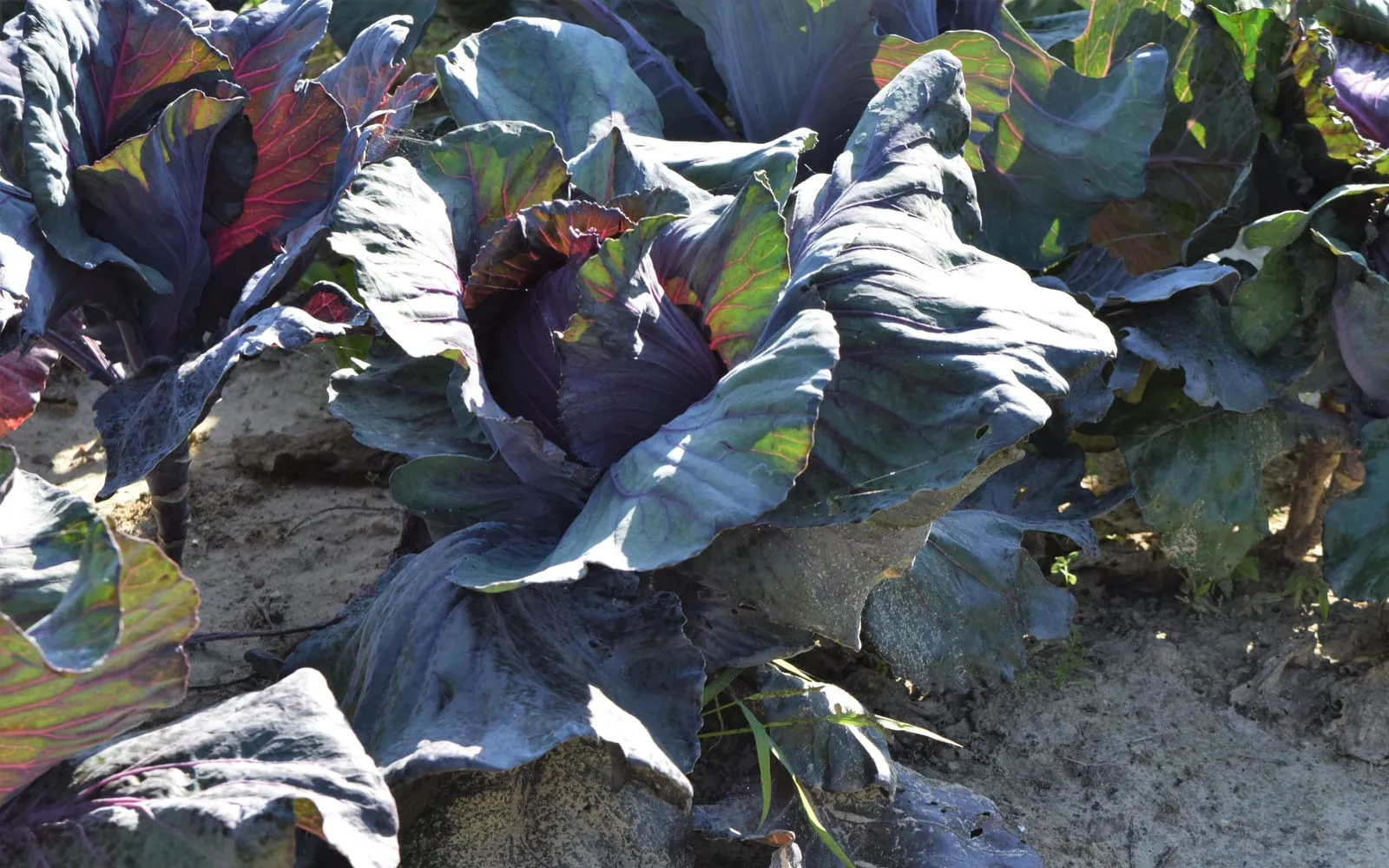
Red cabbage has deep purple-red leaves throughout, holds its shape well and stores best.
Spring greens are spring cabbages harvested young as loose leafy heads before hearting.
The root system is shallow and fibrous, which is why firm soil and steady water matter.
Left to a second year the plant bolts, sending up a tall branching stem of yellow four-petalled flowers.
Where it is from
Bred from wild cabbage, Brassica oleracea, which grows on sea cliffs along the Atlantic and Mediterranean coasts of Europe, including chalk cliffs in southern England.
That wild plant is the ancestor of an extraordinary range of vegetables. Cabbage, kale, broccoli, cauliflower, Brussels sprouts, kohlrabi and calabrese are all the same species, selected for different parts. Cabbage is the selection for the terminal bud.
Heading cabbages appear in European records from around the twelfth century, and the familiar dense-headed forms date from the middle ages onwards.
The coastal origin explains the plant’s tolerance of salt and its liking for lime, and brassicas do best on soil around pH 6.5 to 7.
Cabbage has an outsized place in northern European food history through preservation. Sauerkraut and kimchi both come from lactic fermentation of cabbage, and both were important sources of vitamin C through winters before fresh produce was available.
Club root, caused by Plasmodiophora brassicae, has been recognised as a brassica disease since the nineteenth century and its resting spores survive in soil for up to twenty years.
How it grows
Lime the bed the autumn before if the soil is acid. Brassicas want pH 6.5 to 7, and lime also suppresses club root. Test the pH rather than guessing.
Dig in well-rotted manure or compost the autumn before, then leave the ground to settle over winter.
Tread the bed firm before planting, and do not dig or fork it again.
Sow in a seedbed or in modules rather than in place, which uses the ground more efficiently and produces better plants.
Sowing and planting times depend on the type.
Sow summer cabbage from February to April under cover, or outside from March. Plant out in May or June and harvest from July to September.
Sow autumn and winter cabbage in April or May, plant out in June or July, and harvest from October to February.
Sow savoy in April or May, plant out in July, and harvest from November to March.
Sow spring cabbage in July or August, plant out in September or October, and harvest in April and May as greens or as hearted cabbage.
Transplant when the plants have four or five true leaves, watering the seedbed first and lifting with as much root as possible.
Plant at 30 to 45 cm spacing for summer types and 45 to 50 cm for winter and savoy. Closer spacing gives smaller heads, which is often what a household wants.
Firm each plant in hard. Plant to the base of the lowest leaves, then press the soil down around it with your heel until the plant resists a firm tug on a leaf.
Water in generously.
Net the whole bed with fine insect mesh from the moment of planting, supported on hoops so the leaves do not press against it. This excludes cabbage white butterflies, pigeons and cabbage root fly at once.
Fit a collar of cardboard or roofing felt around the stem of each transplant if you are not netting, which stops cabbage root fly laying at the base.
Water regularly and steadily, since fluctuating moisture splits heads.
Top dress with a nitrogen feed six weeks after planting, and again in late winter for spring cabbage.
Earth up the stems of winter cabbages in autumn and stake savoys on exposed sites.
Harvest by cutting the head with a sharp knife, leaving the stump in place. Cut a shallow cross in the cut surface of a spring or summer cabbage stump and it produces a second crop of small heads.
Rotate. Do not grow brassicas in the same ground more than one year in three or four.
Through the seasons
Winter is harvest for savoys and winter cabbage, and the time to lime and manure next year’s bed.
Spring harvests spring cabbage and spring greens, and it is the main sowing and planting season for summer types.
Summer harvests summer cabbage and plants out the winter crop, and it is the peak period for caterpillars.
Autumn harvests autumn cabbage, plants spring cabbage, and is when pigeon damage starts.
Care difficulty
Moderate. Cabbage is easy to grow and difficult to grow well, and almost all the difficulty is pests and soil preparation.
Getting the ground right in the autumn before, treading it firm, and netting the crop from day one removes most of the problems in advance.
Club root is the one thing that cannot be fixed. It stays in the soil for up to twenty years and there is no treatment, so the response is liming, drainage, resistant cultivars and container growing.
Steady watering and a nitrogen top dressing handle the rest.
Watering
Water regularly and evenly through the growing season, giving a thorough weekly soak in dry weather rather than a daily sprinkle.
Water generously at transplanting and for the first fortnight afterwards, which is when losses happen.
Keep the supply steady. A dry spell followed by heavy rain or watering causes heads to split open, and steady moisture prevents it.
Mulch after planting to conserve moisture, keeping the mulch clear of the stems.
Cut a split head immediately and use it, since it will not keep.
Warning signs, diseases and pests
Leaves reduced to veins in a few days in summer, with green or yellow-black caterpillars on the undersides, is cabbage white butterflies. Large white lays yellow eggs in clusters and small white lays single white eggs. Net the crop with fine insect mesh from planting, and rub off any eggs you find on the undersides of leaves.
Young plants wilting and dying, with the roots eaten away and small white maggots present, is cabbage root fly. Fit collars around the stems at planting or net the crop.
Swollen, distorted, club-shaped roots with stunted yellowing plants that wilt in sun is club root. There is no cure and the spores persist for up to twenty years. Lime the soil to pH 7.2, improve drainage, raise plants in large pots so they go out with a substantial root system, grow resistant cultivars, and never move soil or plants off the affected ground.
Leaves shredded to the ribs in winter is pigeons. Net the crop.
Heads splitting open is irregular watering, usually rain after drought. Water steadily and harvest promptly.
Grey-white mealy colonies on the undersides of leaves with distorted growth is mealy cabbage aphid. Squash small colonies and remove badly affected leaves.
Loose leafy heads that never firm up is soft soil, insufficient nitrogen or spacing that is too generous.
White or yellow blotches on the upper leaf surface with grey mould beneath is downy mildew, which follows wet weather and crowding.
Harlequin bug, a boldly black-red-and-yellow shield bug, drains the leaves into pale cloverleaf-shaped blotches across the southern and central United States, where it can overwinter, and turns up further north as a seasonal visitor. Hand-pick adults, nymphs and the black-and-white banded egg clusters. It has not established outside the Americas.
Small pinholes and papery windowpane patches on the leaves, with a thin pale green caterpillar that wriggles hard and drops off on a silk thread when touched, is diamondback moth. It is worldwide the most economically damaging brassica pest there is, breeding continuously through the year in warmer growing regions and notorious for evolving resistance to almost every insecticide used against it. The same mesh that excludes cabbage whites keeps it off too.
Growing environment
Full sun.
Firm, fertile, moisture-retentive soil, limed to pH 6.5 to 7, and manured the autumn before rather than at planting.
Hardy, with savoy and winter types standing hard frost and improving in flavour after it.
Allow 30 to 50 cm between plants depending on type, and closer spacing for smaller heads.
It suits a vegetable bed, an allotment, a raised bed or a large container for a few plants.
Rotate on a three or four year cycle, following legumes or potatoes and preceding roots.
Grow the whole brassica bed together under one run of netting, since cabbage, kale, broccoli, cauliflower and sprouts share the same pests and the same protection.
Grow spring cabbage to fill the hungry gap in April and May, when little else is ready.
Feeding
Manure or compost the bed the autumn before planting rather than at planting, which lets it settle and firm.
Apply a general balanced fertiliser before planting.
Top dress with a high-nitrogen feed such as sulphate of ammonia or dried poultry manure about six weeks after planting, hoeing it in and watering it.
Top dress spring cabbage again in late February, which is what turns overwintered plants into heavy heads.
Avoid heavy nitrogen late in the season on winter types, which produces soft growth that frost damages.
Lime the ground in autumn where the pH is below 6.5, and keep lime and manure applications in different seasons.
Troubleshooting
My cabbages never form solid heads. Usually soft ground. Cabbages need firm soil. Tread the bed before planting, plant to the base of the lowest leaves and firm each plant in with your heel until it resists a tug. Insufficient nitrogen and over-generous spacing are the other causes.
Caterpillars stripped the plants. Cabbage whites. Cover the bed with fine insect mesh on hoops from the day you plant, and check the undersides of leaves for eggs.
The roots are swollen and the plants wilt in the sun. Club root. There is no cure and the spores last up to twenty years. Lime to pH 7.2, improve drainage, raise plants in large pots first, use resistant cultivars, and keep the soil on that ground.
The heads split open. Irregular watering, usually rain after a dry spell. Water steadily and evenly, and harvest promptly once heads are firm.
Young plants wilted and died. Cabbage root fly larvae eating the roots. Fit collars round the stems at planting or net the crop.
Pigeons are eating my winter cabbage. Net it. Nothing else works reliably.
Can I get a second crop from the stump? Yes on spring and summer cabbage. Leave the stump in the ground and cut a shallow cross in the cut surface, and it produces several small heads.
When should I lime? In autumn, well before planting, and never at the same time as manure. Test the pH first and aim for 6.5 to 7, or 7.2 where club root is present.
Which cabbage for which season? Summer types sown February to April, autumn and winter types sown April to May, savoy sown April to May for November to March, and spring cabbage sown July to August for April and May.
Cabbage problem guides
Not sure what is wrong? See the common vegetable pests guide.
- Cabbage white caterpillars, which strip a plant in days
- Club root, which stays in the soil for twenty years
- Pigeons, which shred the leaves in winter
- Cabbage root fly, whose larvae kill young transplants
- Harlequin bug across the southern and central US
- Diamondback moth, the world's most insecticide-resistant brassica pest
- Cutworms severing transplants at ground level