
Edible
Gooseberry
Ribes uva-crispa
Also known as European gooseberry, Goosegog
How to grow gooseberries, Ribes uva-crispa. Growing on a leg, thinning for dessert fruit, American gooseberry mildew, and the sawfly that strips a bush in days.
At a glance
- Difficulty
- Easy
- Water
- Weekly in dry weather while the fruit swells
- Light
- Full sun to partial shade
- Temperature
- Very hardy, and among the first fruit into leaf in spring
- Hardiness
- USDA 3-8, RHS H7, hardy to -35 C
- Type
- Deciduous shrub, productive for twenty years or more
- Height
- 1.2-1.5 m
- Native to
- Europe, North Africa and western Asia, including native Britain
- Best month
- November in the Northern Hemisphere, May in the Southern Hemisphere
Gooseberry needs 800 to 1500 chill hours and breaks bud earlier than any other soft fruit, so a warm spell in late winter followed by frost catches it. Humid summers bring American gooseberry mildew, which is the reason the crop is grown far more in northern Europe than in North America. Ribes planting restrictions apply in several US states.
Hardiness zones describe winter cold alone. Summer heat, humidity, rainfall and the length of the growing season decide as much, so treat the range as the outer limit rather than as a recommendation.
Every month named in this guide is for the temperate Northern Hemisphere. If you garden in the Southern Hemisphere, shift each one by six months, so November becomes May. Closer to the equator the wet and dry seasons matter more than the calendar, and the shift stops being a useful guide.
Not known to be toxic
- Safe to eat
- The fruit, raw when fully ripe and cooked when green
Non-toxic. The ASPCA does not list Ribes uva-crispa among plants harmful to cats, dogs or horses, and the fruit is a food crop for people. Green gooseberries picked in late May and June are sharp and are used for cooking, and the same fruit left on the bush until July ripens soft and sweet enough to eat straight from the branch. Neither state is harmful. The genuine hazard when growing them is mechanical rather than chemical, since the branches carry stiff sharp spines up to 2 cm long, usually in threes at each node, and they catch hands and forearms badly during picking and pruning. Wear thick gloves and long sleeves, prune to keep the centre of the bush open so you can reach in, and site a bush away from paths and from where small children play. Thornless and near-thornless varieties such as 'Pax' and 'Captivator' exist and are worth choosing on those grounds alone.
Sources: ASPCA toxic and non-toxic plants, RHS potentially harmful garden plants
About
Gooseberries are grown on a leg, meaning a short clear stem of 10 to 15 cm before the branches begin. That is the opposite of a blackcurrant and it is deliberate. A clear stem lets you weed underneath, keeps the fruit off the soil, and lets air move through the base of the bush.
They also give two crops from one planting. Thin the fruit hard in late May and you eat the thinnings as sharp green cooking gooseberries, while the remainder swells and ripens into something sweet enough to eat raw in July.
Britain has a longer history with this fruit than anywhere else. Gooseberry clubs in the north of England competed on berry weight from the eighteenth century, and some still do.
Appearance and character
A low arching deciduous shrub of 1.2 to 1.5 m, densely branched and armed with stiff spines, usually in groups of three at each leaf node.
Leaves are small, lobed and toothed, mid-green, appearing very early in spring, often in March.
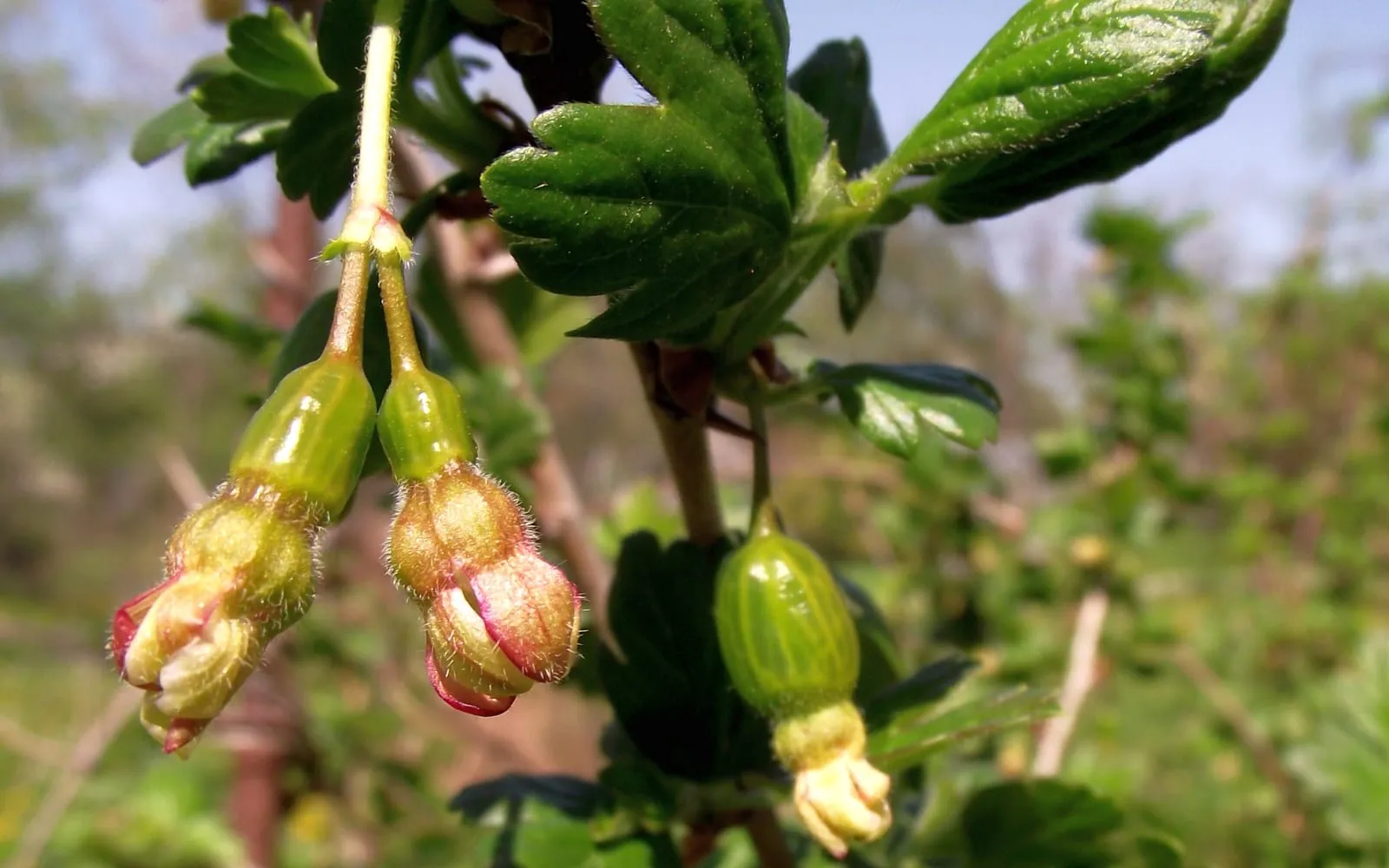
Flowers are small, greenish-pink and bell-shaped, hanging singly or in pairs along the branches from April. Bees work them heavily.
Fruit is round to oval, sometimes hairy and sometimes smooth, from 2 to 4 cm, in green, yellow, white or deep red. The skin is translucent with visible veins.
Growth habit varies. Some varieties are stiffly upright and others weep almost to the ground, and the weeping ones need harder pruning to keep the fruit clear of the soil.
Trained cordons and standards are both common and both crop well.
Where it is from
Europe, North Africa and western Asia, including Britain, where wild gooseberries grow in hedgerows and woodland edges, though many of those are garden escapes.
It became a serious garden fruit in Britain from the sixteenth century and reached a peak in the nineteenth, when competitive gooseberry growing produced hundreds of named varieties and berries the size of a small plum.
The species belongs to cool damp northern conditions. Gooseberries want moisture at the roots, tolerate shade, and dislike hot dry summers.
They break dormancy very early, which is both an advantage and a risk. Early leaves mean early fruit, and they also expose the flowers to April frost.
Like blackcurrants, they were banned in parts of the United States for decades because Ribes species host part of the white pine blister rust cycle.
How it grows
Plant bare-root bushes from November to March, 1.5 m apart, keeping the clear leg above soil level rather than burying it. Deep planting produces suckers and destroys the shape.
Remove any suckers or shoots that appear on the leg or from below ground.
Fruit is carried on spurs on two-year-old and older wood, and on the base of one-year shoots. That is why gooseberry pruning is a spur system rather than the stool renewal used for blackcurrants.
Prune in winter, between November and February. Aim for an open goblet with eight to ten main branches, shorten the leaders by about a quarter, and cut the side shoots back to two or three buds.
Prune again lightly in June, shortening the current season’s side shoots to about five leaves. This improves air movement against mildew and lets light reach the fruit.
Thin the crop in late May, taking every other fruit for cooking and leaving the rest to ripen.
Propagate from hardwood cuttings in autumn, rubbing off the lower buds so the cutting makes a clear leg rather than a stool.
Through the seasons
Winter is planting and the main pruning. Plant bare-root bushes, prune to an open goblet, and mulch with manure.
Spring brings very early growth and flowering. Watch for sawfly from late April, and net against birds, which strip the buds.
Early summer is thinning and the cooking crop. Thin in late May, prune the side shoots in June, and keep watering.
Midsummer ripens the dessert crop in July. Pick when the fruit softens and colours fully, and net it well before that point.
Care difficulty
Easy, with one pest that demands vigilance.
Gooseberry sawfly can strip a bush to bare stems in under a week and it is easy to miss until the damage is done. Checking the centre of the bush from late April is the whole defence.
Mildew is the second problem and open pruning is most of the answer.
Thorns make picking and pruning unpleasant rather than difficult. Gloves and an open bush shape solve it.
Beyond that the plants are hardy, long-lived, shade-tolerant and productive with very little input.
Watering
Water weekly during dry weather while the fruit is swelling, from flowering through to picking.
Irregular watering causes the fruit to split, particularly in varieties with thin skins.
Mulch thickly each winter or early spring with well-rotted manure or compost, which conserves moisture and feeds the bush.
The roots are shallow, so avoid deep hoeing close to the stem.
Do not let the ground become waterlogged.
Warning signs, diseases and pests
Gooseberry sawfly is the pest that matters. Small pale green caterpillars with black spots start in the centre of the bush, low down, and eat outward. A bush can be reduced to bare stems within a week and the fruit then fails to ripen. Inspect the middle of the bush every few days from late April, and pick the larvae off by hand. There are usually three generations in a season, so keep checking into August. Open pruning makes inspection possible, which is one of the best reasons for it.
American gooseberry mildew coats the shoot tips, leaves and fruit in a white powdery growth that turns brown and felted. The fruit is still usable once the felt is rubbed off. Prune for an open centre, avoid heavy nitrogen, and choose resistant varieties such as ‘Invicta’, ‘Pax’ or ‘Hinnonmaki Red’.
Birds strip the fat fruit buds through winter, which removes the crop before it starts. Net from midwinter as well as in summer.
Gooseberry dieback kills whole branches, often after mildew or damage. Cut back to clean wood.
Capsid bugs distort and tatter the young leaves at the shoot tips in spring.
Split fruit follows uneven watering.
A bush that has become an impenetrable thicket needs several winters of hard renewal pruning.
Growing environment
Full sun gives the sweetest dessert fruit, and gooseberries crop acceptably in partial shade, which makes them useful in a difficult corner.
Fertile, moisture-retentive but well-drained soil, neutral to slightly acid.
Good air movement matters because of mildew, so avoid a stagnant enclosed corner and space bushes 1.5 m apart.
Keep the leg clear. Plant at the same depth the bush grew before and remove any growth from the stem.
Netting or a fruit cage protects against birds both in winter for the buds and in summer for the fruit.
Cordons against a wall or fence take very little room and make picking far easier among the thorns.
Feeding
Feed with a potassium-rich fertiliser such as sulphate of potash in late winter. Gooseberries need potassium more than nitrogen.
Mulch with well-rotted manure or compost every winter.
Avoid heavy nitrogen, which produces soft sappy growth that mildew attacks.
Magnesium deficiency, showing as yellowing between the veins on older leaves, is common on light soil and corrects with Epsom salts.
A dressing of general-purpose fertiliser in spring suits a bush on poor ground.
Troubleshooting
The bush has been stripped to bare stems. Gooseberry sawfly. Check the centre of the bush from late April and pick the caterpillars off. Expect three generations a season.
White powdery coating on shoots and fruit. American gooseberry mildew. Prune for an open centre, cut off affected tips, and choose a resistant variety next time.
The buds vanished over winter. Birds. Net the bush from midwinter as well as in summer.
The fruit is splitting. Uneven watering. Water steadily and mulch.
Should I pick them green or ripe? Both. Thin in late May and cook the sharp green thinnings, then let the rest ripen soft and sweet for July.
The bush is a thorny thicket I cannot pick. Renovate over two or three winters, taking out old, crossing and low branches to leave an open goblet on a clear leg.
Suckers keep coming from the base. The bush was planted too deep, or the leg was not kept clear. Rub off any shoots on the stem as they appear.
Which variety for a beginner? ‘Invicta’ for a heavy mildew-resistant cooking crop, ‘Hinnonmaki Red’ for dessert fruit, and ‘Pax’ if the thorns put you off.
Gooseberry problem guides
Not sure what is wrong? See the common vegetable pests guide.