
Edible
Potato
Solanum tuberosum
Also known as Spud, Tattie
How to grow potatoes, Solanum tuberosum. Chitting, earthing up, first and second earlies against maincrop, blight, and why a green potato should go in the bin.
At a glance
- Difficulty
- Easy
- Water
- Little until the plants flower, then heavily every week
- Light
- Full sun. Shade gives small crops
- Temperature
- 15-20 deg C. Frost destroys the foliage
- Hardiness
- USDA 3-10, RHS H2, hardy to 0 C
- Type
- Tender herbaceous perennial grown as an annual
- Height
- 60-90 cm of haulm
- Native to
- Andes of southern Peru and north-western Bolivia
- Best month
- March in the Northern Hemisphere, September in the Southern Hemisphere
Tuber formation slows and then stops as soil goes above about 25 deg C, which is why the crop is grown in highlands and cool seasons throughout the tropics rather than on the plains. Frost destroys the foliage in a night. Wild and older cultivars tuberise on short days only, and modern maincrops have been bred close to day-neutral.
Hardiness zones describe winter cold alone. Summer heat, humidity, rainfall and the length of the growing season decide as much, so treat the range as the outer limit rather than as a recommendation.
Every month named in this guide is for the temperate Northern Hemisphere. If you garden in the Southern Hemisphere, shift each one by six months, so March becomes September. Closer to the equator the wet and dry seasons matter more than the calendar, and the shift stops being a useful guide.
Toxic if eaten
- Safe to eat
- The tubers, peeled of any green and free of sprouts
- Do not eat
- Leaves, stems, green fruits, sprouts and any green skin on a tuber
- Harm from
- Eating it
- Affects
- People, cats, dogs and horses
The tuber is food and the rest of the plant is not. Potato belongs to the nightshade family and its foliage carries glycoalkaloids, principally solanine and chaconine. The ASPCA lists the potato plant as toxic to cats, dogs and horses and names the green parts and the sprouts as the danger, with the cooked tuber listed as safe. The small green fruits that sometimes follow the flowers look like cherry tomatoes and hold enough solanine to make a child seriously ill, so pick them off where children play. In the kitchen the rule concerns light and warmth. A tuber exposed to light turns green as it makes chlorophyll, and solanine rises alongside it. The green itself is harmless and it is a reliable marker for the alkaloid that is not, so cut away any green generously or discard the tuber. Sprouted potatoes are the same case. Solanine survives boiling, frying and baking, so cooking is not a remedy. Store the crop in the dark, cool and dry, and never feed peelings or haulm to livestock.
Sources: ASPCA (Potato, Solanum tuberosum), RHS potentially harmful garden plants
About
Potatoes are the crop that repays a beginner fastest. Bury a seed potato in March, mound soil over the shoots twice, and dig up several kilograms in July from a plant that asked for almost nothing.
They also fix ground. A potato bed is dug twice, once at planting and once at harvest, and the dense foliage smothers annual weeds through the summer. Old allotment practice put potatoes into newly broken turf for exactly that reason.
The choice that shapes everything else is the maturity group. First earlies are in the ground for around ten weeks and dodge blight entirely. Maincrops occupy a bed for twenty weeks and store through winter.
Appearance and character
A bushy plant of divided leaves, each made of a large end leaflet with smaller pairs below, mid-green and slightly crinkled.
The stems are angular and brittle, and they snap at the base rather than bend, which is why a windy site needs the rows run across the prevailing wind.
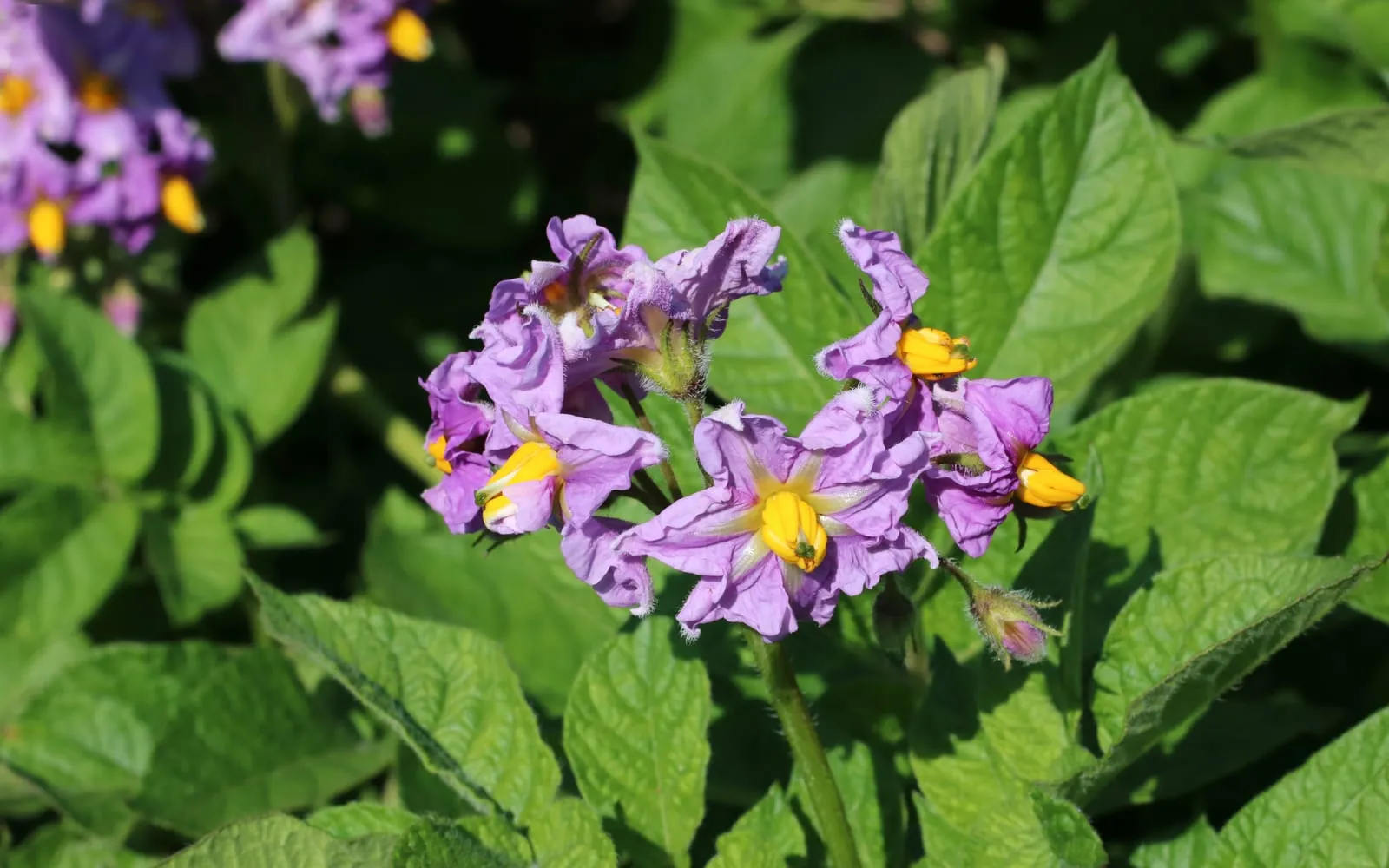
Flowers are white, pink or violet with a yellow centre, held in loose clusters above the foliage. Some varieties barely flower and crop perfectly well regardless.
Small green fruits follow the flowers on some varieties, round and about the size of a cherry tomato. They are not edible and they are not a sign of anything wrong.
The crop grows underground on short stems called stolons, so a potato is a swollen stem rather than a root. The eyes are buds, which is what makes a tuber able to grow a new plant.
Where it is from
The Andes of southern Peru and north-western Bolivia, around Lake Titicaca, where potatoes were domesticated at least seven thousand years ago and where thousands of local varieties are still grown at altitudes above 3,000 metres.
Those highlands are cool, bright and wet in season, with sharp drainage down steep slopes. The plant tolerates cool nights well and dislikes heat, which is why potatoes suit a cool maritime summer and struggle in a Mediterranean one.
Spanish ships brought them to Europe in the late sixteenth century, where they were treated with suspicion for two hundred years. Ireland adopted them early, and the near-total dependence on a narrow genetic base is what made the blight epidemic of the 1840s catastrophic rather than merely bad.
The Andean crop had, and still has, enormous variety. European potatoes descend from a small handful of introductions, which is why breeding programmes keep returning to South America for resistance genes.
How it grows
A seed potato is a tuber rather than a seed, and it carries the food reserve that powers the first weeks of growth.
Chitting starts the process early. Stand the tubers eye-end up in egg boxes in a cool, light, frost-free room from late January, and let them grow short, stubby, dark green shoots about 2 cm long. Long white shoots mean the room is too dark and too warm.
Plant 12 to 15 cm deep once the soil has warmed, from mid-March for earlies to mid-April for maincrops. Space earlies 30 cm apart in rows 60 cm apart, and maincrops 40 cm apart in rows 75 cm apart.
Earthing up is drawing soil over the emerging shoots to make a ridge. Do it when the haulm reaches 20 cm and again a few weeks later. It protects early growth from frost, gives the stolons more depth to work in, and keeps light off the developing tubers.
Tubers begin to form around flowering. Everything after that point is bulking, and that is when the crop needs water.
Through the seasons
Late winter is for chitting. Buy certified seed potatoes in January and February and set them up in the light.
Spring is planting, from mid-March for first earlies through to late April for maincrops. Earth up as the shoots appear, and cover the ridge with fleece if a frost is forecast, since frosted haulm sets a crop back by weeks.
Summer is watering and watching. Lift first earlies from June, once the flowers open, by scraping into the side of a ridge to see whether the tubers are egg-sized.
Autumn finishes maincrops. Cut the haulm down in early September and leave the tubers in the ground for a further two weeks so the skins harden, then lift on a dry day and store in paper sacks in the dark.
Care difficulty
Easy, and among the most forgiving crops there is. A tuber planted in reasonable soil will produce something.
Blight is the one real threat and it applies to maincrops in a wet summer. Growing first earlies is the simplest answer, because they are lifted before the disease usually arrives.
Water is the second factor, and it decides yield more than anything else. Plants kept dry through July make plenty of leaf and few potatoes.
Space is the honest constraint. Maincrops hold a bed for five months and give a lower return per square metre than almost anything else you could grow there, so in a small garden the case for them is weaker than for earlies and salad varieties.
Watering
Water sparingly until the plants flower. Early watering encourages leaf at the expense of tubers, and a dry start pushes the roots down.
From flowering onward, water heavily and regularly. Around 15 to 20 litres per square metre once a week through a dry spell is what turns flowers into a crop.
Irregular watering causes hollow heart and cracked tubers, where a dry period followed by a soaking makes the flesh expand faster than it can hold together.
Mulch after the final earthing up to steady the moisture.
Container-grown potatoes need water almost daily in summer, since a full bag of foliage transpires hard and holds little reserve.
Warning signs, diseases and pests
Blight, Phytophthora infestans, is the disease that defines the potato year. Brown patches appear on the leaves with a pale margin, a white mould shows on the undersides in damp weather, and the whole plant collapses within a week or two. It arrives in warm humid spells from July. There is no cure, and the response is to cut the haulm off at ground level immediately so the spores cannot wash down to the tubers, then wait two weeks before lifting. Grow first earlies to avoid it, or choose resistant varieties such as ‘Sarpo Mira’.
Common scab produces rough corky patches on the skin. It is cosmetic, the potatoes peel and eat perfectly well, and it is worse on dry alkaline soil. Do not lime a potato bed, and water in dry spells.
Slugs tunnel into maincrop tubers left in the ground into autumn. Lift earlier and avoid the worst varieties on heavy wet soil.
Potato cyst eelworm stunts the plants and causes early yellowing, and it builds up where potatoes are grown in the same ground repeatedly. Rotate on a four-year cycle.
Wireworm bores narrow holes straight through tubers and is commonest in ground recently under grass.
Green skin is a storage and earthing fault rather than a disease, and it means light has reached the tuber.
Colorado potato beetle, boldly striped in black and cream with a humpbacked orange grub, strips foliage across North America, continental Europe and parts of Asia and is the crop’s defining pest wherever it has established. Hand-picking adults and their bright yellow egg clusters from shoot emergence controls it on a garden scale. Britain is a notable exception: the beetle has never established there and DEFRA treats any sighting as notifiable rather than something to treat at home.
Growing environment
Full sun. Potatoes in shade make leaf and little else.
Deep, fertile, free-draining soil enriched with well-rotted manure or compost dug in the previous autumn. Slightly acid ground suits them, and lime encourages scab.
Rotate the bed on a four-year cycle. Potatoes share blight with tomatoes and build up soil-borne pests when repeated.
Shelter helps, since the brittle haulm breaks in strong wind.
Containers work well for earlies. Use a bag or bin of at least 40 litres, put three tubers in 10 cm of compost, and top up with more compost as the shoots grow until the container is full.
Frost is the risk in April and May. Fleece the emerging shoots or draw soil over them when a cold night is forecast.
Feeding
Work a general-purpose fertiliser into the bed before planting, alongside plenty of organic matter.
Apply a second dressing when the shoots reach about 20 cm, at the first earthing up, and choose something with more potassium than nitrogen.
Avoid heavy nitrogen. It grows an impressive plant with disappointing tubers and softens the foliage against blight.
Well-rotted manure dug in during autumn is the traditional preparation and it remains the best one, since potatoes are hungry and want moisture-holding soil.
Container crops depend entirely on what you give them. Use a liquid tomato feed fortnightly once the plants flower.
Troubleshooting
Brown patches spreading fast on the leaves in a wet July. Blight. Cut the haulm to the ground at once, bin it rather than composting it, and lift the tubers two weeks later.
The potatoes have green patches. Light reached them, either in the ridge or in storage. Cut the green away generously or discard the tuber, and store the crop in the dark. Cooking does not remove solanine.
Plenty of foliage and hardly any potatoes. Too much nitrogen, too little water at flowering, or lifted too early. Feed with potassium rather than nitrogen and water hard from flowering.
Rough corky patches on the skin. Common scab. Harmless once peeled, worse on limed or dry soil.
Small green fruits like tomatoes on the plant. Normal, and inedible. Remove them where children play.
Holes tunnelled through the tubers. Slugs on heavy wet soil, or wireworm on ground recently under grass. Lift earlier.
When do I dig up first earlies? Once the flowers open, usually ten weeks after planting. Scrape into the side of a ridge and feel for egg-sized tubers.
Can I plant supermarket potatoes? They are treated to suppress sprouting and carry no health certification, so they crop badly and can introduce disease. Buy certified seed potatoes.
Potato problem guides
Not sure what is wrong? See the common vegetable pests guide.
- Potato blight
- Slugs, which tunnel into the tubers
- Potato cyst eelworm
- Wireworm
- Common scab on dry alkaline soils
- Colorado potato beetle, established across North America and continental Europe
- Green potatoes from tubers left exposed to light in the ground or in store
- Bacterial soft rot, which turns a stored tuber to liquid inside its skin
- Herbicide damage from aminopyralid in manure, which fern-leafs the foliage