
Disorder
Bitter pit
Also called Bitter pit of apple, Cork spot
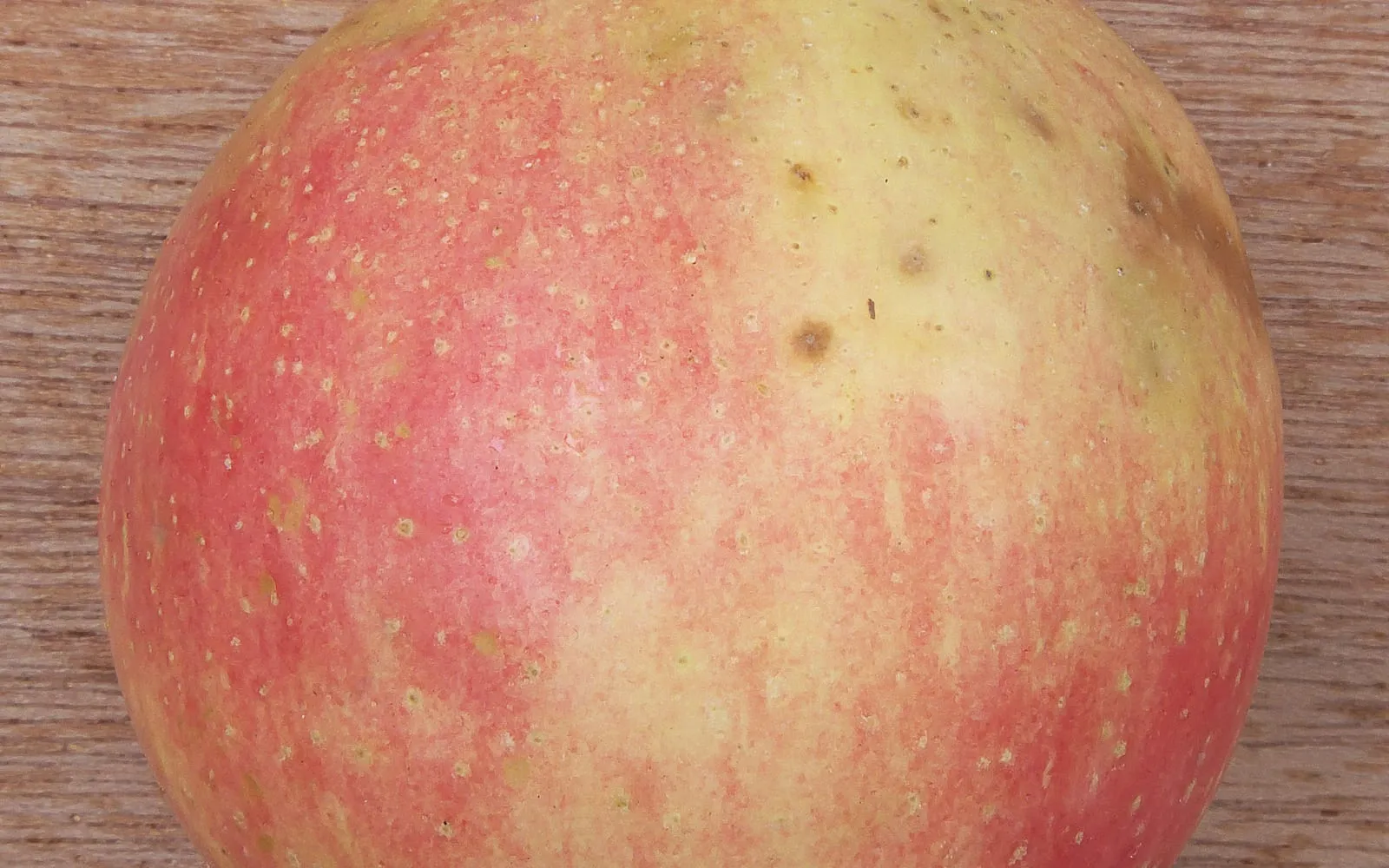
Bitter pit makes small sunken marks on apple skin and bitter brown flecks in the flesh, worst at the eye end and in store. Steady watering helps the tree move calcium into the fruit.
At a glance
- Type
- Disorder
- Cause
- Feeding or nutrients
- Severity
- Destroys the crop or display
- Affects
- Herbs and edibles
- Active
- August to January
What you are seeing
- Small sunken dimples on the skin, darker than the surrounding fruit, mostly near the eye end
- Brown or dark green corky flecks a few millimetres across scattered through the flesh just under the skin
- A bitter taste in the affected flesh
- Damage appearing or worsening after several weeks in store rather than on the tree
- The biggest apples on the tree affected worst
- Worst in a year with a light crop, a dry summer, or heavy pruning the previous winter
- Large cooking apples such as Bramley's Seedling affected while dessert varieties beside them stay clean
Before you treat anything
Bitter pit is safe to eat. The affected flesh tastes bitter and can be cut out, and the rest of the apple is sound.
What you are looking at
Small dimples in the skin of an apple, sunken and darker than the fruit around them, most of them clustered towards the eye end. Pare the skin off and there are brown or dark green corky flecks in the flesh underneath, a few millimetres across, scattered through the outer centimetre. Taste one and it is bitter.
The fruit is otherwise firm. Nothing is soft, nothing smells, and there is no mould, no hole and no tunnel.
Most people meet it in store rather than in the orchard. Apples that looked acceptable at picking come out of the box in November covered in pits, because the disorder goes on developing after the fruit comes off the tree.
Large cooking apples suffer worst, and ‘Bramley’s Seedling’ is the variety that brings most people to this page.
Calcium, and why the soil test is a red herring
Bitter pit is a calcium problem in the fruit. It is almost never a calcium shortage in the soil, and adding lime or garden calcium to ground that has plenty achieves nothing.
Calcium travels in the water stream, pulled up through the tree by evaporation from the leaves. It moves in one direction only and it does not get redistributed once it has arrived somewhere. So the parts of the plant that pull hardest get most of it, and leaves pull enormously harder than fruit does. A leaf is built to lose water; an apple has a waxy skin and few pores and is built not to.
That leaves the fruit permanently at the back of the queue, and anything increasing the competition or interrupting the flow pushes it further back.
A dry spell stops the water moving and the calcium with it. Heavy leafy growth from too much nitrogen or hard pruning gives the fruit more competitors. A very large apple has more flesh to supply through the same narrow stalk. And a heavy dressing of potash competes with calcium for uptake at the root.
That last set is the practical list, and none of it involves how much calcium the soil contains.
The same mechanism as blossom end rot
Anyone who has grown tomatoes will recognise this. Blossom end rot is the identical failure in a different crop, and the parallels are worth drawing because both are widely misexplained.
In both cases the plant has plenty of calcium available and the fruit does not get enough of it. In both cases the damage appears at the end furthest from the stalk, because that is the last tissue the water stream reaches. In both cases irregular watering is the commonest trigger. And in both cases the fix is in how you grow the plant rather than in what you add to the soil.
The difference is timing. A tomato shows blossom end rot within days on a growing fruit; an apple shows bitter pit weeks later, often after it has been picked.
What to do about it
Water through dry summers and mulch in spring, so the supply never stops and starts.
Keep a clear circle of mulched ground round the trunk rather than grass.
Feed sparingly and keep nitrogen and potash down on a tree that pits.
Leave more fruit on the tree rather than thinning to produce very large apples.
Prune moderately, spreading the renovation of a neglected tree over several winters.
On a tree that pits every year, apply a calcium foliar feed from June, repeated every fortnight until picking.
Sort at picking, store the clean fruit cool, and use the marked apples first.
Cut the pits out and eat the rest.
What it gets mistaken for
Apple scab makes rough raised corky patches that crack open, with sound flesh beneath and no flecks in it.
Brown rot spreads a soft brown patch with concentric rings of buff pustules on the surface.
Codling moth leaves an entry hole and a frass-filled tunnel to the core.
Apple canker can rot fruit from the eye end in store, and that rot is a spreading soft brown decay rather than separate firm dry pits.
Water core is a glassy, translucent, water-soaked appearance in the flesh rather than brown corky flecks, and it often disappears during storage.
Russeting is a brown roughness spread evenly over the skin of certain varieties, and it is a characteristic of the fruit rather than a fault.
What to do, in order
Start here
Prevention, and the changes that stop the problem returning. Most of these pages should end at this tier.
- Water consistently through the summer
- Calcium moves through the plant in the water stream, so it stops moving whenever the tree runs short. A dry August followed by heavy rain is the classic recipe. Water young and container-grown trees through dry spells, and mulch established ones in spring to hold what the soil has.
- Mulch, and keep the grass off the root area
- A metre of clear mulched ground round the trunk evens out the moisture supply far more than occasional watering does. Grass growing right up to the trunk competes for water at exactly the wrong time of year.
- Go easy on nitrogen
- Heavy feeding pushes leafy growth, and leaves compete with fruit for the calcium arriving in the water stream. A tree growing strongly on rich ground or a lawn feed that has drifted into the root zone will show more bitter pit, not less. Apples on reasonable soil need very little nitrogen.
- Do not over-thin the crop
- The largest fruit on a tree are the ones that pit, because a big apple has more flesh to supply from the same slender connection. Thinning hard to produce show apples makes the problem worse. In a light-cropping year, expect it and leave more fruit on than instinct suggests.
- Prune moderately, and spread it out
- Hard winter pruning provokes vigorous leafy regrowth the following season, which competes with the fruit. Where a neglected tree needs bringing back, do it over three or four winters rather than in one.
- Watch the potassium and magnesium
- These compete with calcium for uptake, so a heavy dressing of a high-potash fertiliser can produce bitter pit on ground with plenty of calcium in it. Lime an acid soil if the pH warrants it, and otherwise leave the feeding alone.
- Consider a calcium foliar feed on a tree that pits every year
- Calcium nitrate or calcium chloride applied to the foliage and fruit, at the rate on the packet, from around June and repeated every couple of weeks until picking, is the commercial answer and it works. It is a nutrient rather than a pesticide. One application does nothing; the benefit comes from repeating it through the season, which is why most gardeners are better served by sorting out the watering.
- Use the affected fruit early
- Bitter pit develops further in store, so an apple that looks lightly marked at picking will be worse at Christmas. Sort at picking, keep the clean fruit for storing and cook the marked ones straight away. The flesh is safe and the pits can be cut out.
Then reach for a barrier
Netting, hand removal and water. Nothing here harms anything except the target.
- Sort carefully into store and check the boxes
- Pick over the crop as it goes in and again after a month. Bitter pit does not spread from fruit to fruit, but the pits let secondary rots in, and one rotting apple in a box does spread.
- Store cool
- The disorder progresses faster in a warm shed than in a cold one. A steady 3 to 5 degrees C slows it along with everything else that spoils stored apples.
Plants affected
Guides that name it among the problems to watch for. The list is the plants it is characteristic of rather than everything it will feed on.