
Edible
Blueberry
Vaccinium corymbosum
Also known as Highbush blueberry, Northern highbush
How to grow blueberries, Vaccinium corymbosum. Why they need ericaceous compost and rainwater, planting two for cross-pollination, and the pruning that keeps a bush cropping.
At a glance
- Difficulty
- Moderate
- Water
- Frequently through summer, and never let it dry out
- Light
- Full sun for the best crop, tolerating light shade
- Temperature
- Very hardy. It needs winter chilling to fruit well
- Hardiness
- USDA 3-8, RHS H6, hardy to -30 C
- Type
- Deciduous shrub, long-lived and slow to reach full cropping
- Height
- 1.2-1.8 m
- Native to
- Eastern North America
- Best month
- August in the Northern Hemisphere, February in the Southern Hemisphere
Soil acidity decides this one before climate does, since the roots cannot take up iron above pH 5.5 and the plant yellows and starves in neutral ground. Northern highbush cultivars need 800 to 1000 chill hours, southern highbush 150 to 600, and rabbiteye types crop in the warm humid southeastern United States where neither of the others will.
Hardiness zones describe winter cold alone. Summer heat, humidity, rainfall and the length of the growing season decide as much, so treat the range as the outer limit rather than as a recommendation.
Every month named in this guide is for the temperate Northern Hemisphere. If you garden in the Southern Hemisphere, shift each one by six months, so August becomes February. Closer to the equator the wet and dry seasons matter more than the calendar, and the shift stops being a useful guide.
Not known to be toxic
- Safe to eat
- The fruit
Non-toxic. The ASPCA does not list Vaccinium corymbosum among plants harmful to cats, dogs or horses, and the berries are safe for people and pets alike, though a dog eating a large quantity will get an upset stomach as it would with any fruit. Blueberries are among the safest fruit to grow where children play, since there are no thorns, no toxic parts, and no stones to choke on. The main identification caution concerns wild berries rather than garden ones. Several unrelated shrubs produce small blue or black berries that are not edible, including deadly nightshade, privet and buckthorn, so nothing gathered from the wild should be eaten on the strength of colour alone. A garden blueberry bought as a named variety and grown in a pot of ericaceous compost carries none of that risk.
Sources: ASPCA toxic and non-toxic plants, RHS potentially harmful garden plants
About
Blueberries have one non-negotiable requirement and every other question about them is secondary. They need acid soil, between pH 4.0 and 5.5, and in ordinary garden soil they will not grow. Most soils sit neutral to alkaline, which is why so many blueberries are grown in pots.
The second rule follows from the first. Tap water in a hard water area is alkaline, and watering a pot of ericaceous compost with it raises the pH over a season or two until the plant yellows and stops. Collect rainwater.
Get those two right and blueberries are straightforward, long-lived and handsome, with white spring flowers, blue fruit and scarlet autumn leaves.
Appearance and character
An upright multi-stemmed deciduous shrub, usually 1.2 to 1.8 m, with fine twiggy growth and shallow fibrous roots that sit near the surface.
Leaves are oval and smooth, blue-green in summer and turning brilliant scarlet and orange in autumn, which is reason enough to grow the plant.
Flowers are small white or pink urn-shaped bells hanging in clusters in April and May, and bumblebees work them hard.
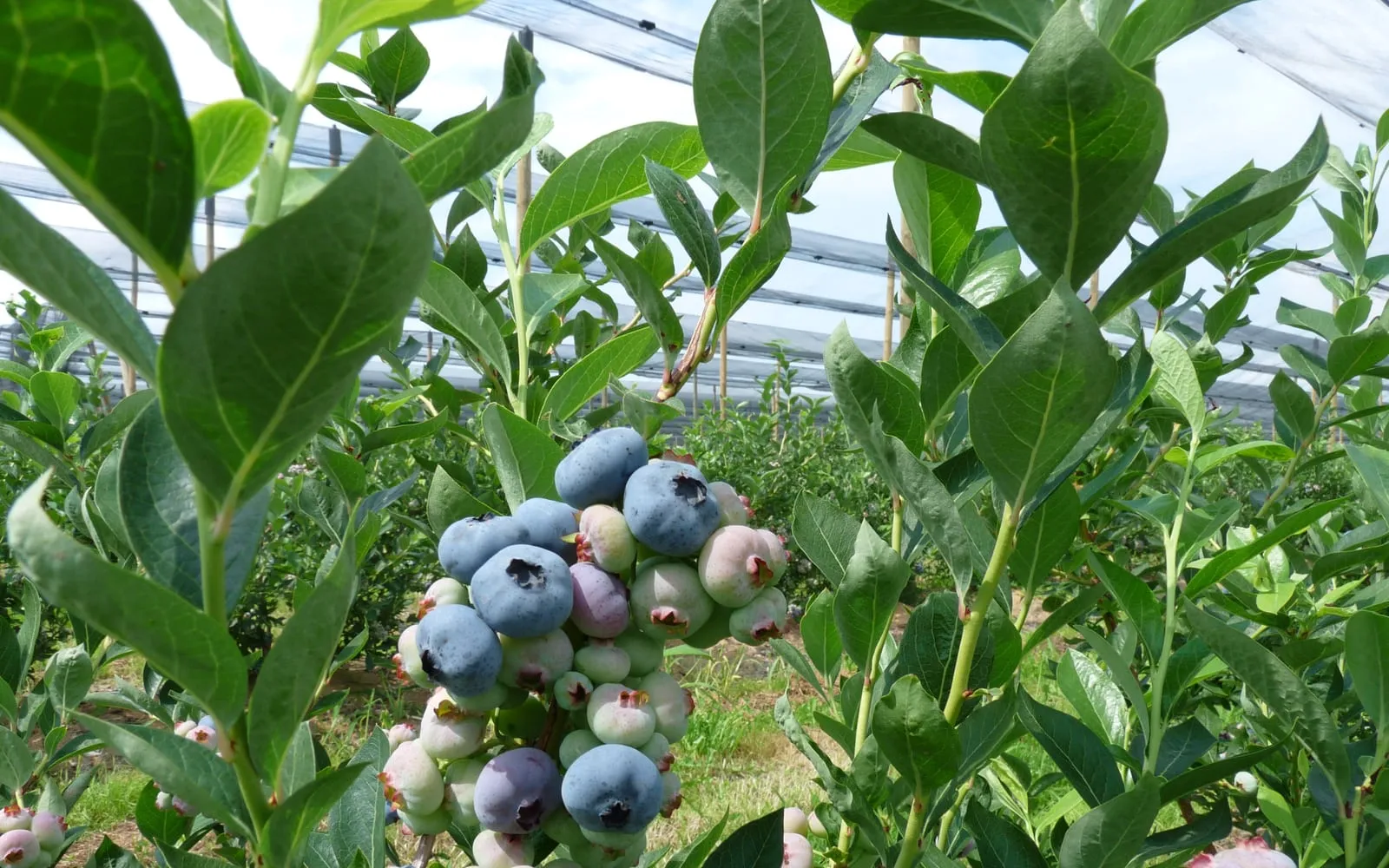
Fruit ripens from July to September depending on variety, each berry carrying a five-pointed crown at the tip and a pale bloom over the blue skin.
Stems are green and slender in their first year and turn brown and woody afterwards, which is how you tell what to prune.
Related species are grown too. Lowbush blueberry is a low creeping plant, and bilberry is the European relative with dark flesh and no bloom.
Where it is from
Eastern North America, from Nova Scotia to Florida, where highbush blueberries grow in acid bogs, damp woodland and pine barrens.
Domestication is remarkably recent. The first cultivated varieties were bred by Elizabeth White and Frederick Coville in New Jersey between 1908 and 1916, which makes this the newest major fruit crop in cultivation.
The natural habitat explains every requirement. Acid peaty ground gives the low pH, boggy conditions give the constant moisture, and the surface root system that suits wet peat is exactly what dries out fastest in a pot.
Acidity is about nutrient availability rather than acid itself. Above about pH 5.5, iron becomes chemically unavailable to the plant, and the leaves yellow while the soil still contains plenty of iron.
Winter cold is a requirement. Northern highbush varieties need several hundred hours below 7 deg C to flower well, which any cool winter supplies.
How it grows
Plant in autumn or spring into ericaceous compost, either in a large pot or in a prepared acid bed.
Use a container of at least 40 cm to start and pot on to 50 or 60 cm as the plant grows. A large pot dries out more slowly, which matters more than anything else.
Plant two different varieties. Most blueberries are partly self-fertile and all of them crop far more heavily, with larger berries, when cross-pollinated. Choose two that flower at the same time.
Expect little fruit for the first two or three years while the bush builds its framework. Full cropping comes around year five or six.
Prune from the third or fourth winter. Take out any dead, weak, twiggy or crossing growth, and cut one or two of the oldest thickest stems right down to the base to force new ones. Fruit is best on two and three-year-old wood, so the aim is constant renewal.
Pick when the berries have been fully blue for several days. A berry that comes away with the lightest touch is ripe, and one that resists needs longer.
Through the seasons
Winter is planting and pruning. Prune between November and March, and top-dress the pot with fresh ericaceous compost.
Spring brings flowering in April and May. Feed with ericaceous fertiliser as growth starts, and keep the compost damp.
Summer is watering and picking. Water with rainwater almost daily in a pot, net the bush before the fruit colours, and pick over several weeks as the berries ripen unevenly.
Autumn gives the leaf colour. Reduce watering as the plant goes dormant, and leave it outdoors, since it needs the winter cold.
Care difficulty
Moderate, and it is entirely about soil chemistry and water rather than skill.
Chlorosis from alkaline conditions is the commonest failure and it is almost always caused by tap water rather than by the compost.
Drying out is the second killer. Those shallow roots in a pot in July need checking every day.
Birds take the entire crop with complete reliability. Netting is not optional.
The pruning is gentle and forgiving, and a bush left unpruned still fruits for years, just less well.
Watering
Water with rainwater wherever possible. In a hard water area, tap water will raise the pH of the compost within a season or two and yellow the plant.
Keep the compost consistently damp through the growing season. In a pot in summer that usually means daily.
Never let a blueberry dry out completely. The fine surface roots die quickly and the plant takes a long time to recover.
Avoid waterlogging as well. Damp rather than sodden is the aim.
If you must use tap water occasionally, alternate it with rainwater and repot into fresh ericaceous compost every two or three years.
Mulch the surface of the pot with composted bark or pine needles to slow the drying.
Warning signs, diseases and pests
Yellow leaves with green veins is the classic blueberry problem. It is iron deficiency caused by the pH rising above about 5.5, usually from tap water or from ordinary compost. Repot into fresh ericaceous compost, switch to rainwater, and apply a chelated iron feed or sequestered iron to correct it quickly.
Birds strip the fruit within days of it colouring. Net the bush before that point, and use a proper cage rather than draped netting, which traps birds.
Vine weevil grubs eat the roots of container-grown plants, and the first sign is usually a plant that wilts and then collapses. Check the rootball when repotting, and use a biological nematode drench in late summer.
Drying out shows as scorched leaf margins and shrivelled fruit.
Grey mould rots the berries in a wet summer. Pick regularly and improve airflow.
A bush that flowers well but sets few berries usually has no pollination partner.
Very little new growth on an old bush means it needs renewal pruning, with one or two old stems taken to the base each winter.
Spotted wing drosophila lays eggs in fruit while it is still ripening, and berries that looked sound can collapse within a day. It has been established across North America and Europe since 2008 and remains a quarantine priority in Australia and New Zealand. Pick promptly and cover the crop with fine mesh where it occurs.
Plum curculio cuts a crescent-shaped scar into developing berries and is confined to North America east of the Rocky Mountains. Beneficial nematodes watered into the soil beneath the bushes have shown strong results against it in trials.
Growing environment
Full sun for the heaviest and sweetest crop. Light shade is tolerated with a smaller yield.
Acid conditions at pH 4.0 to 5.5. In a pot that means ericaceous compost, and never multipurpose. In the ground it means soil that is already acid, and no amount of adding sulphur will hold a chalky garden at the right pH for long.
Containers are the practical answer for most temperate gardens. Use at least 40 cm to start, and pot on as the plant grows.
Plant two varieties for cross-pollination, matched for flowering time.
Leave the plant outdoors all winter. It needs the cold to flower properly.
A fruit cage or firm netting from June onward.
Wind shelter helps, since the fine twiggy growth breaks.
Feeding
Use an ericaceous fertiliser and nothing else. General fertilisers, bone meal and mushroom compost all raise the pH and cause chlorosis.
Feed twice, once in early spring as growth starts and again in early summer.
Top-dress the pot each spring with fresh ericaceous compost, and repot fully every two or three years.
Sequestered iron corrects yellowing leaves quickly while you fix the underlying pH problem.
Do not lime, and do not add wood ash.
Troubleshooting
Yellow leaves with green veins. Iron deficiency from a pH that has drifted too high, usually from tap water. Repot into ericaceous compost, water with rainwater, and apply sequestered iron.
The birds took every berry. Net before the fruit colours, using a cage rather than loose draped netting.
Flowers but very little fruit. No pollination partner. Plant a second variety that flowers at the same time.
The plant wilted and collapsed suddenly in a pot. Check for vine weevil grubs in the rootball, or for a compost that dried out completely.
Can I grow blueberries in the garden soil? Only where it is already acid. Most soil is not, and attempts to acidify a chalky bed fail within a season or two. Use a large pot.
Can I use tap water? In a soft water area yes. In a hard water area it will raise the pH and yellow the plant, so collect rainwater.
When is a blueberry ripe? Several days after it turns fully blue. A ripe berry drops into your hand at a touch.
How do I prune it? From year three or four, take out dead and twiggy growth in winter and cut one or two of the oldest stems to the base to force new ones.
Blueberry problem guides
Not sure what is wrong? See the common vegetable pests guide.