
Disease
Powdery mildew
Also called Mildew, White mould on leaves
Powdery mildew makes white patches on leaves and stems, especially when roots are dry and air is humid. Watering, mulching and airflow matter more than spraying, and each mildew has a narrow host range.
At a glance
- Type
- Disease
- Cause
- Fungus
- Severity
- Weakens the plant
- Affects
- Garden plants, Herbs and edibles
- Active
- June to October
- Established in
- Worldwide
What you are seeing
- White or pale grey powdery patches on the upper surface of a leaf, spreading until the whole leaf is coated
- The powder rubbing off on a finger, unlike a leaf spot or a mineral deposit
- Young rose shoots distorted, with the growth tip purplish and curled
- Leaves yellowing under the coating, then browning and dropping early
- Tiny black specks scattered through an old mat of mildew in late summer
- Fruit and flower buds coated, opening badly or not at all
Before you treat anything
Milk and sodium bicarbonate sprays circulate widely as home remedies for this. Setting aside how thin the evidence is, using any substance as a plant protection product in the UK requires that substance to be approved for the purpose, and neither is. The measures above are what the law and the evidence both support.
What you are looking at
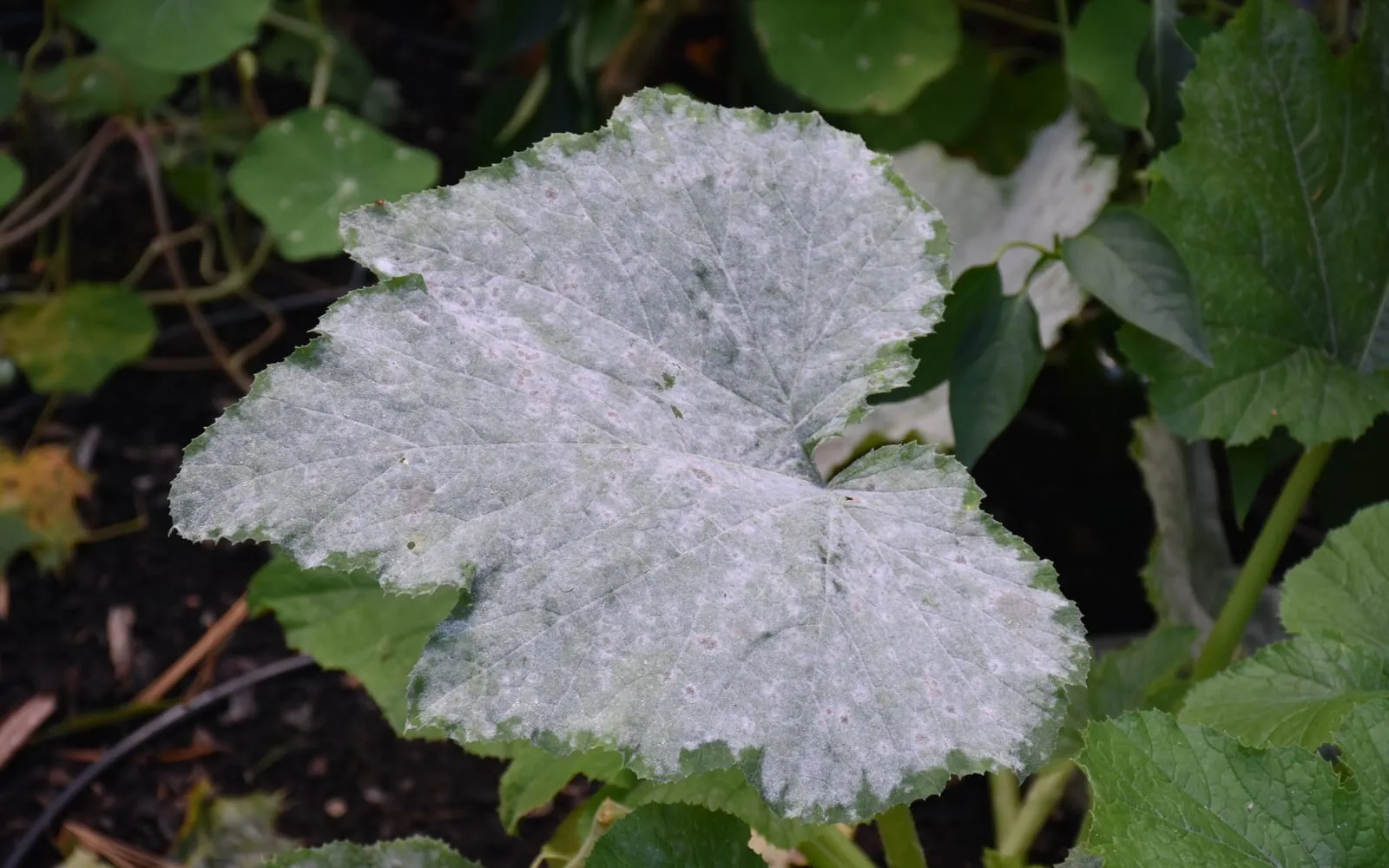
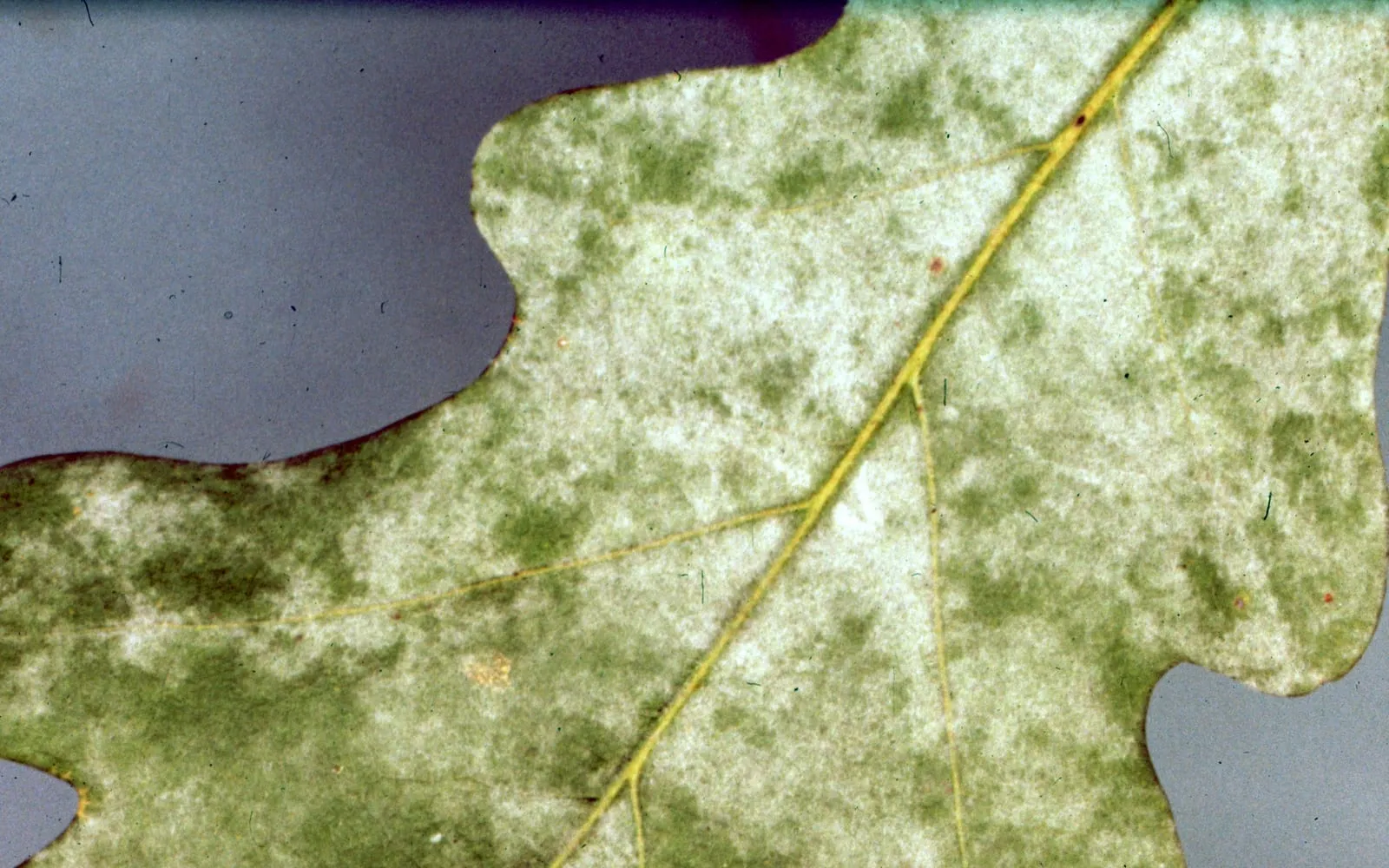
White or pale grey patches on the upper surface of a leaf, starting as discrete circles and merging until the leaf looks dusted with flour. Run a finger across one and it wipes a clear green track, because the fungus grows on the surface rather than inside the tissue. That single test separates it from almost everything else that marks a leaf.
Roses show it differently at first. The young shoots distort, the growing tip curls and takes on a purplish cast, and the white coating follows. On a gooseberry it goes felty and brown as the season wears on. On a courgette it begins as a few coins on the oldest leaves in July and covers the plant by September.
Late in the season, look closely at an old mat of mildew for a scatter of tiny black specks the size of a full stop. Those are the overwintering fruiting bodies, and they are the reason autumn leaf clearance is on the list of things that work.
The mildew on your courgette will not reach your roses
Powdery mildew is a name for a large family of fungi rather than one organism, and almost all of them are restricted to a narrow group of hosts. Rose mildew is Podosphaera pannosa and lives on roses. Oak mildew is Erysiphe alphitoides and lives on oaks. The one on cucurbits is a different fungus again, and it will not cross to a phlox growing beside it.
That matters for what you do next. Isolating a mildewed courgette from a rose achieves nothing. Neither does removing a mildewed oak branch overhanging a vegetable bed. What does help is dealing with the source on the same host, which usually means last year’s fallen leaves and this year’s dormant buds.
Why dry roots and humid air
Most fungal diseases need free water on the leaf to germinate, so they arrive with rain. Powdery mildew works the other way round. Its spores carry enough water of their own to germinate on a dry leaf, and a film of rainwater damages them and washes them off.
What it does need is humid air. Warm days, cool humid nights and dry soil is the exact combination that produces the worst outbreaks, which is why a fine settled August is a mildew year and a wet one is not.
Follow that through and the advice inverts. A plant sitting in dry ground has leaf cells short of turgor, and that is the tissue the fungus colonises most readily. Watering more at the root, and mulching so the moisture stays there, does more against powdery mildew than anything you can put on the foliage. The plants that go first every year are the ones in dry shade at the base of a wall, a fence or a hedge.
What the damage amounts to
On an established plant this is disfiguring rather than dangerous. Coated leaves photosynthesise poorly and drop early, the plant makes less than it should, and it goes into winter with smaller reserves. A rose does it every year for a decade and carries on.
Where it costs you is yield and display. A courgette or cucumber losing its leaves in August stops setting fruit weeks early. A phlox or a Michaelmas daisy coated by flowering time is not worth looking at. Young plants and cuttings can be checked badly enough to stall.
What to do about them
Water the roots properly and mulch, and do it in spring rather than after the white patches appear. Give the plants space when you put them in. Choose a resistant cultivar when you buy, which costs nothing at the point of decision and is the largest single lever on this page.
Once mildew is present, take off the first affected leaves and bag them, and keep watering. Do not strip a plant bare in an attempt to remove all of it. A courgette in September will be white whatever you do, and the leaves that are left are ripening the last of the crop.
On roses, the winter prune is the intervention that pays. The fungus overwinters in dormant buds on the stems, so cutting out thin twiggy growth and any shoot that carried mildew last summer removes the starting population before it moves.
Why there are no products listed here
The biological tier is empty because nothing can be introduced to eat a fungus growing on a leaf. The last tier is empty for a different reason. Amateur fungicide approvals in Great Britain have been withdrawn steadily over the past fifteen years, several of the actives that older gardening books recommend for mildew are no longer approved at all, and the ones that remain give a partial result on a disease that cultural change addresses better.
Milk sprays and sodium bicarbonate solutions turn up constantly in this context. Beyond the thin evidence for either, using a substance as a plant protection product in the UK requires it to be approved for that use, and neither is.
What it gets mistaken for
Downy mildew is a different organism, an oomycete rather than a fungus, and it sits on the underside of the leaf as a greyish or purplish fuzz with angular yellow blotches above, bounded by the veins. It needs wet leaves and cool conditions, so it appears in a wet spring rather than a dry August, and it is much more damaging.
Grey mould is a looser, greyer, fluffier growth that appears on damaged or dying tissue and on fruit, and it puffs out a cloud of spores when knocked. Powdery mildew stays as a flat film.
Hard water deposits and the residue from a foliar feed both leave white marks on a leaf, and both are confined to where the droplets landed rather than spreading outwards in circles. Neither grows.
Woolly aphid and mealybug both look like white fluff at a distance, and both are animals sitting on the plant rather than a film across the leaf blade. Look at the stem joints and the leaf axils, which is where they gather.
What to do, in order
Start here
Prevention, and the changes that stop the problem returning. Most of these pages should end at this tier.
- Water the roots more, not less
- A plant short of water at the root loses turgor in its leaf cells, and that is the condition this fungus exploits. A courgette that gets a thorough soaking twice a week resists what a lightly sprinkled one cannot. Almost everyone reduces watering when they see mildew, which makes it worse.
- Mulch to hold the moisture in
- Five centimetres of compost, bark or leaf mould over damp soil in spring keeps the root zone from swinging between wet and bone dry. The plants that get mildew first are the ones in dry soil at the foot of a wall or a hedge, where the ground is robbed by something bigger.
- Space plants so the air moves
- Still, humid air around a leaf is what lets the spores germinate. Thinning out a congested rose, giving courgettes the full distance on the packet, and taking out a few of the oldest stems on a phlox all cut the humidity in the canopy.
- Grow a cultivar bred to resist it
- Resistance varies enormously and costs nothing to choose. Among courgettes, Defender and Parador hold on where an old variety collapses in August, and modern shrub roses bred for disease resistance carry clean foliage in gardens where a hybrid tea defoliates every year.
- Ease off high-nitrogen feed
- Soft sappy growth forced with a nitrogen-rich feed is more readily infected than firm growth. A balanced feed and a potassium-rich one for flowering and fruiting plants gives tougher tissue.
- Clear the fallen leaves in autumn
- The black specks in an old mildew mat are fruiting bodies that overwinter on fallen leaves and in bud scales. Raking up under a rose or a gooseberry, and binning rather than composting the leaves, removes part of next year's starting inoculum.
Then reach for a barrier
Netting, hand removal and water. Nothing here harms anything except the target.
- Pick off the worst leaves as they appear
- Taking out the first few coated leaves in June slows the build-up noticeably, because each one is producing spores continuously. Bag them rather than dropping them under the plant, where they carry on sporulating.
- Prune infected rose shoots out in winter
- The fungus survives inside dormant buds on rose stems and comes out with the new growth in spring. Cutting out thin, twiggy and previously infected wood during the winter prune removes it before it starts.
- Accept the late-season leaves on a squash
- By September a courgette that has cropped all summer will be white, and stripping every leaf off leaves nothing to ripen the last fruit. Take the oldest few, leave the rest, and pull the plant when the crop is over.
In pictures
Plants affected
Guides that name it among the problems to watch for. The list is the plants it is characteristic of rather than everything it will feed on.
Common on UK allotments
This is one of the pests and diseases allotment growers meet most often. See it alongside the other common problems on the allotment guide.
Common allotment pests and diseasesA common tomato problem
This is one of the problems tomato growers meet most often. See it alongside the other pests, diseases and disorders on the tomato guide.
Common tomato problemsA common rose problem
This is one of the pests, diseases and disorders that rose growers meet most often. See it alongside the others on the common rose problems guide.
Common rose problems