
Disease
Honey fungus
Armillaria
Also called Armillaria root rot, Bootlace fungus
Honey fungus attacks the roots and base of garden trees and shrubs. Confirm it by looking for white fungal sheets under the bark, black rhizomorphs in the soil and honey-coloured toadstools in autumn.
At a glance
- Type
- Disease
- Cause
- Fungus
- Severity
- Can kill the plant
- Affects
- Garden plants
- Active
- September to November
- Established in
- Worldwide
What you are seeing
- A sheet of creamy white fungal growth between the bark and the wood at the base of the trunk, smelling strongly of mushroom
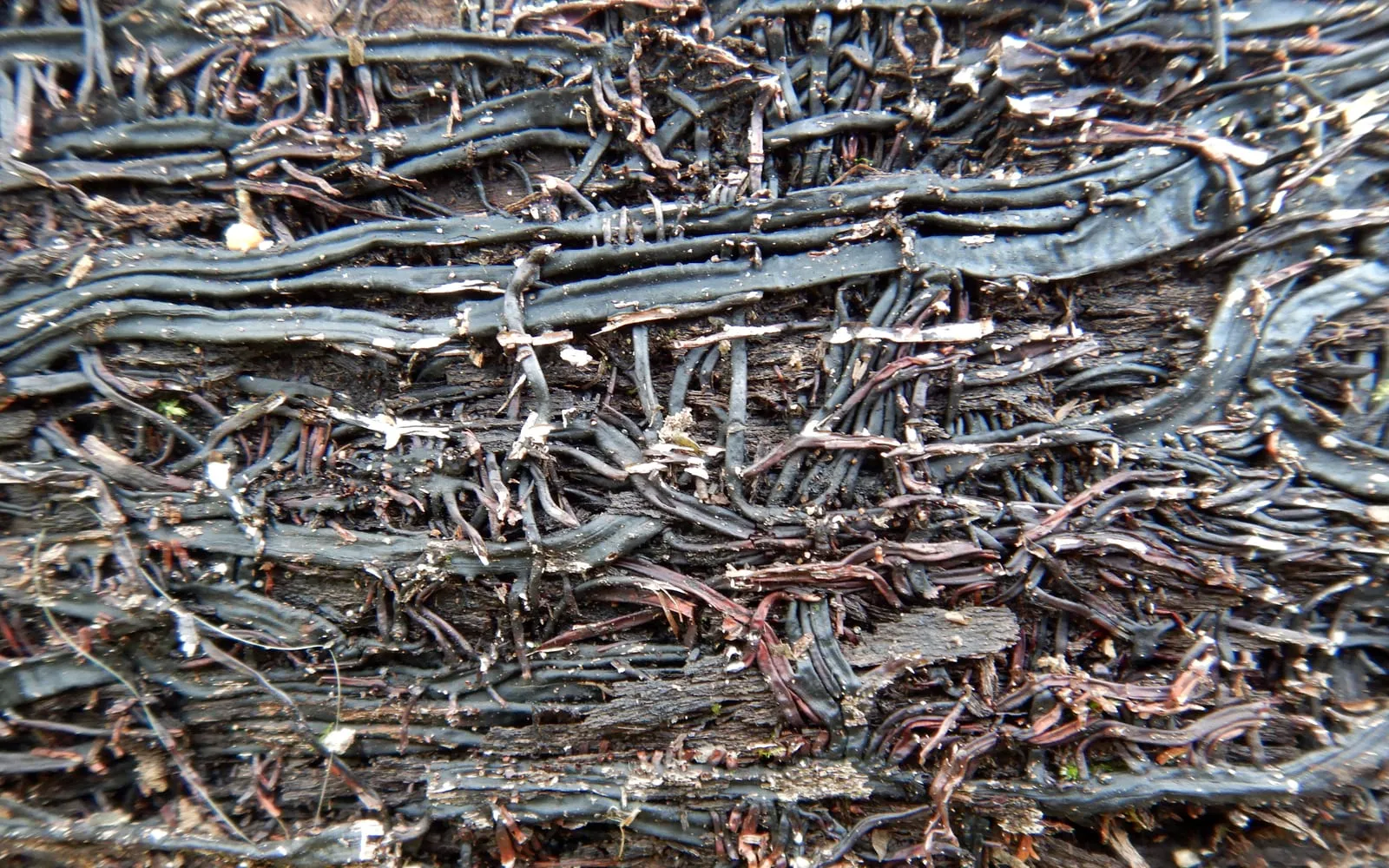
- Black flattened strands like bootlaces in the soil around the roots and under the bark, tough, black outside and white within
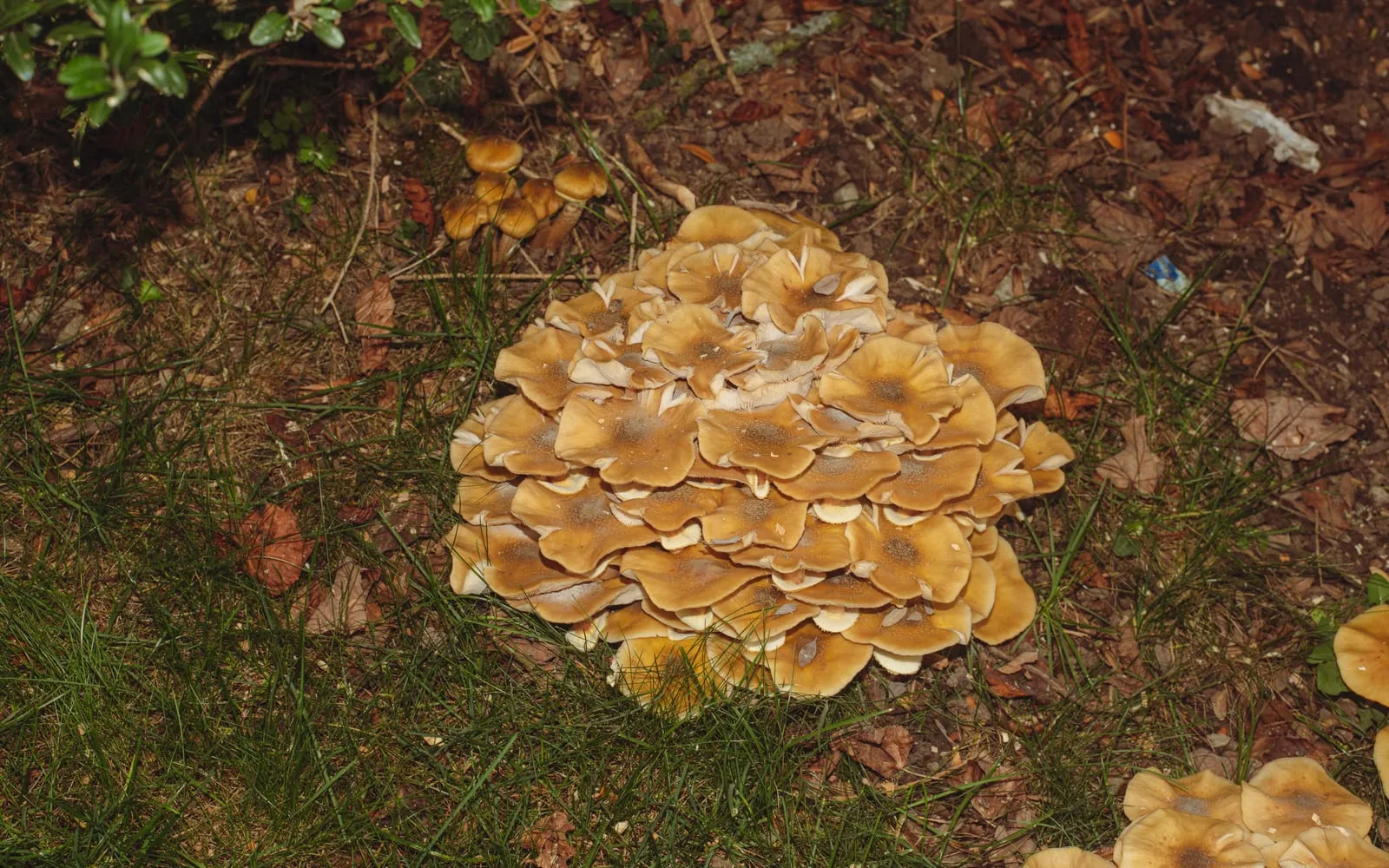
- Clumps of honey-coloured toadstools with a ring on the stem, at the base of a stump or over the root run, in autumn
- A shrub or tree dying suddenly, sometimes over a few weeks in summer
- Leaves smaller and paler than usual, early autumn colour, die-back in the crown
- An unusually heavy crop of flowers or fruit in the year before death
- Cracking or bleeding at the base of the trunk
Before you treat anything
Armillaria mellea is eaten in parts of Europe, and it must never be eaten raw or undercooked, since it upsets a proportion of people even when well cooked. There are also poisonous lookalikes growing in the same places at the same time. Do not eat anything from this page on the strength of a photograph.
Confirm it before you believe it
More garden plants are declared dead of honey fungus than die of it. Drought, waterlogging, root damage from building work and Phytophthora all kill shrubs in ways that look identical from above, and the diagnosis usually gets made from a clump of toadstools in the lawn.
There are three signs, and they are not equally reliable.
The definitive one is a sheet of creamy white fungal growth between the bark and the wood at the base of the trunk, extending down into the main roots. Cut a flap of bark away below soil level with a knife and look. It is white to cream, sheet or fan-shaped, and it smells powerfully of mushroom. Nothing else does that.
The second is the rhizomorphs. Black, flattened, tough strands one to three millimetres across, like bootlaces, running through the soil around the roots and under the bark. Snap one and it is white inside. These are how the fungus travels between plants, and it moves through soil at up to about a metre a year.
The third is the toadstools, and they are the weakest evidence. Honey-coloured caps with a ring on the stem, in dense clumps at the base of a stump or over a root run, in autumn. They appear in some years and not others, and several harmless fungi are similar enough to fool anyone.
Not every Armillaria is the same
Britain has several species and they differ considerably in what they do. Armillaria mellea is the one that kills garden shrubs. Armillaria gallica lives mostly on dead wood and takes only plants already failing for another reason. Armillaria ostoyae is largely a conifer problem.
A clump of toadstools on an old stump at the end of the garden, with everything around it in good health, is usually a fungus breaking down dead wood. Toadstools beside a dying hedge need closer inspection.
Why there is no cure
No fungicide is approved for honey fungus in Great Britain, at any scale, for amateur or professional use. Products that were once recommended for it, including Armillatox and Jeyes Fluid, are not approved as pesticides and cannot legally be used as one. They are sold as cleaning products.
The reason is structural rather than a gap in the market. By the time a plant shows symptoms, the fungus is inside the root system and behind the bark, and it is also in the soil for metres around as rhizomorphs and in every piece of buried woody debris. There is nothing to spray and nowhere to spray it.
Saying so plainly is more use than the hedged non-advice that fills this search. What follows is management, and management works.
What to do about it
Dig out the dead plant with as much of the root system as you can get. This is the one action that changes the outcome. The fungus lives on that dead root mass and uses it as a base to reach whatever you plant next, so a stump ground level with the soil and its roots left in place has removed the eyesore and none of the problem.
Then go looking for the other reservoirs. Old stumps from trees felled years ago, buried fence posts, lengths of timber left in a trench, a heap of prunings in a corner. Every one is a food source.
Where you want to protect something specific, sink a barrier. A vertical sheet of heavy butyl or thick plastic to 45 centimetres, with a couple of centimetres proud of the surface, stops rhizomorphs at the line.
Keep everything else growing strongly. This fungus is far more damaging to stressed plants, so watering through a drought, mulching and keeping mowers away from trunks all raise the odds for the plants you still have.
What to plant afterwards
Two routes are open, and the second is better than most people expect.
Choose woody plants with some resistance and accept that resistance is relative. Yew, box, hornbeam and beech come through infected ground far better than privet, rhododendron, rose, apple, birch, wisteria, viburnum and hydrangea, which are among the readiest to die. Check a current resistance list rather than working from memory, because these lists get revised.
Or stop planting woody things there. Honey fungus decays woody tissue, and herbaceous perennials, bulbs, ferns, grasses and annuals are broadly unaffected. A boundary that has swallowed three shrubs in five years can become an excellent perennial border, and that is a real answer rather than a consolation.
What it gets mistaken for
Phytophthora root rot also kills shrubs from the roots up and is common on wet ground. It leaves no white sheet under the bark and no bootlaces, and the affected roots go dark and brittle. Rhododendron, yew and lawson cypress are common victims of that one.
Waterlogging kills roots outright and produces the same crown die-back and sudden collapse, usually after a wet winter on heavy ground, with several plants affected across a low-lying area rather than spreading from one point.
Fairy rings and the general run of autumn toadstools in a lawn are fungi feeding on organic matter in the turf. They are not attacking anything, and they need no action beyond a mower.
Bracket fungi on a standing trunk are decay fungi of the wood rather than root killers, and they indicate a different problem, usually one for an arboriculturist to look at on safety grounds.
What to do, in order
Nothing available to a gardener will cure this once a plant has it. The steps below are about limiting the spread and deciding what to plant in its place.
Start here
Prevention, and the changes that stop the problem returning. Most of these pages should end at this tier.
- Confirm it before you act
- A great deal is blamed on honey fungus that turns out to be drought, waterlogging or Phytophthora. Cut a flap of bark away at the base of the trunk, below soil level, and look for the white sheet of fungal growth. Confirm the disease before removing plants or changing the border.
- Keep the plants you still have growing well
- Armillaria takes vigorous plants much less readily than stressed ones. Watering through a drought, mulching, easing compaction and avoiding damage to the trunk with a mower or a strimmer all make a real difference to what survives on an infected site.
- Plant species with some resistance
- Resistance is relative rather than absolute, and no plant is immune. Yew, box, hornbeam and beech come through infected ground far better than privet, rhododendron, rose, apple, birch and wisteria, which are among the most readily killed. Check a current list before replanting a whole boundary.
- Consider replanting with herbaceous plants
- The fungus is a decayer of woody tissue, so perennials, bulbs, grasses, ferns and annuals are largely unaffected. A border that has lost three shrubs in five years can become a very good herbaceous border rather than a fourth attempt at a shrub.
- Do not move soil off an infected area
- Rhizomorphs travel in soil and in woody debris. Barrowing soil from an infected bed to another part of the garden, or composting infected roots, is how a problem confined to one corner reaches the whole plot.
Then reach for a barrier
Netting, hand removal and water. Nothing here harms anything except the target.
- Dig out the dead plant and as much root as you can
- The fungus feeds on the dead root system and uses it as a base to reach the next plant. Removing the stump and the main roots takes away the food supply, and it is the single most effective action available. A stump grinder that leaves the roots behind does only part of the job.
- Sink a physical barrier
- A vertical sheet of heavy butyl rubber or thick plastic, buried to about 45 centimetres with two or three centimetres standing above the surface, blocks rhizomorphs travelling through the soil. This is worth doing to protect a specimen tree or to isolate one bed from the rest of a garden.
- Take out old stumps and buried timber
- Every stump, every length of buried fence post and every pile of old prunings is a reservoir. Clearing them is slow, unglamorous and the thing that decides whether the garden gets worse.
In pictures
Plants affected
Guides that name it among the problems to watch for. The list is the plants it is characteristic of rather than everything it will feed on.
A common rose problem
This is one of the pests, diseases and disorders that rose growers meet most often. See it alongside the others on the common rose problems guide.
Common rose problems