
Pest
Sawflies
Symphyta
Also called Gooseberry sawfly, Rose slug sawfly, Solomon's seal sawfly, Slugworm
Sawfly larvae strip gooseberries, roses and aquilegias, often leaving only the ribs of the leaf. Count the prolegs to separate them from caterpillars, because some caterpillar treatments will not work.
At a glance
- Type
- Pest
- Cause
- Insect
- Severity
- Weakens the plant
- Affects
- Garden plants, Herbs and edibles
- Active
- April to September
- Established in
- Worldwide
What you are seeing
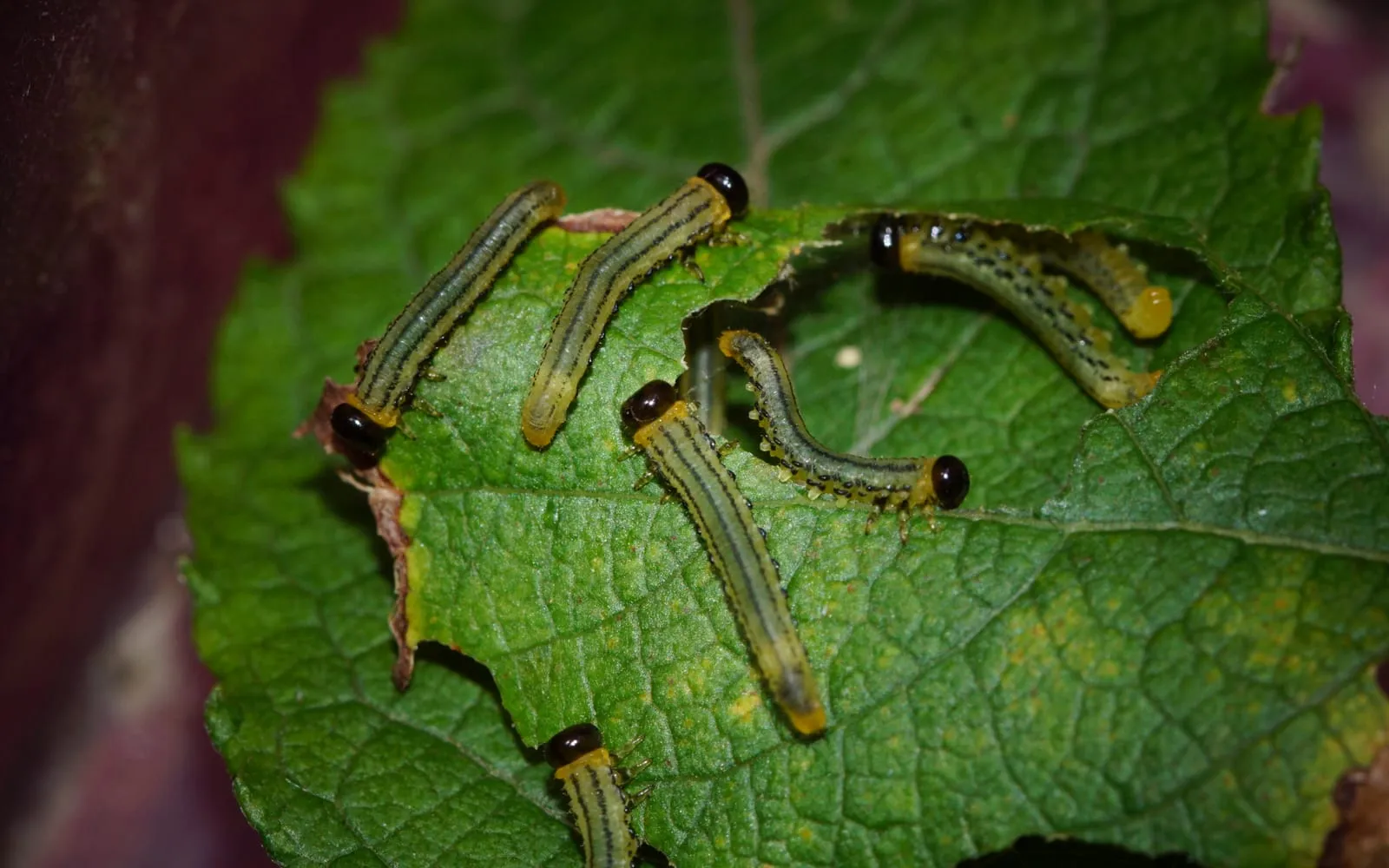
- Larvae that look like caterpillars but carry six or more pairs of fleshy prolegs behind the three pairs of true legs
- Larvae rearing the back half of the body into an S shape when the leaf is touched
- A gooseberry or currant bush stripped to bare ribs and leaf stalks within a fortnight, starting at the centre
- Rose leaves grazed to a lace of veins on one surface, going papery and brown
- Slimy black slug-like larvae on the upper surface of pear and cherry leaves
- Rows of larvae feeding shoulder to shoulder along a leaf edge, all facing the same way
- Aquilegia and Solomon's seal reduced to stems by early summer
Before you treat anything
Sawfly larvae are harmless to handle, and adult sawflies have no sting despite belonging to the same order as wasps and bees.
Count the legs
Behind the three pairs of jointed true legs at the head end, both caterpillars and sawfly larvae carry stumpy fleshy prolegs along the abdomen. A butterfly or moth caterpillar has five pairs of those at the very most, and often fewer. A sawfly larva has six, seven or eight.
The head gives a second reading. A sawfly larva has one large simple eye on each side, which reads as a single dark bead. A moth caterpillar has a cluster of tiny ones that no eye picks out in the field.
Behaviour is the third. Touch a leaf carrying sawfly larvae and the whole row lifts the back half of the body into a raised S at once, held for a few seconds.
Getting this right changes the advice. Sawflies are related to wasps and bees rather than to butterflies, so Bacillus thuringiensis, which handles caterpillars on brassicas and box, does nothing whatever to them. So do the nematode products sold for caterpillars. Anyone who treats a stripped gooseberry with a caterpillar product and watches the damage continue has met this distinction the expensive way.
Which ones you will meet
Gooseberry sawfly is the destructive one. Larvae hatch low in the middle of a gooseberry, red currant or white currant, work outwards, and can take a bush to bare ribs in a fortnight. Three generations run from late April into August, so a bush cleared in May is stripped again in July by a gardener who stopped looking.
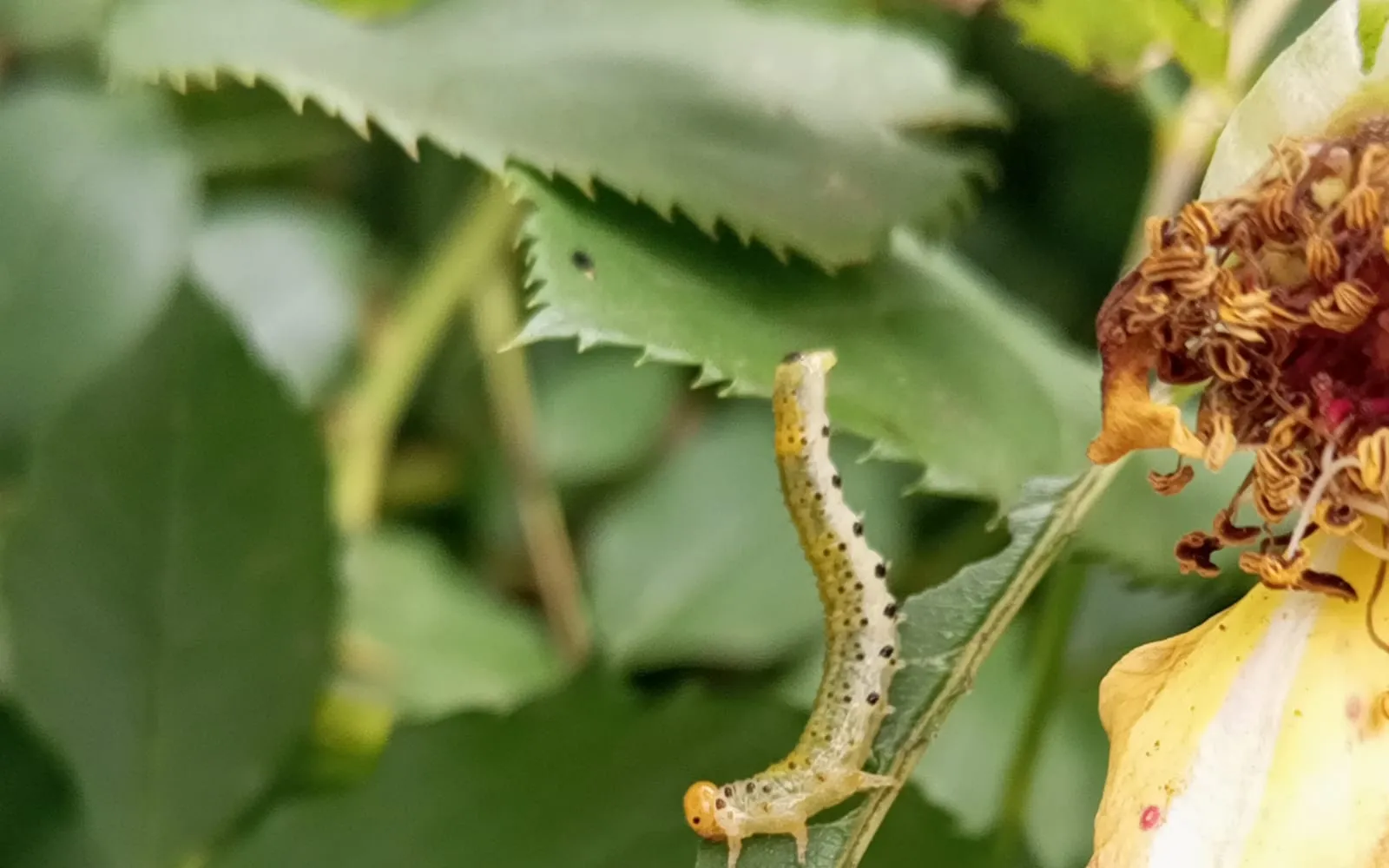
Rose slug sawfly grazes the surface off rose leaves and leaves a lace of veins that dries to brown parchment. The large rose sawfly instead eats whole leaves and cuts rows of slits into young green stems to lay its eggs, which splits and browns the shoot along the line.
Pear and cherry slugworm looks like a small black slug on the upper surface of the leaf, coated in its own slime, and skeletonises pear, cherry and hawthorn foliage from midsummer.
Solomon’s seal sawfly and aquilegia sawfly strip their host to bare stems in early summer, both after the plant has flowered.
Birch sawfly larvae feed in ranks along a leaf edge on birch and alder, and do no meaningful harm to a tree.
What the damage costs
Very little of this kills anything. A gooseberry stripped in June ripens its crop and refoliates, an aquilegia eaten in July has already set seed, and a birch loses a fraction of one summer’s leaves.
The cost falls on the following year rather than this one. A fruit bush spends the second half of the summer building the buds it will flower from next spring, and it cannot do that with no leaves and no water. That is what makes a defoliated gooseberry worth watering and mulching, and why repeated stripping year after year thins a bush out.
Ornamental damage is a separate question and it is your own to answer. A rose grazed to lace at the front of a border matters in a way that a birch at the end of the garden does not.
What to do about it
Look under the leaves weekly from late April, starting at the centre and the base of gooseberries and currants.
Pick the larvae off, or take off the whole leaf where twenty are feeding together, and tread on it. Hold a bucket under a branch and tap it, since most species let go.
Go back in July. The second and third generations arrive on plants that were clean in June.
Cut out rose shoots that carry a line of laying slits, and the eggs leave with the prunings.
Keep a stripped fruit bush watered and mulched through the rest of the summer.
Leave the birch, and the Solomon’s seal after it has flowered, to the wasps.
What it gets mistaken for
Caterpillars are the constant confusion, and the proleg count settles it in five seconds. Getting it wrong sends people to treatments that cannot work.
Slugs on pear and cherry leaves would leave slime trails across the soil and feed at night. Slugworm sits on the leaf in daylight, has a head and legs underneath the slime, and never leaves the tree.
Leaf miners tunnel between the two surfaces of a leaf, leaving both intact over a hollow blotch or squiggle. Sawflies remove tissue from outside.
Vine weevil adults cut small clean notches out of the leaf margin at night and leave the rest of the leaf whole.
What to do, in order
Start here
Prevention, and the changes that stop the problem returning. Most of these pages should end at this tier.
- Look under the leaves from late April, at the centre of the plant
- Gooseberry sawfly starts low and inside the bush, and the first generation is usually found only when the outside starts to look thin. Part the branches and check the undersides of the lowest leaves once a week from the end of April. Roses and aquilegia want the same treatment from May.
- Accept the damage on anything that has finished its year
- A birch stripped in August, or a Solomon's seal eaten after flowering, has already done most of its growing. Those plants come back unchanged next spring and the larvae feed a great many birds and wasps in the meantime. Save the effort for the fruit bushes.
- Keep a defoliated gooseberry watered and fed
- A bush stripped in June will still ripen the fruit it is carrying, and it refoliates within weeks. What it cannot do is build next year's buds while short of water, so mulch it and keep it going through the summer.
- Turn the soil under gooseberries and currants over winter
- The larvae drop off and spin cocoons in the top few centimetres of soil beneath the bush. Lightly forking that ground in winter brings some of them to the surface for the birds and breaks up the cycle a little. It thins the first generation rather than removing it.
- Choose roses grown for tough foliage
- Rose slug sawfly grazes soft young leaves hardest. Cultivars with thick, glossy, disease-resistant foliage carry less damage and show it less, and they are the same cultivars worth having for black spot.
Then reach for a barrier
Netting, hand removal and water. Nothing here harms anything except the target.
- Pick them off and squash them
- Hand removal is the whole answer on a garden scale. Run a gloved hand up the underside of a leaf, or hold a bucket beneath and tap the branch, since most species drop when disturbed. Two passes a week apart clears a gooseberry bush.
- Snap off the worst leaves rather than searching them
- Sawfly larvae feed in groups, so one leaf often carries twenty of them. Taking that leaf off and treading on it is quicker than picking them individually, and a rose or a gooseberry can spare the foliage.
- Slit the egg-laying scars on rose stems
- The large rose sawfly saws a row of slits into a young green stem to lay in, and the stem splits and browns along the line. Cut those shoots out when you see them and the eggs go with them.
Then bring in the predators
Encourage what already lives in the garden, and buy predators in where the problem is under glass and nothing will arrive on its own.
- Let the wasps and birds work, and do not spray over them
- Social wasps take enormous numbers of sawfly larvae to feed their grubs, and tits strip them off fruit bushes given the chance. A garden that is not sprayed keeps both. Hanging a nest box near the fruit does more for a gooseberry in June than any product.
Biological controls are live organisms and their sale and release are regulated country by country. An agent sold freely in one place may be unapproved in another, so buy from a licensed supplier where you live and never import or move one yourself.
In pictures
Plants affected
Guides that name it among the problems to watch for. The list is the plants it is characteristic of rather than everything it will feed on.
Common on UK allotments
This is one of the pests and diseases allotment growers meet most often. See it alongside the other common problems on the allotment guide.
Common allotment pests and diseasesA common rose problem
This is one of the pests, diseases and disorders that rose growers meet most often. See it alongside the others on the common rose problems guide.
Common rose problems