
Disease
Rose black spot
Diplocarpon rosae
Also called Black spot, Rose blackspot
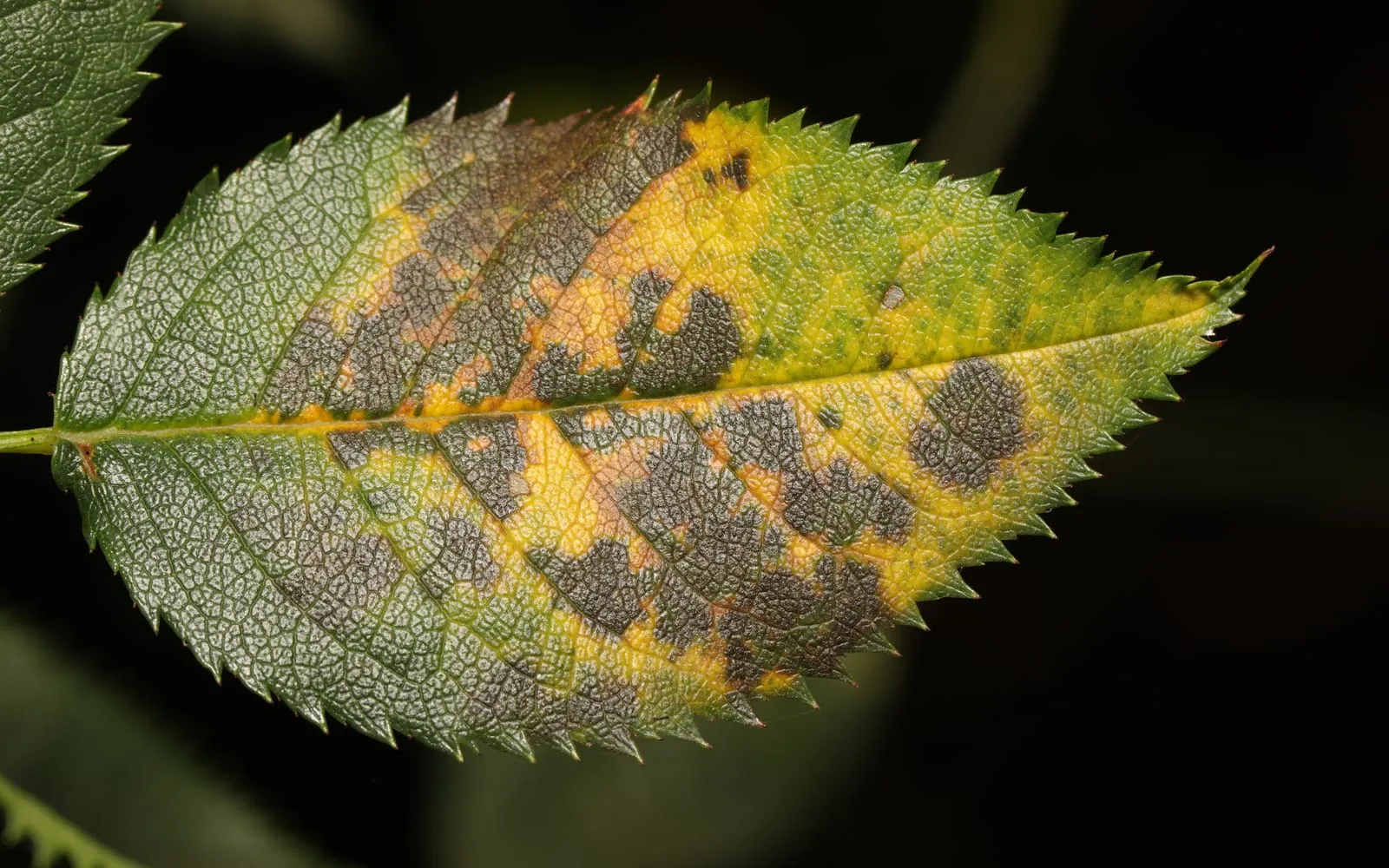
Rose black spot causes dark fringed blotches, yellowing leaves and bare stems by late summer. The green rings around spots show where the fungus is still active, and resistant varieties matter more than sprays.
At a glance
- Type
- Disease
- Cause
- Fungus
- Severity
- Weakens the plant
- Affects
- Garden plants
- Active
- May to October
- Established in
- Worldwide
What you are seeing
- Rounded purple-black blotches up to about a centimetre across on the upper surface of the leaf
- A ragged, fringed edge to each blotch rather than a clean circle
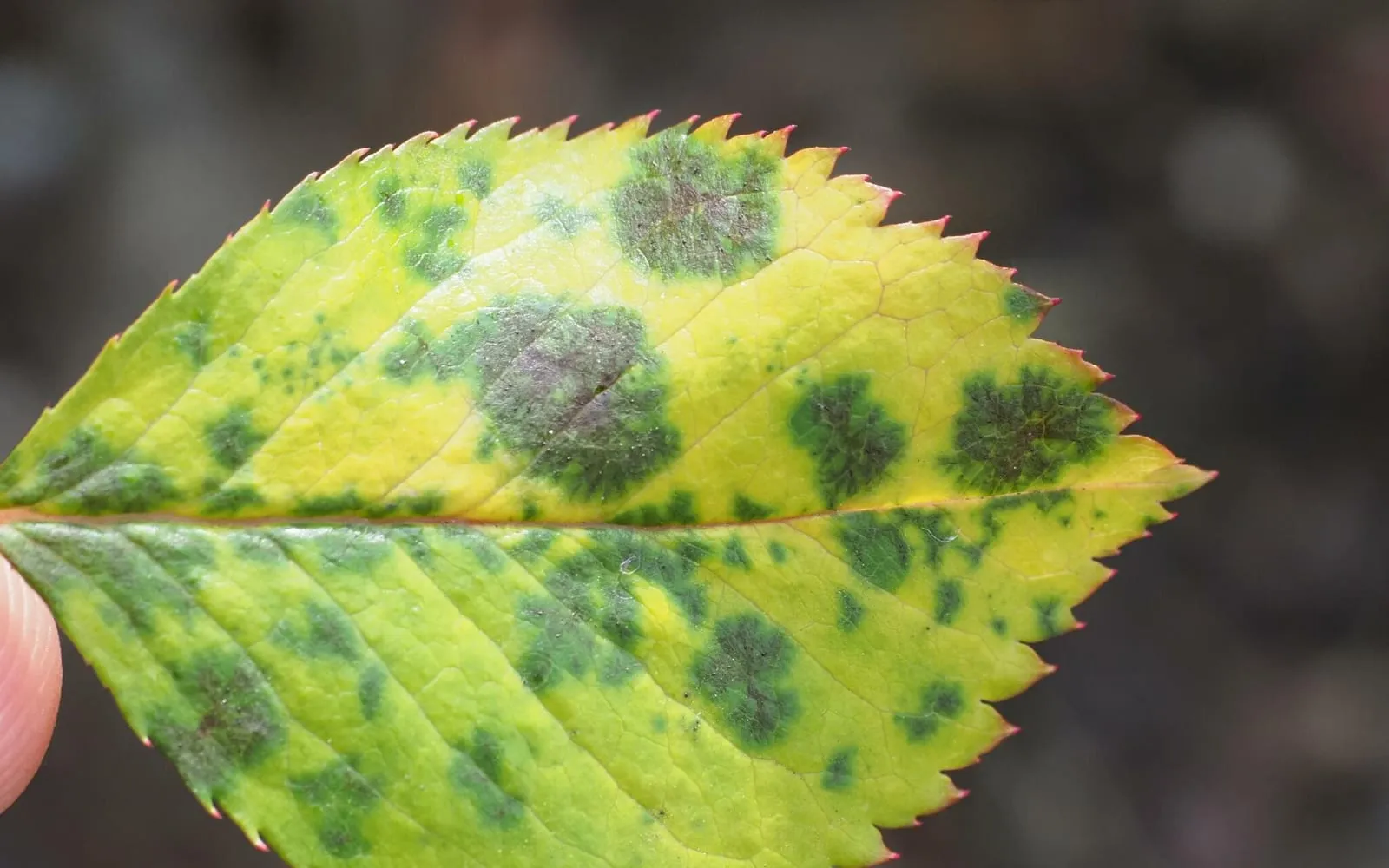
- The leaf yellowing while a green ring stays around each spot
- Leaves dropping from the base of the plant upwards through summer
- A bush half bare by August and completely bare by September
- Small purple-black blotches on young green stems
Before you treat anything
Black spot affects roses and nothing else, and it is harmless to people and animals. Infected leaves should go in the household waste rather than a home compost heap, which rarely reaches a temperature that kills the fungus throughout.
What you are looking at
Dark blotches on the upper surface of a rose leaf, purple-black, anything up to a centimetre across, and edged like a torn piece of paper rather than a drawn circle. That fringed margin is the identifying character. Most other things that mark a rose leaf make a spot with a clean edge.
Around and between the blotches the leaf goes yellow, and then it falls. Working from the bottom of the plant upwards, a bush that looked well in June can be half bare in August and completely bare by mid-September, still trying to flower on naked stems.
Look at the young green stems too. Small purple-black blotches there are the same fungus, and they are how it gets through the winter on the plant itself.
The green rings, and what they tell you
Hold up a yellowing leaf. Each black spot usually sits in a ring of tissue that has stayed green while everything around it has gone.
Those are green islands, and they are the fungus at work. Diplocarpon rosae produces plant hormones of the cytokinin group, which delay ageing in the cells immediately around the lesion. The fungus is a biotroph and needs living tissue, so it keeps its own patch of leaf alive while the rest of the leaf is abandoned.
It is a good diagnostic and a reminder of what you are dealing with. This organism is not poisoning the plant. It is farming it.
Why it needs a wet leaf for seven hours
Spores arrive by rain splash from fallen leaves below and from lesions on the stems. To infect, one needs a continuous film of water on the leaf surface for around seven hours at somewhere between 18 and 25 degrees C. Symptoms follow three to ten days later, and each new lesion produces spores that start the cycle again.
Everything effective follows from that single requirement. A rose in an open sunny position with air moving through it dries within a couple of hours of dawn. A rose in a still corner, crowded by other planting, watered from a hose over the top of it in the evening, stays wet all night. The two plants can be the same cultivar and have entirely different summers.
Why it is worse than it was
Black spot was uncommon in industrial British cities for most of the twentieth century, and rose growers knew it. Sulphur dioxide in the air suppressed the fungus, which is why urban roses were noticeably cleaner than country ones.
Clean air legislation removed that accidental fungicide from the 1970s onwards, and black spot spread into gardens that had never had it. Anyone whose parents grew unblemished roses in a town garden is remembering something real.
What the damage amounts to
The plant loses leaves and therefore loses the capacity to feed itself. A bush defoliated by August makes less growth, flowers less well the following year and goes into winter with smaller reserves. Repeated over several seasons that adds up to a weak plant, and a weak plant is more vulnerable to everything else.
It will not kill an established rose. Treat it as a chronic condition to be managed rather than an emergency, and put the effort into keeping the plant growing well enough to replace what it drops.
What to do about it
Clear up. Every fallen leaf, through the season as well as in autumn, into the household waste rather than the compost heap. The fungus overwinters in that litter, and removing it removes most of next spring’s starting inoculum.
Then mulch thickly over the cleared ground. Five centimetres of compost buries anything left and stops rain splashing spores up onto the new leaves in April.
Prune out stems carrying black blotches in winter, and strip off any leaves still clinging to the bush before you start, because the lesions on the wood are the part that clearing the ground never reaches.
Water at the base, in the morning, and give the plant room. Where you are planting new, choose a cultivar bred for disease resistance and put it somewhere open and sunny. That decision does more than everything else on this list combined, and it costs nothing at the point it is made.
Accept some spotting. A rose that carries a little black spot and keeps growing is in better shape than one being fought over every fortnight.
Why there are no products listed here
Nothing can be introduced to eat a fungus growing inside a leaf, so the biological tier is empty.
The last tier is empty because amateur fungicide approvals in Great Britain have narrowed steadily, and the products that remain are protectant. They can slow infection of leaves not yet infected, they do nothing about what is already inside the plant, and they need repeating every fortnight from bud burst to leaf fall to have any effect at all. A resistant cultivar in an open position, with the fallen leaves cleared, delivers more for one afternoon’s work than a season of spraying.
What it gets mistaken for
Rose rust makes raised orange or brown pustules on the underside of the leaf that rub off as powder, with pale spots above. Black spot is flat, dark, and sits on the upper surface.
Downy mildew on roses produces angular purplish blotches bounded by the veins, often with a faint greyish growth beneath, and it moves fast in cool wet conditions in spring and autumn. Black spot lesions are rounded and cross the veins freely.
Spray damage and leaf scorch leave marks that are symmetrical, follow the pattern of where droplets landed, and appear on every leaf at once rather than spreading over weeks.
Sooty black deposits that wipe off are sooty mould growing on aphid honeydew. Black spot will not wipe off, because it is inside the leaf.
What to do, in order
Start here
Prevention, and the changes that stop the problem returning. Most of these pages should end at this tier.
- Choose a cultivar bred for resistance
- This is the largest single decision on the page and it is made at the point of buying. Modern shrub roses bred for healthy foliage, and the rugosa group in particular, carry clean leaves in gardens where a traditional hybrid tea is bare by August. Check the breeder's disease rating before the flower colour.
- Plant in an open, sunny position
- Infection needs about seven hours of continuous water on the leaf. A rose in a still corner against a fence holds dew until midday and gets it; a rose in moving air and morning sun dries in two hours and does not.
- Water the soil and never the foliage
- Spores are splashed from below and germinate in the film of water they land in. A can at the base in the morning gives the plant everything it needs without providing the one condition the fungus cannot do without.
- Feed and water so the plant can replace what it loses
- A rose that keeps making new leaves through a black spot summer comes through in reasonable shape. Mulching in spring, watering in a dry August and feeding after the first flush all matter more than they sound, because this disease costs the plant leaves rather than killing it.
- Give each bush room
- Roses planted close together, or underplanted with something dense and leafy, sit in their own humidity. Space them, and keep the ground at the base of the plant clear.
- Expect resistance to fade
- The fungus exists as many genetically distinct races, so a cultivar that stays clean in one garden can be spotted in another twenty miles away, and a variety sold as resistant twenty years ago may not be now. Treat a resistance claim as a good bet rather than a guarantee.
Then reach for a barrier
Netting, hand removal and water. Nothing here harms anything except the target.
- Collect the fallen leaves, all season
- The fungus overwinters in dead leaves on the ground, and clearing them is the single most effective thing you can do. Do it through summer as leaves drop as well as in autumn, and put them in the household waste rather than the compost heap.
- Strip the last leaves off in late winter
- Taking the few remaining leaves off the bush before pruning removes overwintering infection that would otherwise be sitting a few centimetres from the new growth.
- Prune out spotted stems
- The fungus survives in lesions on young wood, which is how a rose that was cleared of every fallen leaf still gets black spot in April. Cut back into clean wood during the winter prune.
- Mulch thickly after clearing up
- Five centimetres of compost or bark over cleared ground in late winter buries any spores left in the surface debris and stops rain splashing them up onto the new leaves.
In pictures
Plants affected
Guides that name it among the problems to watch for. The list is the plants it is characteristic of rather than everything it will feed on.
A common rose problem
This is one of the pests, diseases and disorders that rose growers meet most often. See it alongside the others on the common rose problems guide.
Common rose problems