
Outdoor plant
Japanese rose
Rosa rugosa
Also known as Rugosa rose, Beach rose, Ramanas rose
How to grow rugosa rose, Rosa rugosa. The best rose for salt wind and sand, tomato-sized hips you can eat, and why it is now controlled as an invasive species.
At a glance
- Difficulty
- Easy
- Water
- Rarely once established
- Light
- Full sun, and it tolerates light shade at the cost of flowering
- Temperature
- Extremely hardy, and it is unbothered by salt wind and hard frost
- Hardiness
- USDA 2-7, RHS H7, hardy to -40 C
- Type
- Deciduous shrub, long lived and strongly suckering
- Height
- 1-2 m
- Native to
- Coastal north-east Asia, from Japan, Korea, north-east China and eastern Siberia
- Best month
- October in the Northern Hemisphere, April in the Southern Hemisphere
Salt wind, sand and cold are all taken to a degree no other rose matches, which is why it holds sea walls and coastal car parks. That same toughness has made it a listed invasive of Union concern in the European Union, banned from sale and planting across the member states, and it has taken over dune systems along the Baltic and North Sea coasts and in New England. It suckers into thickets and resents pruning.
Hardiness zones describe winter cold alone. Summer heat, humidity, rainfall and the length of the growing season decide as much, so treat the range as the outer limit rather than as a recommendation.
Every month named in this guide is for the temperate Northern Hemisphere. If you garden in the Southern Hemisphere, shift each one by six months, so October becomes April. Closer to the equator the wet and dry seasons matter more than the calendar, and the shift stops being a useful guide.
Skin irritant
- Safe to eat
- The hips and the petals
- Do not eat
- The hairs surrounding the seeds inside the hip
- Harm from
- Handling it
- Affects
- People
Rugosa rose is a food plant and the caution is mechanical rather than chemical, exactly as it is for the native dog rose. The flesh of the hips is edible, high in vitamin C, and large enough to be worth preparing, and the petals are used for rose syrup, jelly and Japanese preserves. Inside each hip is a mass of seeds wrapped in fine stiff hairs that irritate skin, mouth and gut severely, so hips must be strained through muslin or a jelly bag, or split and scraped, before anything is eaten. Never eat one whole. Rose is not listed by the ASPCA as toxic to cats, dogs or horses, and no part of the plant carries recognised toxicity. The other hazard is physical. Rugosa stems are covered in dense fine bristles as well as thorns, and the bristles break off in skin and are hard to see, so wear thick gloves and long sleeves.
Sources: RHS potentially harmful garden plants, ASPCA toxic and non-toxic plants
About
Rugosa rose grows in pure sand, in the teeth of a salt gale, on a dune that nothing else will hold, and it flowers from June until the frosts while doing it.
That toughness explains both its popularity and its problem. Local authorities planted it along coastal roads and car parks across Britain and northern Europe for decades because nothing else survived there. It then spread from those plantings onto the dune systems themselves, where it forms dense thickets that shade out the specialised dune flora and change the habitat permanently.
It is now listed as an invasive alien species of Union concern in the European Union. Britain no longer applies that list, and the plant remains legal to sell and grow here, so anyone planting one near the coast is making a decision rather than following a rule. Check the current position with your local wildlife trust if you garden on or near a dune system.
Inland and in an ordinary garden it is a good plant. The flowers are large, single, strongly scented of cloves, and they keep coming all summer. The hips are the size of small tomatoes and they ripen while the plant is still flowering, so a rugosa in September carries both at once.
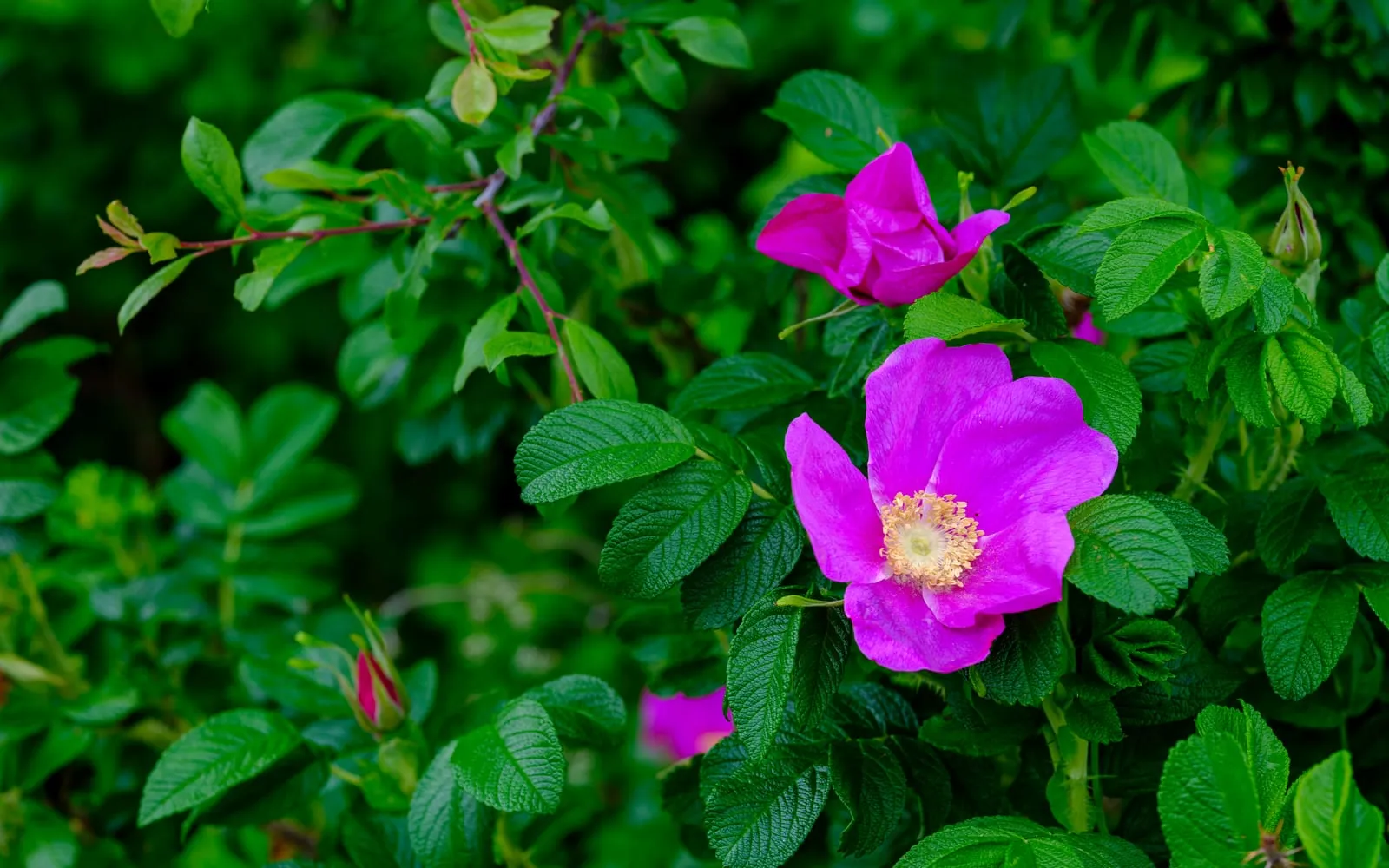
The leaves are the give-away. Deeply wrinkled, thick and glossy, which is what rugosa means, and almost immune to the blackspot and mildew that plague garden roses.
Appearance and character
A deciduous shrub reaching 1 to 2 m, forming a dense upright thicket that spreads outwards by suckers.
Stems are the identification. They are covered along their whole length in dense fine bristles as well as straight thorns, so the wood looks furry rather than smooth.
Leaves are pinnate with five to nine leaflets, thick and leathery, deeply corrugated between the veins, glossy dark green above and downy beneath. They turn a good clear yellow in autumn.
Flowers open from June to the first frosts, 6 to 9 cm across, single with five broad petals, in deep purple-pink or white depending on the form. The scent is strong and distinctly clove-like.
Hips ripen from August, and they are unlike any other rose. Round and flattened, 2 to 3 cm across, glossy orange-red, and produced while the plant is still in flower.
Double-flowered cultivars exist. ‘Roseraie de l’Hay’ and ‘Blanc Double de Coubert’ are the common ones, and neither sets a worthwhile crop of hips.
Where it is from
Coastal north-east Asia, from northern Japan through Korea and north-east China into eastern Siberia and Kamchatka.
Its natural habitat is beach and dune, growing in loose sand within reach of salt spray and tolerating burial by blown sand, which is why it survives conditions that kill almost everything else.
It reached Britain around 1796 and was planted widely from the twentieth century for coastal shelter, road verges, motorway plantings and municipal landscaping.
In Japan it is hamanasu, the beach pear, and the hips have been eaten and the petals preserved for centuries. It is the prefectural flower of Hokkaido.
The plant naturalised across northern Europe and North America, and it is now a recognised problem on dune systems in Denmark, Germany, the Netherlands and parts of Britain.
Rose hip products across northern Europe use rugosa in preference to wild dog rose, because the hips are far larger and easier to process.
How it grows
Plant bare-root between November and March or container-grown at any frost-free time, in full sun.
Poor sandy soil is ideal. It grows in almost pure sand, in gravel and on thin ground, and it needs free drainage above all.
Avoid chalk, where it yellows badly, and avoid heavy wet clay, which it dislikes.
Think about where the suckers will go before you plant. A rugosa spreads outwards from the roots every year and one plant becomes a thicket of several metres given a decade.
Plant it where that behaviour is useful. A bank, a boundary, a windbreak, a car park edge, a wild corner or a hedge all suit it.
Do not plant it into a mixed border unless you intend to cut suckers every year, and do not plant it on or near a dune system.
For a hedge, space plants 60 to 90 cm apart in a single row and let them knit together.
Prune very little. Rugosa flowers on new wood and needs no more than the removal of dead stems in late winter.
Renovate an old congested plant by cutting the whole thing to 30 cm in late winter, which it takes without complaint and regrows within a season.
Cut suckers where you do not want them. Slice them off below ground with a spade rather than at soil level.
Leave the hips on. Deadheading a rugosa removes the best part of its autumn, and it keeps flowering anyway.
Propagate by lifting a rooted sucker in winter, which is the easiest method of increasing any rose.
Through the seasons
Winter is planting season and the time for hard renovation, and the stems and any remaining hips carry the interest.
Spring breaks into fresh wrinkled leaves early, and growth is fast.
Summer flowers from June onwards without a break, with the scent strongest in warm still weather.
Autumn carries flowers and ripe hips together into October, and the foliage turns clear yellow.
Care difficulty
Easy to the point of being difficult to stop.
It is one of the healthiest roses grown. Blackspot, mildew and rust rarely touch it, so the spraying regime that goes with hybrid teas is unnecessary.
It survives salt spray, gales, drought, sand, hard frost, poor soil and neglect.
The two real problems are suckering and handling. It spreads outwards indefinitely and needs cutting back at the edges, and the dense bristles on the stems break off in skin and make every job on the plant slower than it should be.
Do not spray it with anything. Fungicides sold for roses can scorch rugosa foliage, and it does not need them.
Watering
Water through the first summer after planting.
An established rugosa needs no watering in a temperate climate and is among the most drought-tolerant shrubs available.
It dislikes wet feet more than dry, so improve drainage on heavy ground rather than adding water.
Warning signs, diseases and pests
Yellow leaves with green veins on chalky soil is lime-induced chlorosis. Rugosa is markedly intolerant of alkaline ground and there is no lasting fix.
Suckers coming up several metres from the plant is normal behaviour rather than a symptom. Cut them out below ground with a spade.
Scorched or blotched foliage after spraying is chemical damage. Rugosa is sensitive to rose fungicides and does not need them.
Blackspot and mildew occur occasionally and are far milder than on cultivated roses. Clear fallen leaves and take no other action.
Sawfly larvae skeletonising leaves in summer look alarming and do little lasting harm. Pick them off.
Leaves cut into neat semicircles is leafcutter bee work, which is harmless and worth encouraging.
Poor flowering is almost always shade. Rugosa needs full sun.
Aphids on the shoot tips feed a large number of predators and rarely need any action.
Growing environment
Full sun. It tolerates light shade and flowers badly in it.
Poor, sandy, free-draining soil is ideal, and it also grows on gravel and on made ground. Avoid chalk and heavy wet clay.
Extremely hardy, and the best rose there is for exposed coastal planting. Salt wind does not mark the foliage.
Allow 1.5 to 2 m for a single plant and expect it to keep expanding. Plan for the suckers rather than fighting them.
It suits a coastal garden, a windbreak, a hedge, a bank, a car park edge or a boundary where a thorny barrier is useful.
Think carefully before planting it within reach of dunes, shingle or any coastal conservation site. Its spread onto those habitats is the reason it is regulated across the European Union, and the same risk applies here whether or not the law follows.
Its wildlife value is good. Single-flowered forms give bees easy access, the hips feed birds through autumn, and the thicket is dense nesting cover.
Feeding
None needed, and feeding is counterproductive.
Rugosa evolved on sand with almost nothing in it. Rich soil and nitrogen produce soft growth and more suckering without improving the flowers.
Skip the rose fertiliser entirely.
Yellowing on chalk is a pH problem rather than a nutrient shortage, and sequestered iron buys a season at most.
Troubleshooting
Can I eat the hips? Yes, and they are the best rose hips for the purpose because of their size. Strain the pulp through muslin or a jelly bag, or split and scrape each hip, because the hairs around the seeds are a serious irritant.
Should I deadhead it? No. Deadheading removes the hips, which are the best thing about it in autumn, and it keeps flowering regardless.
Suckers are coming up all over the bed. Normal. Rugosa spreads by root suckers. Cut them out below ground with a spade, and plant it somewhere the spread is useful next time.
Is it invasive? On coastal dunes, yes, and it is listed as an invasive alien species of Union concern in the European Union. Britain does not apply that list and it remains legal to grow here. Do not plant it near a dune system.
The leaves are yellow with green veins. Chlorosis on chalky soil. Rugosa needs acid to neutral ground and there is no permanent fix on chalk.
Should I spray it for blackspot? No. It rarely gets blackspot and rose fungicides can scorch the foliage.
How do I prune it? Barely. Remove dead stems in late winter. To renovate an old plant, cut everything to 30 cm in late winter and it comes back in a season.
Which cultivar should I choose? The species or a single-flowered form if you want hips and want to feed bees. ‘Roseraie de l’Hay’ and ‘Blanc Double de Coubert’ are double, strongly scented and set almost no fruit.
It hardly flowers. Too much shade. Move it into full sun.
Japanese rose problem guides
Not sure what is wrong? See the common rose problems guide.