
Disease
Grey mould
Botrytis cinerea
Also called Botrytis, Grey mold
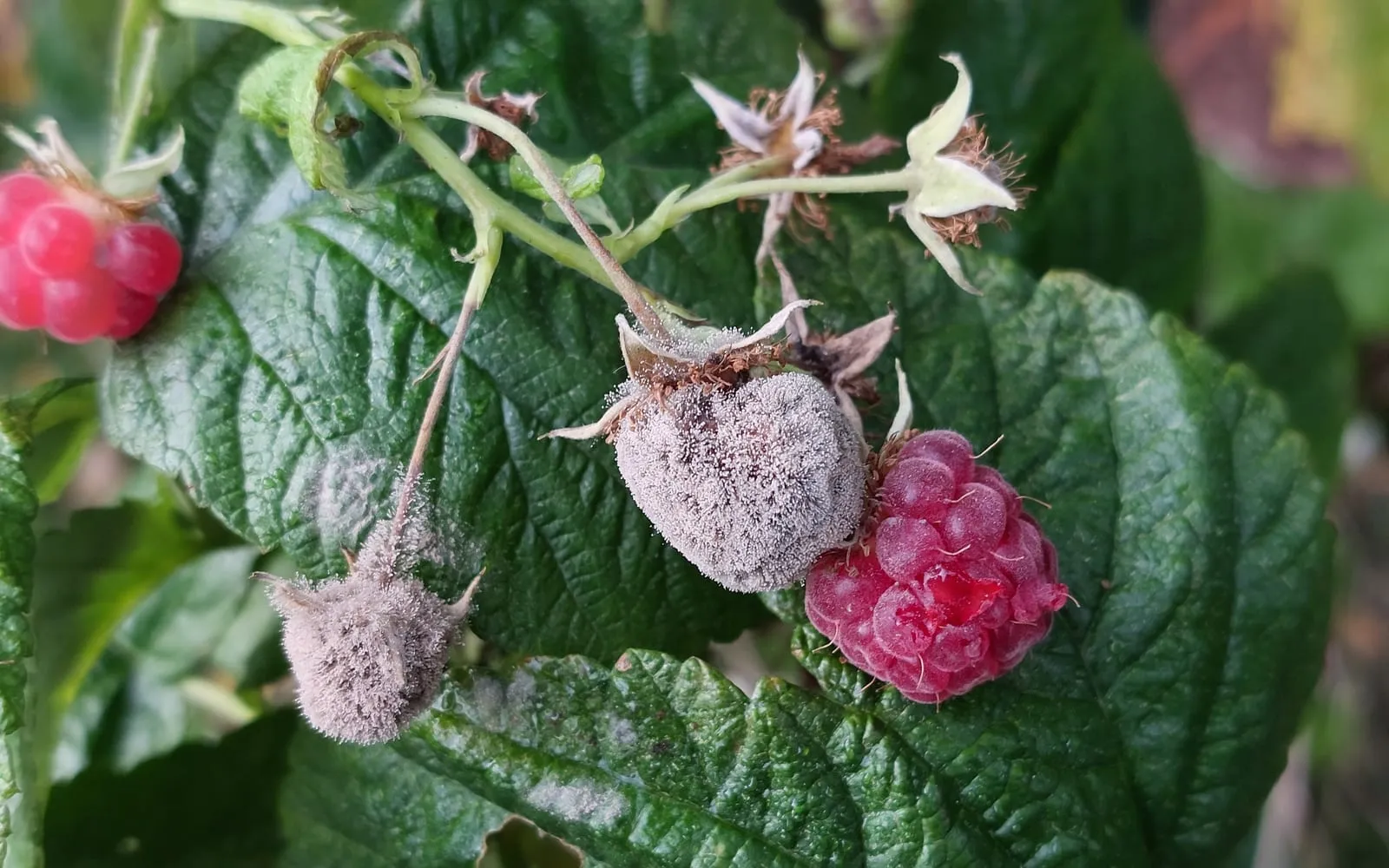
Fuzzy grey growth on fruit, seedlings and greenhouse plants releases spores when touched. It starts on dead or wounded tissue, then spreads fastest in still, damp air.
At a glance
- Type
- Disease
- Cause
- Fungus
- Severity
- Destroys the crop or display
- Affects
- Garden plants, Herbs and edibles, Houseplants
- Active
- All year
- Established in
- Worldwide
What you are seeing
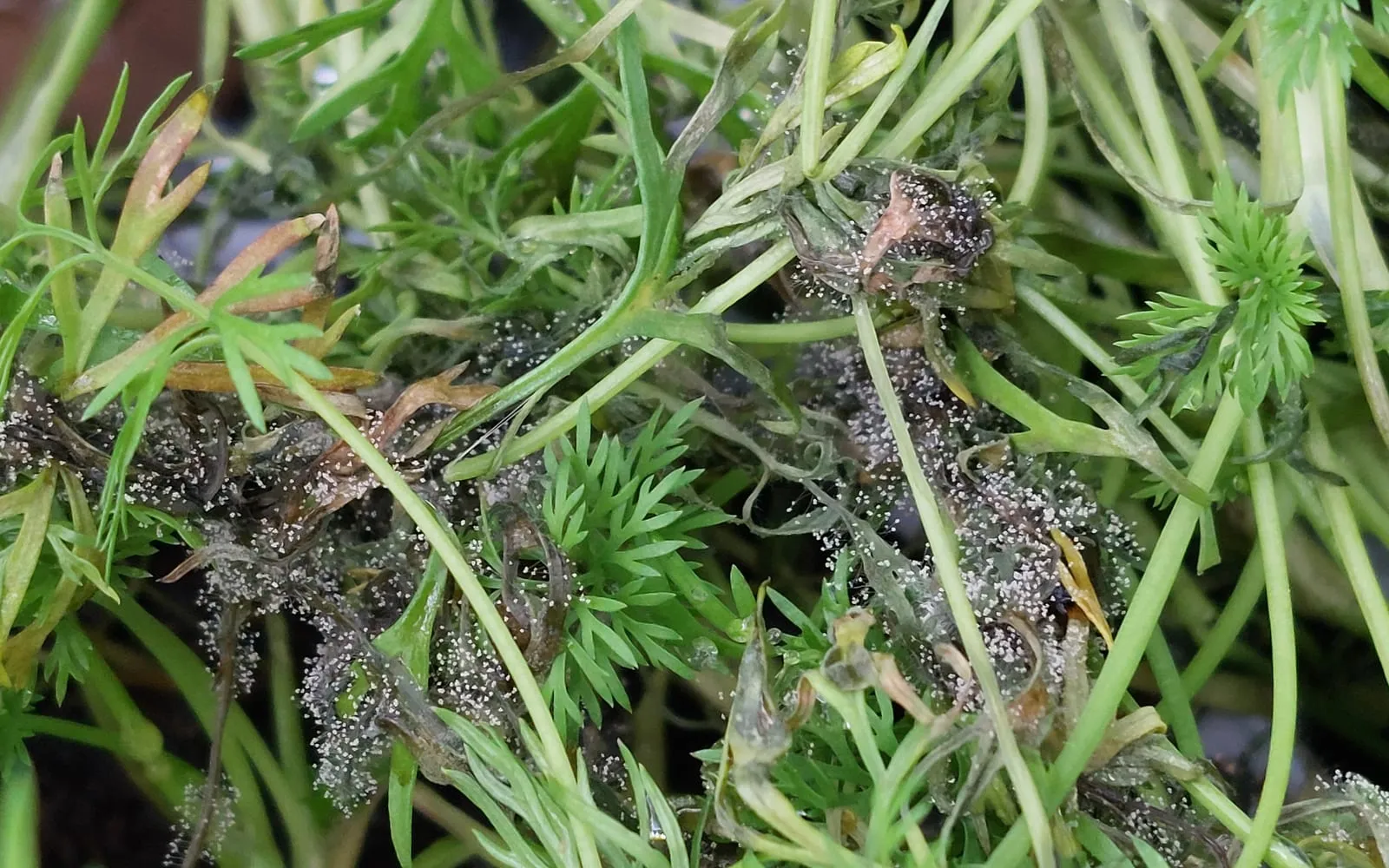
- A dense fuzzy coat of grey-brown mould on fruit, flowers, stems or seedlings
- A cloud of dust-fine spores rising when the growth is knocked or breathed on
- Soft brown decay in the tissue underneath, spreading from a wound or a dead petal
- Whole strawberries and raspberries turning grey and mummifying on the plant
- Pale rings or ghostly spots on otherwise sound tomato skins
- Hard black lumps a few millimetres across in old dead stems
- Seedlings and cuttings collapsing in a propagator with grey fuzz at the base
Before you treat anything
Grey mould produces very large numbers of airborne spores, and they are a recognised trigger for people with mould allergies or asthma. Clear a badly affected greenhouse on a day you can leave the door open, and wear a mask if you react to mould.
What you are looking at
A dense coat of grey-brown fuzz, longer and looser than the flat film of powdery mildew, sitting on a fruit, a flower, a stem or the base of a seedling. Underneath it the tissue is soft and brown.
Knock it, or breathe on it, and a cloud of fine dust rises. Those are the spores, and there are millions of them. That puff is the identifying test.
In old dead stems you may find hard black lumps a few millimetres across, like grains of coal embedded in the tissue. Those are sclerotia, the resting bodies, and they survive in debris and soil for years waiting for conditions to return.
It needs a wound, or something already dying
Grey mould is a necrotroph. It kills tissue and eats what it has killed, and it is poor at attacking healthy living cells directly. What it does instead is establish on something already dead and use that as a base.
A faded petal fallen onto a leaf. A yellowing lower leaf on a tomato. A pruning snag dying back. Frost-damaged tissue. A slug bite. A bruise on a fruit. A dead flower still attached to a young strawberry. From any of those it builds enough mass to push into living tissue next door, and by then it is unstoppable on that shoot.
Everything on the control list follows from this. Removing dead material is the control measure. Handling plants gently is the control measure. Cutting to a bud rather than leaving a stub is the control measure.
Why it spreads in winter greenhouses
Grey mould spreads in humidity near saturation, still air, and cool rather than warm conditions. It works well between about 15 and 20 degrees C and carries on slowly close to freezing.
A British greenhouse in October has all of that. The heating comes on, the vents stay shut against the cold, the air holds moisture it cannot lose, and every surface goes damp overnight. That is why an overwintering fuchsia or pelargonium collection can be ruined between November and February while the same plants were untouched all summer.
Heat and ventilation have to go together. Warming a closed greenhouse raises the amount of moisture the air can carry and then traps it, which makes matters worse rather than better.
Noble rot on grapes
The same fungus on ripe grapes, under dry autumn conditions that let the fruit shrivel rather than rot, is noble rot. It concentrates the sugars and produces Sauternes, Tokaji and the German Trockenbeerenauslese wines.
The difference between the great sweet wines of Europe and a punnet of ruined raspberries is humidity and timing.
What to do about it
Open the vents. In a greenhouse, a conservatory or a propagator, moving air is the intervention, and it is free. Ventilate on every dry day through the winter, and if you heat the space, ventilate it as well.
Go over your plants weekly and take off everything dead or dying. Faded flowers, old leaves, fallen petals, spent fruit. On cyclamen, begonias and primulas, pull dead flower stalks out from the base rather than snapping them halfway.
When you find an infection, cut it out well past the visible edge, on a dry day, without shaking the plant. Bag what you remove. Compost heaps in a British garden do not reliably kill this.
Pick fruit often and sort it as you go. One mouldy strawberry in a punnet takes the rest within two days.
Clear the greenhouse right out in autumn, wash it down, and do not leave last year’s stems under the staging.
Why there are no products listed here
The biological tier is empty because nothing available to a gardener can be introduced to control a fungus growing through dead plant tissue.
The chemical tier is empty because grey mould develops fungicide resistance readily, and commercial crops can carry resistance to several chemical groups at once. Amateur approvals in Great Britain have also narrowed to a handful of protectant products that cannot reach an infection already inside a stem. Air, hygiene and spacing are the available tools for gardeners, and they work.
What it gets mistaken for
Powdery mildew is a flat white film across a leaf surface that wipes away in a clear track. Grey mould is fuzzy, three-dimensional and grey-brown, and it grows on dying tissue rather than on a healthy leaf blade.
Downy mildew produces a fine greyish or purplish growth confined to the underside of a leaf, with angular yellow patches above bounded by the veins. Grey mould is not confined to the underside and does not respect veins.
Damping off kills seedlings at soil level with a dark pinched stem and often no visible growth at all, and it is caused by different organisms in the compost. Where a collapsed seedling carries a grey fuzzy coat, this is the one.
White fluffy growth on the surface of compost is usually a harmless saprophytic fungus feeding on the compost itself. It is white rather than grey, it sits on the compost rather than the plant, and it does no damage.
Sclerotinia produces a white cottony growth with much larger black sclerotia inside hollow stems, and it collapses whole plants rather than working in from dead flowers.
What to do, in order
Start here
Prevention, and the changes that stop the problem returning. Most of these pages should end at this tier.
- Ventilate, even when it is cold
- This fungus needs still, saturated air. Opening greenhouse vents and a door on any dry day through autumn and winter changes the conditions more than anything you could apply, and a greenhouse heated but unventilated is the worst combination of all.
- Take dead and dying material off promptly
- Faded flowers, fallen petals, yellowing lower leaves and old fruit are the way in. Going over a greenhouse or a pot of cyclamen once a week and removing everything past its best cuts off the fungus at the point it needs to begin.
- Water the soil in the morning
- Overhead watering leaves the foliage wet overnight, which favours grey mould. Water at the base, early enough that anything splashed has dried before dark.
- Give plants room
- Congested growth traps humid air inside itself. Thinning a crowded pot of seedlings, spacing lettuce properly and taking out a few lower leaves on a tomato lets air move where the fungus is trying to establish.
- Do not leave snags when you prune
- A stub of stem left above a bud dies back and gives the fungus a dead entry point a few centimetres from living tissue. Cut back to a bud or to the branch collar, and prune in dry weather.
- Keep fruit off the ground
- A layer of straw or a fruit mat under strawberries stops the berries sitting on damp soil, which is where most of them are infected. Train raspberries and blackberries properly so the fruit hangs clear.
Then reach for a barrier
Netting, hand removal and water. Nothing here harms anything except the target.
- Cut out infected tissue back into healthy growth
- Take it well past the visible edge of the rot, since the fungus is ahead of what you can see. Do it on a dry day, bag what you remove, and do not shake the plant on the way, because the spores travel in the air you are disturbing.
- Pick fruit promptly and sort it
- One infected berry in a punnet will take the rest. Pick over a strawberry bed every day or two in the fruiting season, remove the mouldy ones into a separate bag, and do not compost them.
- Clear the greenhouse down in autumn
- Old plant debris, fallen leaves under the staging and last year's tomato stems all carry the fungus through winter, and the black lumps in them survive for years. Clear everything out and wash the structure down.
- Handle plants less, and more gently
- Every bruise, snapped leaf and torn stem is a door. Being careful when tying in and picking over a crop is a control measure rather than good manners.
In pictures
Plants affected
Guides that name it among the problems to watch for. The list is the plants it is characteristic of rather than everything it will feed on.
Common on UK allotments
This is one of the pests and diseases allotment growers meet most often. See it alongside the other common problems on the allotment guide.
Common allotment pests and diseasesA common tomato problem
This is one of the problems tomato growers meet most often. See it alongside the other pests, diseases and disorders on the tomato guide.
Common tomato problemsA common rose problem
This is one of the pests, diseases and disorders that rose growers meet most often. See it alongside the others on the common rose problems guide.
Common rose problems