
Disease
Rust
Pucciniales
Also called Leek rust, Rose rust, Mint rust, Hollyhock rust
Rust diseases make rusty spots under leaves and yellow blotches above. Most rusts are host-specific, so control depends on dry foliage, resistant varieties and removing infected leaves.
At a glance
- Type
- Disease
- Cause
- Fungus
- Severity
- Weakens the plant
- Affects
- Garden plants, Herbs and edibles
- Active
- May to October
- Established in
- Worldwide
What you are seeing
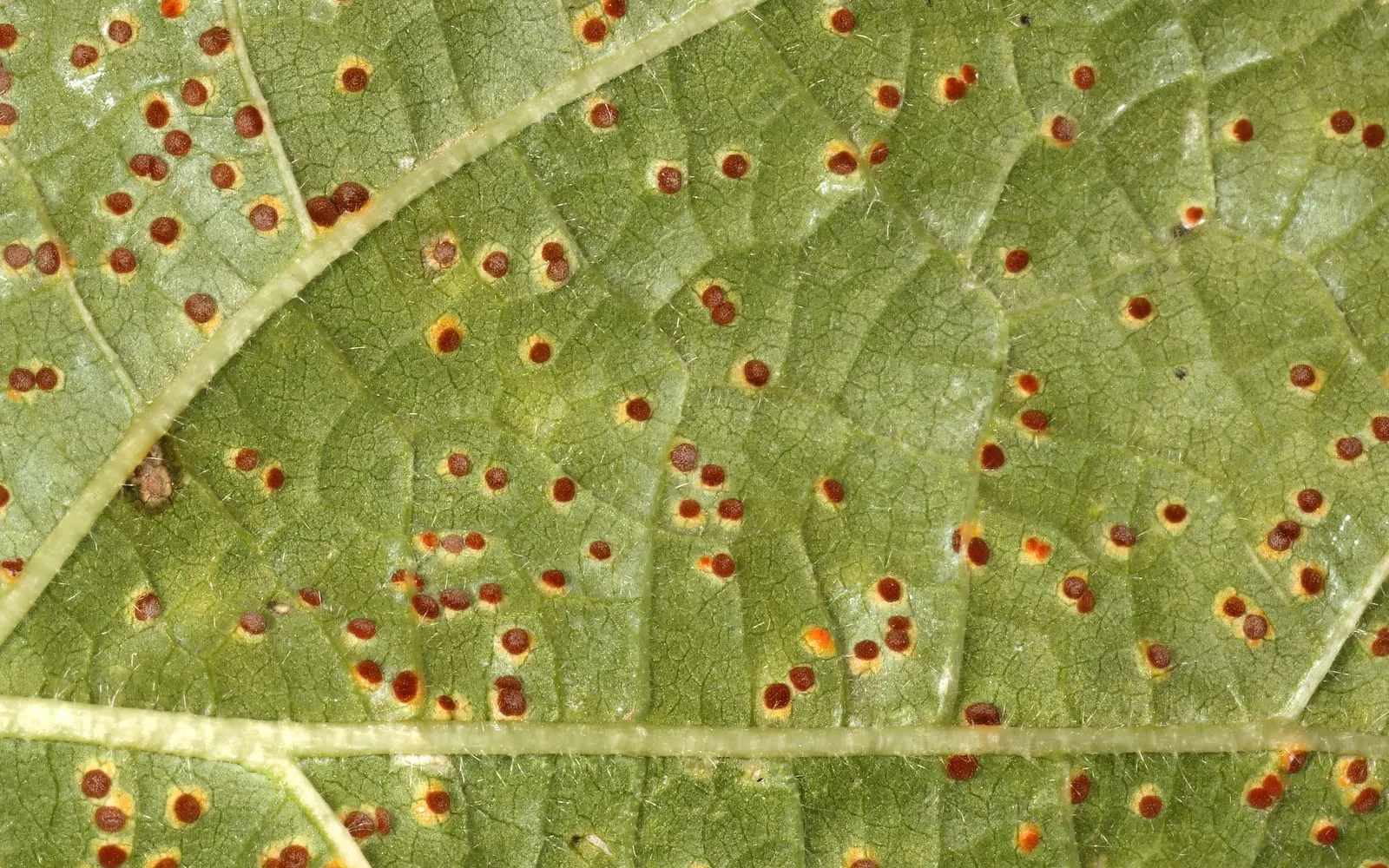
- Raised pustules on the underside of a leaf, powdery when rubbed, orange, rust-brown or nearly black
- Pale yellow spots on the upper surface directly above each pustule
- Orange powder coming off on your fingers or your clothes
- Leaves yellowing and dropping from the bottom of the plant upwards
- Concentric rings of brown pustules on a pelargonium leaf
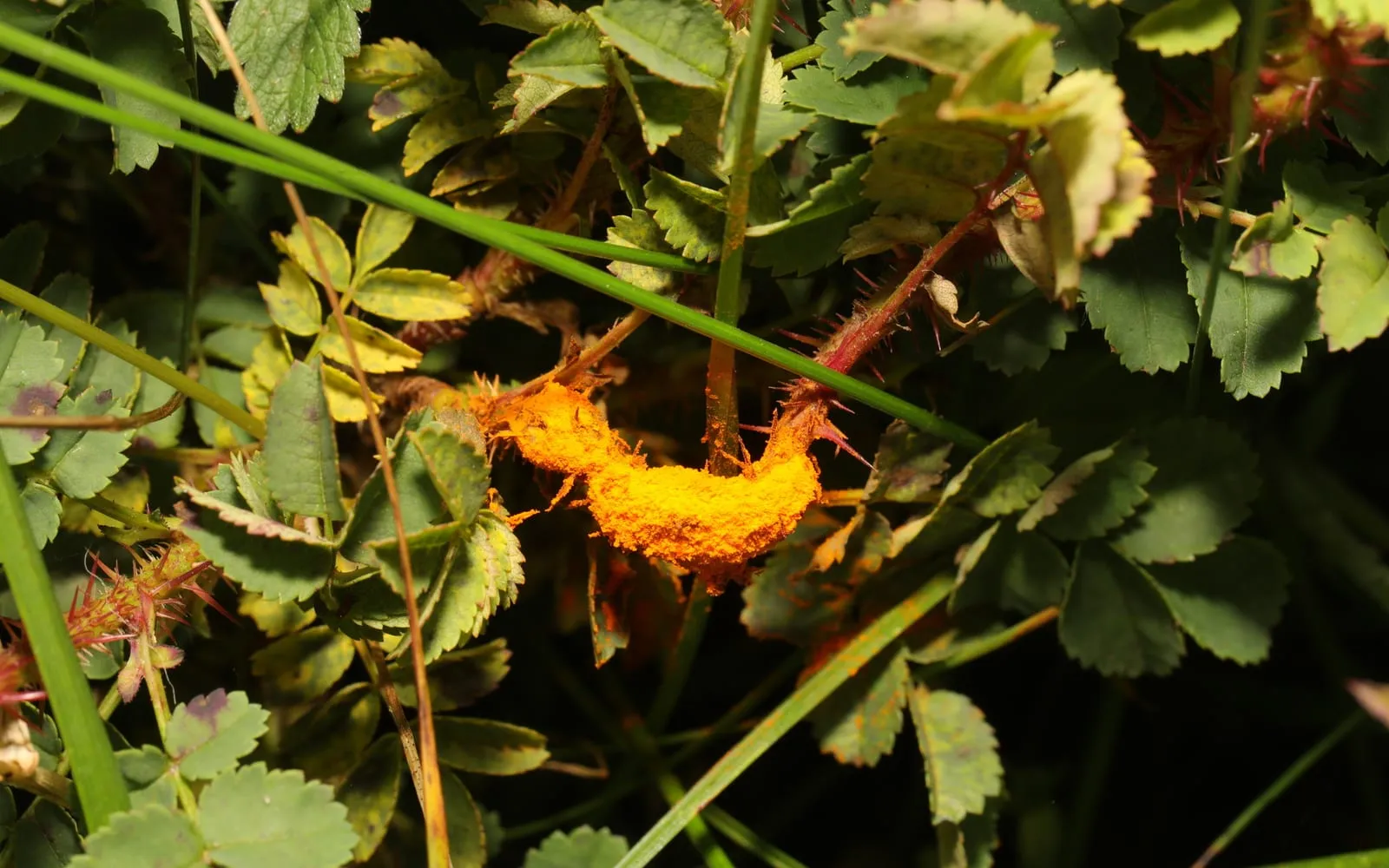
- Distorted, swollen shoots on roses and brambles, coated in bright orange spores in spring
Before you treat anything
Rust does not affect people or animals, and the orange powder is a nuisance on clothing rather than a hazard. Rust-infected leaves are safe to handle, and lightly affected leeks and mint remain edible once the marked leaves are removed.
What you are looking at
Turn the leaf over. Rust announces itself on the underside as raised pustules that have broken through the surface from within, powdery to the touch, and coloured somewhere between bright orange and dark brown depending on the species and the time of year. Rub one and the powder comes off on your finger.
On the upper surface, directly above each pustule, there is a pale yellow spot where the tissue has been killed from below. Someone looking at a leek or a rose from above sees only the yellowing and diagnoses a nutrient problem.
Pelargoniums do something distinctive. The pustules form in concentric rings on the leaf, unlike the marks made by most other leaf diseases.
Every rust has one host, or two, and no more
There are several thousand rust fungi and each is restricted to a narrow range of plants. Leek rust lives on leeks, onions, garlic and chives. Rose rust lives on roses. Mint rust lives on mint. None of them will cross to a plant outside that group, however close together they are growing.
That is not a technicality. It means an infected mint bed poses no threat to the leeks beside it, and it means the only source of infection for your roses is roses, which narrows the problem to the plants and debris in front of you.
Some rusts do need two unrelated hosts to complete their cycle, alternating between them across the year. That biology explains a few strange local patterns in fruit rusts, and for a gardener the practical version stays the same. Deal with the host in your garden.
Why it needs a wet leaf
A rust spore lands, and to germinate it needs several hours of liquid water on the leaf surface at a moderate temperature. Give it that and it pushes a thread into a stomatal pore and it is inside the plant. Deny it and nothing happens.
So the outbreaks come after warm wet spells, in dense plantings that hold dew past mid-morning, in gardens where a sprinkler runs in the evening, and against walls and fences where the air does not move.
That is the opposite of powdery mildew, though the two are often treated as if they behave the same way. Powdery mildew spreads in humid air on dry-stressed plants. Rust needs wet leaves. Water the soil rather than the foliage, in the morning rather than at dusk.
What the damage amounts to
Rust is a biotroph. It needs the plant alive and takes nutrients from living cells rather than killing tissue outright, which is why an infected leaf carries on working for weeks before it yellows and drops.
Damage builds through the season. Leaves lost through summer mean a smaller plant, poorer flowering and a weaker crown going into winter. A leek crop can lose most of its leaf area in a bad August and still produce usable stems, and a hollyhock left untreated for three seasons becomes a stick with rusty rags on it.
Where the fungus gets into the stem, as it does on roses and brambles, the shoot distorts and swells and produces spores from the wood. Cut that shoot out promptly.
What to do about it
Change the watering first. Soil rather than leaves, morning rather than evening, and no sprinklers over susceptible crops. Then open the planting up, since a leek row or a rose against a fence that stays wet until noon is the condition the disease is asking for.
Pick off affected leaves as soon as you see them and put them in the household waste. Each pustule is producing spores continuously, so the first few leaves in June are worth more than a bin bag full in September.
Clear everything in autumn. Fallen rose leaves, dead leek foliage, hollyhock stems. The late-season pustules that look almost black are the overwintering stage, and they survive on that debris to start again in spring.
Rotate alliums on three years. Grow hollyhocks as biennials from seed. Start a rusted mint bed again from a clean plant somewhere else in the garden, because the fungus is in the rhizomes and picking leaves will never reach it.
Why there are no products listed here
Nothing can be introduced to eat a fungus living inside leaf tissue, so the biological tier is empty.
The last tier is empty because amateur fungicide approvals in Great Britain have narrowed sharply, several of the actives older books recommend for rust can no longer be used, and the ones that remain are protectant rather than curative. They do nothing to an infection already established, which is the state a plant is in by the time anyone notices rust on it. Spacing, watering and hygiene do more, and they work on next year as well as this one.
What it gets mistaken for
Leaf spot diseases produce flat marks in the leaf tissue rather than raised pustules on the underside, and nothing rubs off on a finger.
Red spider mite yellows and dulls a leaf, and the damage is a fine even stippling across the upper surface with no pustules beneath and often fine webbing at the shoot tips.
A magnesium or nitrogen shortage yellows leaves from the bottom of the plant upwards, exactly as heavy rust does. Turn a leaf over before concluding anything. Pustules mean rust, and a clean underside means it is worth looking at feeding and watering instead.
Orange powder on a lawn in late summer is grass rust, a different member of the same group. It follows drought and poor feeding, and it goes when the grass grows again.
What to do, in order
Start here
Prevention, and the changes that stop the problem returning. Most of these pages should end at this tier.
- Water the soil rather than the leaves
- Rust spores need several hours of free water on a leaf to germinate. Watering at the base in the morning, and never with a sprinkler in the evening, removes the condition the fungus depends on. Powdery mildew behaves differently, though the two diseases are often discussed as if they behave alike.
- Space plants so the foliage dries by mid-morning
- Leeks at close spacing, roses grown against a fence and a mint bed left to thicken all hold dew until midday. Wider spacing, thinning and an open aspect shorten the wet period enough to matter.
- Rotate alliums on a three-year cycle
- Leek rust builds up in a bed that grows onions, leeks or garlic every season. Three years between allium crops on the same ground breaks the carry-over, and sowing leeks a little later so they bulk up after the worst of the summer spore load helps as well.
- Grow hollyhocks as biennials from seed
- A hollyhock kept for years accumulates rust until it is barely worth having. Raising fresh plants from seed and discarding the old ones after flowering keeps ahead of it, which no treatment on a long-lived clump does.
- Start mint again from clean stock
- Mint rust survives in the rhizomes, so a badly affected clump stays infected however carefully the leaves are picked off. Buy or beg a clean plant, put it in fresh ground well away from the old bed, and dig the old one out.
- Feed for firm growth rather than fast growth
- High-nitrogen feeding produces soft tissue that rust colonises more readily, and it delays the hardening that would otherwise slow it. A balanced feed, with potassium for flowering and fruiting plants, gives a tougher leaf.
Then reach for a barrier
Netting, hand removal and water. Nothing here harms anything except the target.
- Pick off affected leaves early and bin them
- Each pustule releases spores continuously, so removing the first few leaves in June makes a real difference to August. Put them in the household waste rather than the compost heap, which rarely gets hot enough throughout.
- Clear every fallen leaf in autumn
- The dark pustules that appear late in the season are the overwintering stage, and they sit out the winter on dead foliage. Raking under roses, cutting hollyhocks to the ground and clearing leek debris removes next year's starting point.
- Cut mint to the ground and destroy the top growth
- A hard cut in late summer, with everything removed rather than left as a mulch, gives a flush of clean growth and takes a generation of spores out of the bed.
- Prune out swollen, distorted shoots
- On roses and brambles the fungus can invade the stem, producing a thickened shoot that carries bright orange spores in spring. Cutting those out at the base removes a source that leaf picking never reaches.
In pictures
Plants affected
Guides that name it among the problems to watch for. The list is the plants it is characteristic of rather than everything it will feed on.
Common on UK allotments
This is one of the pests and diseases allotment growers meet most often. See it alongside the other common problems on the allotment guide.
Common allotment pests and diseasesA common rose problem
This is one of the pests, diseases and disorders that rose growers meet most often. See it alongside the others on the common rose problems guide.
Common rose problems