
Outdoor plant
Dog rose
Rosa canina
Also known as Wild rose, Briar rose, Dogberry
How to grow dog rose, Rosa canina. The wild hedgerow rose, picking hips for syrup, why the seed hairs were used as itching powder, and its role as a rootstock.
At a glance
- Difficulty
- Easy
- Water
- Rarely once established
- Light
- Full sun to partial shade, and it flowers best in sun
- Temperature
- Fully hardy, to about -30 deg C
- Hardiness
- USDA 4-8, RHS H6, hardy to -30 C
- Type
- Deciduous shrub, long lived and vigorous
- Height
- 3-5 m through a support
- Native to
- Europe, north-west Africa and western Asia, and native throughout Britain
- Best month
- June in the Northern Hemisphere, December in the Southern Hemisphere
It takes cold, drought, chalk and neglect, and it is the rootstock most garden roses are budded onto for exactly that reason. Birds spread the hips widely and it is a declared noxious weed in Victoria and New Zealand and invasive through Chile and Argentina, where it has taken over grazing land on a large scale.
Hardiness zones describe winter cold alone. Summer heat, humidity, rainfall and the length of the growing season decide as much, so treat the range as the outer limit rather than as a recommendation.
Every month named in this guide is for the temperate Northern Hemisphere. If you garden in the Southern Hemisphere, shift each one by six months, so June becomes December. Closer to the equator the wet and dry seasons matter more than the calendar, and the shift stops being a useful guide.
Skin irritant
- Safe to eat
- The flesh of the hips, once the seeds and hairs are removed
- Do not eat
- The hairs surrounding the seeds inside the hip
- Harm from
- Handling it
- Affects
- People
Dog rose is a hedgerow food plant and the caution attached to it is mechanical rather than chemical. The flesh of the hips is edible, very high in vitamin C, and was collected on a national scale during the Second World War for rosehip syrup. Inside each hip is a mass of seeds wrapped in fine stiff hairs, and those hairs are a powerful irritant to skin, mouth, throat and gut. They were sold as itching powder for exactly this reason. Preparing hips means either straining the pulp through muslin or a jelly bag so no hairs get through, or splitting each hip and scraping the seeds and hairs out before cooking. Never eat a hip whole and never let a child do so. The petals and the flesh carry no recognised toxicity, and rose is not listed by the ASPCA as toxic to cats, dogs or horses. The other hazard is the thorns, which are curved and hooked and tear rather than puncture, so wear long sleeves and thick gloves when cutting it.
Sources: RHS potentially harmful garden plants, ASPCA toxic and non-toxic plants
About
Dog rose is the pale pink five-petalled rose that appears in European hedges in June and is gone within a fortnight.
It has none of the qualities a garden rose is bred for. The flowers are single, they last a few days, they come once and never repeat, and the scent is faint. What it has instead is a season of scarlet hips from September, complete indifference to soil and weather, and the ability to grow through a hedge to five metres without any help.
The stems tell you what kind of plant it is. They arch out, they are armed with curved hooked thorns rather than straight spines, and those hooks work as grappling irons that let the plant climb through whatever it lands in. A dog rose does not stand up on its own.
It is also the plant underneath a great many cultivated roses. Rosa canina has been the standard rootstock in European rose growing for generations, which is why the suckers coming up beside a hybrid tea so often turn out to be a wild rose.
The name is old and its origin is uncertain. The usual story is a Roman belief that the root cured the bite of a rabid dog, and an alternative is that dog was a dismissive word for a common thing.
Appearance and character
A deciduous shrub with long arching stems reaching 3 to 5 m where it has something to climb through, and forming a sprawling mound of two metres or so in the open.
Thorns are the identification. They are stout, flattened at the base and strongly hooked backwards like a cat’s claw, and they are spaced along the stem rather than crowded.
Leaves are pinnate, made of two or three pairs of oval toothed leaflets plus one at the tip, hairless and mid-green.
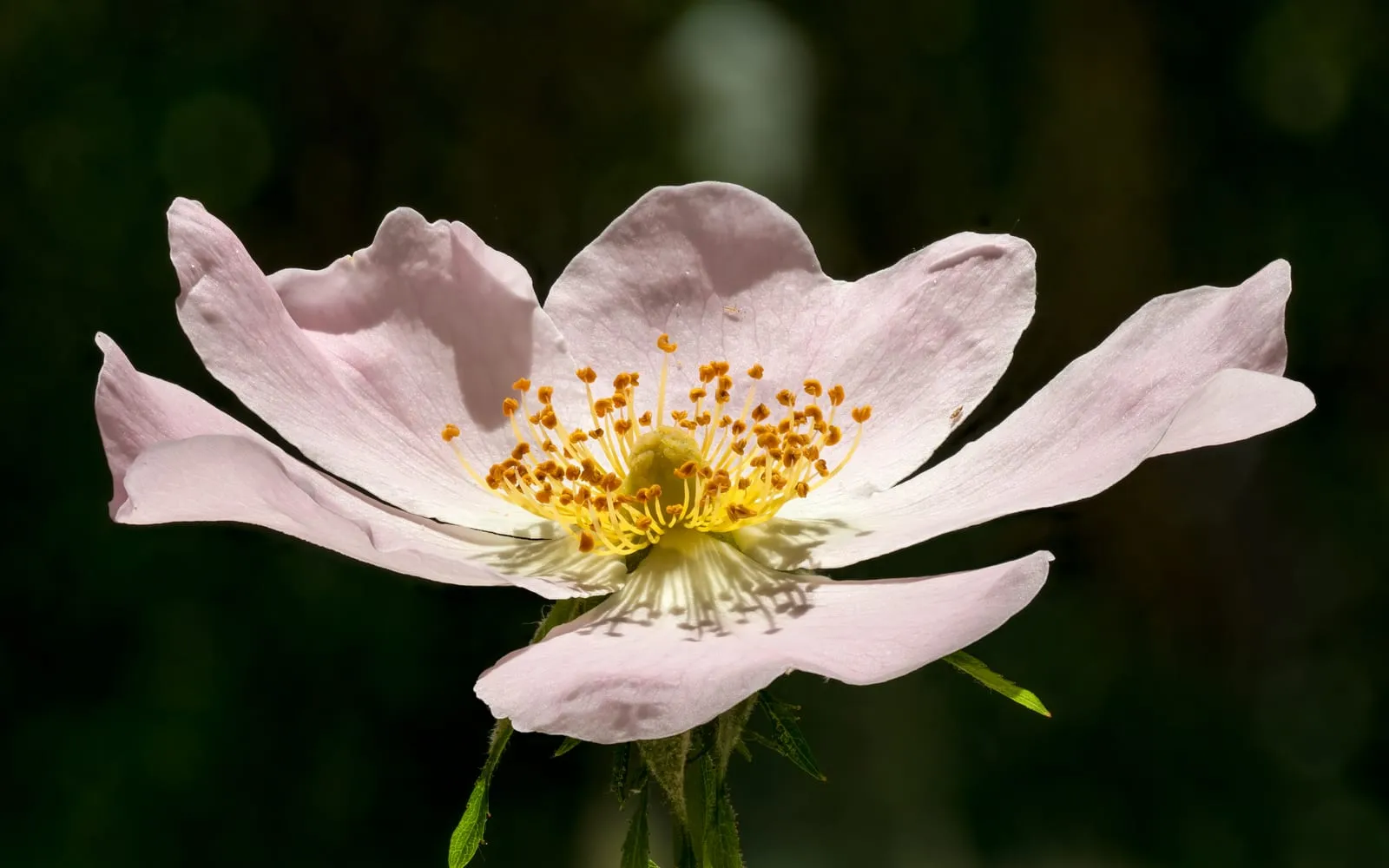
Flowers open in June, 4 to 6 cm across, with five broad petals in pale pink to almost white, notched at the tip, around a boss of yellow stamens. They are lightly scented and the whole flowering lasts two to three weeks.
Hips ripen from September, oval to egg-shaped, 1.5 to 2 cm long, glossy scarlet and held on the stem well into winter.
Stems are green to reddish, smooth apart from the thorns, and they arch and layer where the tips touch ground.
Where it is from
Europe, north-west Africa and western Asia, and native throughout Britain and Ireland apart from the far north of Scotland.
It grows in hedgerows, scrub, woodland edges, on railway embankments and on waste ground, on any soil including heavy clay and thin chalk.
The species is taxonomically messy. Rosa canina is an aggregate covering many microspecies, and it reproduces through an unusual system that produces offspring resembling the mother plant more closely than ordinary sexual reproduction would.
Rosehip syrup is the best-known British use. During the Second World War, when citrus imports stopped, county herb committees organised schoolchildren to collect hips by the ton, and the syrup was distributed through welfare clinics. A hip carries several times the vitamin C of an orange by weight.
Robin’s pincushion, the red mossy ball found on dog rose stems in late summer, is a gall caused by the wasp Diplolepis rosae and was once hung indoors as a charm against whooping cough.
The plant carries heraldic weight. The Tudor rose is a stylised heraldic device rather than a species, and the wild rose behind the imagery is this one.
How it grows
Plant bare-root between November and March, which is cheap and establishes well, or container-grown at any time outside a hard frost.
It grows on any soil in sun or partial shade, and it flowers and fruits far better in sun.
Give it something to grow through. Dog rose is a scrambler, and planted in the open it makes an untidy mound rather than the arching thing you see in a hedge.
For a hedge, plant it among hawthorn, blackthorn, hazel and field maple at around five plants per metre in a double staggered row, with the rose at intervals rather than continuously.
Cut everything back hard after planting to build density at the base.
Trim an established mixed hedge in winter, avoiding March to August when birds are nesting, and cut on a two or three year rotation so the rose has a chance to flower and fruit.
Prune a free-standing plant very little. Remove dead and damaged wood in late winter and take one or two of the oldest stems out at the base every few years to keep new growth coming.
Layer it to make more plants. Peg an arching stem to the ground in autumn and it roots where it touches.
Propagate from hardwood cuttings in November, which strike readily, or from seed that needs a long cold period and often takes two winters.
Pick hips from September, and after a frost if you can, which softens them.
Through the seasons
Winter is planting and pruning season, and the hips stay on the stems for the birds.
Spring breaks into leaf early and puts on fast extension growth.
Summer brings the flowers in June for a short season, and the galls appear in July and August.
Autumn ripens the hips from September, which is picking season and the point at which thrushes and blackbirds start on them.
Care difficulty
Easy, and hard to kill.
It tolerates clay, chalk, sand, drought, waterlogging, shade, exposure and neglect. It needs no feeding, no watering once established and no routine pruning.
The two difficulties are containment and handling. It grows fast, arches everywhere and layers itself where the stems touch soil, so it takes over a border. The hooked thorns tear skin and clothing and make cutting it a slow job.
It is far less troubled by blackspot, mildew and rust than cultivated roses, and where those diseases do appear they rarely need treating.
Watering
Water through the first summer after planting, particularly bare-root stock.
Established dog rose needs no watering in a temperate climate and copes with drought better than any garden rose.
Mulch a new planting to suppress grass, which competes far harder than dry weather does.
Warning signs, diseases and pests
A red-green mossy ball on a stem in late summer is robin’s pincushion, a gall caused by a tiny wasp. It does no harm and it is worth leaving. Cut it off in winter if you dislike it.
Orange pustules on the undersides of leaves is rose rust. Remove and bin the affected leaves and expect the plant to shrug it off.
Black-purple blotches with yellowing around them is blackspot. It is common on cultivated roses and much less troublesome on the species. Clear fallen leaves and leave it alone.
White powder on shoot tips in a dry summer is powdery mildew. Improve air movement and mulch to keep the roots damp.
Wild rose shoots appearing beside a cultivated rose are suckers from a dog rose rootstock. Trace each one to where it joins the root and pull rather than cut, since cutting makes more of them.
Aphid colonies on new shoots feed ladybirds, hoverfly larvae and blue tits. Leave them.
Leaves cut into neat semicircular pieces is leafcutter bee work. It is harmless and worth encouraging.
Growing environment
Full sun to partial shade, with far better flowering and fruiting in sun.
Any soil. Clay, chalk, sand and poor ground all suit it.
Fully hardy to about -30 deg C, and tolerant of wind, exposure and coastal conditions.
Allow 2 to 3 m of spread in the open, or plant it into a hedge where the spread stops being a problem.
It suits a mixed native hedge, a wild boundary, a bank, a scrubby corner or a large informal garden. It does not suit a small border.
Its wildlife value is high. The open flowers give easy access to bees and hoverflies where a double garden rose gives none, the hips feed blackbirds, thrushes, redwings and fieldfares through winter, the thorny growth is prime nesting cover, and it hosts a range of gall wasps and moth caterpillars.
Pair it with hawthorn and blackthorn in a hedge, which is what most old British hedges did, and the three flowering seasons run from March to June.
Feeding
None needed on any ordinary soil.
Mulch a newly planted hedge or shrub with compost for its first two springs, which helps mainly by suppressing grass.
Avoid nitrogen feeds, which push soft growth that aphids and mildew both prefer.
A weak plant is nearly always competing with grass at its base rather than short of nutrients.
Troubleshooting
Can I eat the hips? Yes, and prepare them properly. The flesh is edible and very high in vitamin C. The hairs around the seeds are a severe irritant, so strain the pulp through muslin or a jelly bag, or split and scrape each hip before cooking.
When do I pick them? From September, and traditionally after the first frost. Freezing them overnight does the same job.
What is the red mossy ball on the stem? Robin’s pincushion, a gall made by the wasp Diplolepis rosae. Harmless. Leave it or cut it off in winter.
Wild rose shoots are coming up around my garden rose. Suckers from the dog rose rootstock. Trace each to the root and pull it off rather than cutting, because a cut sucker produces several more.
Is this dog rose or field rose? Dog rose has hooked thorns, pink flowers and styles that stay separate. Field rose, Rosa arvensis, has white flowers and its styles are fused into a single column.
It has taken over the border. Dog rose layers wherever an arching stem touches soil. Cut the layered sections out, and grow it in a hedge rather than a bed.
When do I prune it? Late winter, lightly. Take out dead wood and remove one or two of the oldest stems at the base every few years.
The leaves have orange spots underneath. Rose rust. Pick off and bin the affected leaves. The species tolerates it far better than a hybrid tea.
Dog rose problem guides
Not sure what is wrong? See the common rose problems guide.