
Outdoor plant
Columbine
Aquilegia vulgaris
Also known as Granny's bonnet, Granny's nightcap, European crowfoot
How to grow aquilegia, Aquilegia vulgaris. Self-seeding, cultivar variation, cutting back after flowering and keeping the foliage fresh.
At a glance
- Difficulty
- Easy
- Water
- In dry spells during the growing season
- Light
- Full sun to partial shade
- Temperature
- Fully hardy, to about -35 deg C
- Hardiness
- USDA 3-8, RHS H7, hardy to -35 C
- Type
- Herbaceous perennial, short lived and dying back each winter
- Height
- 60-90 cm
- Native to
- Europe including Britain, and north Africa
- Best month
- May in the Northern Hemisphere, November in the Southern Hemisphere
Cold is never the limit and summer heat is, so it fades out through the American south. Aquilegia downy mildew, first seen in Europe in the 2010s, kills plants outright and has no chemical control available to a gardener, so the response is to lift and bin affected plants and not replant aquilegias in the same ground. It hybridises freely, so seedlings never come true.
Hardiness zones describe winter cold alone. Summer heat, humidity, rainfall and the length of the growing season decide as much, so treat the range as the outer limit rather than as a recommendation.
Every month named in this guide is for the temperate Northern Hemisphere. If you garden in the Southern Hemisphere, shift each one by six months, so May becomes November. Closer to the equator the wet and dry seasons matter more than the calendar, and the shift stops being a useful guide.
Toxic if eaten
- Do not eat
- The seeds and roots above all, and the whole plant to a lesser degree
- Harm from
- Eating it and handling it
- Affects
- People, cats and dogs
Aquilegia contains cyanogenic glycosides along with alkaloids, and it sits in Ranunculaceae alongside monkshood, hellebore and clematis, a family with a poor safety record. The seeds and roots carry the highest concentrations. Eating them causes burning of the mouth, vomiting, abdominal pain, dizziness and in serious quantities a slowed heartbeat and breathing difficulty. Fatalities from ingesting the seeds have been recorded historically, which is unusual for a common garden perennial and is the reason to take it more seriously than its cottage-garden reputation suggests. The RHS lists aquilegia as harmful if eaten and as a skin irritant. Handling the foliage causes a rash in some people, so wear gloves when cutting it back. The flowers are sometimes described as edible and were eaten in small quantities historically, and that history sits alongside recorded poisonings, so treat the whole plant as something not to eat. Where a child or animal has eaten the seed heads, ring a doctor or vet rather than waiting.
Sources: RHS potentially harmful garden plants, ASPCA toxic and non-toxic plants
About
Aquilegia is the plant that arranges your garden for you.
It seeds itself freely, the seedlings cross with every other aquilegia within range, and within a few years you have a population of your own rather than the named cultivars you bought. Some people find this delightful and some find it maddening, and either way it is what the plant does.
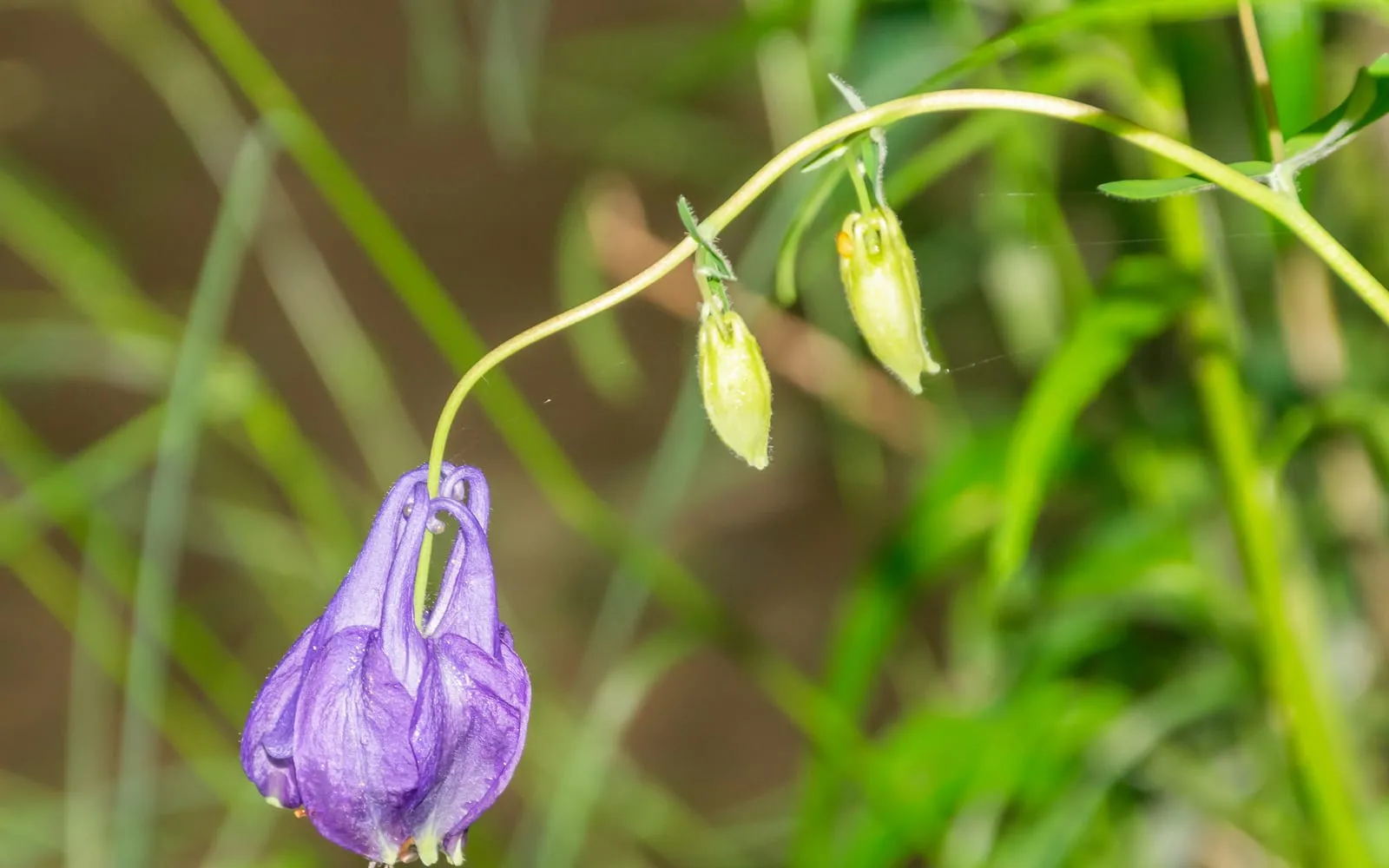
The flowers are unmistakable. Five petals each drawn out backwards into a long hooked spur, held nodding on branched stems above ferny grey-green foliage, in blue, purple, pink, white, crimson and every combination. The wild European species is blue-violet and the garden range is enormous.
It flowers in May and early June, filling the gap between the spring bulbs and the summer border, and it does it in sun or partial shade on almost any soil.
Two things spoil it. Aquilegia downy mildew arrived in Britain in 2013 and kills plants outright, and it has changed how the plant behaves in some gardens. Aquilegia sawfly strips a clump of foliage in under a week in early summer.
The plants are short-lived. Three or four years is typical, which matters less than it would for most perennials because the seedlings replace them.
Appearance and character
A herbaceous perennial reaching 60 to 90 cm in flower, forming a basal clump of foliage that dies back each winter.
Leaves are divided two or three times into rounded three-lobed leaflets, soft grey-green, and they look like a coarse maidenhair fern.
Flower stems branch above the foliage in May and carry several nodding flowers each.
Each flower has five petals, and each petal is drawn backwards into a long hooked spur that holds nectar, with five coloured sepals spreading between them.
Colours run through blue-violet in the wild species and through white, pink, crimson, purple, near-black and bicolours in cultivation. Double and spurless forms exist and are generally less interesting.
The long-spurred hybrids derived from North American species carry much longer straight spurs and a wider colour range including yellow and red.
Seed pods stand upright in clusters and split at the top to shed shiny black seed, which is how the plant spreads.
‘Nora Barlow’ is the double pink and green form, and the Barlow series more generally are spurless doubles.
Where it is from
Europe including Britain, and north Africa, growing in woodland, on woodland edges, in damp meadows and on limestone.
The wild British plant is native and is scarce, found on calcareous soils in open woodland and fen, and most blue aquilegias found in the countryside are garden escapes rather than the true native.
The genus spreads across the northern hemisphere with around seventy species, and the North American ones have far longer spurs, which co-evolved with hummingbirds and long-tongued hawkmoths.
Spur length in Aquilegia is a well-studied example of co-evolution between flower and pollinator, since the species with the longest spurs are pollinated by the animals with the longest tongues.
The name comes either from aquila for eagle, describing the hooked spurs as talons, or from aqua and legere, meaning to collect water, describing the nectar in the spurs.
Columbine comes from columba for dove, since the five spurs seen from above resemble a ring of birds.
Aquilegia downy mildew, Peronospora aquilegiicola, was first found in Britain around 2013 and has spread across Europe since, and it is now the main threat to the plant in cultivation.
How it grows
Plant in autumn or spring, or sow seed where you want it.
It grows in full sun or partial shade, and light shade suits it better in a dry garden.
Any reasonable soil works, ideally moisture-retentive and free-draining. It dislikes prolonged drought and winter waterlogging.
Space plants 30 to 45 cm apart, and expect the population to arrange itself over time.
Decide early whether you want it to seed. Deadhead as soon as flowering finishes if you want to keep named cultivars, and leave the pods if you want a self-sustaining colony.
Named cultivars will not stay true either way. Seedlings cross with everything nearby and drift back towards blue and purple within a few generations.
Grow a named cultivar in isolation if you want it to persist, or replace it every few years.
Cut the whole plant to the ground after flowering, in late June, once the foliage starts to look tired and leaf-mined. It regrows a fresh clump of clean leaves within a few weeks that carries the plant to autumn.
Water in dry spells while it is growing.
Mulch in spring with compost.
Watch for sawfly larvae from May and pick them off before they defoliate the plant.
Divide only if you must, in spring or autumn. Aquilegia has a deep taproot, resents disturbance and is easier to replace from seed.
Sow seed in autumn or spring in a pot or where it is to grow, and expect flowers in the second year. Fresh seed germinates best.
Replace plants every three or four years, or let the seedlings do it.
Through the seasons
Winter is dormant and the clump disappears completely.
Spring brings fresh grey-green foliage from March, and this is the time to mulch and to watch for sawfly.
Summer flowers in May and early June, then the plant is cut to the ground in late June for a fresh flush of foliage.
Autumn carries clean foliage into the winter and is a good time to sow seed.
Care difficulty
Easy, and self-managing to a degree that some gardeners resent.
It grows in sun or shade on almost any soil, needs no staking, no feeding and no deadheading unless you want to control the seeding.
The problems are downy mildew, which is serious and untreatable, and sawfly, which is alarming and superficial.
Accepting that it will seed and cross, and that individual plants are short-lived, makes the whole thing far easier. Fighting either produces a lot of work for little result.
Watering
Water in dry spells through the growing season, particularly on light soil in sun.
Established plants in reasonable soil manage on rainfall in a temperate climate.
Water at the base rather than overhead, which reduces downy mildew risk.
Mulch in spring with compost, which holds moisture and does more than watering.
It dislikes waterlogged winter ground, so improve drainage on heavy clay.
Warning signs, diseases and pests
Yellow blotches on the upper leaf surface with a grey-white or purplish felt on the underside, followed by wilting, stunting and the death of the whole plant, is aquilegia downy mildew. It arrived in Britain in 2013 and it is the serious one. There is no treatment. Dig up and burn affected plants including the roots, do not compost them, and avoid replanting aquilegia in that spot. It spreads on wind-blown spores and in wet weather, so space plants and avoid overhead watering.
Leaves stripped to the stalks within a few days in May or June, by pale green caterpillar- like larvae, is aquilegia sawfly. It looks catastrophic and the plant recovers. Pick the larvae off by hand or cut the plant to the ground, and it regrows.
Pale winding trails inside the leaves is aquilegia leaf miner. It is cosmetic and cutting the plant back after flowering removes it.
Flowers in the wrong colour is cross-pollination and self-seeding, which is normal. Deadhead to control it.
Powdery white coating in a dry summer is powdery mildew following drought.
Plants dying after three or four years is a normal lifespan rather than a disease.
Aphids on the flower stems feed predators and rarely need action.
Growing environment
Full sun to partial shade. Light shade suits it in a dry garden and sun gives more flowers.
Any reasonable soil that stays moist without waterlogging. It grows on chalk, clay and sand.
Fully hardy to about -35 deg C.
Allow 30 to 45 cm per plant, and expect it to move around the border on its own.
It suits a cottage garden, a herbaceous border, a woodland edge, a shady bed or a gravel garden.
Grow it with plants that flower at the same time or immediately after. Hardy geranium, alchemilla, hosta, fern and late tulips all work, and the aquilegia foliage is cut back just as the summer perennials take over.
Its wildlife value is good. Long-tongued bumblebees reach the nectar in the spurs properly, and short-tongued species bite through the base of the spur to steal it, which is worth watching for.
Choose the species Aquilegia vulgaris for a self-sustaining cottage-garden population, the long-spurred hybrids for the widest colour range, and the Barlow series for double spurless flowers.
Feeding
None needed on reasonable soil.
Mulch in spring with compost, keeping it clear of the crown.
Feed lightly after the post-flowering cut-back on poor soil, which speeds the fresh foliage.
Avoid high-nitrogen feeds, which produce soft growth and more mildew.
A short-lived plant reaching the end of three or four years is not going to be saved by feeding it.
Troubleshooting
My named cultivars have all turned blue and purple. Aquilegia crosses freely and seeds everywhere, and the seedlings drift back towards the wild colours. Deadhead as soon as flowering ends if you want to keep a cultivar, and grow it away from other aquilegias.
Whole plants yellowed, wilted and died. Aquilegia downy mildew, which arrived in Britain in 2013. Look for a grey-purple felt on the leaf undersides. There is no treatment. Dig up and burn the plants with their roots and do not replant aquilegia there.
Something stripped all the leaves in a few days. Aquilegia sawfly larvae. They look like small pale caterpillars on the undersides. Pick them off or cut the plant to the ground, and it regrows within weeks.
The foliage looks tired and mined by midsummer. Normal. Cut the whole plant to the ground in late June and it produces a fresh clean clump of leaves that lasts until autumn.
How long do the plants live? Three or four years, which is short for a perennial. The seedlings replace them, which is why old cottage gardens are full of aquilegia.
Can I divide it? Poorly. It has a deep taproot and resents disturbance. Grow more from seed instead, which is easy.
Is it poisonous? Yes, more so than its reputation suggests. The seeds and roots contain cyanogenic glycosides and alkaloids, and historic fatalities from eating the seeds are recorded. Wear gloves when cutting it back, since the sap irritates skin.
When do I sow the seed? Autumn or spring, using fresh seed, either in a pot or directly where you want it. Expect flowers in the second year.
Will it grow in shade? Yes, in partial shade, which suits it in a dry garden. Deep shade gives fewer flowers.